
The best year-round perennials for Arizona yards are desert marigold, autumn sage, angelita daisy, blackfoot daisy, red bird of paradise, desert ruellia and globe mallow. No single plant blooms all twelve months, but together they cover most of them.
Key takeaways
- Plant from mid-September through November or from February through March, so roots settle in before summer highs pass 110°F.
- Established plants usually need a deep soak every 7 to 14 days in summer and every 2 to 4 weeks in winter, and overwatering is the most common way to lose them.
- Mix no more than about 25% compost by volume into the backfill, and set the crown at or slightly above the surrounding soil.
- Layer a tall shrub, a mid-height sage and a low daisy to get bloom in every season.
- Red bird of paradise can freeze back in a hard frost, so hold off pruning until mid-February.

Which perennials bloom year-round in Arizona?
None bloom every single month, but these seven overlap so that something is in flower through most of the calendar. They are varieties we commonly carry in our plant department, though availability changes week to week and season to season. Each has one weakness worth knowing.
Desert marigold (Baileya multiradiata)
Desert marigold is a Southwest native with silvery gray foliage and bright yellow flowers on tall, thin stems. It grows 1 to 2 feet tall and wide, wants full sun and needs little water once established. Bloom is heaviest in spring, with scattered flowers into fall. The drawback is a short life. Individual plants tend to fade after a few years, so you rely on reseeding to keep the patch going.
Autumn sage (Salvia greggii)
Autumn sage produces tubular flowers in red, coral, pink and other shades, and hummingbirds visit them regularly. It grows 2 to 3 feet tall and wide, prefers full sun with some relief from afternoon heat, and needs moderate water. It blooms in spring, slows during the hottest weeks, then flowers again from fall into early winter. The drawback is a woody, leggy shape if you skip pruning, so shear it back by about a third after the main bloom flushes.
Angelita daisy (Tetraneuris acaulis)
Angelita daisy forms a neat, grassy mound topped with small yellow daisies. It stays under about 1 foot tall, spreads roughly 1 foot, takes full sun and needs low water. Flowers appear in waves through much of the year, with the heaviest show in spring and fall. It works well along walkways and between boulders. The drawback is that it can look tired in July and August, and it declines quickly in soil that stays wet.
Blackfoot daisy (Melampodium leucanthum)
Blackfoot daisy covers itself in small white flowers with yellow centers and gives a soft, drifting look when planted in groups. It reaches 6 to 18 inches tall and wide, wants full sun and needs low water. Bloom runs from early spring into fall, with pauses in the hottest and coldest weeks. The drawback is root rot. It tolerates lean, rocky ground but melts out where water stands, particularly after monsoon storms.
Red bird of paradise (Caesalpinia pulcherrima)
Red bird of paradise is a large shrub that behaves like a perennial after a freeze, because it often regrows from the base in spring. It reaches 6 to 10 feet tall and wide, needs full sun and moderate to low water, and carries orange-red flower clusters from late spring through early fall. Give it a spot with room. The drawback is frost: a hard freeze can cut it to the ground, and it looks bare through winter.
Desert ruellia (Ruellia peninsularis)
Desert ruellia has an open, airy shape and lavender-purple trumpet flowers that fill in the middle layer of a bed. It grows 3 to 4 feet tall and about as wide, takes full sun and needs moderate water. Flowering is strongest in spring and fall, with some bloom between. The drawback is that frost damages it and it gets leggy, so it benefits from a trim each late winter.
Globe mallow (Sphaeralcea ambigua)
Globe mallow sends up upright stems of small, cup-shaped flowers in orange, coral, pink and sometimes red. It grows 2 to 4 feet tall, wants full sun and needs low water once established. Spring is its best season, with another flush in fall after cooler weather arrives. The drawback is a rangy look after flowering, plus a habit of reseeding generously. Cut spent stems back and thin the seedlings you do not want.

What soil do desert perennials need in Queen Creek?
They need free-draining soil, and most Queen Creek yards already offer the alkaline part: pH often runs 7.5 to 8.5. Caliche, a cemented layer of calcium carbonate, sits somewhere below the surface in many yards and blocks both roots and drainage. Drainage matters most.
Before you plant, dig a hole about 12 inches deep and fill it with water. If it is still full after several hours, caliche or dense clay is holding water, and you should break through the layer with a digging bar or plant in a raised mound. Native soil with a modest amount of compost works for all seven plants. These perennials are adapted to lean ground, and a rich pocket of amended soil can keep roots from reaching out into the surrounding native soil.
How often should I water established desert perennials?
Water deeply and infrequently: a slow soak that wets the root zone 12 to 18 inches down every 7 to 14 days in summer, stretching to every 2 to 4 weeks in winter. Plants like globe mallow, desert marigold and angelita daisy sit at the longer end, while autumn sage and desert ruellia prefer the shorter one.
Check the soil first. Push a screwdriver or probe into the ground near the plant, and wait to water if it comes out damp.
Drip irrigation on a timer gives steady results, but the timer needs seasonal changes. A schedule set for July will soak plants in December. During the monsoon, from roughly July through September, skip irrigation cycles after a good storm, since soggy roots in 100°F weather are an easy way to lose a daisy or a mallow. Hard water leaves salts behind over time, so an occasional deep soak helps move them below the roots.
When and how do I plant perennials in the low desert?
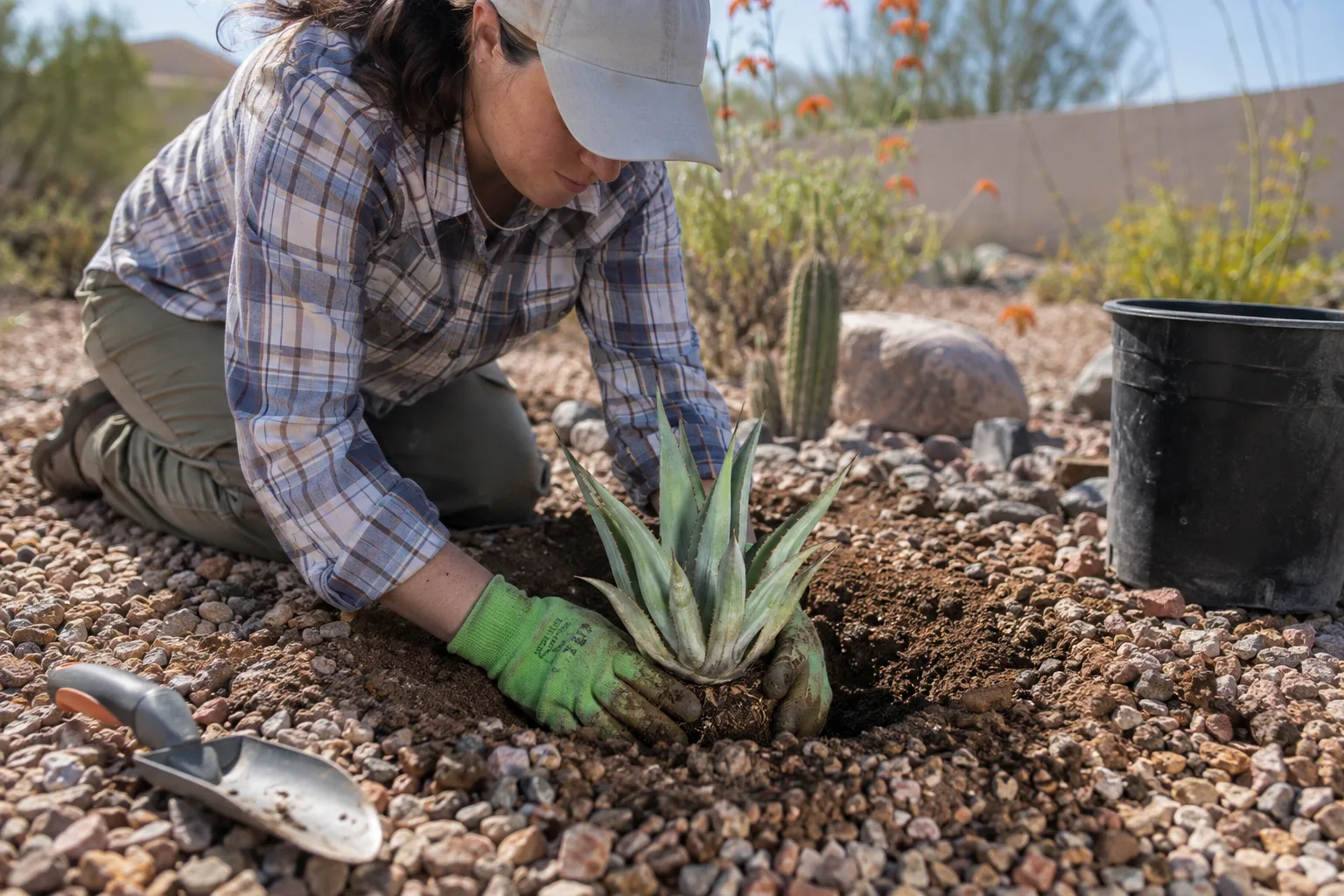
Plant from mid-September through November or from February through March. Fall is the better window, since roots grow all winter before summer arrives. Spring plantings work too, but you will water more often as temperatures climb quickly after March. Avoid planting from late May through August. Our gardening calendars can help you match timing to the month.
- Pick a spot with at least 6 hours of direct sun and soil that drains.
- Dig the hole 2 to 3 times as wide as the container and only as deep as the root ball.
- Loosen any circling roots with your fingers so they grow outward instead of around the pot.
- Set the crown at or slightly above the surrounding soil and backfill with native soil, mixing in no more than about 25% compost.
- Firm the soil gently, then build a low berm of soil around the plant to hold water over the roots.
- Spread 2 to 3 inches of gravel or decomposed granite and keep it pulled back from the stems.
- Water deeply right away, then every 3 to 4 days for the first two weeks and gradually stretch the interval over the next 6 to 8 weeks.
Skip fertilizer for the first couple of months. Planting too deep is the most common mistake, because a buried crown stays wet and rots. Another is giving a new desert perennial the same schedule as a lawn.
How do I combine these perennials for color in every season?
Layer them by height and bloom time. Put red bird of paradise at the back for summer color, autumn sage in the middle for spring and fall, and angelita daisy along the front edge for yellow through most of the year. Add blackfoot daisy for white and desert marigold for extra yellow in spring.
Globe mallow and desert ruellia suit a looser, naturalistic bed, where their orange and purple tones sit well together. Both reseed, so expect the planting to shift over a few seasons. Space each plant for its mature size, not the size in the container. The bed will look sparse at first and fill in over two to three seasons, while crowded plants compete for water and stay damp enough to invite disease.
If you want color while the perennials grow in, annual flowers and foliage can fill the gaps in the first season and be removed as the perennials spread.

What does perennial care look like through the year?
Most of the work falls in spring and fall, with summer and winter mainly about adjusting water. A light schedule keeps these plants in shape without much effort.
Spring, February to April
Cut back frost-damaged growth once the danger of a freeze has passed, usually by mid-February in the East Valley. Shear autumn sage and desert ruellia to shape them. One light application of slow-release fertilizer as new growth starts is plenty.
Summer, May to September
Water deeply but on the long end of the range, and deadhead autumn sage and blackfoot daisy to encourage more flowers. Cut irrigation back after monsoon storms. Do not prune hard in the heat.
Fall, October to November
Fall brings the second bloom flush and the best planting weather. Ease irrigation back as nights cool, and avoid heavy pruning so the plants carry some foliage into winter.
Winter, December to January
Most established plants need water only every 2 to 4 weeks. Cover red bird of paradise and desert ruellia with frost cloth when the forecast calls for freezing temperatures, and leave frost-damaged stems in place until mid-February, since they shield the lower growth from the next cold night.
Frequently asked questions
Can I grow these perennials in containers?
Yes, with limits. Angelita daisy, autumn sage and blackfoot daisy handle large pots best, using a gritty, fast-draining potting mix and drainage holes. Containers dry out faster than ground soil and heat up in summer, so check them often. Browse our pottery and planters for options with good drainage.
How can I tell if a perennial is dead or dormant after winter?
Scratch a stem with a fingernail. Green tissue underneath means the plant is alive, and brown, dry tissue means that stem is dead. Work down toward the base, since frost often kills the tips while the crown survives. Wait until mid-March before pulling anything, because red bird of paradise can look lifeless into late winter.
Do I need to fertilize desert perennials?
Very little. One light application of slow-release fertilizer in late winter or early spring is usually enough, and heavy nitrogen pushes soft growth that suffers in summer heat. Yellow leaves with green veins in our alkaline soil often point to iron deficiency rather than a lack of fertilizer, and chelated iron is the usual fix.
Will these plants attract pollinators?
Many of them do. Autumn sage is a hummingbird favorite, and the daisies, marigold and globe mallow draw bees and butterflies. If bee activity near a seating area concerns you, plant them toward the back or edges of the yard instead of directly beside a patio or walkway.
Will they spread on their own?
Desert marigold, globe mallow and desert ruellia reseed readily, and angelita daisy and blackfoot daisy can too. Seedlings usually appear after cooler weather or rain. Leave the ones you want, pull or move the rest, and cut spent flower stalks before they drop seed if you want a tighter planting.
Are year-round perennials right for your yard?
They suit most sunny Queen Creek yards, especially where you want color with less replanting than annuals need. Pick them for full sun, drainage and a willingness to water on a seasonal schedule. Skip them if your yard is mostly shade, if the soil stays soggy, or if you want a uniform, clipped look, since several of these plants reseed and sprawl. Visit us in Queen Creek and we will help you match them to your space.