
The ideal watering schedule in Arizona’s desert climate is deep and infrequent: soak the whole root zone, then let the soil dry before the next cycle. Frequency shifts with season, plant type and soil.
Key takeaways
- Water trees to a depth of 18 to 36 inches and shrubs to 12 to 18 inches, then let the soil dry before the next cycle.
- Established desert shrubs usually need water every 7 to 14 days in summer and every 3 to 4 weeks in winter.
- New plantings need water every 2 to 3 days at first, then taper off gradually over the first year.
- Run drip irrigation in the early morning, roughly 2 a.m. to 6 a.m., when evaporation is lowest.
- Cut run times to roughly 30 to 40% of summer levels in December and January, and skip a cycle after a soaking monsoon storm.

How deep should I water in the low desert?
Water deeply enough to wet the entire root zone, which is about 18 to 36 inches for trees and 12 to 18 inches for shrubs. Light daily sprinkling keeps roots near the surface, where summer highs above 110°F cook them. Surface moisture can vanish within minutes on a July afternoon.
To check depth, push a long screwdriver or soil probe into the ground an hour after a watering cycle and note where it stops sliding easily. Test at the dripline of the canopy, where feeder roots sit, rather than at the trunk. Matching plants to their water needs makes any schedule easier, and you can browse our plant selection by type to plan zones that share similar needs.
How does Queen Creek soil change my watering schedule?
Alkaline soil and caliche slow drainage, so you water less often and often in several short cycles rather than one long one. Local soil commonly tests at a pH of 7.5 to 8.5. Caliche, a hard layer of calcium carbonate, can sit anywhere from 6 inches to 3 feet down.
Water perches on top of caliche, and roots sitting in that saturated layer rot even when the surface looks dry. A simple test tells you what you have. Dig a hole about 18 inches deep, fill it with water, and time how long it takes to drain. Under 30 minutes means fast-draining soil. Several hours means clay or caliche.
For slow soil, program cycle-and-soak: three shorter runs with 30 to 45 minute pauses between them. Our irrigation water is also hard, so salts can build up near the surface of the soil. An occasional deep soak pushes those salts below the root zone.

How often should I water in each season?
Plan on every few days for new plants and every few weeks for established ones, shifting with the calendar. The table in the next section gives starting points by plant type. Adjust them by probing the soil.
Winter (December to February)
Winter calls for the least water of any season. With daytime highs in the 60s and 70s, evaporation is low, and established desert shrubs and trees can often go 3 to 4 weeks between waterings, or longer after rain. Warm-season plants such as lantana (Lantana camara) and bougainvillea (Bougainvillea species) slow down or go semi-dormant. Wet soil during a cold snap invites root disease. Reduce controller run times to roughly 30 to 40% of summer levels.
Spring (March to May)
Increase water gradually starting in March as growth picks up. By late April, with highs in the 90s to 100s, many plants are close to summer frequency. New plantings need water every 2 to 3 days until roots spread. Cool-season vegetables finishing their run still need steady moisture until harvest.
Summer (June to September)
June is the hottest, driest stretch, with triple-digit highs before the monsoon arrives. Established desert-native trees may need a deep soak only every 2 to 4 weeks, while non-native shade trees and citrus often want water every 5 to 10 days. Once monsoon storms start, rain can cover part of the need. A single inch of rain does not replace a full week of irrigation, though, so probe the soil first.
Fall (October to November)
Fall is the time to step irrigation back. Begin reducing frequency in October as highs drop into the 80s, and by November most established plants are back to a spring-like schedule. It is also a good planting window, because roots settle in during mild weather. Our gardening calendars show what to plant and when.
How often should I water each type of plant?
Every plant type has its own range, and mixing them on one valve without adjusting causes most watering problems. Use these as starting points, then check the soil.
| Plant type | Summer (Jun to Sep) | Spring and fall | Winter (Dec to Feb) |
|---|---|---|---|
| Established desert-native trees | Every 2 to 4 weeks | Every 3 to 4 weeks | Every 4 to 8 weeks or rain only |
| Non-native shade trees and citrus | Every 5 to 10 days | Every 10 to 14 days | Every 3 to 4 weeks |
| Established desert shrubs | Every 7 to 14 days | Every 14 to 21 days | Every 3 to 4 weeks or none |
| Tropical-type shrubs | Every 5 to 7 days | Every 7 to 14 days | Every 3 to 4 weeks |
| Cacti and succulents | Every 2 to 4 weeks | Every 3 to 5 weeks | Every 4 to 8 weeks or none |
| Bermuda grass lawn | Every 2 to 3 days | Every 4 to 7 days | Every 2 to 4 weeks if dormant |
| Vegetable beds | Every 1 to 2 days | Every 2 to 3 days | Every 3 to 5 days |
| New plantings | Every 2 to 3 days | Every 3 to 4 days | Every 5 to 7 days |
Desert-native trees such as palo verde (Parkinsonia species) and desert willow (Chilopsis linearis) need the least once established, usually after about two years. Our desert trees are a good place to start if you want low water use. Citrus runs thirstier, and you can see the citrus trees we commonly carry, though availability changes through the year. Vegetables need the most frequent watering, and our herbs, vegetables and berries section covers what suits each season.
How do I build a watering schedule for my yard?
Group plants by water need, calculate run time in gallons, and adjust through the year. Work through these steps in order.
- Walk each irrigation zone and list what grows in it. Move thirsty plants away from cacti and desert shrubs where you can.
- Find your emitter flow rate, typically 0.5 to 2 gallons per hour, and count the emitters on each plant.
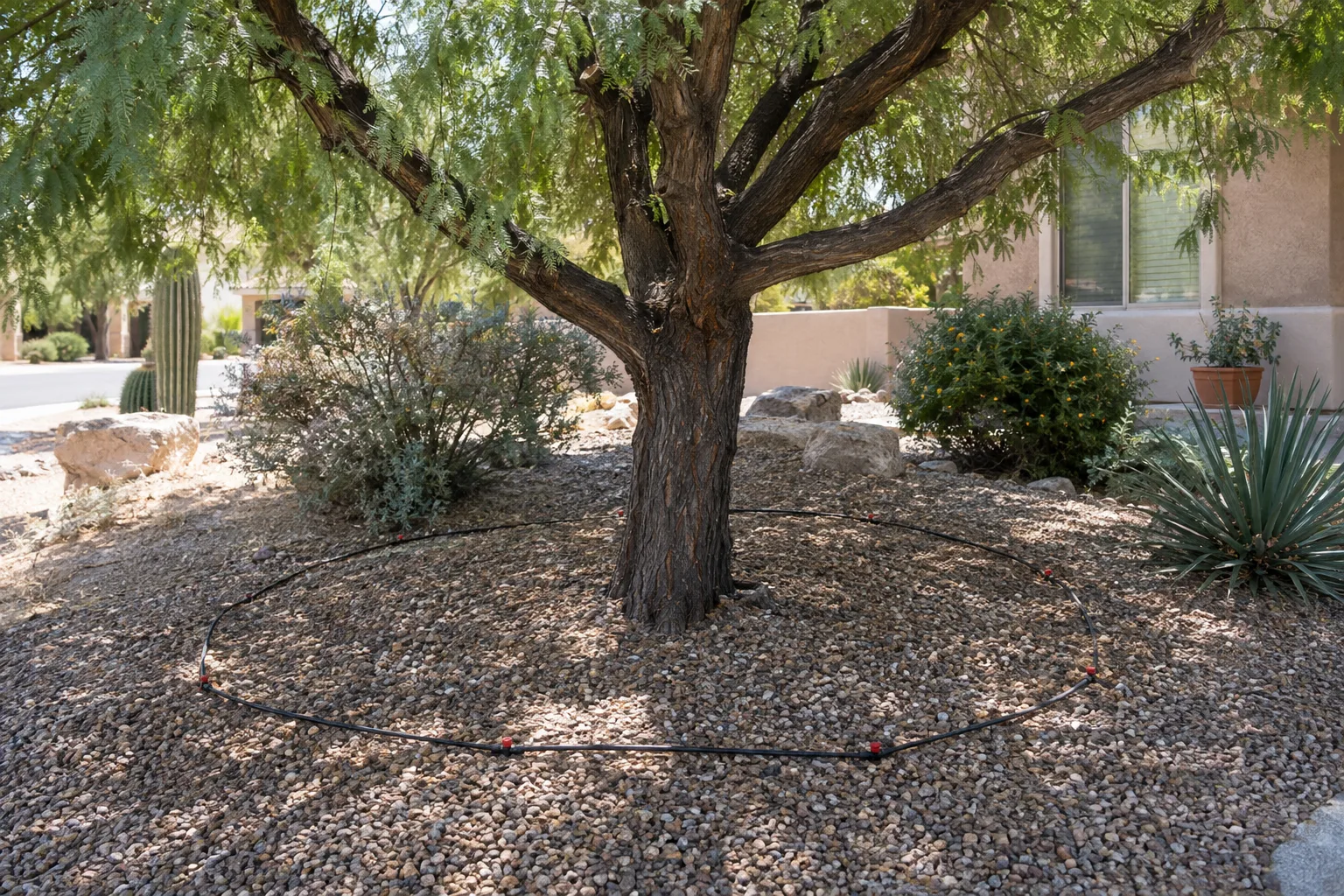
- Place emitters at the dripline of trees and large shrubs, not at the trunk. A large tree needs several, spaced around the canopy edge.
- Work out run time in gallons. Four 2-gallon-per-hour emitters running one hour deliver about 8 gallons, so a large tree may need several hours.
- Split long runs into cycles with pauses if your soil is clay or has caliche.
- Set seasonal adjustments on your controller. Start at 100% in June, move toward 60 to 70% in October, and drop to roughly 30 to 40% in December and January.
- Add a rain sensor or a weather-based controller so rain pauses the system automatically.
- Probe the soil monthly. It should feel moist 12 to 18 inches down after a cycle, not soggy and not dusty.
Is drip or spray better for Arizona yards?
Drip is better for almost everything except turf. Spray heads running on a hot afternoon lose a large share of their water to evaporation and wind before it reaches the soil. Drip puts water at the roots, wets less bare ground, and grows fewer weeds between plants.
Lawns are the exception, since they need overhead water. Rotary nozzles apply water more slowly than standard spray heads, which suits compacted soils and slopes where runoff is common. Whichever method you use, run it in the early morning. Your city or water provider may have its own rules on when irrigation can run, so check with them before setting a timer.
How should I adjust watering during the monsoon?
Reduce or pause irrigation after measurable rain, and probe the soil before restarting. The monsoon runs from roughly July through September, and a strong storm can drop an inch or more in under an hour. That is enough to satisfy most established desert plants for several days.
Storms are patchy, so your yard may get two inches while a street over gets none. Check soil moisture at about 12 inches deep rather than assuming. A rain sensor or weather-based controller handles most of this automatically. Young trees and newly planted shrubs still need supplemental water in their first summer, because their roots are shallow and limited.
How can I tell if a plant is overwatered or underwatered?
Look at the leaves and the soil together. Yellow leaves are the most common signal in low desert yards, and overwatering is a frequent cause. In alkaline soil, waterlogged roots struggle to take up iron, so leaves turn yellow between green veins, a pattern called iron chlorosis.
- Overwatering: yellow or pale leaves, soft stems at the base, leaf drop on evergreens, wilting while the soil is wet, and algae on the soil surface.
- Underwatering: crisp brown leaf edges, curled leaves in the morning, wilting that does not recover overnight, and dropped flowers or fruit.
Afternoon wilt in summer is normal for many plants, which close their leaf pores to save water in peak heat and recover by evening. Wilt that persists in the morning points to dry soil or root damage. Adding water to chase afternoon wilt tends to cause problems.

Frequently asked questions
What time of day should I water?
Early morning, roughly 2 a.m. to 6 a.m., is best. Temperatures are lowest, so less water evaporates, and leaves dry quickly after sunrise. Avoid evening watering in monsoon humidity, because wet leaves overnight encourage fungal problems on roses, fruit trees and vegetables.
How should I water a newly planted tree or shrub?
Water new plants every 2 to 3 days at first, aiming the water at the root ball and the soil just beyond it. Roots have not yet spread into the surrounding ground. Taper the frequency gradually over the first year, and keep probing the soil rather than following the calendar alone.
Can cacti and thirsty shrubs share one irrigation zone?
It is best to separate them. A zone set for hibiscus will overwater a cactus, and a zone set for a cactus will leave hibiscus stressed. If you cannot split the zone, program for the thirstiest plant and move the drought-tolerant ones to emitters you can turn off.
How do I water plants in containers?
Container plants dry out faster than in-ground plants, so they often need water daily in peak summer. Water until it drains from the bottom, then check again before the next watering. Make sure pots have drainage holes, and stick a finger a couple of inches into the soil to test.
Do watering restrictions affect my schedule?
They can, and rules vary by city and water provider. Some limit when or how often irrigation can run. Check your city’s or provider’s current guidelines before programming a controller, since conditions and policies change over time.
Is a fixed watering schedule right for your yard?
A schedule is a good starting point, but your soil and plants decide the final numbers. It suits anyone with automatic irrigation who is willing to adjust the controller four times a year and probe the soil monthly. If you will not touch the timer after setting it, favor desert-adapted plants that tolerate neglect. Gardeners with mostly cacti and natives need very little. Stop by the nursery in Queen Creek and ask us to help you match plants to your irrigation.