

Twisted myrtle stands out among Arizona evergreens for its gnarled, sculptural branches, small glossy leaves and modest water needs once established. It grows best in the low desert with morning sun, afternoon shade and good drainage, and it can scorch against a hot west wall.
Key takeaways
- Twisted myrtle usually reaches 5 to 8 feet tall and 4 to 6 feet wide, growing at a slow to moderate pace.
- Plant from October to early November or from February to March, and avoid June through August.
- Morning sun with afternoon shade protects the leaves from reflected heat above 110°F.
- Once established, water deeply about every 7 to 10 days in summer and every 2 to 4 weeks in winter.
- Prune lightly with hand pruners in late winter, because shearing removes the twisted structure you planted it for.
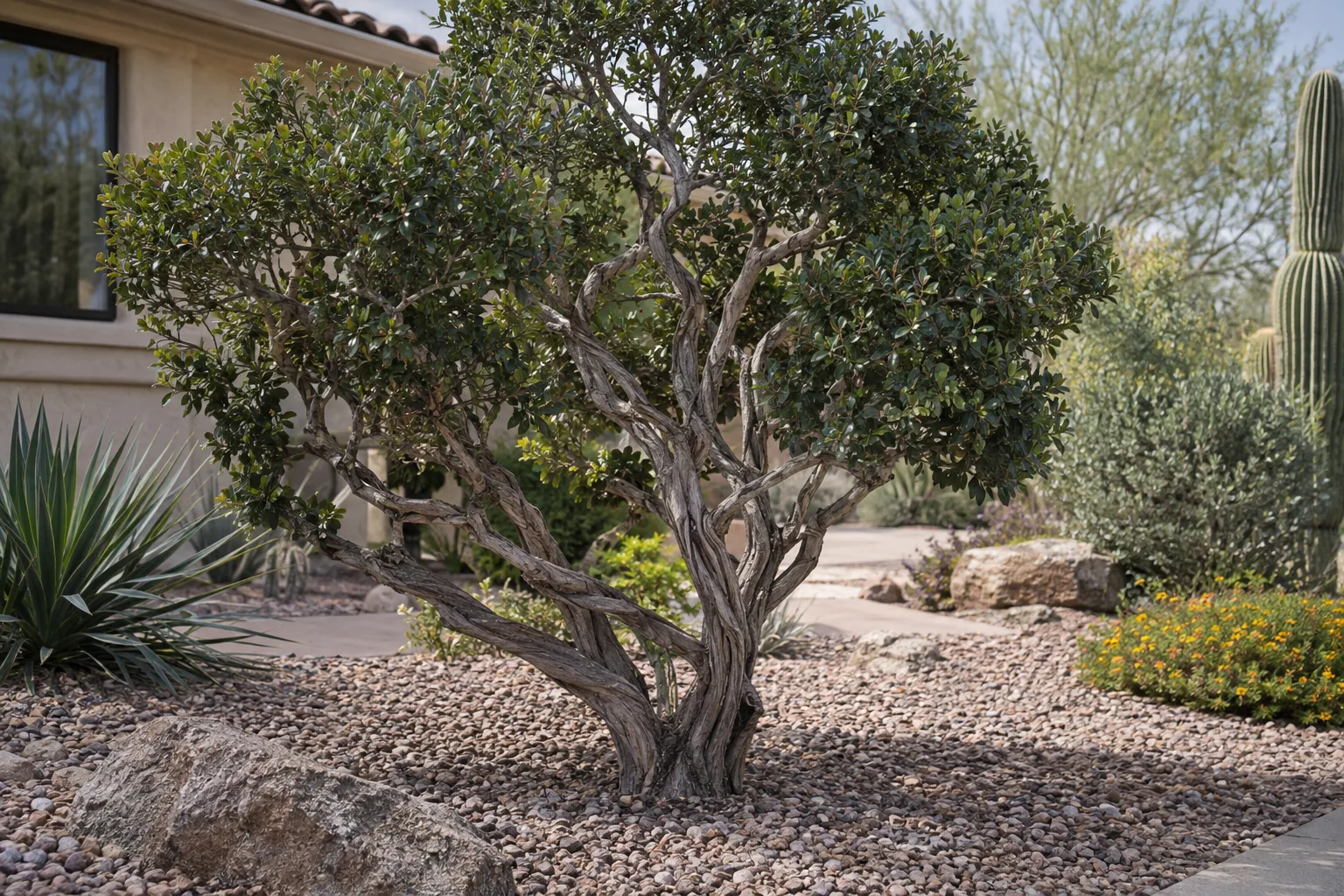
What sets twisted myrtle apart from other evergreens in the low desert?
Its branching. Twisted myrtle (Myrtus communis ‘Boetica’) is a broadleaf evergreen shrub with bent, spiraling stems, small deep green leaves and a sharp, resinous scent when you brush them.
Most evergreen shrubs here are grown as clipped hedges or rounded masses, so a plant with visible structure in every season fills a different role in the yard. In spring it carries small white flowers, followed by dark berries that birds eat. The tradeoff is pace and pickiness, since it grows more slowly than hedge shrubs and needs more thought about afternoon heat than tougher desert natives do. You can browse more shrubs in our plants department, and what is on the shelf changes week to week and season to season.
Where does twisted myrtle grow best in Queen Creek?
It grows best with morning sun and shade or filtered light from about 2 p.m. onward, such as the east side of a house or beneath the high canopy of a desert tree.
Full sun is fine through the cooler months. In summer, highs above 110°F combined with heat bouncing off a west-facing block wall or stucco can scorch leaf edges and stall new growth, so a plant in that spot needs shade cloth or a taller companion for its first few summers. Give it room to reach its full width, and keep it away from walkways where the branches will brush passersby.

When should I plant twisted myrtle in Arizona?
The best windows are October to early November and February to March, when soil is warm enough for roots to grow but air temperatures are mild. Fall planting gives roots a full cool season before the first summer.
Avoid June, July and August, when stressed roots cannot keep up with the heat. For a month-by-month view of what to plant and when, see our gardening calendars. Dig the hole 2 to 3 times wider than the container but no deeper than the root ball, loosen any circling roots, and set the top of the root ball at or slightly above the surrounding soil. That small lift keeps water from pooling around the crown after a monsoon storm.
How often should I water twisted myrtle?
Once established, twisted myrtle does well with a deep soak about every 7 to 10 days in summer and every 2 to 4 weeks in winter. Depth matters more than frequency.
New plants need closer attention. Water every few days for the first couple of weeks, then stretch the interval toward weekly over the first summer as roots spread. Check the soil 4 to 6 inches down before you water, and wait if it is still damp. After a monsoon storm that soaks the ground, skip the next irrigation cycle, because constantly wet soil around the crown invites root rot. Hard irrigation water leaves salts behind, so an occasional slow, deep soak helps flush them below the root zone.
What soil and feeding does twisted myrtle need?
It needs soil that drains. Twisted myrtle tolerates the alkaline soil common in Queen Creek, but it does not tolerate standing water, and caliche (the hard, white calcium carbonate layer found in many East Valley yards) can trap water under the roots.
Probe the bottom of the planting hole, and if you hit caliche, break through it so water can drain. Backfill mostly with the native soil you dug out, mixed with a modest amount of compost, since heavy amendments can create a pocket that holds water. Feed lightly with a slow-release fertilizer in March if growth looks weak. Yellow leaves with green veins on new growth point to iron chlorosis, which a chelated iron product applied to the soil usually corrects. Follow the label for rates.
How and when should I prune twisted myrtle?
Prune lightly in late winter, around February, once the worst frost risk has passed and before spring growth begins. Use clean hand pruners rather than hedge shears.
Remove dead wood and crossing interior branches to let air move through the plant, and cut any branch you want shorter back to where it joins another branch. Shearing the tips turns the plant into a dense ball and hides the twisting stems that make it worth growing. Avoid heavy cuts in summer, when fresh wounds and sun-exposed inner wood stress the plant. If you want a small tree form, you can remove the lowest branches over several seasons, or look at our evergreen trees for something with more height.

What problems does twisted myrtle get in the East Valley?
The usual problems are leaf scorch from reflected heat, iron chlorosis, root rot from overwatering and a few sap-feeding insects. Most trace back to placement and irrigation.
Scorch shows up as brown, crisp leaf edges on the side facing a hot wall. Chlorosis causes pale new leaves with green veins. Root rot brings yellowing, wilting despite wet soil and soft stems near the base, and it is far easier to prevent than to fix. Aphids and whiteflies sometimes gather on tender spring growth, and a strong spray from the hose often knocks them back. Young plants can lose branch tips in a hard freeze, so cover them with frost cloth when the forecast nears freezing.

Can I grow twisted myrtle in a container?
Yes, a large pot with good drainage holes works well, and it lets you control both soil and sun. Choose a container at least 18 to 24 inches across.
Pots dry out faster than ground soil, and dark containers on a south or west patio can overheat the roots in July. Keep the pot where it gets morning sun and afternoon shade, raise it off hot concrete if you can, and check moisture every few days in summer. See our pottery and planters for options with room for roots to spread.
Frequently asked questions
How big does twisted myrtle get?
Most reach 5 to 8 feet tall and 4 to 6 feet wide over several years. Growth is slow to moderate, often under a foot per year, and faster in the cooler months of spring and fall. Light pruning can keep it smaller, but plan for its mature width when you choose a spot.
Is twisted myrtle related to crape myrtle?
No, they are different plants that share part of a common name. Crape myrtle (Lagerstroemia) is deciduous, loses its leaves in winter and blooms in summer. Twisted myrtle (Myrtus communis) is evergreen with small fragrant leaves and spring flowers, and it needs different care.
Does twisted myrtle flower and produce berries?
Yes, it carries small white flowers in spring, and dark berries usually follow later in the year. The flowers attract bees and other pollinators, and birds eat the berries. Timing shifts with the weather, and heavy pruning in late winter can reduce the display.
Will a frost damage twisted myrtle?
Established plants usually handle normal East Valley winter lows without trouble. Young plants are more tender, so cover them with frost cloth on nights forecast near freezing. If tips turn brown after a cold snap, wait until spring to prune, since the damaged growth helps shield the buds below.
Can I use twisted myrtle as a hedge or screen?
You can plant a row about 4 to 5 feet apart for an informal, loose screen. It will not form the tight, uniform wall of a sheared hedge. Shearing also removes the twisted branching, so choose a different shrub if you want a formal clipped line.
Is twisted myrtle the right evergreen for your yard?
Twisted myrtle suits you if you have a spot with morning sun and afternoon shade, want year-round structure and are willing to water deeply on a schedule instead of lightly every day. It is a poor match for an unshaded west wall, for anyone who needs a fast privacy screen, or for a yard with poor drainage that cannot be fixed. If it fits, it gives you a sculptural evergreen that looks good in every season. Stop by the nursery in Queen Creek and we will help you pick a spot.