

The trees to prune in April in Arizona are blue palo verde, velvet mesquite, desert willow, Texas ebony, tipu and shoestring acacia. April falls after frost danger and before 110°F heat, leaving roughly six to eight weeks for cuts to start closing.
Key takeaways
- Prune these six trees in April, after frost danger has passed and before summer highs reach 110°F.
- Remove no more than about 25 percent of the canopy in one session, and closer to 15 to 20 percent for slow-growing Texas ebony.
- Let blue palo verde finish its March and April bloom before you cut.
- Cut just outside the branch collar and skip wound paint or sealant.
- Soak the root zone slowly after pruning, then add 3 to 4 inches of mulch kept 4 to 6 inches from the trunk.
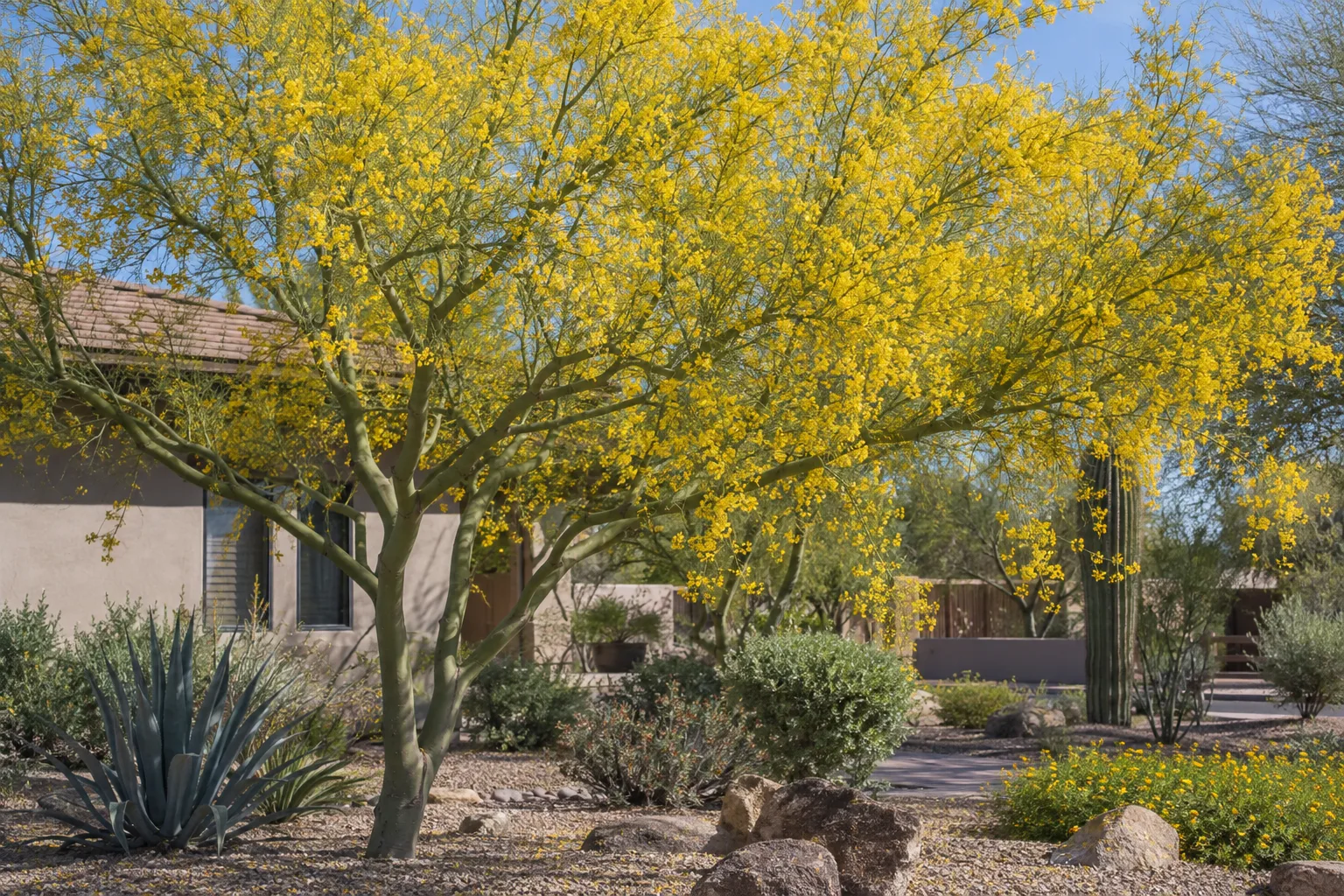
Why is April a good month to prune desert trees in Arizona?
April sits between the last frost risk and the first stretch of highs above 110°F. Trees are in active growth, so cuts begin closing quickly, and the canopy you leave can still shade the trunk and roots through summer. In Queen Creek, where cold nights can linger into early March, waiting until April also keeps cuts from pushing tender growth that a late frost could burn.
Cut earlier and you may trim off spring flowers. Cut from June through August and fresh wounds and newly exposed bark face full summer sun. Most of the trees below are desert trees that handle our alkaline soil and heat well, but even tough trees need cuts made at the right time. Timing matters.
What tools do you need to prune a desert tree?
You need bypass pruners, loppers, a pruning saw and a pole pruner, matched to the thickness of each branch. Bypass pruners handle stems up to about 3/4 inch. Loppers take branches up to roughly 1.5 inches, and a pruning saw covers anything thicker. A pole pruner with a saw head saves ladder time on tall, multi-trunk trees.
Wear thick gloves, long sleeves and eye protection, because mesquite, palo verde and Texas ebony all carry thorns or sharp twigs that find bare skin quickly. Wipe blades with 70 percent isopropyl alcohol between trees so you do not carry disease from one to the next.
Many gardeners believe pruning paint protects a cut. It does not, and sealants can trap moisture against the wound. Clean cuts close on their own.
Which trees should you prune in April in Arizona?
These six trees respond well to April pruning, and each one needs a slightly different cut. They are varieties we commonly carry, though availability changes week to week and season to season. Sizes are typical mature ranges for the low desert.
Velvet mesquite (Prosopis velutina)
Velvet mesquite grows 20 to 30 feet tall and about as wide, wants full sun and needs little water once established. April cuts should raise the canopy for clearance, usually 6 to 8 feet over a patio or walkway, and remove branches with tight V-shaped crotches that split in monsoon wind. Take out dead interior wood as well. Keep removal under about 25 percent, because heavy cuts push up a thicket of watersprouts. The drawback is thorns, plus a steady drop of leaflets and seed pods.

Blue palo verde (Parkinsonia florida)
Blue palo verde reaches 20 to 30 feet tall and wide, takes full sun and needs low water once established. Wait until the yellow flowers, which open in March and run into April, have faded before you cut. Then remove crossing branches, frost-damaged tips and a little interior growth. Avoid lion-tailing, which strips the inner branches and leaves tufts at the ends, because the weak attachment that results makes limbs more likely to fail in monsoon storms. The drawback is a spring carpet of petals and later seed pods. If you want more spring color, see our flowering trees.
Desert willow (Chilopsis linearis)
Desert willow stays smaller, at 15 to 25 feet tall and 15 to 20 feet wide, in full sun with low to moderate water. It flowers on new growth from late spring into summer, so light April shaping sets up the wood that will carry blooms. Cut off the previous season’s seed pods and thin crowded base suckers down to 3 to 5 main trunks. The drawback is a loose, sometimes leggy habit and bare branches in winter.
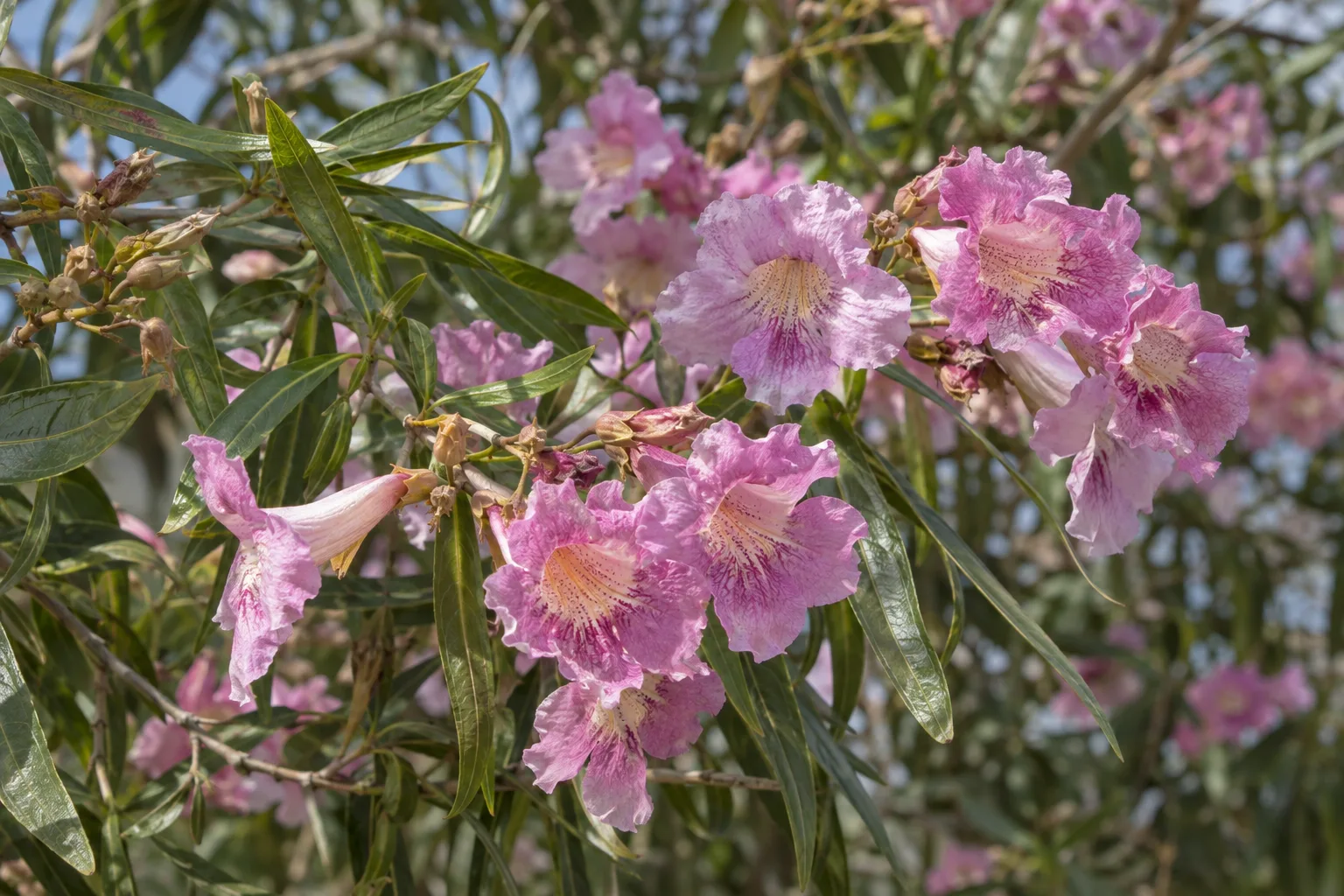
Texas ebony (Ebenopsis ebano)
Texas ebony grows slowly to about 15 to 30 feet tall and 15 to 25 feet wide, in full sun with low water once established. Its dense, dark foliage lasts through most of the year, which makes it a good screen. In April, after frost danger has passed, remove winter-killed branches, lift the lower skirt for clearance and thin spots where growth is packed tight, limiting removal to roughly 15 to 20 percent. The drawbacks are thorns and slow growth, so a bad cut stays visible for years. For other year-round screening, browse our evergreen trees.
Tipu tree (Tipuana tipu)
Tipu grows fast to 25 to 40 feet tall with a broad canopy of similar width, and it wants full sun and moderate water. Keep April pruning light. Remove dead wood, branches heading toward a roof or utility line, and competing leaders at weak crotches. Because it blooms in late spring, heavy cuts cost you flowers. The drawbacks are size, which calls for a large yard, and cold sensitivity, since frost can injure young trees.
Shoestring acacia (Acacia stenophylla)
Shoestring acacia reaches 20 to 30 feet tall and 15 to 20 feet wide with a weeping shape, in full sun and low water. Thin a congested center, remove branches growing back toward the trunk and clear ground suckers. Leave the long drooping branchlets alone, because that form is the reason to plant it. The drawbacks are steady leaf litter and a shorter lifespan than mesquite or palo verde.
How do you prune a desert tree step by step?
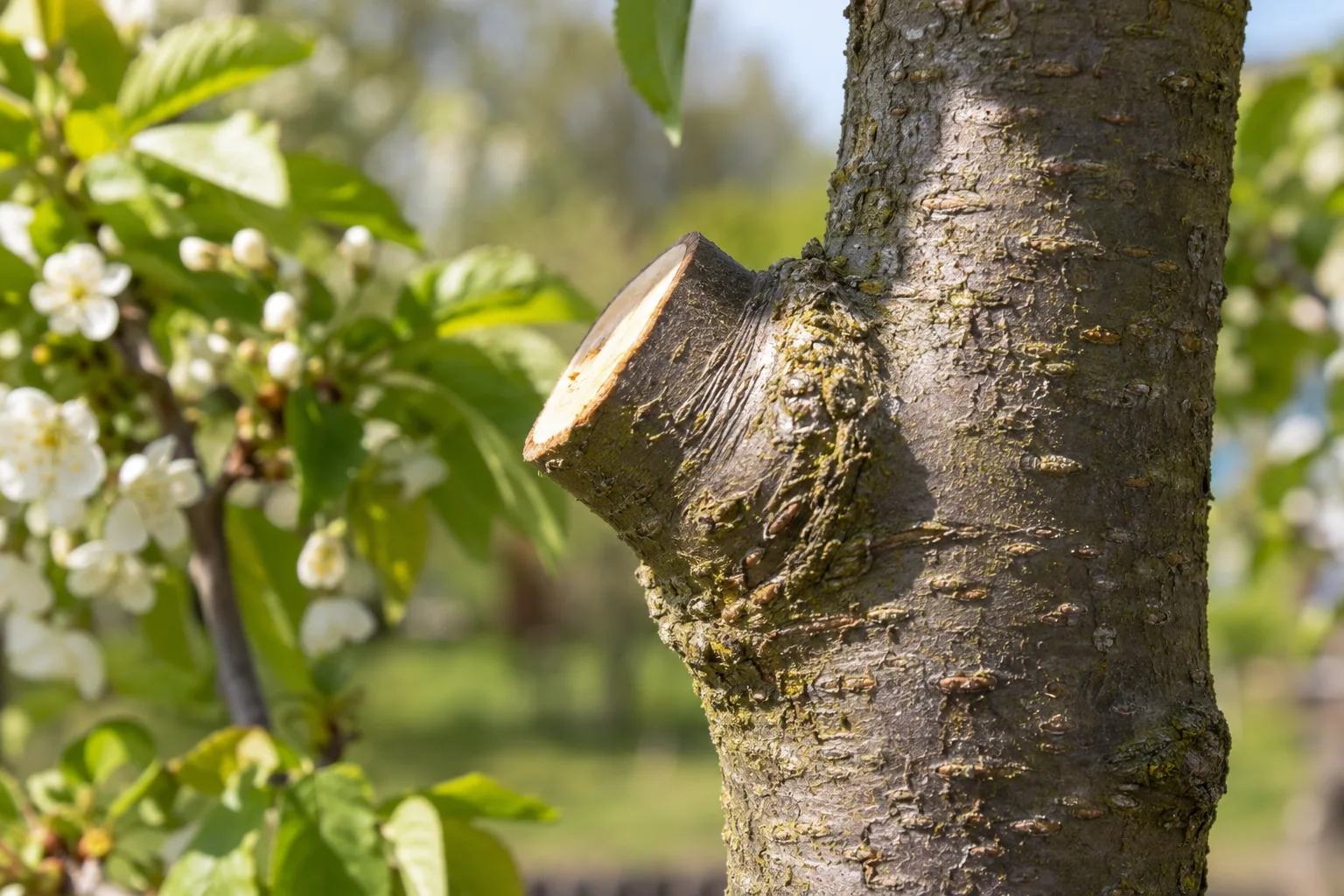
Work from dead wood to structure to thinning, and make every cut just outside the branch collar, the slightly swollen ring where a branch meets its parent limb.
- Walk around the tree first. Look for dead wood, crossing branches, weak V-shaped crotches and anything within 6 feet of a roof or wall, and decide what comes out before you pick up a tool.
- Remove dead and damaged wood. Cut back to living tissue or to the branch collar.
- Fix structure next. Take out one of two competing leaders and any branch growing toward the canopy center.
- Thin for airflow. Remove a modest share of overlapping interior branches while staying under 25 percent of the canopy overall.
- Make each cut correctly. Flush cuts and long stubs both slow closure. On branches thicker than about 1 inch, make an undercut first, then the top cut, then the final cut at the collar so the bark does not tear.
- Step back after each major cut. Look from 10 to 15 feet away, because you can always remove more but cannot put a branch back.
- Clean up and water. Remove all cuttings from under the tree and give the root zone a slow soak within a day.
What pruning mistakes damage desert trees?
Topping, over-pruning and badly placed cuts do the most damage. Topping is the worst of these. It means cutting the trunk or main limbs back to stubs, and the tree responds with weakly attached watersprouts that tend to break in the first monsoon storm. Height reduction works better as selective cuts back to a side branch.
Taking more than about 25 percent of the canopy in one season forces the tree to spend stored energy on replacement leaves just before summer. Exposed trunks can also sunscald within days. Flush cuts and long stubs slow wound closure, so cut just outside the collar. Pruning during bloom costs you flowers, and pruning while frost is still possible exposes new growth to damage. Stay conservative.
How should you care for trees after pruning?
Slow, deep watering and mulch are the two jobs after pruning. Soak the root zone with a slow trickle for a couple of hours at the drip line instead of a quick spray, then let the soil dry. Established desert trees often go 2 to 3 weeks between soaks through May, though soil and tree age change that.
Spread 3 to 4 inches of wood chip mulch and pull it back 4 to 6 inches from the trunk. It slows evaporation and cools the soil. Skip fertilizer, because soft new growth is more vulnerable to summer heat. If limbs that used to be shaded are now exposed, check the bark over the next few weeks for browning or cracking.
Some trees are too damaged or poorly shaped to fix with pruning. In that case, browse all our trees and compare mature sizes before choosing a replacement.
When is the best pruning window for each tree?
A typical window for each tree appears below, and our gardening calendars cover other seasonal jobs through the year. Dates shift with the weather in any given spring, so use them as a guide. Check the forecast first.
| Tree | Best window | Avoid | Note |
|---|---|---|---|
| Velvet mesquite | April to May | Heavy cuts in summer heat | Keep removal under 25 percent |
| Blue palo verde | After bloom fades, April to May | March bloom | Thin, do not strip |
| Desert willow | Late winter to April | Peak summer bloom | Flowers on new growth |
| Texas ebony | April, after frost danger | Winter and midsummer | Aim for 15 to 20 percent |
| Tipu tree | April, light work | Frost periods | Heavy cuts cost flowers |
| Shoestring acacia | April to May | Peak summer heat | Keep the weeping form |
Frequently asked questions
What if I miss the April window?
Dead, broken or hazardous branches can come out any time of year, but hold structural cuts until temperatures drop in fall or until the following spring. Summer cuts expose bark and force wounds to close in extreme heat. If a branch threatens a roof or power line in July, call a certified arborist rather than waiting.
Can I prune a mesquite myself?
Yes, for light work. Removing dead wood, ground suckers and branches under about 2 inches is reasonable with the right tools. Hire an ISA Certified Arborist for limbs above ladder reach, anything near power lines, or heavy structural cuts on a mature tree. A professional should also carry liability insurance in case a large limb damages property.
Should I fertilize after pruning?
No, skip fertilizer right after pruning. New soft growth pushed ahead of summer heat is more prone to heat stress and pests, and desert-adapted trees rarely need feeding. If leaves show a yellowing pattern that suggests a nutrient problem, check it before adding anything, because alkaline soil can limit how much iron a tree can use.
How do I handle a tree that froze back over winter?
Wait until new growth appears in spring before cutting. Scratch a twig with your thumbnail, and green tissue underneath means the branch is alive, while brown and dry means it is dead. By April the line between live and dead wood is usually clear, so cut dead branches back to healthy tissue.
Should you prune your trees in April or wait?
Prune in April if your tree has dead wood, crossing branches or low limbs over a walkway, and the blooms have faded. Skip it if the tree is young, healthy and well shaped, because a tree that needs no cuts gains nothing from them. Skip DIY pruning too if limbs are thicker than your forearm, near power lines or above ladder reach, and hire an ISA Certified Arborist instead. If you are choosing a tree for next spring, stop by our Queen Creek nursery and talk it through with our team.
