

Toxic succulents for cats in Arizona include aloe, euphorbia, kalanchoe and jade plant, all on the ASPCA’s toxic list. Haworthia, echeveria, hens and chicks and Christmas cactus are safer swaps for the same spots.
Key takeaways
- Aloe, euphorbia, kalanchoe and jade plant are all listed as toxic to cats by the ASPCA.
- Kalanchoe contains heart-active compounds, so a chewed plant calls for a same-day call to a vet or poison control.
- Euphorbia sap irritates skin, mouths and eyes, so wear gloves and eye protection when you prune.
- Haworthia, echeveria, hens and chicks and Christmas cactus are the four safer swaps, and each still needs shade from afternoon sun in summer.
- Look up every plant by botanical name in the ASPCA’s toxic and non-toxic plant database before it comes home.

Why are succulents a risk for cats in the low desert?
Many popular succulents contain latex, saponins or heart-active compounds, and in the East Valley they sit within paw’s reach nearly all year. A pot that spends March on a patio can be on a kitchen windowsill by June, so your cat’s access changes with the season. The risk follows the pot.
Cats chew on plants out of curiosity, boredom and the feel of a leaf. Even a small nibble, or a lick of sap off a paw during grooming, can cause trouble with the wrong plant. Outdoor and indoor-outdoor cats also meet whatever grows in neighbors’ yards and shared planting beds, and you cannot control those.
If you are shopping for succulents, our plants department shows the kinds of succulents we commonly carry, though availability changes week to week and season to season.
Which succulents are toxic to cats?
Four widely planted succulents appear on the ASPCA’s list of plants toxic to cats: aloe, euphorbia, kalanchoe and jade plant. Each entry gives size, light, water and the main concern.
Aloe (Aloe vera)
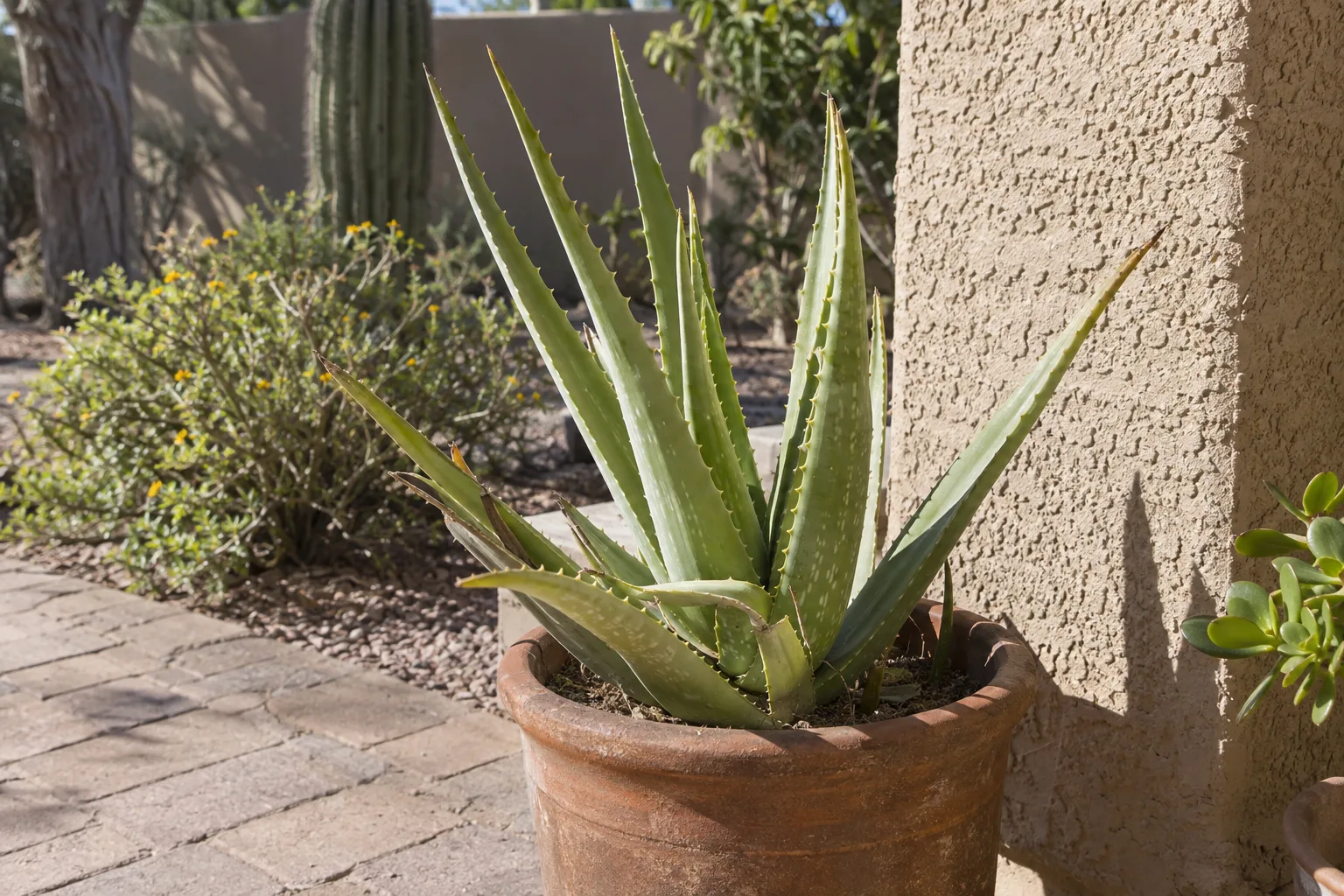
Aloe grows about 2 to 3 feet tall and wide, wants full sun to light afternoon shade, and needs water roughly every 2 to 3 weeks in summer once established. The ASPCA lists it as toxic to cats because of the latex under the leaf skin, with vomiting, diarrhea, lethargy and changes in urine color as the usual signs. The drawback is how common it is: aloe sits in countless yards and kitchen windowsills, and the gel that soothes a sunburn on you is not safe for your cat to chew.
Euphorbia (Euphorbia milii, Euphorbia trigona, Euphorbia tirucalli)
Crown of thorns stays around 2 to 3 feet, while African milk tree and pencil cactus can reach 6 to 10 feet or more in the ground. All want full sun and little water once established, roughly every 2 to 4 weeks in summer. Their drawback is the milky sap, which irritates the mouth, skin and eyes of cats and people alike. Euphorbias often pass for cacti, but they are a different group of plants. Pencil cactus snaps easily and releases sap fast.
Kalanchoe (Kalanchoe blossfeldiana)
This compact bloomer reaches 6 to 18 inches, prefers bright light with morning sun, and needs water about every 1 to 2 weeks, once the top inch of soil is dry. It contains bufadienolides, which are heart-active compounds, and the ASPCA lists it as toxic to cats and dogs. The drawback is its cheerful look: it is often sold as a flowering gift plant, so it lands in homes with pets before anyone checks.
Jade plant (Crassula ovata)
A jade plant grows 2 to 4 feet in a pot and larger in the ground, likes morning sun with afternoon shade in summer, and needs water about every 2 to 3 weeks in warm months and less in winter. The ASPCA lists it as toxic to cats, with vomiting, lethargy and wobbly movement reported. The drawback is that the toxic compound has not been identified, so there is no way to judge how much is too much. Jade often sits on low shelves and patios within easy reach.
Are true cacti toxic to cats?
Most true cacti, such as prickly pear and barrel cactus, are not generally listed as poisonous to cats, but their spines cause injuries. Spines and the tiny hair-like glochids on prickly pear can lodge in paws, mouths and eyes, and a broken spine left in the skin can lead to an abscess.
Have a vet remove any deeply embedded spine. Check every cactus-shaped plant by botanical name, because a euphorbia with a cactus look carries toxic sap.
Which succulents are safe for cats?
Haworthia, echeveria, hens and chicks and Christmas cactus are listed as non-toxic to cats by the ASPCA or generally regarded as safe. These are types we commonly carry, and availability changes week to week and season to season.
Haworthia (Haworthia species)
Haworthia stays 3 to 6 inches tall, wants bright indirect light, and needs water about every 2 to 3 weeks. It suits an east-facing windowsill, where the light is gentle. The drawback is sun tolerance: direct afternoon sun in the low desert scorches the leaves, so keep it indoors or under a shaded porch.
Echeveria (Echeveria species)
Echeveria forms rosettes 4 to 12 inches across in blue-green, lavender, pink and burgundy. It does best with morning sun and afternoon shade in summer, with water about every 1 to 2 weeks in pots and much less in winter. Its drawback is weather: sustained heat above 105°F can scorch the leaves, and a frost can damage them, so grow it in containers you can move.

Hens and chicks (Sempervivum tectorum)
This plant makes tight rosettes 2 to 4 inches tall that spread by offsets into a clump 6 to 12 inches wide. It likes bright light with afternoon shade here and water about every 1 to 2 weeks. The drawback is its origin. A mountain plant that handles hard cold, it can struggle in low-desert summers, so it does best in a shaded container rather than a sunny rock bed.
Christmas cactus (Schlumbergera hybrids)
Christmas cactus grows 1 to 2 feet wide, wants bright indirect light with no direct sun, and needs water when the top inch of soil dries. It blooms in red, pink, white or orange from late fall into winter. Its drawback is moisture: it wants more humidity than a true succulent, so it fits indoors or a covered, shaded spot better than an open patio.
How do I replace toxic succulents without redoing my whole yard?
Move the toxic plants out of your cat’s reach first, then swap them one at a time with a safe plant that likes the same light. The table pairs each toxic plant with a swap for a similar spot.
| Toxic plant | Typical use | Safer swap | Light and care note |
|---|---|---|---|
| Aloe | Sunny patio pot | Echeveria | Morning sun, afternoon shade in summer |
| Euphorbia | Sculptural accent pot | Hens and chicks in a shallow bowl | Bright light, shade from hot afternoon sun |
| Kalanchoe | Flowering gift plant | Christmas cactus | Bright indirect light, blooms late fall to winter |
| Jade plant | Indoor tabletop plant | Haworthia | Bright indirect light, water every 2 to 3 weeks |

- Write down every succulent you own by botanical name and check each one in the ASPCA’s toxic and non-toxic plant database.
- Move the toxic ones behind a closed door or into a fenced area your cat does not visit, since cats climb past most high shelves.
- Choose a swap from the table that matches the light in that spot, and browse our houseplants for indoor options.
- Plant swaps in pottery and planters you can shade or move, because containers let you pull plants away from afternoon sun when highs top 110°F.
- Add one or two plants at a time and watch how your cat reacts before replacing the rest.
- Pass toxic plants to a friend without pets rather than tossing them.
Go slowly, since a gradual swap lets you learn which spots your cat favors before you spend on new plants.
What should I do if my cat chews a succulent?
Call your vet, an emergency animal hospital or the ASPCA Animal Poison Control Center at (888) 426-4435 right away, without waiting for symptoms. The poison control center may charge a consultation fee.
- Move your cat away from the plant and gently rinse its mouth with plain water if your cat tolerates it.
- Take a photo of the plant and note its botanical name, or keep the plant label, to show the vet.
- Do not induce vomiting unless a vet or poison control tells you to.
- Watch for drooling, vomiting, diarrhea, lethargy, wobbly walking, tremors or labored breathing, and go to an emergency vet if any appear.
- Get veterinary care promptly if euphorbia sap reaches your cat’s eyes.
Save the number of your nearest 24-hour emergency vet in your phone before you need it. Time matters with kalanchoe.
Frequently asked questions
Can I keep aloe if I have a cat?
Only if your cat can never reach it. Cats climb, so a high shelf is unreliable, while a closed room, a front yard your cat never visits or a secure hanging planter are better options. If you cannot guarantee separation, replacing the aloe with echeveria or haworthia is the lower-risk choice.
Do cats avoid poisonous plants on their own?
No, cats have no dependable instinct for avoiding toxic plants. Curiosity, boredom and texture drive most chewing, and a plant that tastes bad to one cat may not stop another. Plan your space as if your cat will chew whatever it can reach.
Are these succulents toxic to dogs too?
Aloe, euphorbia, kalanchoe and jade plant are also on the ASPCA’s toxic plant lists for dogs. Haworthia, echeveria and Christmas cactus are listed as non-toxic for both species. Always confirm by botanical name, because lists differ by species and common names overlap between plants.
Does non-toxic mean my cat can eat the plant freely?
No. Non-toxic means the ASPCA lists no poisoning risk, but a cat that eats a lot of any plant can still vomit or have an upset stomach. Offer a pot of cat grass as a legal alternative, and keep potting soil and fertilizer out of reach.
Where can I check whether a plant is safe for cats?
Search the plant’s botanical name in the ASPCA’s toxic and non-toxic plant database, and ask your vet about anything unclear. Common names overlap, so confirm the exact species before you buy. If you are unsure what a plant is, you can contact us with a photo.
Do I need to remove every toxic succulent if I have a cat?
Not always. A cat that never goes near an aloe growing in a fenced front bed is a low risk, and households without cats or roaming pets can keep any of these plants. Kalanchoe and euphorbia deserve the most caution, so move or replace those first. If your cat chews on plants, climbs everywhere or spends time outdoors, replace the toxic ones with safe swaps and keep the rest behind a closed door. We would be glad to see you at our nursery in Queen Creek.