The eight tough desert plants below handle Arizona heat with little care once established: Desert Willow, brittlebush, Parry’s penstemon, Texas sage, blackfoot daisy, agave, red bird of paradise and creosote. Each tolerates summer highs above 110°F and our alkaline soil.
Key takeaways
- Plant in fall (September to November) or spring (February to April) so roots settle before the first 110°F summer.
- Expect one to two growing seasons of regular watering before any of these plants can run on deep soaks every few weeks.
- Drainage matters more than rich soil, so break through caliche and skip heavy compost in the planting hole.
- Mature size runs from about 1 foot (blackfoot daisy) to 15 to 25 feet (Desert Willow), so space for the adult plant.
- Red bird of paradise can freeze back in a cold winter, and Texas sage dies faster from soggy soil than from heat.
Which tough desert plants handle Arizona heat best?
These eight cover a small tree, shrubs, a groundcover and an accent plant, so together they can fill a yard. They are varieties we commonly carry in our plant department, though availability changes week to week and season to season. Each profile lists mature size, sun, water once established and one drawback.
Desert Willow (Chilopsis linearis)
Desert Willow reaches 15 to 25 feet tall and wide and casts light shade in full sun. Pink, lavender, burgundy or white trumpet flowers open from late spring into fall, depending on the cultivar, and hummingbirds visit them. Once established it does well on a deep soak roughly every two to three weeks in summer. The drawback is mess: it drops its leaves in winter and sheds seed pods. Our desert trees page shows the kinds we commonly carry.
Brittlebush (Encelia farinata)
Brittlebush forms a silver-leaved mound 2 to 3 feet tall and wide. Yellow daisy flowers cover it from about February through April. It wants full sun and fast drainage, and established plants usually get by on rainfall plus an occasional summer soak. The drawback is its summer look, because it goes semi-dormant and ragged in the heat. It also self-seeds freely, and a hard cutback in late fall tidies it.
Parry’s penstemon (Penstemon parryi)
Parry’s penstemon sends up spikes of hot pink tubular flowers in late winter and spring, rising 3 to 4 feet above a clump about 2 to 3 feet wide. Hummingbirds visit during spring. It needs full sun, well-drained soil and a deep soak every two to three weeks in warm weather once settled. The drawback is a plain, leafy clump after the bloom ends.
Texas sage (Leucophyllum frutescens)
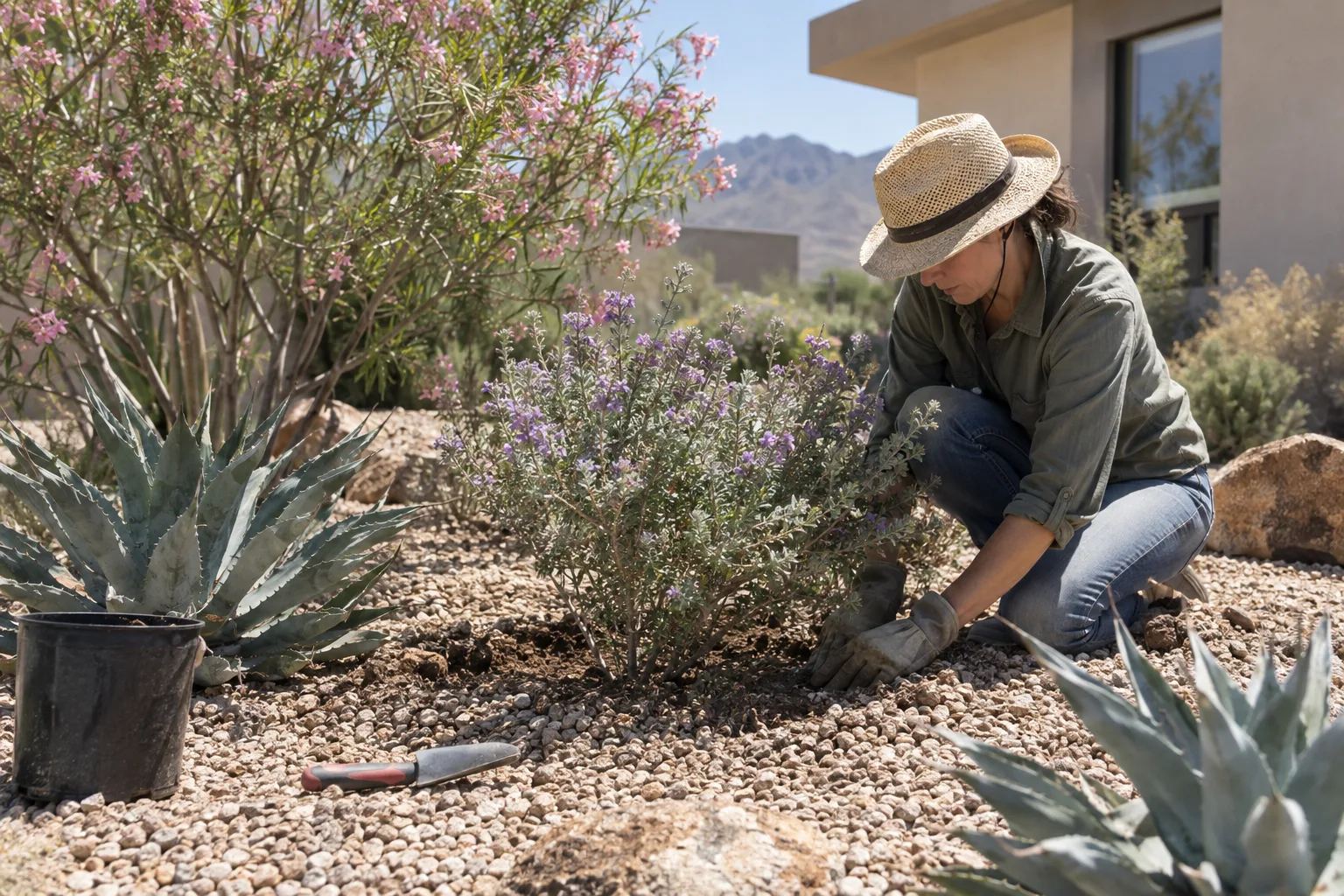
Texas sage, also called cenizo, grows 4 to 6 feet tall and wide, with silver-gray leaves and purple flowers that often appear after humid weather or monsoon rain. It takes full sun and reflected heat from block walls, and needs a deep soak only every few weeks in summer once established. The drawback is that soggy soil kills it. Shearing it into a ball also removes flowering wood, so prune lightly.
Blackfoot daisy (Melampodium leucanthum)
Blackfoot daisy is a low mound about 1 foot tall and 1 to 2 feet wide, covered in white flowers with yellow centers from spring into fall. It likes full sun, rocky or gravelly soil and a deep soak every two to three weeks in summer once established. Use it at the front of a bed or between shrubs. The drawback is a modest life span, and it rots in heavy, wet clay.
Agave (Agave species)
Agave ranges from compact Agave parryi, about 2 to 3 feet across, to Agave americana, which can reach 6 to 8 feet tall and wide. All store water in thick leaves and want full sun and sharp drainage. Established plants often need water only about once a month in summer and rarely in winter. The drawbacks are sharp spines near walkways and a single bloom, after which the rosette dies and leaves pups behind. Frost tolerance varies by species.
Red bird of paradise (Caesalpinia pulcherrima)
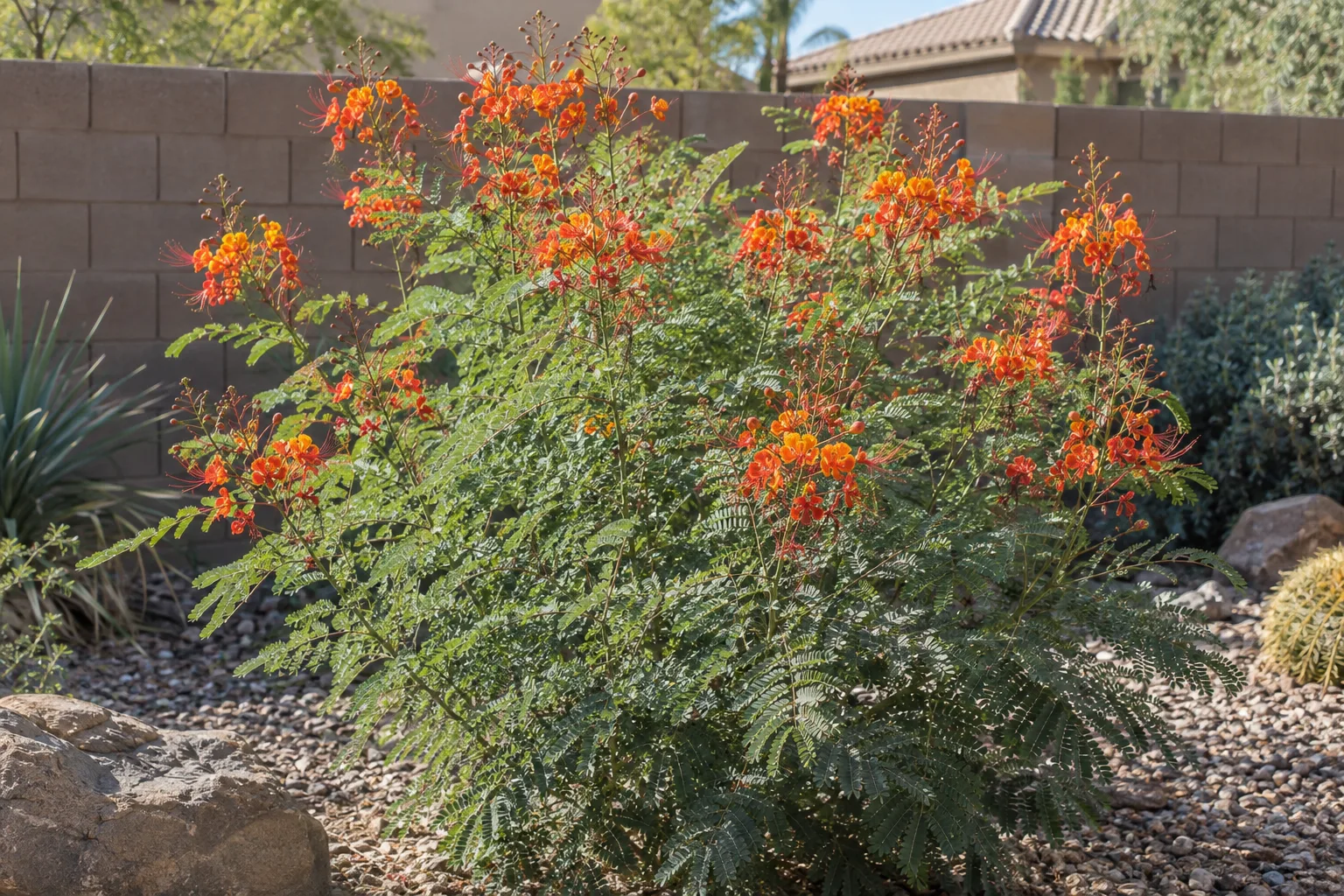
Red bird of paradise grows 6 to 10 feet tall and wide, with clusters of orange, red and yellow flowers from late spring through fall. It takes full sun and reflected heat, and wants a deep soak every two to three weeks in summer once established. The drawback is frost. A cold winter can kill it to the ground, so wait until frost danger passes (roughly March) before cutting back dead wood.
Creosote bush (Larrea tridentata)
Creosote bush grows 4 to 8 feet tall and wide, with small yellow flowers in spring and the earthy smell that fills the air after rain. It wants full sun, gravelly soil and very little water once established. The drawbacks are patience and looks. It can be slow to settle in from a container, and its plain, open form suits naturalized plantings better than formal beds.
How long do desert plants need regular watering?
Most need regular watering for one to two growing seasons, and larger plants like Desert Willow can take longer. Low-water does not mean no-water, and that misconception kills plenty of new plantings. Roots need a year or more to reach moisture stored deeper in the soil.
During establishment, water deeply and let the soil dry before the next soak, because this pushes roots down instead of leaving them near the surface. Check new plants every few days when highs top 108°F, and taper the schedule as growth picks up. Watch the plant, not the calendar.
When should I plant desert plants in Queen Creek?
Fall, from September through November, is the best window, with spring (February to April) a close second. Fall planting gives roots the mild months of winter and spring to spread before their first summer. Planting in May through July forces you to water heavily just to keep plants alive.
Our gardening calendars lay out what to plant and do each month in the East Valley. Frost can nip tender plants like red bird of paradise in January and February, so cover young plants on nights near freezing.
How do I plant in caliche and alkaline soil?
Dig wide, break through the caliche, and keep the backfill mostly native soil. Caliche is the hard, whitish calcium layer that often sits a foot or two down in Queen Creek yards, and it blocks drainage and deep roots. These plants evolved in lean, alkaline ground, so rich amendments add little.
- Dig a hole two to three times as wide as the root ball and no deeper than its height.
- Fill the hole with water. If it is still standing after several hours, break through the caliche with a digging bar or plant on a mound 4 to 6 inches high.
- Set the crown at or slightly above the surrounding soil.
- Backfill with the soil you dug out, with only light amendment.
- Build a shallow basin around the plant and soak it thoroughly.
- Add 2 to 3 inches of decomposed granite or gravel, kept a few inches back from the stem.

How much water do established desert plants need?
Established plants generally want a deep soak every two to four weeks in summer, less in spring and fall, and little or none in winter. Agave, brittlebush and creosote sit at the low end, while red bird of paradise and blackfoot daisy lean toward the higher end. Soil type, exposure and plant size shift every number, so treat these as starting points.
Hard water and heat are rough on drip hardware. Check emitters monthly in summer for clogs and cracked tubing. A plant that wilts between soaks needs water sooner, and one with yellowing leaves and wet soil needs less.
Can I grow these desert plants in pots?
Yes, agave and blackfoot daisy are the best fits among these eight, though container plants need water more often than in-ground plants. A dark pot in afternoon sun can heat roots well past what the plant tolerates, so choose a light-colored, thick-walled planter and place it where it gets afternoon shade.
Use a pot with drainage holes and a fast-draining mix. Our pottery and planters page shows styles we commonly carry. Large trees and shrubs like Desert Willow and Texas sage do better in the ground.
How should I arrange them in the yard?
Plan around mature size and water use. Desert Willow needs room to spread, and red bird of paradise can crowd a narrow bed within a season. Put plants with similar water needs on the same drip zone so agave and creosote are not drowned along with thirstier neighbors.
Layer heights for depth: Desert Willow as the canopy, Texas sage and red bird of paradise as mid-size shrubs, brittlebush and penstemon in front, and blackfoot daisy at the edge. Boulders help too, since the east side of a large rock gets afternoon shade and holds a little extra moisture.
Frequently asked questions
Do these desert plants need fertilizer?
Most need little or none. Heavy nitrogen pushes leafy growth on Texas sage at the expense of flowers, and agave does not need feeding. If leaves turn yellow with green veins, a common sign of iron chlorosis in alkaline soil, check watering and drainage first and ask us about an iron product.
Will frost damage these plants?
Red bird of paradise is the one most likely to freeze back in a cold winter, and it usually regrows from the base in spring. Desert Willow, Texas sage, brittlebush and creosote handle typical East Valley winter lows. Agave varies by species, so check the cold rating on the tag, and cover young plants on nights near freezing.
Can I prune these in summer?
Limit summer pruning to dead or damaged wood. Heavy cuts expose inner growth to sun and stress plants already working hard in 110°F heat. Cut brittlebush back in late fall, trim red bird of paradise after frost danger passes, and tidy penstemon after it finishes blooming.
Is gravel mulch worth using?
Yes, a 2 to 3 inch layer of decomposed granite or gravel slows evaporation, moderates soil temperature and holds down weeds. Keep it a few inches away from trunks and agave bases so moisture does not sit against the plant. Self-seeding plants like brittlebush need bare soil patches to reseed.
Can monsoon rain hurt desert plants?
Established desert plants generally handle monsoon rain well, but poor drainage can cause root rot when storms soak the ground repeatedly. Texas sage and agave are the most sensitive to soggy soil. Skip irrigation after a good soaking rain, and plant on a gentle mound if your yard holds water.
Is a low-care desert yard right for you?
For most Queen Creek homeowners, yes. These plants cut watering and upkeep once established, and they bloom through the heat. They are a poor match if you want a lush, tropical look, if your yard stays soggy after every rain, or if you will not water new plants through their first year or two. Stop by our nursery in Queen Creek and we will help you choose the right mix.