
To make a small Arizona yard feel more relaxing, start with overhead shade, then add height, the sound of water, calming plants, a cooler ground surface, soft lighting and less clutter. These eight changes work even in a 400-square-foot yard.
Key takeaways
- Put shade over your main seat first; a 12-by-12-foot shade sail or a pergola covers a small table and chairs.
- Build height up to about 8 feet with trellises, tall grasses or climbing vines so the eye travels upward.
- Choose a self-contained fountain, because its sound masks street noise far better than its evaporation cools the air.
- Use flagstone or decomposed granite near seating; river rock and artificial turf hold a lot of heat in July.
- Warm, low lighting at several heights stretches comfortable evenings from late September through May.
Where should I start in a small Arizona yard?
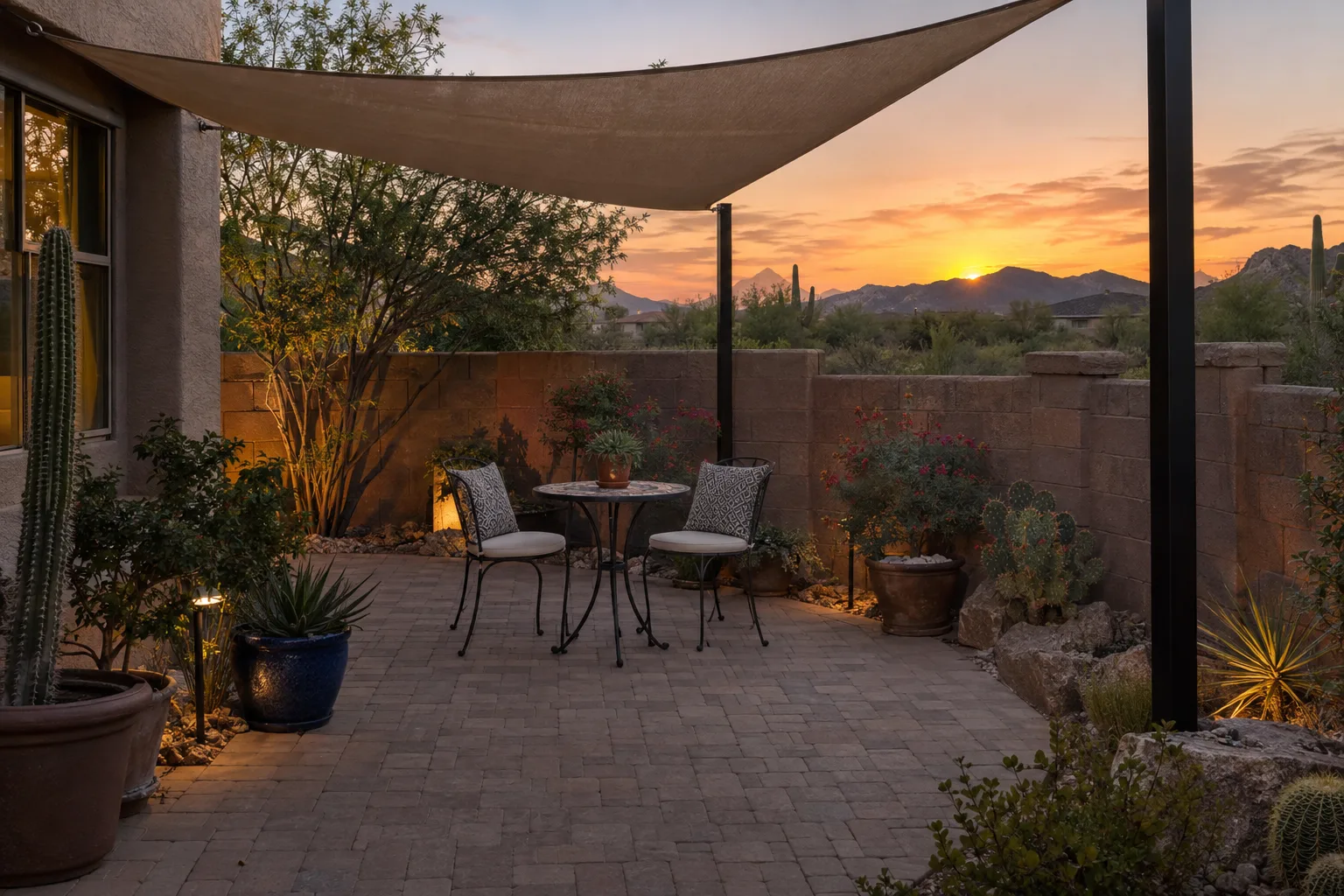
Put shade over the spot where you most want to sit, and do it before anything else. With summer highs above 110°F, an uncovered patio in Queen Creek is too hot to use for much of the day, however good the plants look. Shade comes first.
A shade sail is the quickest fix. Choose high-density polyethylene fabric with a UV block rating of 90% or higher, and anchor it to solid posts or a sound wall, since monsoon gusts from roughly July through September put heavy loads on the corners. A 12-by-12-foot sail covers a small table and chairs. Check the hardware each June.
A pergola or ramada with a solid roof outlasts fabric. Leave the sides open so air moves through, because an enclosed corner holds heat. Trees add dappled shade over time. Desert willow (Chilopsis linearis), which reaches roughly 15 to 25 feet, suits a small lot better than velvet mesquite (Prosopis velutina), which can grow far larger. Browse our desert trees to compare mature sizes before you choose.
How do I make a small yard feel larger?
Add height and divide the space into two or three zones. A yard with places for the eye to travel reads as bigger than one flat surface, even when the square footage is identical.
For height, mount trellis panels on a block wall and train bougainvillea or queen’s wreath (Antigonon leptopus) up them. Bougainvillea is frost tender, and queen’s wreath dies back in a hard freeze before regrowing in warm weather. Tall grasses such as deer grass (Muhlenbergia rigens) add movement while using very little floor space. Aim to layer interest from the ground up to about 8 feet. Our plants section is a good place to compare heights and habits.

For zones, give each purpose its own surface or level: a shaded seating area, a planted edge along the wall, and one small feature such as a fountain, fire pit or herb pot. Changing from concrete to decomposed granite to flagstone marks each shift, and even a single step up or down makes a separate room. Keep each zone small.
Does a fountain make a small patio feel calmer?
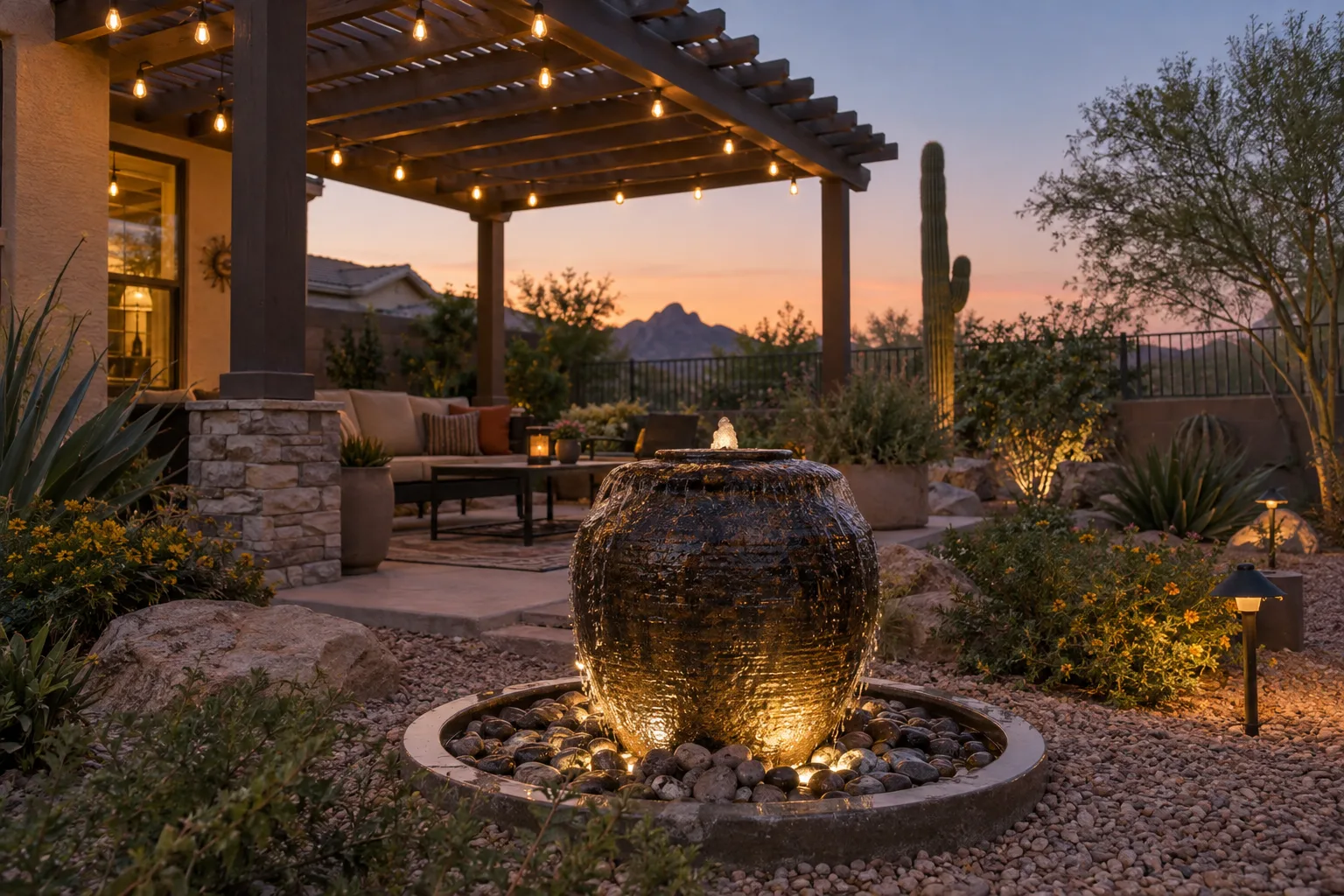
Yes, mainly through sound. A recirculating fountain adds steady white noise that softens traffic and neighbor noise, and evaporation gives a small cooling effect only within a few feet of the water.
A bubbling pot or tiered fountain with a built-in reservoir fits a patio corner and needs no digging. You can compare styles in our fountains department. Hard water leaves white mineral scale on stone and pumps, so wipe surfaces regularly, follow the maker’s cleaning directions, and top off the reservoir often, because a small basin can drop low quickly in summer heat. Never let the pump run dry.
Which plants make a small yard feel calm?
Pick plants for fragrance, soft texture and two or three strong colors, and keep the count low. Five or six well-placed plants look settled in a small yard, while fifteen look busy. Each of these has a drawback worth knowing.
- Desert lavender (Hyptis emoryi) has aromatic gray-green leaves and lavender-purple flowers from late winter into spring. It can reach 5 to 8 feet, so it needs a corner.
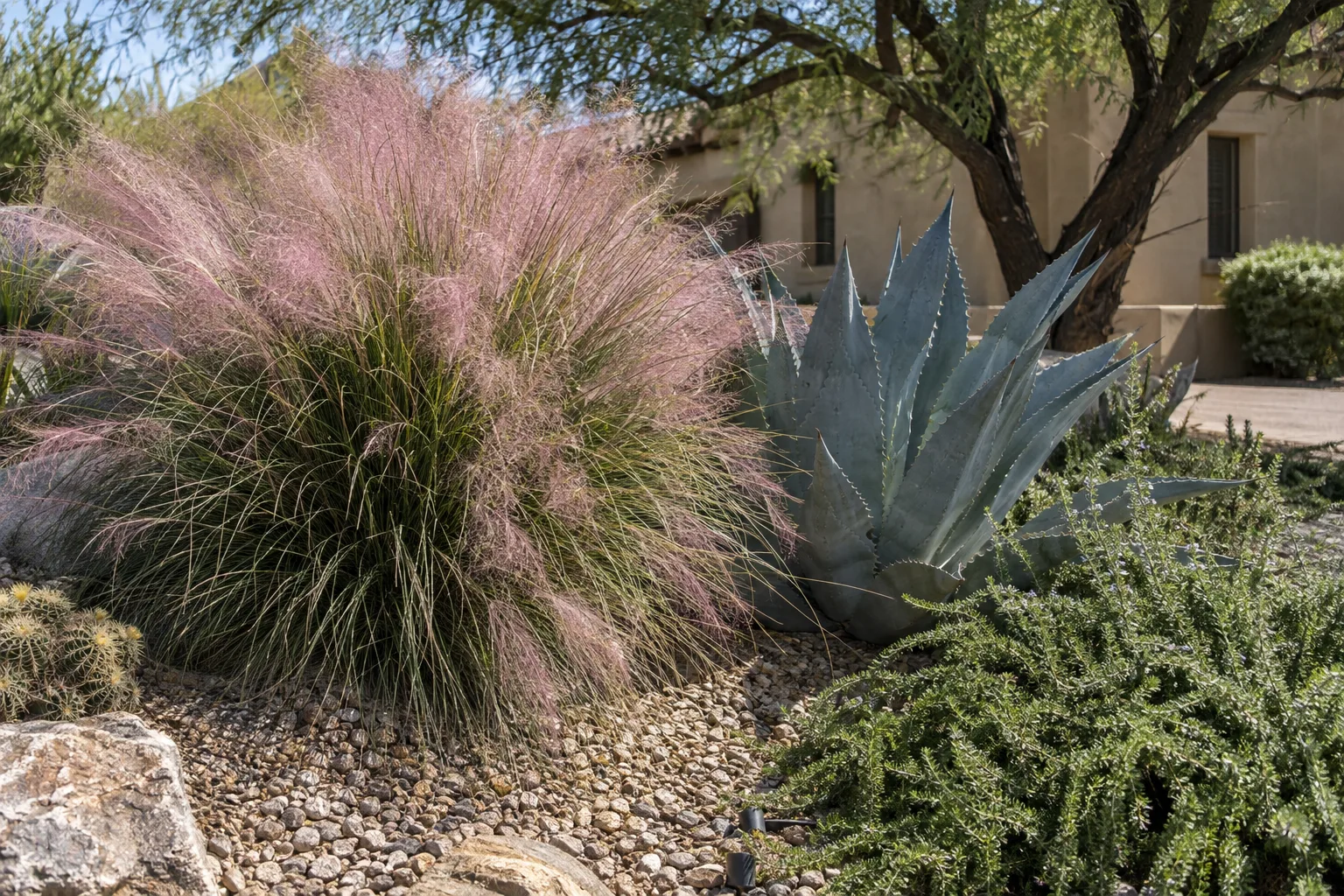
- Agave ‘Blue Glow’ forms blue-gray rosettes about 2 to 3 feet across with softer margins than many agaves. The leaf tips are still sharp, so keep it away from walkways and seats.
- Gulf muhly (Muhlenbergia capillaris) sends up pink plumes in fall on mounds about 3 feet tall. It looks plain for much of the year.
- Trailing rosemary (Rosmarinus officinalis ‘Prostratus’) spills over walls and releases scent when brushed. It rots in soggy soil, so drainage matters.
- Bougainvillea gives magenta, coral, white or purple color on a trellis. It has thorns and frost damages it.
These are varieties we commonly carry, though availability changes week to week and season to season. Where the ground is caliche or the patio is paved, grow them in pottery and planters with drainage holes. A pot can also be moved into afternoon shade during July and August.
What should I put on the ground instead of bare gravel?
Flagstone with decomposed granite joints suits most small seating areas. Decomposed granite looks softer than river rock, and flagstone gives chairs a firm, even surface.
| Surface | Summer heat | Look | Upkeep |
|---|---|---|---|
| Decomposed granite | Moderate; lighter colors stay cooler | Soft, earthy | Low; rake and top up |
| Flagstone with granite joints | Moderate; varies by color | Natural, varied | Low to medium; weeds in joints |
| River rock | Holds heat in direct sun | Hard, cool-toned | Low |
| Artificial turf | Gets very hot in direct sun | Lush, uniform | Low to medium; needs rinsing |
Edge the seating area with low plants such as blackfoot daisy (Melampodium leucanthum) or desert marigold (Baileya multiradiata), which add flowers where gravel would sit. Before you commit to any hard surface, rest your hand on a sample in direct sun at 3 p.m. in summer.
How should I light a small yard for evenings?
Use warm, low-level light at several heights instead of one bright fixture. A single floodlight flattens a small yard and makes it feel like a parking lot. String lights across a pergola or between sail posts give a soft amber glow, path lights mark the edges, and a spotlight aimed up into a desert willow throws leaf shadows onto the wall. Keep bulbs warm white.
Solar fixtures work well in our strong sun, though brightness and battery life vary by quality. Hardwired low-voltage systems give steadier output and let you dim each fixture. Evenings from late September through May are often the best hours outdoors, so good lighting stretches how long you use the yard.
How do I cut clutter in a small yard?
Remove anything that has no job and adds no beauty. In a 300-square-foot patio, a loose hose, mismatched pots and exposed drip lines all draw the eye. Tuck drip tubing under rock, store tools in a closed cabinet or wall rack, and keep furniture to two or three colors such as terracotta, charcoal and natural wood. Before you add anything new, ask whether it adds calm. Cut what does not.
In what order should I tackle these eight ideas?
Work from the biggest comfort gain to the smallest, and plant in the cooler months. Our gardening calendars show the best planting windows for the low desert.
- Add overhead shade over the main seat.
- Put up a trellis, vine or tall grass for height.
- Mark two or three zones with surfaces or a step.
- Set a self-contained fountain where you can see it from your chair.
- Plant a few fragrant, textured plants near the seating.
- Replace hot or monotonous ground cover with flagstone or decomposed granite.
- Layer in warm lighting at low heights.
- Edit out clutter and settle on a short color palette.
Frequently asked questions
Can I keep a lawn in a small Arizona yard?
You can, but turf needs far more water than desert plantings. Bermuda grass is the usual warm-season choice in the low desert, and it turns brown in winter unless overseeded. In a small yard, a flagstone and decomposed granite patio with planted edges usually gives you more usable space with less work.
How do I handle alkaline soil and caliche in a small bed?
Dig the planting hole wider than the root ball and break through any caliche layer so water can drain. Our soil is alkaline, and most desert-adapted plants tolerate that. Fill a hole with water first and see whether it empties within a day. If it stays full, choose a raised bed or a pot.
What is the fastest way to add privacy without a hedge?
A trellis with a fast climbing vine plus a few tall grasses gives privacy faster than a hedge. Bougainvillea or queen’s wreath can cover a trellis within a couple of growing seasons, and clumps of deer grass screen a block wall. Reed or bamboo panels give instant cover while the plants fill in.
Which containers survive a hot west-facing patio?
Large pots of heat-adapted plants such as bougainvillea, agave or rosemary hold up best. Bigger pots hold moisture longer and keep roots cooler than small ones. Choose pots with drainage holes, avoid broad, thin-leaved plants that scorch in July, and slide pots out of the hottest afternoon sun in July and August.
Is a small yard redesign worth the effort?
Yes, if you avoid your patio from May through September, because shade and a fountain change how often you use the yard more than any single plant. Skip the full plan if you rent and cannot add posts or alter walls, or if you want open turf for kids and dogs to run on, since these ideas favor sitting over playing. Start with one shaded chair and one container. Stop by the nursery in Queen Creek and we will help you plan the rest.