April is a good month to plant small trees for Arizona front yards, because the soil is warm and 100°F days are still weeks away. This list covers eight trees that mature between 10 and 30 feet.
Key takeaways
- Plant in April while overnight lows stay above about 50°F and daytime highs are still below 100°F.
- Six of the eight trees below stay at or under about 25 feet. Both mesquites can reach 30 feet.
- Dig the hole 2 to 3 times as wide as the root ball but no deeper, with the root flare at or slightly above the surrounding soil.
- Water every 2 to 3 days for the first 2 weeks, then stretch to every 5 to 10 days as the heat builds.
- Keep small trees 6 to 8 feet from walls and mesquites about 15 feet from foundations, driveways and water lines.

Why is April a good month to plant trees in the Arizona low desert?
April gives a new tree about six to eight weeks of mild weather to start rooting before summer highs pass 110°F. Soil in the East Valley is commonly in the 65°F to 75°F range then, which is comfortable for new roots.
A November planting sits nearly dormant until February. A July planting spends its first weeks fighting heat. By late May and June, soil near the surface can climb above 90°F, so the roots you grow in April are the ones that carry the tree through its first summer. Our trees department shows the range of trees we work with, and availability changes week to week and season to season.
Which small trees work best for Arizona front yards?
The eight trees below all handle full sun, alkaline soil and low-desert heat once established. Browse the desert trees page for more options. These are varieties we commonly carry, but availability changes week to week and season to season, so check before you plan around one.
Desert Museum palo verde (Parkinsonia hybrid)
Expect 15 to 20 feet tall with a broad canopy, full sun and low water once established. It sets few seed pods and carries yellow spring flowers over a green trunk. The drawback is litter, since tiny leaflets and petals collect in gutters and pool edges.
Velvet mesquite (Prosopis velutina)
This Sonoran Desert native reaches 20 to 30 feet with light, feathery shade. It wants full sun and very little water after the first couple of years. Its drawback is size and root spread, so it suits a roomy front yard and not a narrow strip.
Texas mountain laurel (Sophora secundiflora)
It grows 10 to 15 feet tall, slowly, with evergreen leaves and purple, grape-scented flowers in late winter to early spring. Give it full sun or light afternoon shade and low water. The drawback is the red seeds in the pods, which are poisonous if chewed or swallowed, so think twice with small children or dogs.
Chilean mesquite (Prosopis chilensis)
Faster than velvet mesquite, it reaches 20 to 30 feet with a slightly weeping canopy. It needs full sun and low water once established. The drawback is that a fast-growing top needs structural pruning in the first few years, and the mature size overwhelms a small lot.
Little leaf palo verde (Parkinsonia microphylla)
This native grows slowly to roughly 12 to 20 feet, with yellow-green bark and tiny leaves. Full sun and low water suit it. Its drawback is light shade, so it will not cool a patio as much as a mesquite does.
Chaste tree (Vitex agnus-castus)
Lavender-blue flower spikes show from late spring into summer on a tree 10 to 15 feet tall and wide. It likes full sun and moderate water, more than the native trees on this list. The drawback is a shrubby habit, so you will prune it to a single or multi-trunk form. See more color in our flowering trees.
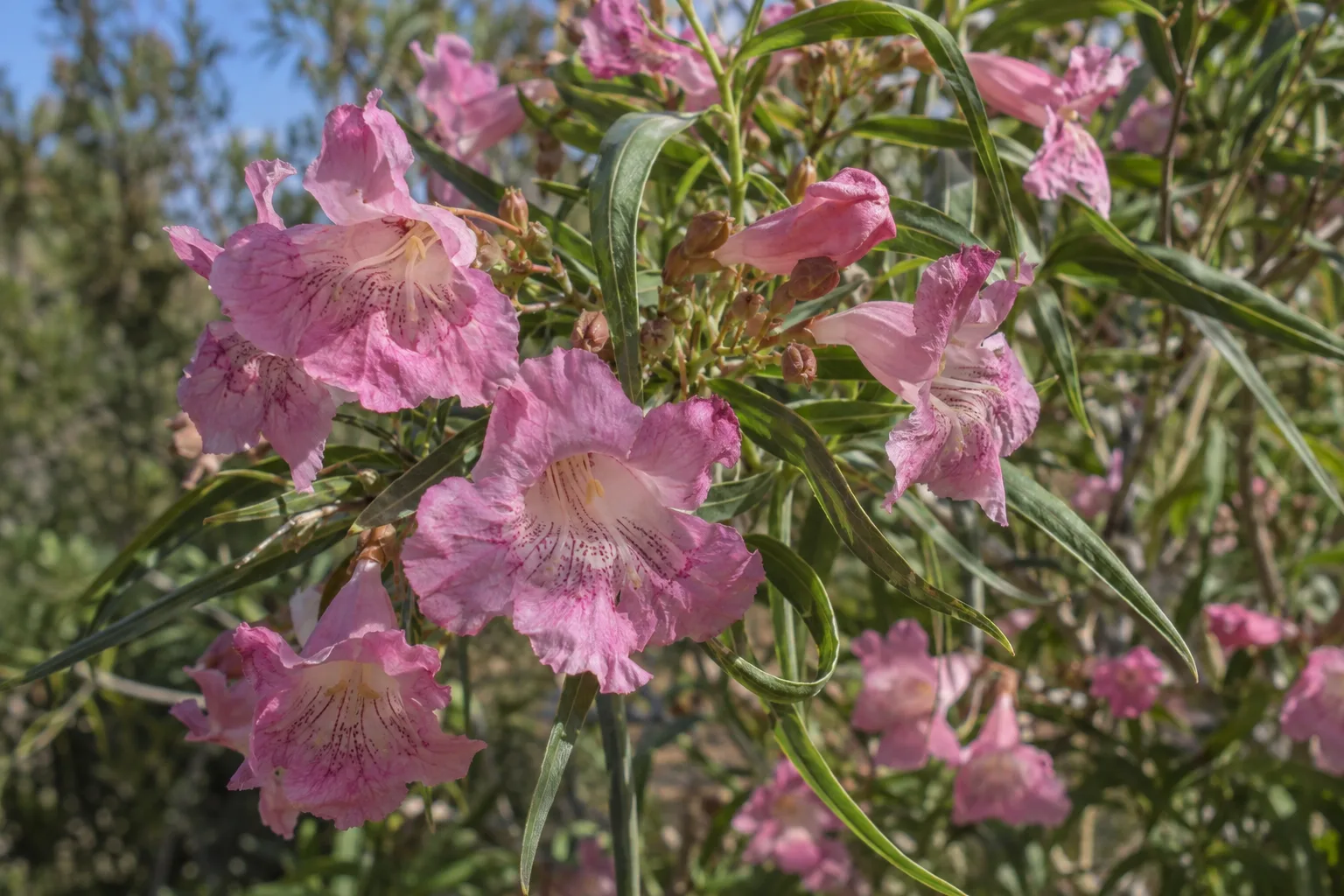
Desert willow (Chilopsis linearis)
Trumpet-shaped pink, purple or white flowers appear from spring into fall on a tree 15 to 25 feet tall with narrow, willow-like leaves. It takes full sun and low water. The drawback is a bare winter look, plus seed pods that need raking.
Sweet acacia (Vachellia farnesiana)
Fragrant yellow puffball flowers open in late winter and early spring on a tree 10 to 20 feet tall. It wants full sun and low water. The drawback is thorns, so set it 6 to 10 feet back from walkways and anywhere children play.
How do I plant a small tree in April?
Dig a wide, shallow hole, loosen circling roots, backfill with the native soil and water deeply right away. A shallow planting hole with the root flare slightly above grade is the detail that matters most.
- Choose a spot with clear overhead space and enough room for the mature canopy.
- Call Arizona 811 at least two full business days before you dig.
- Dig 2 to 3 times as wide as the root ball and exactly as deep as it is tall.
- Break through any caliche at the bottom with a digging bar so water can drain.
- Take the tree out of its container and loosen any circling roots by hand.
- Set the tree in the hole and check that the root flare sits at or just above the soil surface.
- Backfill with the soil you dug out, without compost or potting mix.
- Build a basin 4 to 6 inches tall, 24 to 36 inches out from the trunk.
- Fill the basin slowly two or three times so the root zone is soaked about 18 inches deep.
- Add 3 inches of mulch, kept several inches back from the trunk.

Skip staking unless the site is windy. If you do stake, use two stakes with a flexible strap and take them off after about 12 months. Our classes and events page lists hands-on sessions when we offer them.
How often should I water a new tree through its first summer?
Water every 2 to 3 days for the first 2 weeks, every 5 to 7 days through May, and every 7 to 10 days in June and July. Always check the soil first, because clay and caliche hold water much longer than sandy ground.
Push a long screwdriver into the basin before each watering. If it slides in easily, wait another day or two. If it stops at about 6 inches, water now. During the monsoon from roughly July through September, cut back to match rainfall. In October and November, every 10 to 14 days is usually enough. Our gardening calendars track seasonal tasks month by month.

How far from the house should I plant a front yard tree?
Plant small trees 6 to 8 feet from walls and mesquites about 15 feet from foundations, driveways and underground water lines. Stucco reflects heat, so a tree against a west wall faces much hotter air than one in open ground.
Shade on the west or southwest side of the house cuts afternoon heat load on walls and windows. One well-placed tree does more than three crowded ones. Check the mature canopy width on the tag, then picture it ten years out.
What mistakes kill new trees in the first summer?
Planting too deep causes most early losses, followed by watering that swings between soaking and neglect. These errors are avoidable.
- Burying the root flare. The trunk slowly suffocates over one to three years, and it looks like a watering problem.
- Filling the hole with rich compost. In caliche, water pools in the amended pocket and roots stay inside it.
- Putting one emitter against the trunk. Use two to four emitters at the edge of the canopy, and move them outward as the tree grows.
- Heavy pruning at planting. Wait a full season before any major cuts.
- Ignoring the monsoon. Keep irrigating on a dry-weather schedule through July rain and roots can sit in wet soil.
Frequently asked questions
Can I plant these trees in summer if I miss April?
Yes, but it takes more attention. Newly planted trees need frequent checks and some shade protection once highs pass 105°F. If you can wait, late September and October planting is gentler, and roots grow through winter before spring top growth starts.
Should I fertilize a new tree?
Wait 60 to 90 days after planting before feeding. Early roots matter more than top growth, and a nitrogen push can leave the canopy bigger than the roots can support. After that, a light slow-release feeding is plenty for the native trees on this list.
How do I know when my tree is established?
Most of these trees need one to two growing seasons. A tree is established when it puts on strong spring growth, its trunk visibly thickens and it handles longer gaps between waterings without wilting. Stretch the interval in small steps instead of stopping irrigation all at once.
Which tree on this list needs the least water?
The two palo verdes, velvet mesquite and desert willow need very little water once established. Chaste tree asks for the most, with deep soaks every week or two in summer. Every tree on the list still needs steady water for its first year.
Can I prune a new tree to shape it?
Remove only dead or broken branches in the first year. A lopsided young tree usually fills in as it grows. Structural pruning is easier after one full season, and mesquites benefit most from guidance in years two and three.
Is April the right month for your front yard tree?
April works well if you can keep to a watering schedule through June and have the room a tree needs at maturity. Skip it if you will be away for weeks this summer with no one to check the irrigation, or if your front yard is narrower than about 12 feet. A shrub or large container suits that space better. Come visit us in Queen Creek, and we will help you match a tree to your spot.