
The best shade trees for Arizona homes have deep, well-behaved roots, a wide canopy and real heat tolerance. These eight trees suit East Valley yards, and each stays out of trouble when you give it the right distance from walls, pipes and pools.
Key takeaways
- Plant large shade trees 15 to 20 feet from the house, and give the biggest canopies, such as tipu, 20 feet or more.
- Shade the west and southwest sides first, because afternoon sun from about 2 PM onward does the most damage to wall and roof temperatures.
- Deep, infrequent watering sends roots downward, while frequent shallow sprinkling keeps them near the surface where they lift concrete.
- Fall (September and October) and late February through April are the usual planting windows in the low desert.
- Dig the hole 2 to 3 times as wide as the root ball but no deeper, and set the root flare about an inch above finished grade.
Which tree roots cause the least trouble in Arizona?
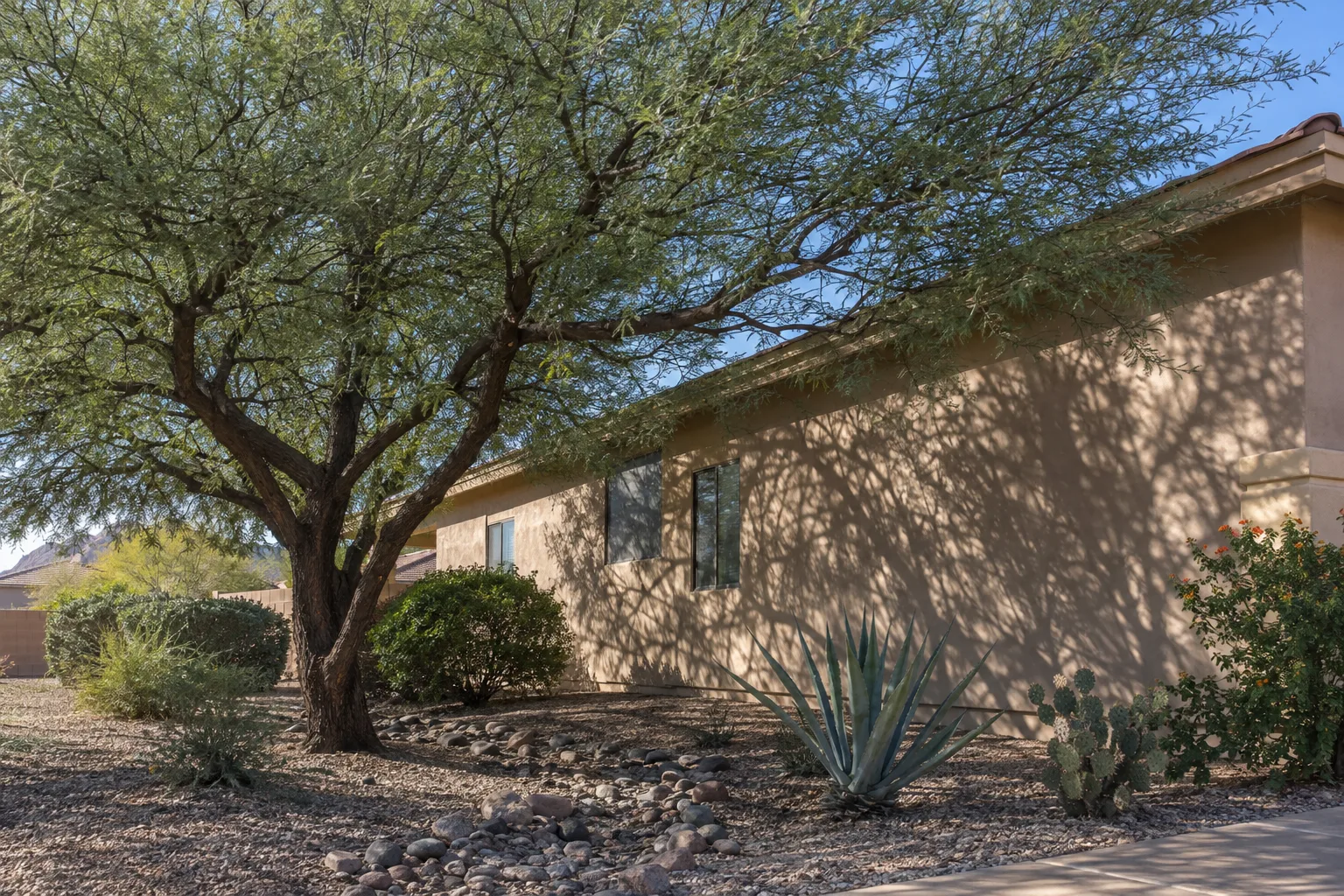
Trees with deep, descending roots cause the least trouble, and how you water has as much influence as which species you choose. Surface roots form when water stays shallow, when soil is compacted, or when roots hit caliche and turn sideways.
Caliche is the cemented, calcium-rich layer that sits anywhere from a few inches to a few feet down in much of Queen Creek and the surrounding East Valley. Water pools above it, and roots follow that water outward instead of down. Trees such as cottonwood, Arizona ash and silver maple are known for shallow, wide-reaching roots, so we steer people away from them near foundations.
None of the trees below is root-proof. Each one behaves better when it gets a soak every week or two instead of a daily sprinkle. You can browse desert-adapted trees to compare these species and others that suit our soil.
What makes a good shade tree for an East Valley yard?
A good shade tree casts dense or broad shade in the afternoon, handles summer highs above 110°F without scorching, and has a root system that stays reasonable on a residential lot. Litter and growth rate matter too.
- Canopy: A wide, spreading crown over the west wall blocks the most heat.
- Heat tolerance: Leaves and bark should handle reflected heat off block walls and pavement.
- Litter: Pods, flowers and leaves all fall somewhere, so think about pools and patios before you choose.
- Growth rate: Very fast trees often have softer wood that breaks in monsoon winds, so plan on structural pruning in the first few years.
Which shade trees work best for Arizona homes?
These eight trees suit the Arizona low desert, from small patio trees to large canopy trees. They are varieties we commonly carry, though availability changes week to week and season to season, so check what is on hand before you plan around one.
Desert willow (Chilopsis linearis)
Mature size is 15 to 25 feet tall and 10 to 20 feet wide, in full sun, with low water once established. It is not a true willow, and its roots are deep and fairly polite. Pink to lavender trumpet flowers show from late spring into the monsoon. The drawback is an open canopy that gives filtered shade, plus seed pods and spent flowers that drop onto patios.
Chilean mesquite (Prosopis chilensis)
This one reaches 25 to 40 feet tall and 30 to 40 feet wide in full sun, with low to moderate water. It grows quickly and makes a broad umbrella of shade that suits a west wall. The drawback is that fast growth means brittle limbs in monsoon wind, and shallow watering can push roots toward the surface. Plant it 20 feet from structures and prune for structure early.
Blue palo verde (Parkinsonia florida)
Expect 15 to 30 feet in height and spread, in full sun, with very low water after establishment. The blue-green bark photosynthesizes, so the tree looks alive even when the small leaves drop. Bright yellow spring flowers cover it. The drawback is light, dappled shade, along with a carpet of petals and seed pods beneath it.

Tipu tree (Tipuana tipu)
A tipu reaches 30 to 50 feet tall and 40 to 60 feet wide in full sun, with moderate water. The wide, flat canopy shades an entire backyard, and it stays semi-evergreen in mild winters. The drawback is size. It needs a large lot and at least 20 feet from the house, and young trees can suffer frost damage in a cold winter.
Thornless honey locust (Gleditsia triacanthos var. inermis)
This tree grows 30 to 45 feet tall and 25 to 35 feet wide in full sun, with moderate water. Its fine, feathery leaves give light shade in summer and let winter sun through, which makes it a good south-side choice among deciduous trees. The drawback is that it drinks more than desert natives, drops seed pods, and sheds all its leaves each fall.
Netleaf hackberry (Celtis reticulata)
Netleaf hackberry grows 20 to 30 feet tall and wide, in full sun to light shade, with low to moderate water. It is native to the Southwest and tolerates rocky, alkaline soils that stump many other trees. Berries attract birds. The drawback is slower growth than the mesquites, and the leaves can develop small galls, which look odd but are usually cosmetic.
Shoestring acacia (Acacia stenophylla)
Shoestring acacia reaches 20 to 30 feet tall and 15 to 20 feet wide in full sun, with very low water. Its long, narrow, weeping foliage stays green through the year and gives moderate shade. The drawback is a shorter lifespan than the other trees here, plus pods and some limb drop, so it works best as a fast, medium-term shade tree rather than a legacy tree.
Velvet mesquite (Prosopis velutina)
Velvet mesquite grows 20 to 30 feet tall and 25 to 35 feet wide, sometimes larger, in full sun, with very low water. It is a native of the Sonoran Desert with a long taproot, and it supports a lot of wildlife. The drawback is thorns, pods and a slow, irregular form while young. Give it plenty of room to spread.
How do these eight shade trees compare?
The table below puts the key numbers side by side so you can match a tree to your lot. Ranges are typical for the low desert and vary with soil, water and pruning.
| Tree | Mature height | Canopy width | Water once established | Leaf habit |
|---|---|---|---|---|
| Desert willow | 15 to 25 ft | 10 to 20 ft | Low | Deciduous |
| Chilean mesquite | 25 to 40 ft | 30 to 40 ft | Low to moderate | Semi-evergreen |
| Blue palo verde | 15 to 30 ft | 15 to 30 ft | Very low | Deciduous (green bark) |
| Tipu tree | 30 to 50 ft | 40 to 60 ft | Moderate | Semi-evergreen |
| Thornless honey locust | 30 to 45 ft | 25 to 35 ft | Moderate | Deciduous |
| Netleaf hackberry | 20 to 30 ft | 20 to 30 ft | Low to moderate | Deciduous |
| Shoestring acacia | 20 to 30 ft | 15 to 20 ft | Very low | Evergreen |
| Velvet mesquite | 20 to 30 ft | 25 to 35 ft | Very low | Deciduous |
Where should I plant a shade tree to cool my house?
Plant on the west and southwest sides first, because walls and windows facing those directions take the hardest afternoon sun. Shade there lowers the heat your air conditioner has to remove.
Measure from the wall to the spot where the trunk will stand, then compare that distance to the mature canopy width. A tree set 15 to 20 feet out will eventually overhang the roof and shade it as well. On the south side, a deciduous tree gives summer shade and lets winter sun warm the house. Shade over an outdoor condenser can help it run more efficiently, but keep leaves and pods from clogging the coil.
If you want shade through winter on a west wall, look at evergreen trees. Keep large trees 10 to 15 feet from pools and a safe distance from sewer and irrigation lines.
When and how should I plant a shade tree in caliche soil?
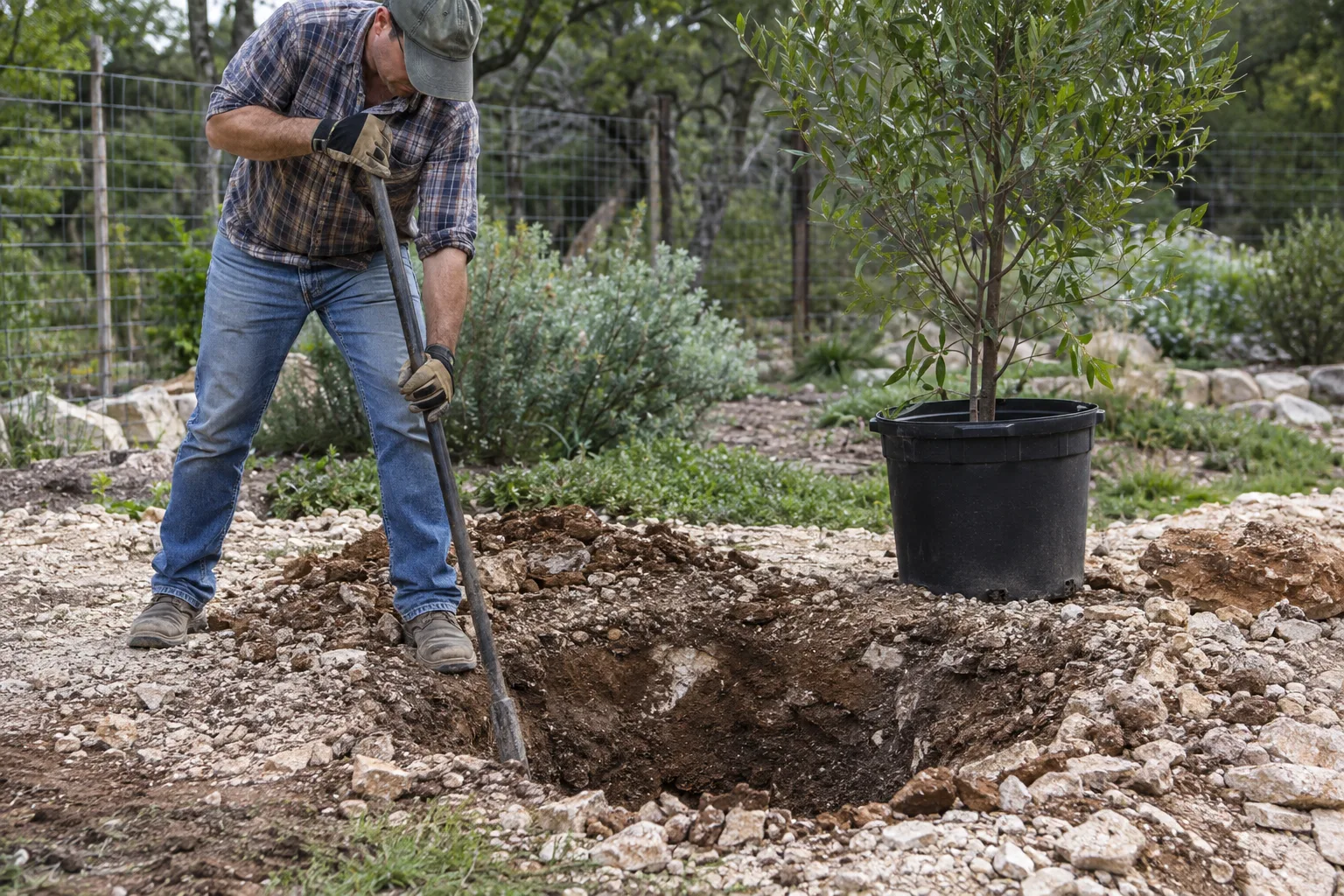
Plant in September and October or from late February through April, and test the drainage of your hole before you set the tree. Planting in summer is possible, but a new tree then needs very close watering. Our gardening calendars show what else belongs on the calendar in each month.
- Dig a test hole about 18 inches deep and fill it with water. If water is still standing after an hour or so, you have a drainage problem, probably caliche.
- Break through any caliche layer with a digging bar or pick, so water can drain below the root zone.
- Dig the planting hole 2 to 3 times as wide as the root ball and only as deep as the root ball.
- Backfill mostly with the native soil, mixing in only a modest amount of compost.
- Set the root flare about an inch above the surrounding grade.
- Water slowly and thoroughly to settle the soil and remove air pockets.
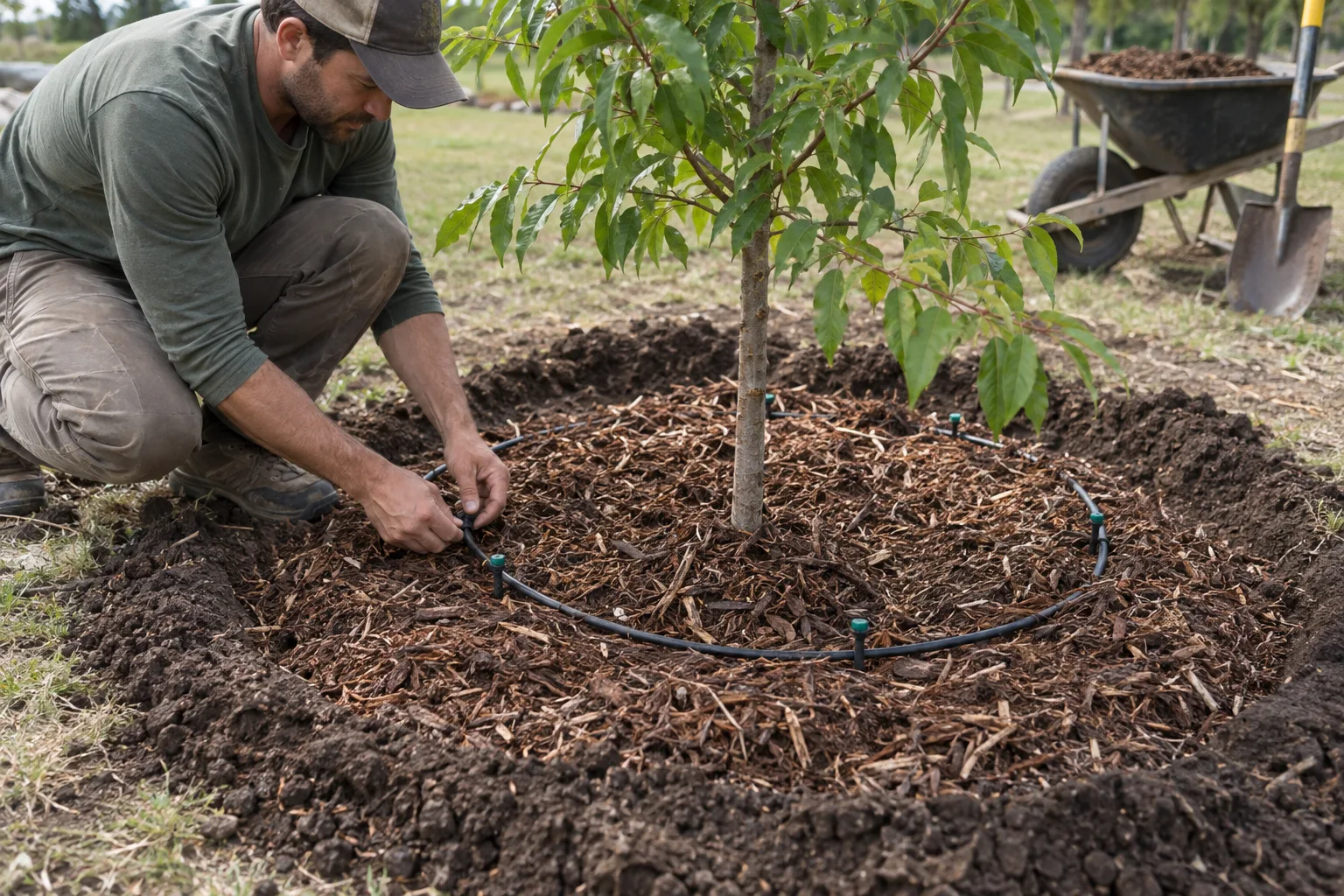
- Build a basin around the planting area and spread 3 to 4 inches of wood chip mulch, keeping it a few inches from the trunk.
- Stake only if the tree cannot stand on its own, and remove ties after about six months.
How often should I water a new shade tree?
Water a new tree often at first, then stretch the interval as roots spread. Frequency depends on tree size, soil and season, so use the numbers below as a starting point.
During the first summer, a new tree usually needs a deep soak every few days for the first month, then roughly weekly. Established trees can generally go 7 to 14 days in summer and 3 to 4 weeks in winter, soaking the soil 18 to 24 inches deep. Water at the edge of the canopy, not at the trunk, and move the emitters outward each year as the tree grows.
Check by pushing a long screwdriver into the soil. It slides easily where soil is moist and stops where it is dry. During monsoon rain, back off and let the soil dry before watering again.
What mistakes cause root and branch problems?
Planting too close, watering too shallowly and pruning at the wrong time cause most shade tree problems. All three are avoidable.
- Crowding structures: Judge the spot by the canopy at maturity, not the little tree in the container.
- Shallow watering: Frequent short cycles keep roots near the surface and under the sidewalk.
- Planting too deep: Burying the root flare invites crown rot, especially when monsoon storms saturate the soil.
- Summer pruning: Heavy cuts in July expose bark to sunburn, so save structural pruning for late winter.
- Choosing speed over structure: Fast growers need early pruning to build a strong frame before the monsoon winds arrive.
Frequently asked questions
Can I plant these trees near a pool?
Yes, but keep them 10 to 15 feet from the edge and expect some litter. Blue palo verde and desert willow drop flowers and small pods, while mesquites drop pods and leaves. No tree is litter-free, so plan on a skimmer basket and regular cleanup.
Which tree gives shade fastest?
Chilean mesquite and tipu are the quickest in this list, often adding a few feet per year in good conditions. Shade over a patio can take 3 to 5 years. Faster growth can mean weaker wood, so prune in the first few years to build a sturdy branch structure.
Do shade trees need fertilizer?
The desert natives here, such as mesquite, palo verde and desert willow, usually need little or none. Honey locust and tipu may benefit from a light spring feeding. If leaves turn yellow with green veins, that suggests iron chlorosis from alkaline soil, which a chelated iron product addresses better than general fertilizer.
Are native desert trees protected by law?
Arizona has a native plant law administered by the Arizona Department of Agriculture that covers some native species, including certain trees. Rules depend on the plant, the land and your city or HOA. Check with the department and your local authority before removing or moving a mature native tree.
Why is my new tree leaning after a storm?
Monsoon wind can loosen a young tree in wet soil, especially one with a small root ball or a heavy canopy. Reset it upright when the soil is moist and firm it in. Use soft ties on two stakes, loosely, and remove them within about six months.
Which shade tree is right for your yard?
Choose by space. A yard with 20 feet or more west of the house can take a Chilean mesquite, a velvet mesquite or a tipu. Smaller yards suit desert willow or blue palo verde. If you want dense, litter-free shade over a small pool, none of these will deliver it, and you may do better with a shade sail. Stop by our Queen Creek nursery and we will help you match a tree to your yard.