The best shade plants for Arizona yards are desert-adapted trees such as blue palo verde, velvet mesquite, Texas ebony and Chinese elm, plus one vine for a ramada. Match the mature canopy to your space and to the walls that take the afternoon sun.
Key takeaways
- Shade on the west and southwest sides of a house does the most good, because that sun arrives after 2 p.m. when temperatures often pass 110°F.
- Mature spread ranges from about 10 feet (desert willow) to 50 feet (Chinese elm), so pick by the room you have, not by the tree you like.
- Fall planting, from October through February, gives roots 6 to 9 months before the first summer.
- Water new trees deeply (a slow soak that reaches 18 to 24 inches down) and widen the gap between waterings as the tree establishes.
- Dig the hole 2 to 3 times as wide as the root ball, set the root flare at or just above soil level, and break through caliche if you hit it.
Where should I plant shade to cool my house?
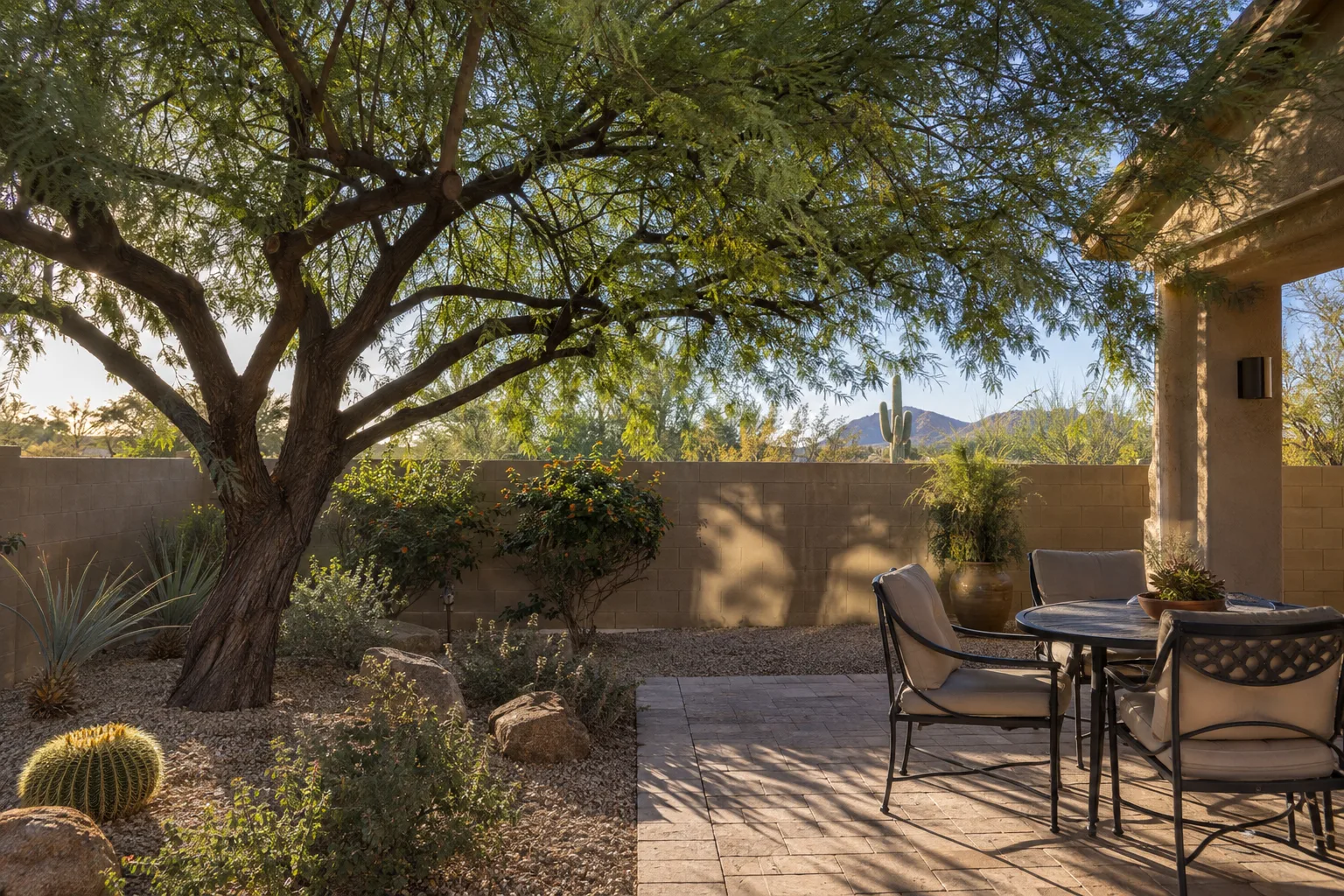
Put the tallest trees on the west and southwest sides of the house. Late afternoon sun hits those walls and windows hardest, and a canopy there keeps the heat off the surface before it reaches the inside.
The U.S. Department of Energy has published estimates that well-placed trees can trim cooling costs noticeably, and we suggest treating any exact percentage as a rough guide. Bare concrete and decomposed granite can also get far hotter than the air above them, so shade over a patio or driveway pays off too.
Give large trees 10 to 15 feet from the house, foundation and sewer lines, and call 811 before digging near buried utilities. East walls need less help. A mid-sized tree 15 to 20 feet away is plenty.
Which shade plants work best in the Arizona low desert?
Eight plants cover most Queen Creek and East Valley yards, from small lots to open back acreage. Each handles alkaline soil, reflected heat from block walls and summer highs above 110°F. These are varieties we commonly carry, though availability changes week to week and season to season, so check with us before you plan around one.
1. Blue palo verde (Parkinsonia florida)
Blue palo verde grows 25 to 30 feet tall and about as wide, in full sun. Its blue-green bark photosynthesizes, so it keeps working when the tiny leaves drop in drought. Established trees need a deep soak every 2 to 4 weeks in summer. The drawback is litter: yellow petals in spring and fine leaves and twigs through the year land on patios and in pools.
2. Velvet mesquite (Prosopis velutina)
Velvet mesquite reaches 20 to 30 feet tall and 30 to 40 feet wide in full sun. It casts a dense but dappled canopy and is one of the lowest-water choices here once established. The drawback is its roots. They spread wide and seek water, so keep it at least 15 to 20 feet from pools, pipes and hardscape. It also needs room above and around it.
3. Desert willow (Chilopsis linearis)
Desert willow is not a true willow. It grows 15 to 25 feet tall and 10 to 15 feet wide in full sun, which suits narrower side yards. Trumpet-shaped flowers appear from late spring into fall, in shades from white to deep pink and burgundy. Established plants need little extra water. The drawback is its light, open canopy, which gives filtered shade, not deep shade, and it drops leaves in winter.
4. Texas ebony (Ebenopsis ebano)
Texas ebony reaches 20 to 30 feet tall and 15 to 20 feet wide in full sun. Its dark, dense evergreen canopy holds up through summer when other trees look tired. Water deeply every 2 to 3 weeks in the hottest months once it is settled. The drawback is speed. It grows slowly, often 1 to 2 feet a year, so you wait longer for shade than you would with an elm or locust.
5. Thornless honey locust (Gleditsia triacanthos var. inermis)
Thornless honey locust grows fast to roughly 30 to 45 feet tall and wide in full sun. Its fine leaflets make light, comfortable shade over a patio where you still want some sky. It is deciduous, so winter sun reaches the house. It needs a deep watering every 1 to 2 weeks in summer. The drawback is mess, since leaflets and seed pods drop and need raking.
6. Chinese elm (Ulmus parvifolia)
Chinese elm grows fast to 40 to 60 feet tall with a spread of 35 to 50 feet, in full sun. It forms a broad, arching canopy and is semi-evergreen in our mild winters, so it holds most leaves until a cold snap. It wants a deep soak every 10 to 14 days in summer. The drawback is size. It overwhelms a small lot, and its water appetite is higher than the desert natives.
7. Palo brea (Parkinsonia praecox)
Palo brea grows 15 to 25 feet tall and wide in full sun, with a lime-green trunk and yellow spring flowers. That mid-size spread fits standard suburban lots. Established trees get by on a deep soak every 3 to 4 weeks in summer. The drawback is that it can carry small thorns, so check the tree before planting it near a walkway or play area.
8. Scarlet trumpet vine (Distictis buccinatoria)
This evergreen climber covers a ramada or pergola, reaching 20 to 30 feet along a strong support. Red-orange trumpet flowers draw hummingbirds. Give it morning sun and afternoon shade its first summer, then water deeply about weekly. The drawback is frost. A hard freeze can burn it back, and the mature vine is heavy, so build the structure to carry the weight.

How do these eight shade plants compare?
Use this table to narrow the list by size and water use. Figures are typical ranges for the low desert, and individual trees vary with soil, irrigation and pruning.
| Plant | Height | Spread | Water once established | Leaf habit |
|---|---|---|---|---|
| Blue palo verde | 25 to 30 ft | 25 to 30 ft | Low | Mostly bare of leaves in drought |
| Velvet mesquite | 20 to 30 ft | 30 to 40 ft | Very low | Deciduous |
| Desert willow | 15 to 25 ft | 10 to 15 ft | Low | Deciduous |
| Texas ebony | 20 to 30 ft | 15 to 20 ft | Low to moderate | Evergreen |
| Thornless honey locust | 30 to 45 ft | 30 to 45 ft | Moderate | Deciduous |
| Chinese elm | 40 to 60 ft | 35 to 50 ft | Moderate | Semi-evergreen |
| Palo brea | 15 to 25 ft | 15 to 25 ft | Low | Mostly deciduous |
| Scarlet trumpet vine | 20 to 30 ft (vine) | Follows its support | Moderate | Evergreen |
Should I choose a deciduous or evergreen shade tree?
Choose deciduous if you want winter sun on a south or west wall, and evergreen if you want shade and a screen all year. Both work in the low desert, and the winter difference is small because our winters are mild.
Browse our deciduous trees for species that drop leaves in cool months, or our evergreen trees for canopy that stays put. Our desert trees section is the best place to start for the natives on this list. Flowering choices such as desert willow and palo verde also appear under flowering trees.
How do I plant a shade tree in caliche and alkaline soil?
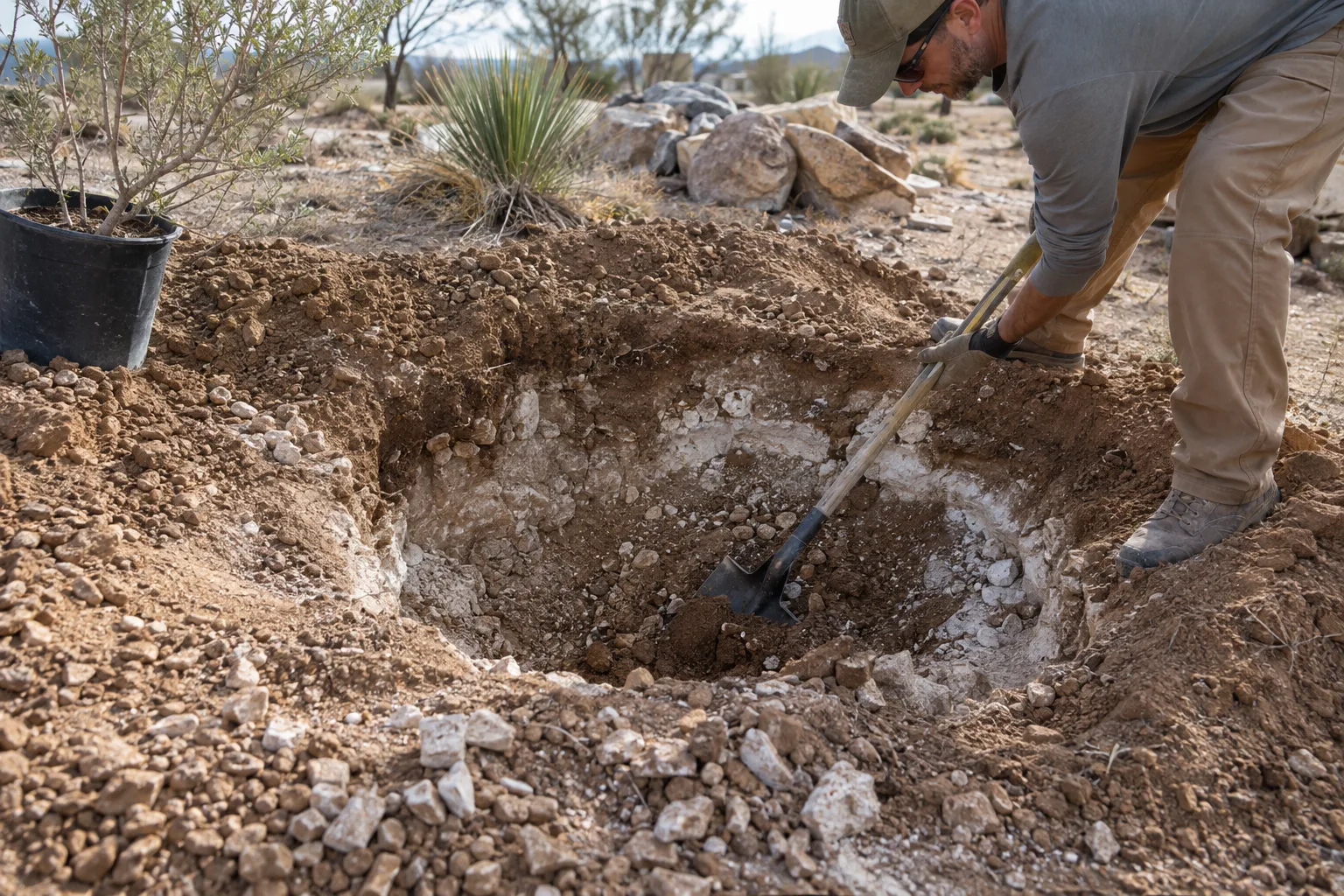
Dig a wide, shallow hole and break through any caliche so water can drain. Most failures here come from roots sitting in a soggy pocket above a hard layer, not from the tree itself.
- Dig a test hole about 2 feet deep. A hard, white or tan cemented layer is caliche.
- Break through it with a digging bar or rented jackhammer, so water can drain below the root ball.
- Dig the hole 2 to 3 times wider than the root ball and no deeper than its height.
- Backfill with native soil, or native soil mixed with a little coarse sand. Heavy amendments encourage roots to circle in the hole.
- Set the root flare at or slightly above the surrounding soil.
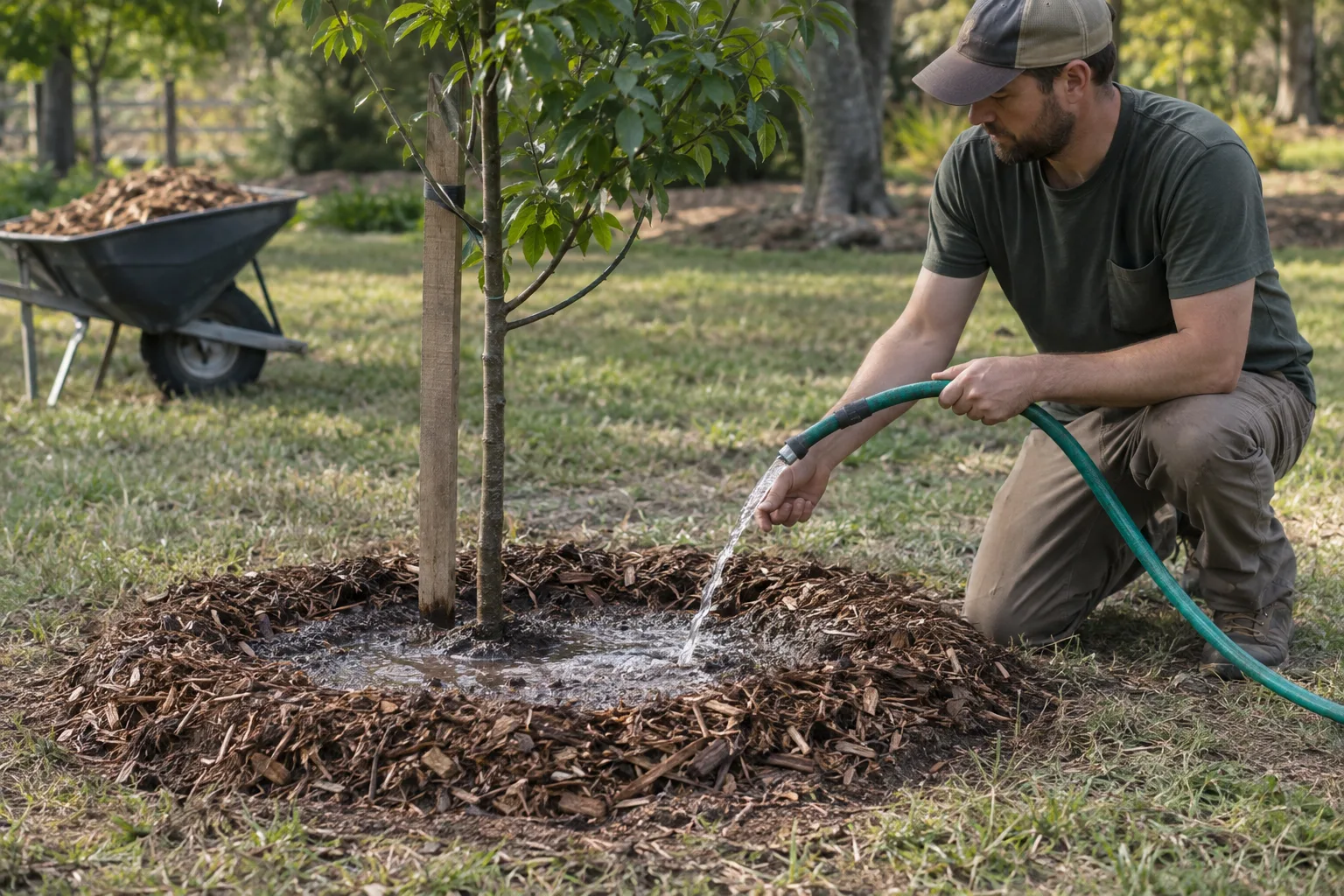
- Build a soil berm 4 to 6 inches high at the edge of the planting hole to hold water.
- Soak slowly until the water reaches 18 to 24 inches down.
- Spread 3 to 4 inches of wood chip mulch, kept about 6 inches off the trunk.
Fertilize lightly. Heavy nitrogen pushes fast, weak growth that breaks in monsoon winds, which can top 60 mph in a microburst. If leaves turn yellow with green veins, that is iron chlorosis, common in alkaline soil, and chelated iron is the usual fix.
How often should I water a new shade tree?
Water new trees every 3 to 4 days for the first month, then every 7 to 10 days through the first summer. Each soak should be slow and deep, because a few minutes a day grows shallow roots that cook in summer.
After the first year, stretch the interval a little at a time. Natives like mesquite and palo verde end up needing a deep soak only every few weeks in summer, while elm and honey locust stay thirstier. During the monsoon, roughly July through September, cut back when rain falls but do not stop, since dry spells of two weeks can follow a storm. Taper off in October as growth slows.
Our gardening calendars lay out seasonal timing, and our classes and events sometimes cover tree planting and care.
Frequently asked questions
How long until a new tree gives useful shade?
Fast growers such as Chinese elm and honey locust give meaningful shade in about 3 to 5 years. Palo verde and desert willow are close behind. Texas ebony may take 7 to 10 years to fill out. Consistent deep watering in the first two years speeds all of them up.
Can I plant shade trees near a pool?
Choose carefully and give them space. Velvet mesquite roots spread wide and are best kept 20 feet or more from a pool. Smaller trees such as desert willow and palo brea are better poolside choices, though all of them drop leaves, flowers or pods into the water.
Will a deciduous tree raise my winter heating costs?
No, it lowers them slightly. Bare branches let winter sun warm south and west walls, then leaves return in spring when you want shade again. Our winters are mild, so the effect is modest, but it favors honey locust or desert willow on the south side.
Does frost hurt these plants?
Most of the trees here handle our occasional winter frost, but young ones can be damaged by a hard freeze. Scarlet trumpet vine is the most tender and may burn back. Cover young plants on cold nights and wait until spring to prune any damage.
Can I use a vine instead of a tree?
Yes, if you already have a ramada, pergola or shade structure. A vine covers it within a few growing seasons and costs no yard space. It does not shade a house wall or driveway the way a tree can.
Which shade plant is right for your yard?
Pick a native such as blue palo verde, velvet mesquite or palo brea if you want low water use and have room for the canopy. Choose Chinese elm or honey locust if you want fast, broad shade and accept regular watering. Skip large trees entirely on a very small lot, or near pools and pipes you cannot move. Stop by our Queen Creek nursery and we will help you match a tree to your yard.