
To save water in an Arizona desert garden, switch to drip irrigation, water deeply but less often, mulch 3 to 4 inches, plant low-water species, improve the soil, capture monsoon rain and adjust your timer each season.
Key takeaways
- Drip emitters deliver about 0.5 to 2 gallons per hour to the root zone, while spray heads lose water to wind and evaporation.
- A soil probe should slide 12 to 18 inches into the ground a day after you irrigate a shrub bed.
- Spread 3 to 4 inches of organic mulch and keep it a few inches off every trunk.
- Reset your timer at least four times a year, because a January plant needs far less water than a June plant facing highs above 110°F.
- New desert plants still need regular deep watering for their first two summers before you taper off.
Which plants use the least water in the low desert?
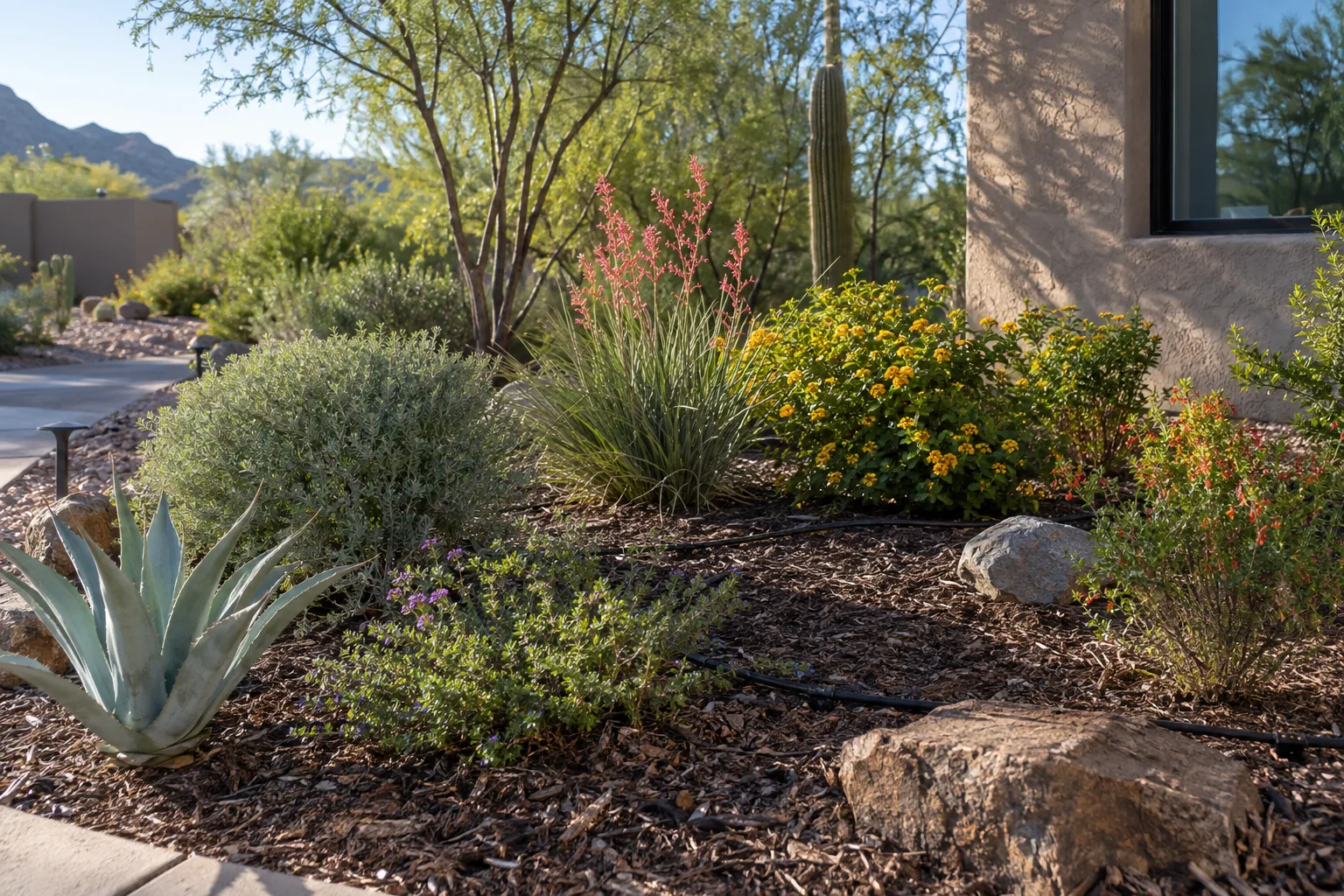
Plants native to or adapted to the low desert use the least water, and most need only occasional deep watering once they are established, usually after one to two years. That saving lasts for the life of the planting, which makes plant choice the most permanent change on this list.
Varieties we commonly carry include desert willow (Chilopsis linearis), a small tree that reaches roughly 15 to 25 feet, and Texas sage (Leucophyllum frutescens), a rounded shrub of about 4 to 8 feet. Brittlebush (Encelia farinosa) forms a silvery mound with yellow flowers in late winter and spring, then drops leaves in summer drought. Parry’s penstemon (Penstemon parryi) adds pink flower spikes in spring. Availability changes week to week and season to season, so browse our full plant selection and ask what is available.

Many gardeners pull out natives after the first summer because the plants look stressed. That reaction comes too early. A new planting needs deep, regular watering through its first two summers while the roots spread, and then you taper off.
How does drip irrigation save water?
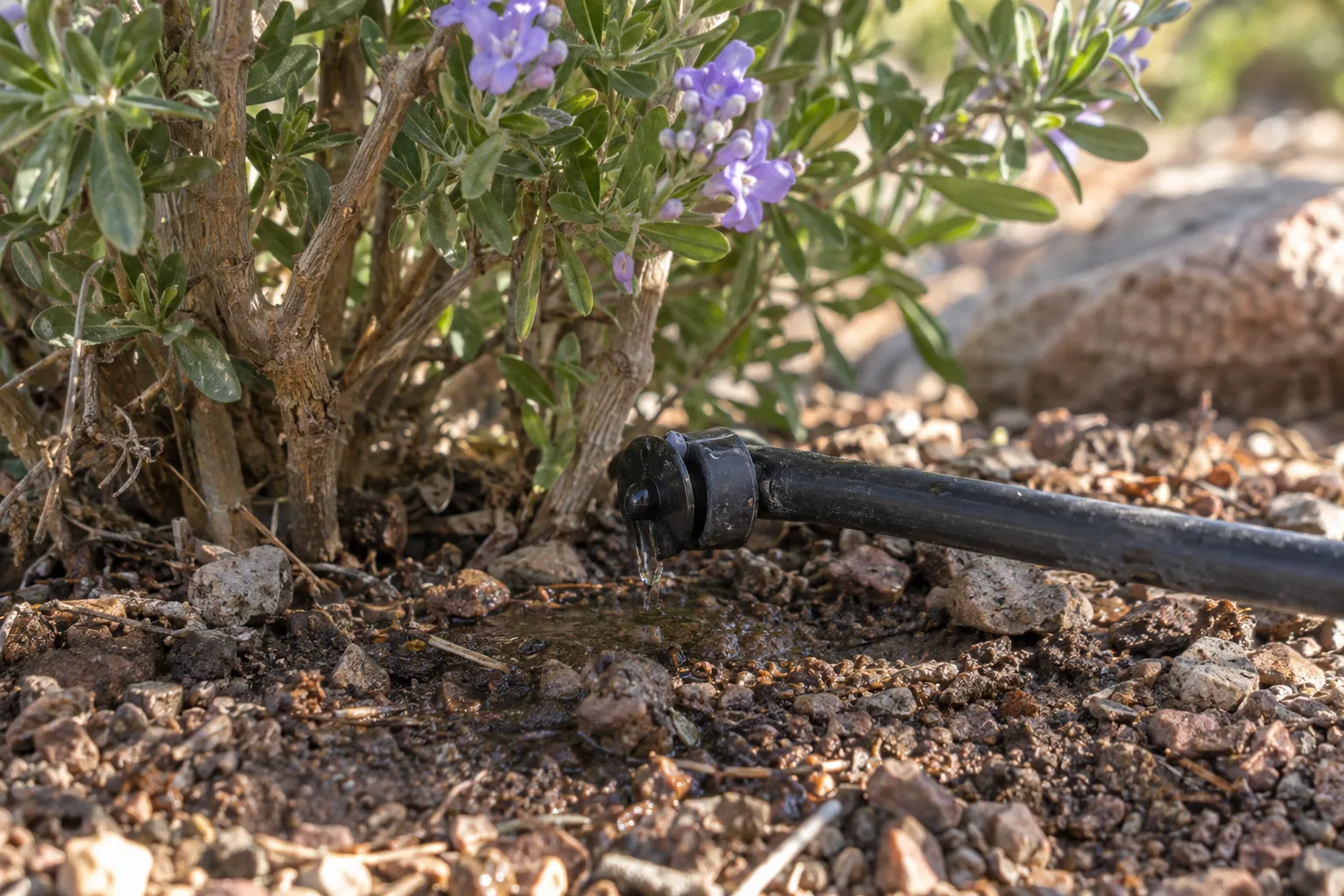
Drip irrigation saves water by delivering about 0.5 to 2 gallons per hour straight to each plant’s root zone instead of spraying it into the air. Spray heads lose water to wind drift, evaporation and overspray onto walls and pavement, and the afternoon winds common in the East Valley make that loss larger.
Place one or two emitters 12 to 18 inches from the trunk of a shrub such as red bird of paradise (Caesalpinia pulcherrima), then move them outward toward the drip line as the plant grows. Large trees need a ring of emitters near the canopy edge. Micro-sprays suit groundcovers and dense plantings, where single emitters would leave dry gaps.
Drip zones run longer than spray zones, often an hour or more, but far less often. Our hard water leaves mineral deposits that clog emitters. Open the end caps and flush each line a couple of times a year.
How deep and how often should I water?
Water deeply and infrequently, so each irrigation soaks 12 to 18 inches down for shrubs and deeper for trees. Short daily cycles wet only the top two inches, which keeps roots shallow in the soil layer that is hottest and dries first.
Test it on one zone first. Push a screwdriver or soil probe into the ground a day after irrigating. If it slides in easily to 12 to 18 inches, your run time works, and if it stops at 4 or 5 inches, lengthen the cycle. For established desert trees such as palo verde (Parkinsonia species) and mesquite (Prosopis species), a deep soak roughly every 10 to 14 days in summer is a common starting point. Young trees need water more often during their first two summers.
How much mulch should I spread around plants?
Spread 3 to 4 inches of organic mulch, such as shredded wood or bark, from just outside the trunk to the drip line, and keep it a few inches away from the trunk. Bare soil under summer sun dries out quickly after irrigation, while mulch shades the ground, cools it and slows evaporation.
Decomposed granite is common in East Valley yards and does reduce evaporation compared with bare ground. It adds no organic matter and holds more heat than wood mulch, so it suits desert shrub beds better than vegetable or flower beds. A 1 to 2 inch layer of compost under the mulch each spring feeds the soil as it breaks down.

Can I improve Queen Creek soil so it holds water?
Yes, but the method depends on the plant. Our soil is alkaline, low in organic matter and often sits on caliche, a cemented calcium carbonate layer that can stop drainage and block roots.
Vegetable and flower beds benefit from 2 to 3 inches of compost worked into the top 8 to 12 inches of soil, which improves water holding in sandy spots and drainage in heavy ones. Desert natives do best in native soil with little amendment, since rich backfill can hold too much water around their roots.
Check drainage before planting a tree. Dig the hole, fill it with water and time how long it takes to empty. If water is still standing after 24 hours, caliche is the likely cause. Break through it with a digging bar or hire someone to do it, or plant in a raised bed or mound instead.
How can I use monsoon rain in my garden?
Slow the runoff with shallow basins around plants, and store roof water in barrels if you want to use it between storms. The monsoon runs roughly July through September, and the storms are brief and uneven, so much of the rain runs off hard ground unless you hold it.
A basin 6 to 8 inches deep around a tree, with a berm on the downhill side, lets water soak in slowly. Keep the basin as wide as the canopy and keep the trunk itself high and dry. A 55-gallon barrel under a downspout fills fast in one storm. It stores little compared with what a yard uses, so treat it as a supplement. Skip your regular irrigation after a soaking storm.
The Arizona Department of Water Resources publishes guidance on residential rainwater harvesting. Read it, and check your HOA rules, before you install barrels or a cistern.
How should I change my watering schedule through the year?
Change your timer at least four times a year. Plants in Queen Creek need far less water in a January with occasional frost than in a June that tops 110°F, and a fixed schedule wastes water for months.
| Season | Months | Established trees | Established shrubs |
|---|---|---|---|
| Summer | June to September | Every 10 to 14 days | Every 5 to 7 days |
| Fall | October to November | Every 2 to 3 weeks | Every 7 to 14 days |
| Winter | December to February | Every 3 to 4 weeks | Every 2 to 3 weeks |
| Spring | March to May | Every 2 to 3 weeks | Every 7 to 10 days |
Treat these as starting points and adjust with the probe test. A smart controller does the seasonal adjustment for you by using local weather data, and it can skip a cycle when rain arrives. Our gardening calendars show what to plant and do each month, and the University of Arizona Cooperative Extension publishes watering guidance for desert landscapes.
How do I check my irrigation system for wasted water?
Run an audit once a year. It takes about two hours and turns up leaks, clogs and misaimed heads before they waste a summer of water.
- Run each zone in daylight and walk it, looking for broken heads, clogged emitters, leaking fittings and spray landing on pavement.
- Set a cup under one emitter for 15 minutes, multiply the amount by four to get gallons per hour, and compare it with the emitter’s rating.
- Probe the soil a day after watering to confirm moisture reaches 12 to 18 inches for shrubs and deeper for trees.
- Check that your drip zones have a pressure regulator holding roughly 20 to 30 psi, since high pressure pops emitters off and low pressure waters unevenly.
- Flush each drip line by opening the end caps for 2 to 3 minutes.
- Write down each zone, the plants it serves, its run time and any repairs, so next year’s audit has a baseline.
Mistakes to avoid are watering in the afternoon, running short daily cycles, piling mulch against trunks and leaving the summer schedule in place through winter. Each one sends water where plants cannot use it.
Frequently asked questions
What time of day is best for watering?
Early morning, roughly 4 to 8 a.m., is best. Temperatures are lowest, winds are usually calm, and water soaks in before the heat builds. Evening watering can encourage fungal problems on roses and vegetables because foliage stays wet overnight. Afternoon watering loses a large share of the water to evaporation before it reaches roots.
Do established native plants need any water?
Most need little beyond rainfall, but a deep soak during a long stretch above 110°F helps them. Plants from Texas or the Chihuahuan Desert often want light summer irrigation even when established. Spots beside block walls or pavement, where reflected heat is intense, also dry out faster and may need extra attention.
Can I collect rainwater from my roof in Arizona?
Residential rainwater harvesting is generally described as permitted in Arizona, but we are not the authority on it. The Arizona Department of Water Resources publishes guidance, and your HOA may have its own rules about barrels and cisterns. Confirm both before you buy equipment or connect a downspout.
How can I tell if I am overwatering?
Soil that stays wet 12 inches down several days after irrigation is the clearest sign. Yellowing leaves, soft or dark stems, mushrooms near the base and leaf drop in a plant that should be steady also point to too much water. Lengthen the gap between waterings before you change anything else.
Will replacing part of my lawn save much water?
It usually saves a good deal, because turf generally needs more water than desert-adapted shrubs on drip. You do not have to remove it all. Converting the hardest areas first, such as strips beside walls and sloped corners, lowers demand while keeping a patch of green for kids and pets.
Is a water-saving desert garden right for your yard?
For most East Valley yards, yes. Drip irrigation, mulch and a seasonal timer cut waste without changing how the yard looks, and low-water plants lower the bill for years. If you love a deep green lawn and want it to stay that way, a full conversion may not suit you, so start with drip and mulch alone. Visit us in Queen Creek, and see what is scheduled on our classes and events page.