

Arizona homes plant rosemary by the door because of a long folklore of protection, remembrance and welcome, and because the plant handles low desert heat, alkaline soil and little water. It also gives you fresh sprigs at the threshold.
Key takeaways
- Give rosemary 6 or more hours of direct sun and plant it between October and March, avoiding June through August.
- Set the root ball level with or slightly above the surrounding soil, because poor drainage kills more rosemary here than heat does.
- Once established, water deeply about every 7 to 14 days in summer and every 3 to 4 weeks in winter, and skip irrigation after monsoon rain.
- Upright types such as Tuscan Blue reach 4 to 6 feet and frame a door, while trailing types stay 1 to 2 feet tall and spill over walls.
- The folklore is old, but the evidence that a rosemary plant keeps mosquitoes away is limited, so grow it for scent, flavor and looks.

Why do people plant rosemary by the door?
People plant it there because European folk tradition tied rosemary to remembrance, protection and welcome, and the habit traveled. Greeks and Romans associated the herb with memory and used it in ceremonies, and Shakespeare’s Hamlet carries the line about rosemary for remembrance. Later folk custom grew it near doorways to guard a household, a belief that rests on tradition rather than evidence.
The practical case is easier to check. A plant at the entry releases a piney scent when a sleeve or a breeze brushes it, it stays green all year, and a sprig for roast potatoes is a few steps from the kitchen. Rosemary is a woody perennial herb, and our herbs, vegetables and berries page shows the category it belongs to.
Why does rosemary grow so well in the low desert?
Rosemary (Salvia rosmarinus, long sold as Rosmarinus officinalis) comes from dry, rocky Mediterranean hillsides, and that background suits our heat, low humidity and lean soil. Its narrow, leathery, resinous leaves lose little water. Established plants handle summer highs above 110°F, though a spot against a west wall adds reflected heat.
Our soil is alkaline, often between pH 7.5 and 8.5, and rosemary tolerates that without rich amendments. Caliche is the bigger concern. This hard mineral layer stops water from draining, and rosemary dislikes wet roots far more than it dislikes heat. Mature plants usually shrug off typical East Valley winter lows, while young plants can be nipped by a hard frost and benefit from a light cover on those nights.
Which rosemary varieties suit an entryway?
Upright varieties suit formal pairs beside a door, and trailing varieties suit walls and raised planters. These are varieties we commonly carry, and availability changes week to week and season to season.
| Variety | Habit | Mature size | Best use at the door |
|---|---|---|---|
| Tuscan Blue | Upright | 4 to 6 feet tall, 3 to 4 feet wide | A pair flanking the entry |
| Arp | Upright, open | 3 to 5 feet tall and wide | Informal corner planting |
| Huntington Carpet | Trailing | 1 to 2 feet tall, 4 to 8 feet wide | Spilling over a low wall |
| Irene | Trailing | 1 to 2 feet tall, 4 to 6 feet wide | Edge of a raised planter |
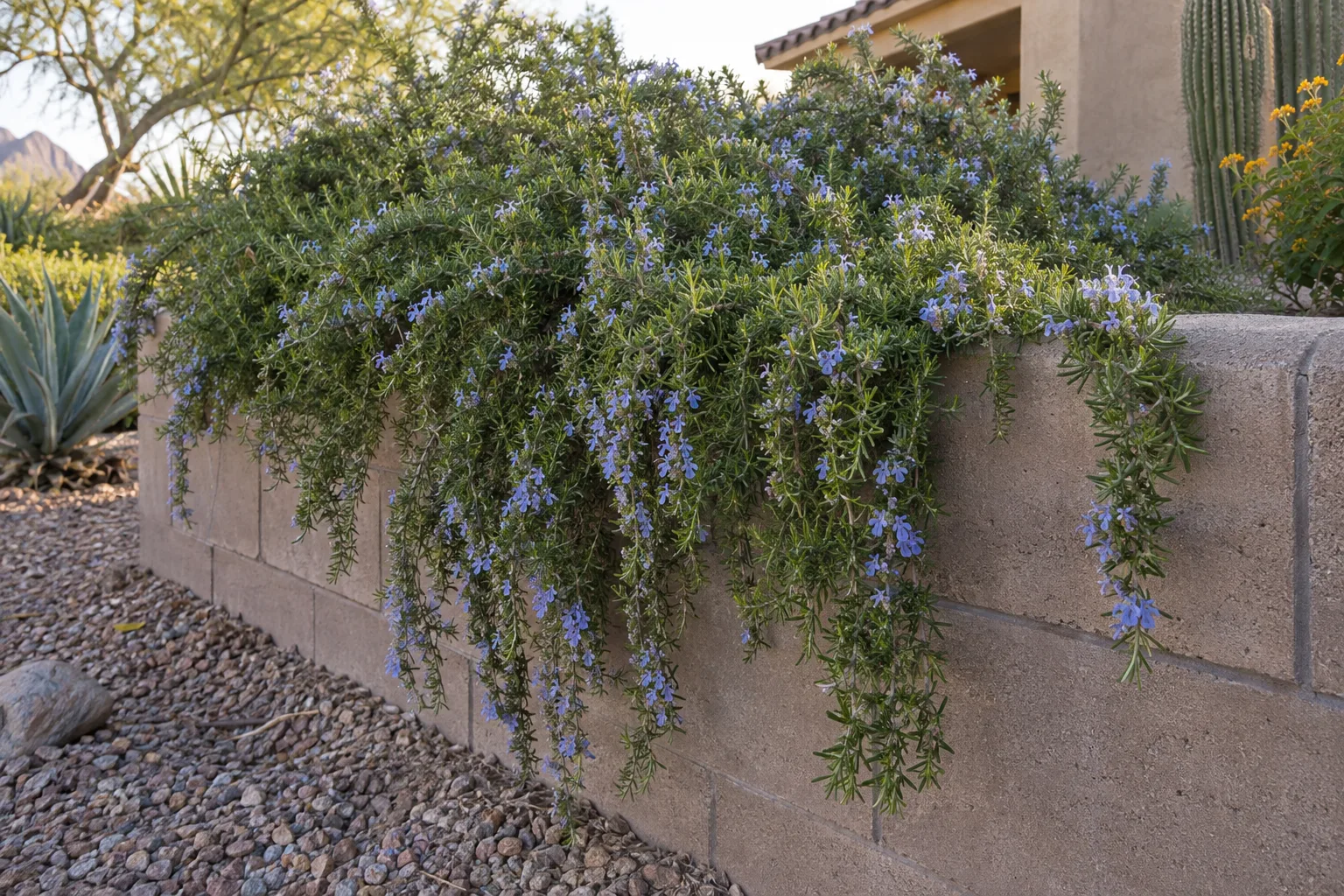
Each has a drawback. Tuscan Blue gets tall enough to need occasional shaping, Arp looks looser than a formal entry may call for, and the trailing types need several feet of room to spread. Measure the space before you choose, since rosemary resents hard cutting back into old wood.
When and how should I plant rosemary in Arizona?
Plant rosemary from October through March, with fall the best window because roots establish in mild soil before summer. Summer planting is possible but needs shade cloth and close watering when highs pass 100°F. Our gardening calendars show how the cool-season planting window lines up with other herbs.
- Pick a spot with 6 or more hours of direct sun. Deep shade produces thin, leggy growth and weak fragrance.
- Dig a hole about twice as wide as the pot and no deeper than the root ball. Break up any caliche below it so water can leave.
- Set the top of the root ball level with or slightly above the surrounding soil. A low crown collects water and invites rot.
- Backfill with the native soil. A little coarse sand or decomposed granite mixed in helps heavy ground drain.
- Water slowly and deeply to settle the soil.
- Spread 2 inches of gravel or decomposed granite around the plant, keeping it a few inches from the stem.

How much water does rosemary need by season?
Newly planted rosemary needs water every 3 to 5 days in warm weather and about weekly in winter for the first several months. After that, you can stretch the interval a little at a time. Deep soaks send roots down into cooler soil, while shallow daily sprinkles keep them near the surface where summer heat reaches them.
An established plant in the ground usually does well with a deep watering every 7 to 14 days in summer and every 3 to 4 weeks in winter. Sandy soil dries faster than clay. Potted rosemary dries out sooner than in-ground plants and often needs water more often in summer. Check the soil a few inches down before you water.
During the monsoon, from roughly July through September, turn off or reduce irrigation after a good rain. Wet soil for several days is the usual setup for root rot. Feeding can stay minimal, with a light application of balanced fertilizer in spring at most, because heavy feeding gives soft, floppy growth.
Does rosemary by the door keep mosquitoes away?
The evidence is limited, so treat it as a pleasant bonus at best. Lab studies have looked at rosemary essential oil as an insect repellent, but a living plant releases far less aroma than a concentrated oil, and any effect is short-range. A rosemary bush will not clear a patio of mosquitoes during the monsoon.
Standing water around the home is the better lever, because mosquitoes breed in saucers, buckets and clogged gutters. Grow rosemary for the scent, the flavor, the evergreen shape and the blue flowers, which often open in late winter and early spring when bees have few other options.
What goes wrong with rosemary by the door?
Root rot from too much water is the most common problem, followed by too little sun and heavy pruning. A plant with rot looks fine for a while, then browns from the base of the stems upward and collapses. Heat stress browns the branch tips first and often recovers when temperatures drop in October.
Pots against a west-facing wall can overheat roots, so choose a light-colored, thick-walled container from our pottery and planters and use a fast-draining mix. Prune lightly in spring or fall, taking no more than about one-third of the green growth at a time, and avoid cutting into bare woody stems, which seldom resprout. Our classes and events page lists upcoming sessions if you prefer to learn pruning in person.

Frequently asked questions
Is it bad luck to cut rosemary from the plant by the door?
No, traditional belief generally treats sharing sprigs as goodwill. Some folk traditions held that removing the whole plant meant giving up the home’s protection. Harvesting sprigs regularly also encourages branching, so cut a few inches from the tips and leave plenty of green growth behind.
Can I grow rosemary in a pot by a west-facing door?
Yes, if the pot is large, light-colored and drains freely. Afternoon sun on a west wall can push container soil well past what roots tolerate, and small or dark pots heat fastest. A pot 14 to 16 inches wide holds steadier moisture and temperature than a small one.
When does rosemary bloom in the East Valley?
Rosemary often blooms from late winter into early spring, with small pale to deep blue flowers. Timing varies by variety and by how cold the winter was. Bloom is modest compared with a flowering shrub, so expect a soft haze of blue rather than a bold display.
What plants look good next to rosemary?
Pair rosemary with plants that also like full sun and infrequent watering. Spanish lavender, Salvia greggii and agave are common companions. Keep thirsty plants away, because they raise soil moisture around the rosemary roots. You can browse our all plants page for sun-loving partners.
Is rosemary by the door right for your home?
Yes, if your entry gets 6 or more hours of sun and the soil or pot drains freely. Rosemary gives you fragrance, year-round green and fresh sprigs for little water once settled. Skip it if the entry sits in deep shade, if lawn sprinklers soak the bed several times a week, or if you want a bold flowering display. Come see the plants in person at our nursery in Queen Creek.