
You can regrow vegetables in water on a low desert windowsill, and green onions, romaine, celery, bok choy, lemongrass and garlic greens all work well. Cabbage and fennel give smaller, slower results.
Key takeaways
- Green onions show new growth in 1 to 3 days and can be snipped again after about a week.
- Keep water 0.5 to 1 inch deep and change it every 1 to 2 days to prevent rot.
- Choose a bright spot away from hot south and west windows, which can run well above room temperature in summer.
- Regrown celery, lettuce and bok choy stay small, so moving them into potting mix after 1 to 2 weeks gives bigger leaves.
- Lemongrass is the one warm-season plant here, and it can go outdoors in a pot once frost danger has passed.
What do I need to regrow vegetables in water?
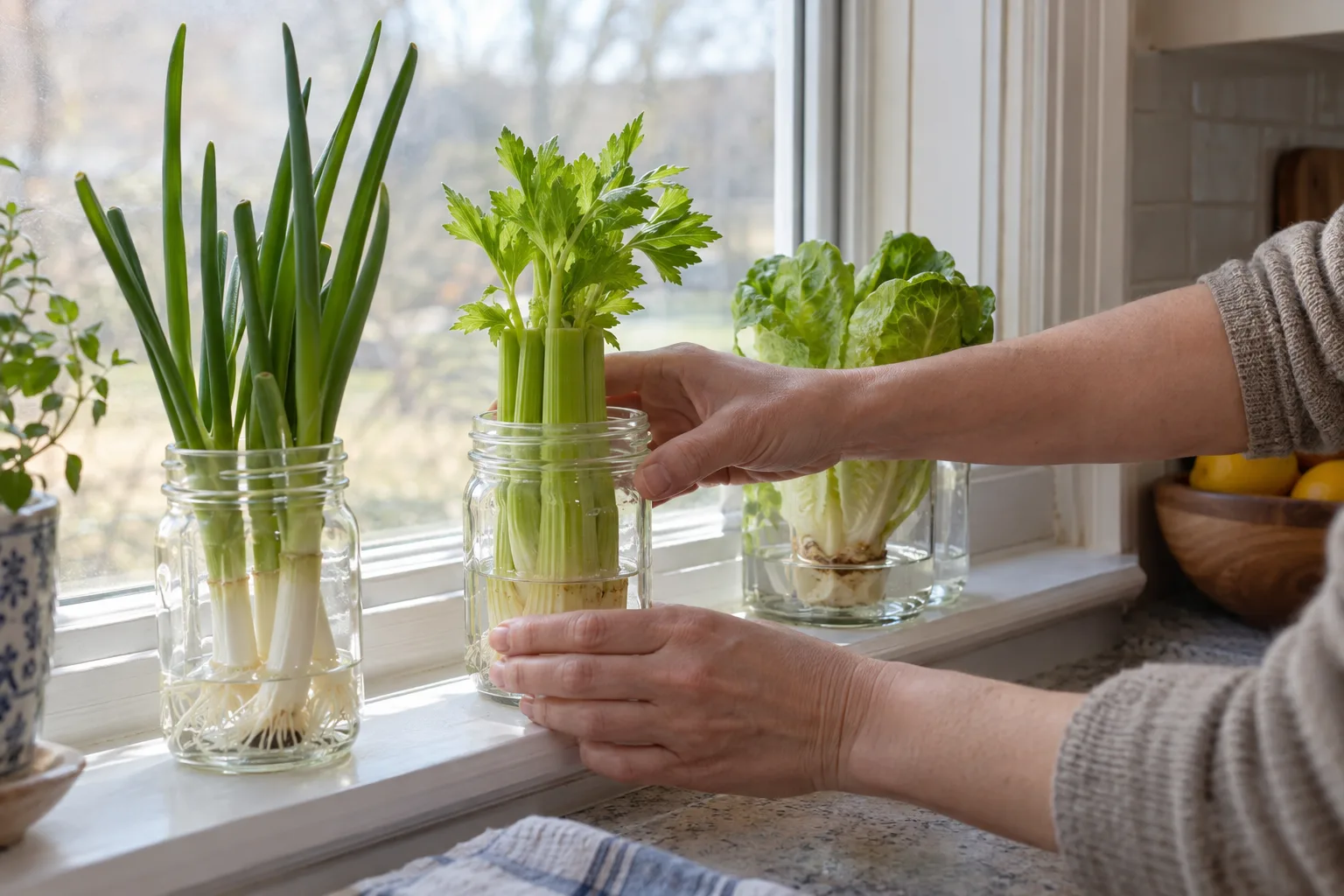
You need a clean glass or jar, a sharp knife, water and a bright indoor spot. Nothing else is required for the first couple of weeks, because the stored energy in the base does the work.
Start with fresh scraps. A celery base saved the day you buy the bunch sprouts far more reliably than one that has sat in the fridge for two weeks, and limp or slimy bases rarely sprout at all. If you would rather skip the scrap stage and grow from a living plant, browse our herbs, vegetables and berries department for starts. Availability changes week to week and season to season, so check what is in before you visit.
Which vegetables can I regrow in water?
Eight common kitchen vegetables will sprout in water, though they differ a lot in how much you get back. Sizes below describe what you can expect from a jar on the counter, not a full-grown plant.
Green onions (Allium fistulosum)
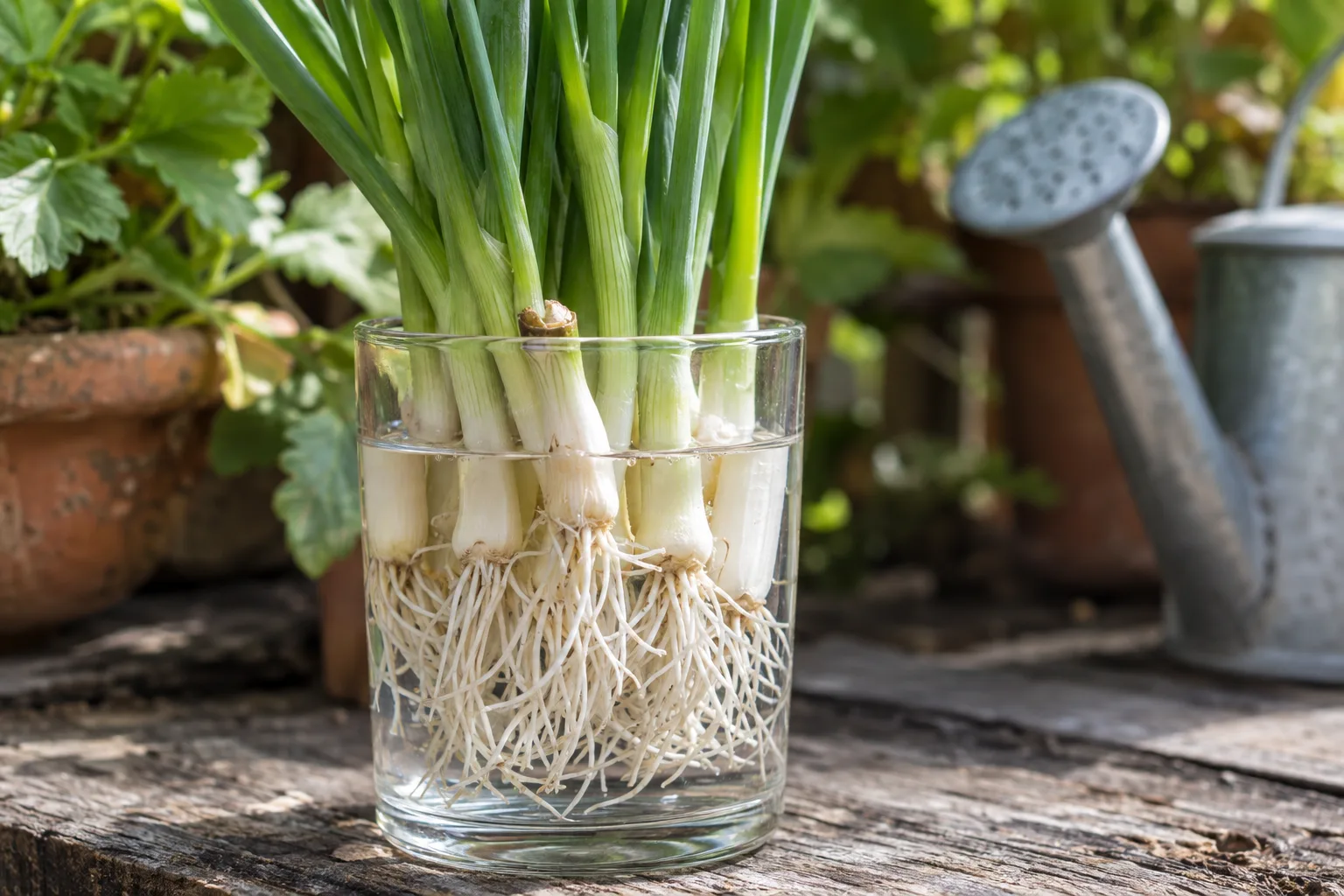
Green onions are the easiest place to start. Save the bottom 1 inch with the roots attached, stand it in a glass with just the roots covered, and new green tops appear within 1 to 3 days. Size: 4 to 10 inches of tops per harvest. Light: bright indirect. Water: 0.5 inch, changed every 1 to 2 days. Drawback: flavor and vigor fade after several cuttings, so expect a few weeks of use per base.
Celery (Apium graveolens)
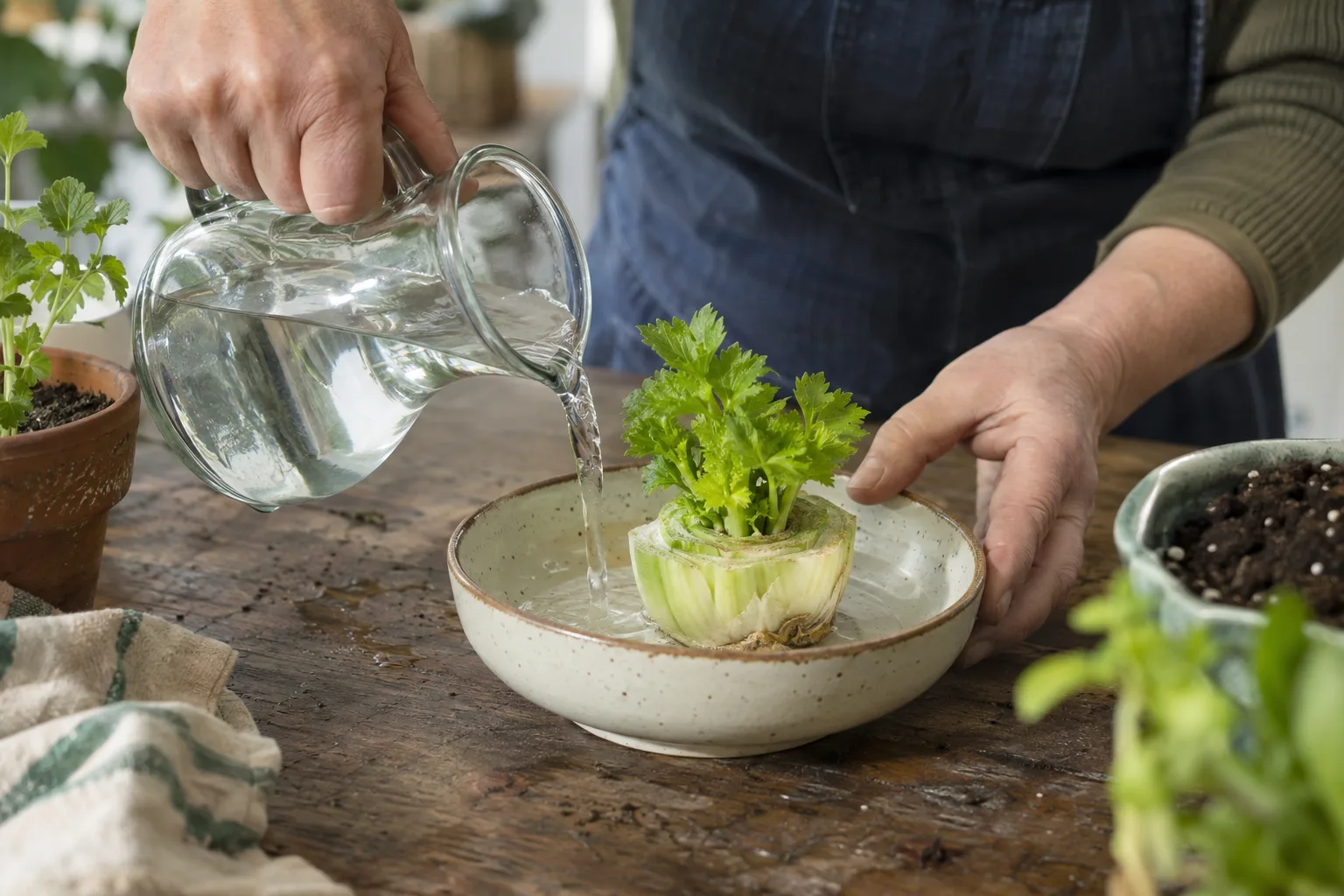
Cut the base about 2 inches above the root end and set it cut side up in a shallow bowl with 1 inch of water. Small pale leaves emerge from the center within about a week. Size: a small rosette, 3 to 6 inches tall. Light: bright. Water: 1 inch. Drawback: you get tender young leaves and thin stalks, not a replacement bunch, and the base softens quickly if the water goes stale.
Romaine lettuce (Lactuca sativa)
Save the bottom 2 to 3 inches of a romaine heart and set it in a dish with about 0.5 inch of water. New leaves push from the center in 3 to 7 days. Size: 3 to 5 inches of soft leaf. Light: bright but not hot. Water: 0.5 inch. Drawback: regrown leaves can turn bitter in a warm window, so use them early and keep the dish cool.
Bok choy (Brassica rapa subsp. chinensis)
Bok choy regrows like romaine. Set the base in shallow water and the center sends up fresh leaves, usually within 3 to 7 days. Size: 3 to 6 inches of leaf. Light: bright. Water: 0.5 inch. Drawback: the regrowth stalls once the base runs out of stored energy, so move it into a pot if you want a second round of leaves.
Cabbage (Brassica oleracea)
Cabbage is the weakest performer on this list. A base with an intact core may push out a few small leaves over 1 to 2 weeks, but many rot before they do. Size: a few leaves 1 to 3 inches long. Light: bright. Water: 1 inch. Drawback: low odds of success, so treat it as an experiment and use a firm, fresh core.
Lemongrass (Cymbopogon citratus)
Stand one or two fresh stalks in a tall glass with 2 inches of water, and roots usually show within 2 to 3 weeks. Size: a stalk can grow into a clump 3 to 4 feet tall once potted outdoors. Light: as much bright light as you can give it. Water: 2 inches. Drawback: it is frost tender and slow to root from store stalks, so patience matters.
Fennel (Foeniculum vulgare)
The cut base of a fennel bulb set in shallow water can send up thin, feathery fronds in 1 to 2 weeks. Size: a few fronds 3 to 6 inches long. Light: bright. Water: 1 inch. Drawback: the bulb itself does not regrow, so you are harvesting garnish, and results vary from base to base.
Garlic greens (Allium sativum)
Set a single clove, root end down, in a small glass with water just touching the base. Green shoots appear within about a week and taste like mild garlic chives. Size: 4 to 8 inches of shoot. Light: bright. Water: 0.25 to 0.5 inch. Drawback: the clove itself shrinks and will not form a new bulb in water.
| Vegetable | First new growth | Water depth | Realistic result |
|---|---|---|---|
| Green onions | 1 to 3 days | 0.5 inch, roots only | Several cuttings of tops |
| Celery | About 1 week | 1 inch | Small leaves and thin stalks |
| Romaine lettuce | 3 to 7 days | 0.5 inch | A handful of small leaves |
| Bok choy | 3 to 7 days | 0.5 inch | Small leaves, better in a pot |
| Cabbage | 1 to 2 weeks | 1 inch | A few leaves, often fails |
| Lemongrass | 2 to 3 weeks for roots | 2 inches | Rooted stalk for potting |
| Fennel | 1 to 2 weeks | 1 inch | Thin fronds for garnish |
| Garlic greens | About 1 week | 0.25 to 0.5 inch | Chive-like shoots |
How do I regrow vegetables in water step by step?
Cut a clean base, set it in shallow water, and change the water every day or two. The details below keep the base from rotting before it sprouts.
- Cut the base with a sharp knife so the surface is flat and clean. Torn edges hold moisture and rot sooner.
- Choose a container that holds the base upright. Wide dishes suit lettuce and celery, and tall glasses suit green onions and lemongrass.
- Add water to cover the roots or the lowest part of the base only. Keep the cut top above the waterline.
- Set the container where it gets bright light for several hours, such as an east-facing windowsill.
- Rinse the container and replace the water every 1 to 2 days.
- Harvest by snipping outer leaves or tops and leave the center to keep growing.
Does hard Arizona tap water hurt regrowing vegetables?
For the first few weeks, usually not. Arizona tap water is hard, so it leaves a white mineral crust on glass, and a quick scrub at each water change keeps that from building up around the roots.
If roots look brown instead of white, or growth stalls, try filtered water for a week. That is a low-cost fix that rules out the water as the cause.
Heat deserves more attention than minerals. A south or west window in a low desert home can run well above the room temperature in summer, and warm water breeds bacteria quickly. Move jars to an east or north window from May through September, and check the water level daily, since dry indoor air pulls it down faster than you might expect.
When should I move regrown vegetables into soil?
Move them into potting mix once roots are 1 to 2 inches long, usually after 1 to 2 weeks. A base in water runs on stored energy, so leaves stay small until roots have real soil and nutrients to draw on.
Use a container with drainage holes and a loose potting mix, and keep it in bright light. Our pottery and planters range covers sizes that suit a kitchen or patio. Cool-season crops such as bok choy, lettuce and celery do best outdoors from roughly October through March, and the University of Arizona Cooperative Extension publishes a vegetable planting calendar for Maricopa County with exact windows. Our gardening calendars give a month-by-month view.
Lemongrass can go outdoors in a pot after the last frost, which usually falls in March or early April in Queen Creek. It handles summer heat above 110°F, though afternoon shade helps a young plant.

Why is my regrowing vegetable slimy or smelly?
Slime and odor point to bacterial rot. The usual causes are water that went too long between changes, a cut surface sitting underwater, or a base that was already past its prime.
Discard a rotten base, because it cannot recover. Wash the container with hot soapy water, rinse well, and start again with a fresh scrap. Use less water than you think you need, and change it every day during warm weather.
Frequently asked questions
How long can a vegetable keep growing in water alone?
Most last about 2 to 6 weeks. Green onions and garlic greens run longest, while lettuce and bok choy give one or two small harvests. Once growth slows, leaves pale or the base turns soft, the stored energy is spent. Pot it in soil or start over with a fresh scrap.
Can I regrow carrots or beets in water?
You can sprout leafy tops, but you will not get a new root. The tops of carrots and beets grow greens for a short time in a dish of water, and those greens are edible. The root itself does not regenerate, so treat it as a short-lived garnish.
Do I need to add fertilizer to the water?
No, not for the first 1 to 2 weeks. The base holds enough stored energy for early growth. If you keep a plant in water longer, a very dilute liquid fertilizer at a fraction of label strength can help, but potting mix is a more reliable long-term fix.
Are regrown vegetables safe to eat?
Yes, if the base was fresh and the water stayed clean. Wash the leaves as you would store-bought produce before eating. Throw out anything slimy, foul-smelling or fuzzy, since rot and mold mean the plant is no longer safe to use.
Is regrowing vegetables in water worth the effort?
Yes, if you want fresh green onions, garlic shoots or a few salad leaves from scraps you would throw away. It costs almost nothing and teaches the basics of how plants root. Skip it if you want full heads of lettuce or celery, because water regrowing gives small harvests, and cabbage and fennel often disappoint. For bigger yields, plant in soil. Stop by our nursery in Queen Creek and we will help you choose.