

The best red perennials for Arizona are autumn sage, firecracker penstemon, red yucca, coral fountain and red justicia. All five return each year in the low desert once established, and most need only occasional deep watering after their first year in the ground.
Key takeaways
- Plant in late September through mid-November, or February to mid-March, so roots establish before summer highs climb above 110°F.
- Water new plants every 2 to 3 days for the first two weeks, then every 5 to 7 days for about a month before tapering off.
- Cut autumn sage back by roughly one-third in late February to keep it dense and flowering.
- Coral fountain and red justicia are frost tender, so cover them when the forecast drops into the upper 20s°F.
- Set the crown at or slightly above soil level and keep compost to about 25% of the backfill, since these plants prefer lean, well-drained ground.
Which red perennials grow best in the Arizona low desert?
Five reliable choices are autumn sage, firecracker penstemon, red yucca, coral fountain and red justicia. They cover different bloom windows, heights and light levels, so you can build a red border that has something flowering through most of the year. Browse our full plant selection to see what is on the grounds. These are varieties we commonly carry, though availability changes week to week and season to season.
Autumn sage (Salvia greggii)
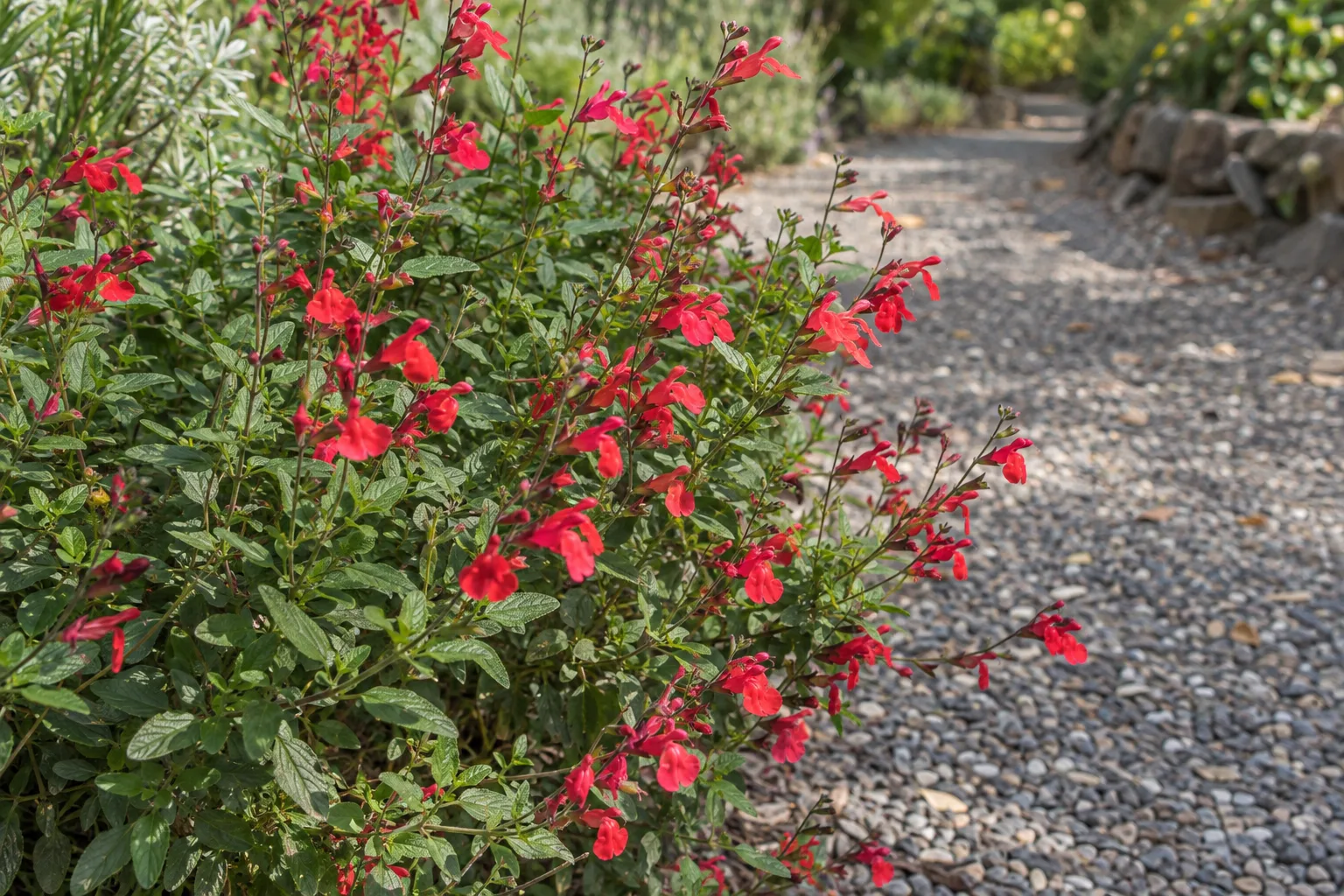
This compact shrubby perennial grows 2 to 3 feet tall and wide in full sun, with small red tubular flowers that hummingbirds visit. It needs low to moderate water once established. Blooms peak in spring and again from roughly September into December, with a pause during the hottest weeks. The drawback is that it turns woody and leggy if you skip the yearly pruning.
Firecracker penstemon (Penstemon eatonii)
A true red penstemon, it sends up spikes of tubular flowers about 2 to 4 feet tall, usually from March into May. It wants full sun, sharp drainage and very little water. The drawback is a short life. Individual plants often fade after a few years, so let a few seed heads drop to keep new plants coming.
Red yucca (Hesperaloe parviflora)
Red yucca is a clumping succulent relative of agave, not a true yucca. Its evergreen, grass-like leaves form a mound 2 to 3 feet across, and flower stalks rise 4 to 5 feet from spring into early fall. It needs full sun and very little water once established. The drawback is color, since the blooms lean coral-pink rather than a deep red.
Coral fountain (Russelia equisetiformis)
Arching, rush-like stems 3 to 5 feet long carry small red tubular flowers from spring into fall. It does best with afternoon shade and moderate water in the low desert. The drawback is frost. Stems blacken in a hard freeze, and the plant needs a protected spot or a cover on cold nights.
Red justicia (Justicia candicans)
A Sonoran Desert native, this shrubby perennial reaches 3 to 5 feet and tolerates full sun or part shade. Clusters of red tubular flowers appear in several flushes, often spring and fall. It needs low to moderate water. The drawback is a ragged look after frost and during peak summer, when it wants a little shade or extra irrigation.

| Plant | Main bloom | Height | Water | Light | Frost |
|---|---|---|---|---|---|
| Autumn sage | Spring, fall | 2 to 3 feet | Low to moderate | Full sun | Hardy |
| Firecracker penstemon | March to May | 2 to 4 feet | Very low | Full sun | Hardy |
| Red yucca | Spring to early fall | 4 to 5 feet (stalks) | Very low | Full sun | Hardy |
| Coral fountain | Spring to fall | 3 to 5 feet | Moderate | Afternoon shade | Tender |
| Red justicia | Several flushes | 3 to 5 feet | Low to moderate | Sun to part shade | Tender |
When should I plant red perennials in Arizona?
Plant from late September through mid-November, or from February to mid-March. Fall planting is better because roots grow all winter and the plant meets its first summer with a full root system. Spring planting works, but it needs closer watching.
Avoid June and July. Soil temperatures are high, humidity is low, and a new transplant has almost no root reach to cope with 110°F days. Our gardening calendars lay out the planting windows month by month for the East Valley.
How do I prepare Queen Creek soil for perennials?
Loosen the native soil, check drainage, and amend lightly. Queen Creek yards often have alkaline soil and a layer of caliche, a cement-like mineral layer that can sit 12 to 24 inches down and holds water in the planting hole like a bathtub.
Dig a test hole about 18 inches deep and fill it with water. If it is still standing after several hours, break through the caliche with a digging bar to open a drainage path. Make the planting hole two to three times as wide as the root ball but no deeper. Mix about 25% compost into the backfill and keep the crown at or slightly above grade. Heavy amendment produces soft leafy growth and fewer flowers.
- Dig the hole and check drainage.
- Loosen circling roots on the root ball with your fingers.
- Set the plant with the crown at or just above soil level.
- Backfill halfway, water to settle the soil, then finish filling and water again.
- Build a low basin about 18 inches across.
- Spread 2 to 3 inches of mulch, keeping it off the crown.
How often should I water red perennials?
Water new plants every 2 to 3 days for two weeks, every 5 to 7 days for the next month, then taper. After a full year in the ground, deep and infrequent watering is better than frequent sprinkling, because it pushes roots down where the soil stays cooler.
Aim to wet the soil 12 to 18 inches deep, then let it dry well before the next watering. A long screwdriver slides in easily where soil is still moist. Expect a longer interval in winter, a shorter one in June before the monsoon, and fewer irrigations once July storms arrive. Red yucca and penstemon sit at the low end of these needs, while coral fountain wants more. Hard Queen Creek water leaves salts at the soil surface, so an occasional deep soak helps push them below the roots.

What care do red perennials need through the year?
Most of the work happens in late winter and fall. Between those windows the plants mostly need water and a light hand.
- February to March: Cut autumn sage back by about one-third. Remove frost-damaged stems from coral fountain and red justicia once the cold has passed. Apply a slow-release fertilizer as growth starts.
- April to May: Deadhead autumn sage for more flowers. Rinse aphids off new growth with a strong spray from the hose. Top up mulch where it has thinned.
- June to August: Skip heavy pruning. Water deeply before the monsoon, then back off when storms arrive.
- September to November: Plant new perennials, divide crowded clumps and enjoy the fall bloom.
Red perennials last longer than annuals, but they do not replace them completely. Our annual flowers and foliage fill the gaps while young perennials are still small.
What problems affect red perennials here?
The common problems are yellow leaves, root rot and sunscald, and all three trace back to soil or timing. Each one has a fix.
Yellowing between green leaf veins is iron chlorosis. Alkaline soil locks up iron even when it is present, and a chelated iron product applied in cooler months corrects it. Root rot shows up as sudden wilting in wet soil, often after monsoon storms on poorly drained ground. Pull the plant and check for brown, mushy roots, then improve drainage before replanting. Sunscald looks like bleached, papery patches on new transplants, and 30% shade cloth for the first few weeks prevents it. For hands-on help with soil and planting, see our classes and events.

Frequently asked questions
Do red perennials bloom all year in Arizona?
No, most bloom in two main flushes, spring and fall. Flowering slows when temperatures stay above about 105°F. Red yucca and red justicia keep going longer into summer than autumn sage does. Winter blooms are sporadic and depend on how warm the season runs.
Can I grow red perennials in containers?
Yes, red yucca and coral fountain are the easiest choices in pots. Container soil heats quickly in summer sun, so pick a large, light-colored or glazed pot and expect to water more often than in the ground. Browse our pottery and planters for options with drainage holes.
Will hummingbirds visit these plants?
Yes, hummingbirds feed on tubular red flowers like autumn sage, penstemon, coral fountain and red justicia. Plants with long bloom seasons give them nectar for more weeks of the year. Planting two or three of these together in a sunny spot makes the visits more regular.
Do red perennials need fertilizer?
They need very little. One application of slow-release fertilizer in early spring is enough for most of these plants. Heavy feeding encourages leafy growth at the expense of flowers, and red yucca and penstemon often do well with none.
How long do they take to establish?
Expect about one full year. During that period the plant builds roots more than flowers, so bloom is modest. By the second spring, plants usually flower more heavily and need less water, particularly if you planted in fall.
Are red perennials right for your yard?
They suit anyone who wants color without replanting twice a year and who has a spot with six or more hours of sun and decent drainage. Coral fountain and red justicia need frost protection, so skip them if you will not cover plants on cold nights. If your yard holds standing water after storms, fix the drainage first. Come by our Queen Creek nursery and see which of these red perennials are in the yard this season.
