Purple paint on Arizona trees most often marks a private boundary where the owner wants visitors to stay out. The same color also shows up on survey lines, utility work, removals, herbicide treatment and research plots. Context decides which of nine meanings applies.
Key takeaways
- Treat repeated, uniform vertical purple stripes along a fence line or tree line as a keep-out sign until you confirm otherwise.
- Nine common meanings exist: keep-out boundary, survey line, utility work, removal flag, herbicide treatment, research tag, trail blaze, land management boundary and plain overspray.
- A numbered metal tag, flagging tape or a cut stump next to the paint points away from a trespassing notice.
- Never paint over, scrub off or remove marks on trees you do not own.
- For a marked tree on your own lot, call the city, your HOA or the utility before anyone cuts it.

What does purple paint on a tree mean in Arizona?
It most often marks a private boundary, but no single meaning covers every purple mark. Several states, including Texas, have laws that treat purple paint on trees or posts as equal to a posted no trespassing sign. We are a nursery and not a legal source, so we cannot tell you how Arizona law treats purple paint.
The Arizona Revised Statutes on criminal trespass, your county sheriff’s office or an attorney can answer that. Until you know, treat uniform stripes along a boundary as a keep-out sign. Walking away costs nothing.
If you are planning trees for your own property line, our desert trees section is a good place to start looking at options that suit the low desert.
What are the nine things purple paint on a tree can mean?
Nine meanings come up most often. Which one applies depends on the pattern of the marks, the location and whatever else is attached to the tree.
1. A private keep-out mark
In states with purple paint laws, landowners paint vertical stripes at about chest height and repeat them along the boundary. Stripe size and spacing differ by state, so we do not give figures for Arizona.
2. A survey or property line mark
Surveyors mark lines with paint, flagging tape and stakes in many colors. A painted tree does not establish the legal line, and only a licensed surveyor’s records can confirm where your boundary runs.
3. Utility vegetation work
Crews trimming near power lines sometimes mark trees that need work, and the color varies by crew. Underground locators use a standard color code in which purple marks reclaimed water, so a purple mark on soil or pavement near a tree may relate to a buried line. Call Arizona 811 before you dig.
4. A removal or pruning flag
City forestry crews, HOA landscape contractors and tree companies mark trees slated for removal or pruning. You see this often after a monsoon storm damages a street tree.
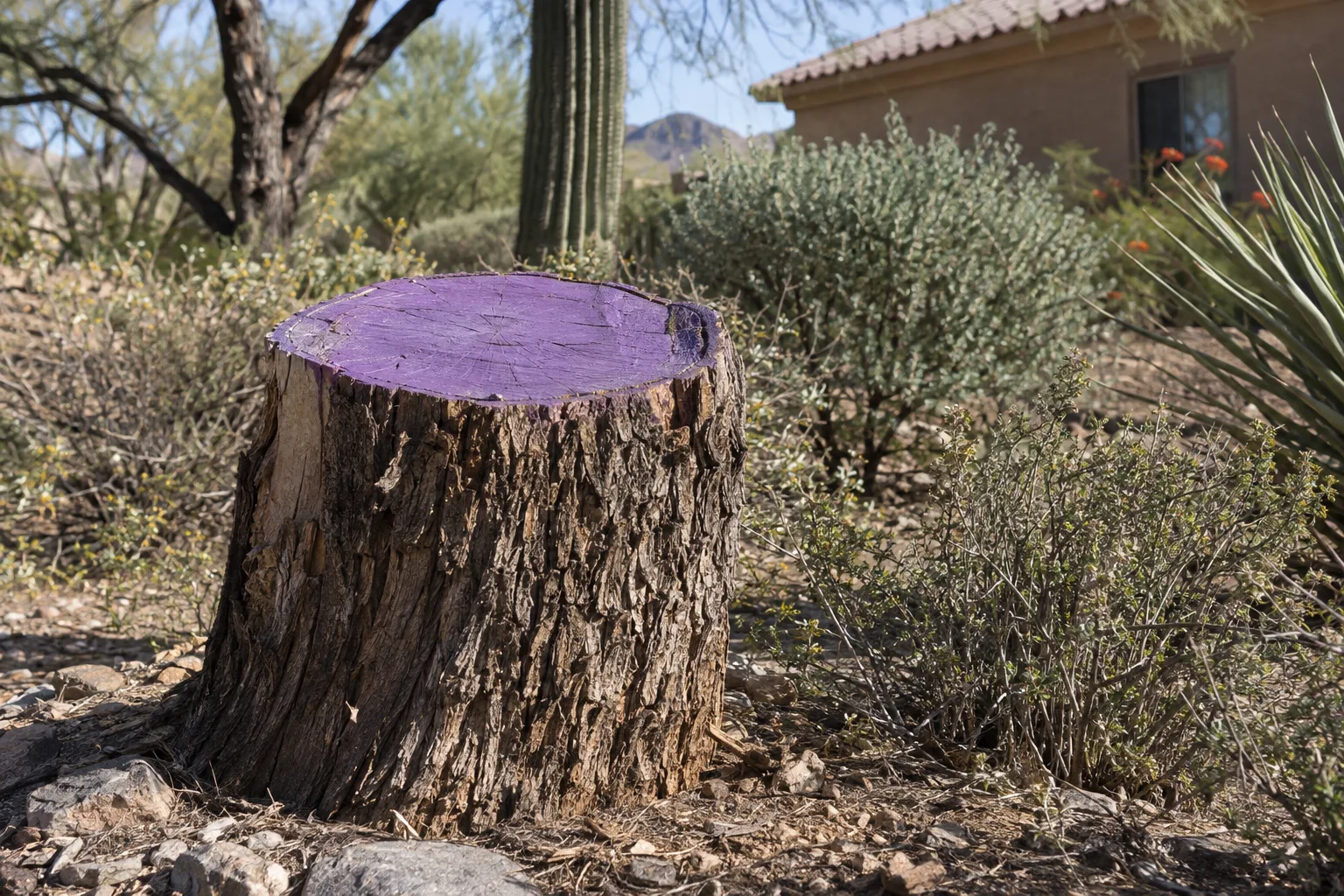
5. An herbicide treatment mark
Land managers sometimes mark cut stumps or treated plants so crews know which ones are done. Invasive trees such as saltcedar (Tamarix) appear on the Arizona noxious weed list. Do not touch a treated stump, and keep pets and children away.
6. A research or inventory tag
Researchers and consultants number trees in monitoring plots. Look for a metal tag or stamped disc nailed nearby.
7. A trail or route blaze
Repeating marks at roughly eye level that follow a line of travel suggest a route marker. Blazes often lead from one tree to the next, and you can usually see the next mark from the last one.
8. A land management boundary
Agencies sometimes mark parcel edges or closed areas with paint alongside signs. Check the signs and the agency’s website for the rules that apply to that area.
9. Overspray or graffiti
Paint drifting from a wall project or a single splash on a trunk usually has no meaning at all. It tends to be irregular, with no repeating pattern.
How can I tell which meaning applies?
Look at the pattern first, then at what surrounds the mark. A uniform series of stripes along a boundary reads very differently from one dab on a single trunk, and a few quick checks usually settle it.
- Pattern: repeated stripes at regular spacing suggest a boundary or trail, while a single mark suggests work on that one tree.
- Attachments: a numbered tag points to research, and flagging tape points to a survey.
- Cut stump or dying tree: this can mean herbicide treatment.
- Location: a rural parcel, a street right-of-way, a power line corridor and public land each suggest a different owner to ask.
- Posted signs: read any sign at gates and entry points together with the paint.
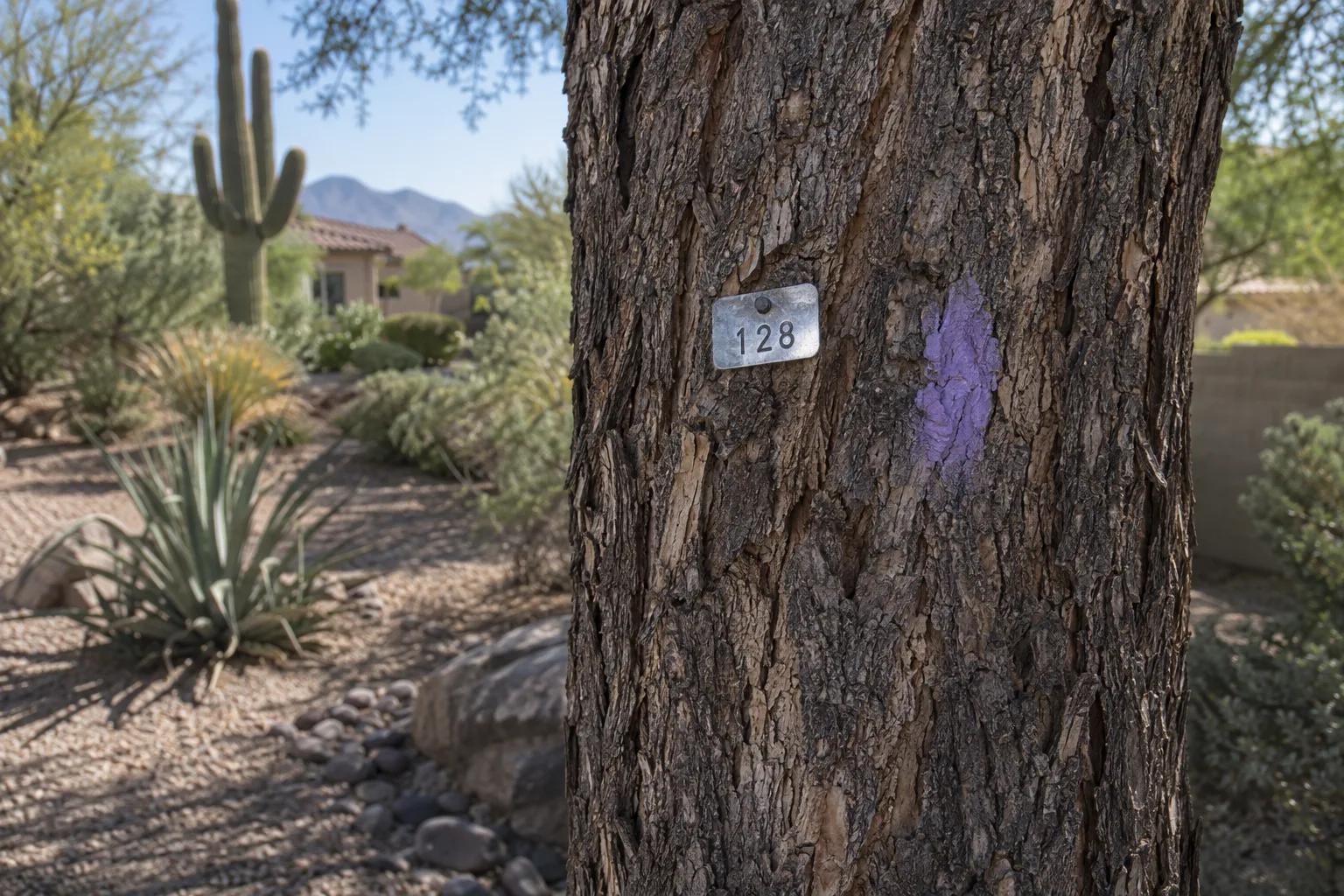
When two readings both fit, assume the stricter one.
What should I do if I see purple paint while hiking or driving a rural road?
Stay on the public road or marked trail and do not cross a fence or enter land where the marks run along an edge. If the area is public land, check the posted signs or the managing agency before you go further. Take a photo and note the location if you want to ask about it later.
Leave the marks alone. Removing or altering marks on trees you do not own can create legal trouble, and we cannot say how much, so ask the landowner, the agency or an attorney if you are unsure.
What if the purple paint is on a tree in my own yard?
Find out who put it there before anyone touches the tree. In a neighborhood, start with your city’s public works or forestry department if the tree sits in the street right-of-way, your HOA if it manages common areas, or your electric utility if the tree is near power lines.
For a tree on your own lot that looks unhealthy, a certified arborist can assess it. Paint on a trunk does not tell you the tree is diseased, and pulling a healthy shade tree in a Queen Creek summer with highs above 110°F leaves a yard with no shade for years.
Which trees work for a living boundary in the low desert?
Dense evergreen or semi-evergreen trees make the clearest living boundary, and a few native and adapted choices handle our alkaline soil and caliche. These are varieties we commonly carry, though availability changes week to week and season to season.
Texas ebony (Ebenopsis ebano) is a dense, slow-growing evergreen that reaches roughly 15 to 25 feet tall, with a similar spread. Its drawback is slow growth, so a screen takes patience. Desert willow (Chilopsis linearis) grows about 15 to 25 feet tall, handles full sun and blooms in warm months, but it drops its leaves in winter and leaves seed pods behind.
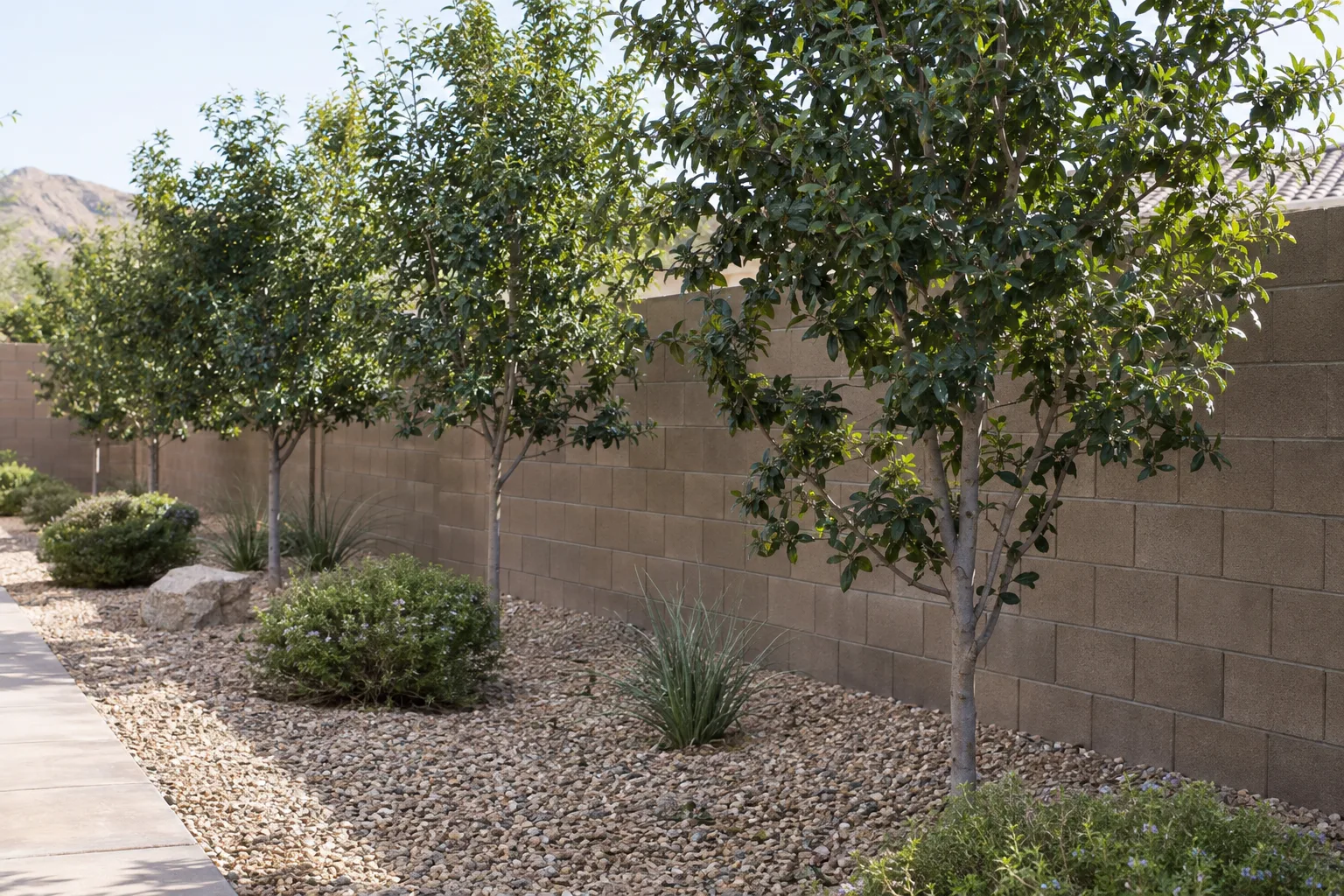
Browse our evergreen trees for screening ideas, and check our classes and events for planting workshops.
Frequently asked questions
Can I paint my own trees purple to mark my property?
Check Arizona law before you do. We cannot confirm that Arizona treats purple paint as a legal substitute for posted signs, so paint alone may not protect you. A licensed surveyor can confirm your lines, and a fence with signs is clearer for visitors. HOA and city rules may also limit painting trees.
Is purple paint on a cut stump safe to touch?
Avoid it. Crews may mark stumps after applying herbicide, and the product label sets the rules for contact, pets and re-entry. Keep children and animals away and do not cut or burn the wood. Ask the landowner or land agency which product was used if you need to know.
Does a single purple dot mean no trespassing?
Usually not. A lone dot or splash is more often overspray, a survey reference or a crew mark for work on that one tree. Repeated uniform stripes along a boundary carry a different message. If the dot sits at a gate or beside a sign, read it together with the sign.
Who do I call about purple paint on a street tree?
Start with your city’s public works or forestry department, since they manage trees in street rights-of-way. In a neighborhood with an HOA, the association’s landscape manager may be responsible instead. If the tree sits near power lines, the electric utility is the other call. Ask what the mark means before anyone prunes.
Do other paint colors on trees mean the same thing?
No. Crews choose colors for their own purposes, so orange, red or blue on a tree has no fixed meaning. Underground utility locators follow a standard code in which purple marks reclaimed water, but that code applies to ground markings. Treat each color as a clue and confirm with the crew or agency.
Should you use purple paint to mark your own property line?
Probably not until you have confirmed Arizona law with an attorney or the county. Paint fades in summer heat above 110°F, and a surveyor’s marker, a fence and a posted sign give visitors a clear message today. Skip it if you live in an HOA subdivision or on a small suburban lot, where walls and signs already do the job. Stop by our nursery in Queen Creek to talk through trees for your property line.