
To prune Texas sage (Leucophyllum frutescens) in Arizona, cut it by hand from late February to mid-March, removing dead wood and trimming stems to different lengths. Skip hedge shears, and leave it alone from July through October.
Key takeaways
- Do the main pruning from late February to mid-March, after the last likely frost and before spring growth speeds up.
- Remove no more than about one third of the shrub in a single session.
- Cut individual stems at different lengths with hand pruners, because shearing builds a dense outer shell and a bare interior.
- Avoid pruning from July through October, when the shrub flowers after humidity and rain and fall cuts push tender growth.
- Water deeply after pruning, then let the soil dry out before the next watering.

Why does Texas sage stop blooming after it gets sheared?
Shearing is the most common reason Texas sage flowers poorly. Hedge shears cut every stem to the same depth, and each stub then sprouts a cluster of new shoots. Within a season the outside is a dense shell that blocks light, and the inner stems lose their leaves and die back.
Texas sage flowers on new growth, and bloom flushes usually follow humidity or rain, most often during the monsoon from roughly July through September. An open shrub with plenty of young stems has more places to flower when that humidity arrives. Overwatering also cuts blooms, because a plant that never dries out keeps making leaves instead.
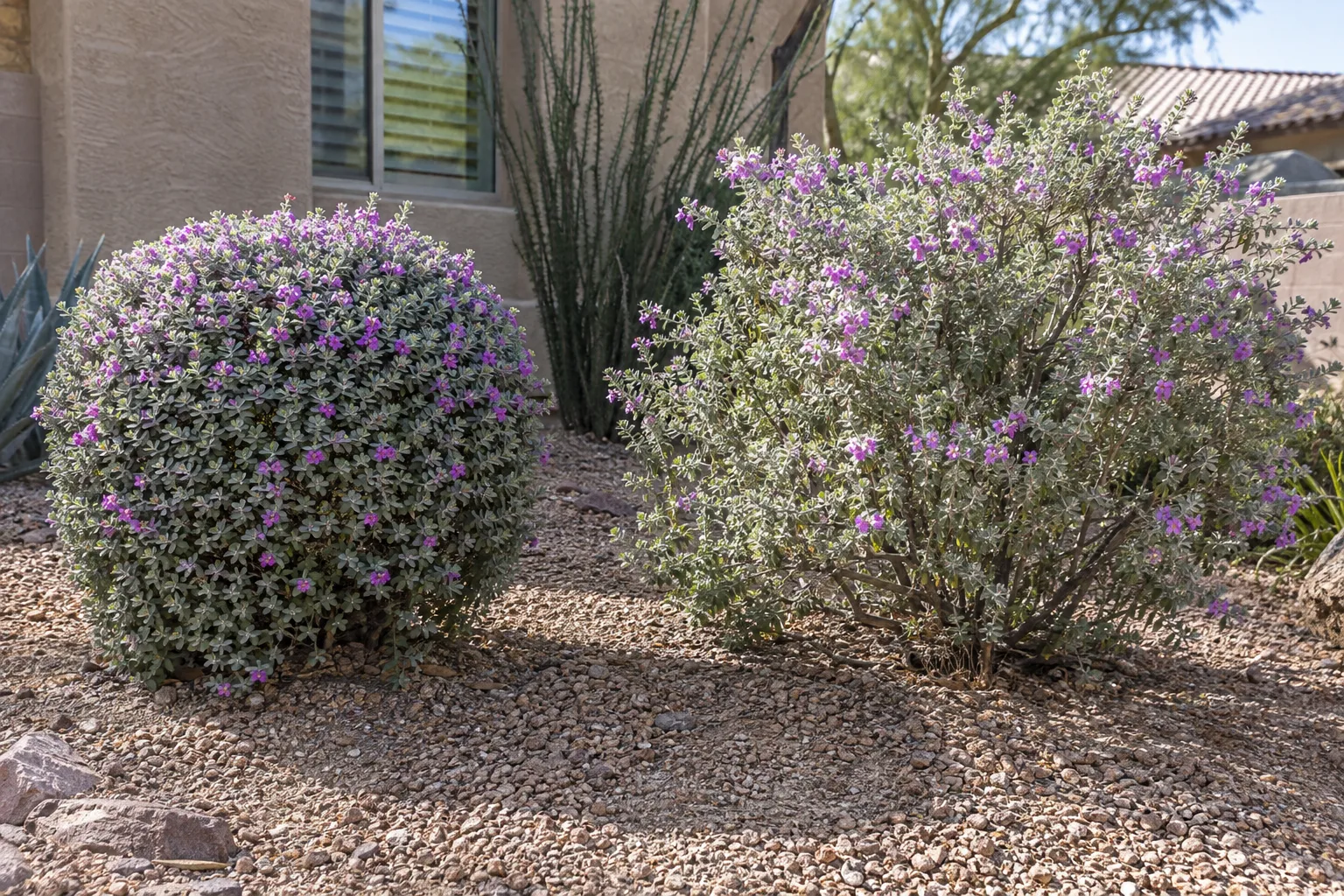
If the shrub has outgrown its spot, you can browse our plants department to compare mature sizes, which range from about 3 feet to 8 feet tall depending on the variety.
When should I prune Texas sage in Arizona?
Late February to mid-March is the best window for the main prune. By then most hard freezes have passed in the East Valley, and the shrub has not yet started its spring push. Pruning at this point gives new growth 6 to 8 weeks to harden before 100°F days arrive.
Queen Creek can run a few degrees colder than central Phoenix on clear winter nights, so check the forecast and wait if frost is coming. A light shaping in late May or early June is fine, as long as you remove no more than 10 to 15 percent of the plant.
Cuts from July through October remove flower buds and push soft new growth in 105 to 110°F heat. Fall cuts produce shoots that have little time to harden before cold nights. Our gardening calendars list what else to do each month.
| Period | What to do with Texas sage |
|---|---|
| Late February to mid-March | Main prune: dead wood, crossing branches, selective shaping |
| April to May | Let new growth fill in, no cuts needed |
| Late May to June | Light shaping only, 10 to 15 percent at most |
| July to September | No pruning while the shrub flowers |
| October to November | No pruning, new growth will not harden in time |
| December to January | Wait for the late February window |
What tools do I need to prune Texas sage?
Sharp bypass hand pruners do most of the work. Add a few other tools for thicker wood:
- Bypass pruners for stems up to about 3/4 inch thick.
- Loppers for stems up to about 1.5 inches.
- A folding pruning saw for thick, old stems.
- Rubbing alcohol to wipe blades between plants.
Sharpen blades first. Dull blades crush stems and leave ragged wounds that heal slowly. Before the first cut, walk around the shrub for two minutes and note the tallest stems, the dead wood inside and any branches that cross or grow inward. A plan prevents random cutting that leaves lopsided gaps.
How do I prune Texas sage step by step?
Work from the inside out, starting with dead wood and finishing with shape.
- Cut dead stems back to the base or to a healthy side branch. Dead wood snaps instead of bending and shows no green under the bark when you scratch it.
- Remove branches that cross, rub or grow toward the center, cutting at the point where they start.
- Shorten the two or three tallest, oldest stems by one third to one half, cutting just above a side branch or leaf bud.
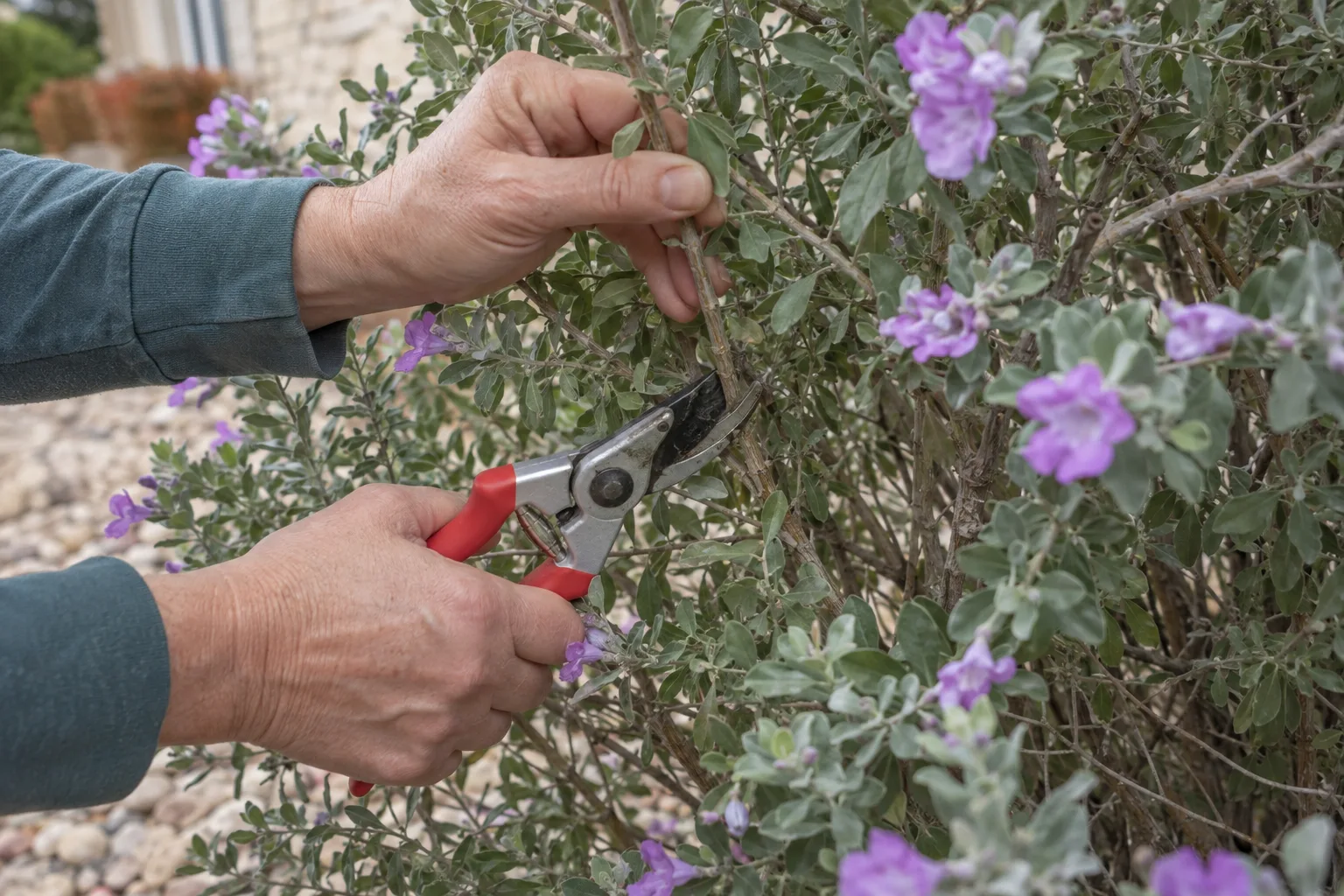
- Reach into the canopy and cut individual stems at different lengths instead of trimming the surface flat. This leaves light paths to the interior.
- After every few cuts, step back 8 to 10 feet and check the outline. Aim for a rounded, slightly irregular mound that is wider at the base than the top.
- Stop when you have removed about one third of the shrub.
- Rake the clippings out of the shrub and off the soil, since trapped debris holds moisture during the monsoon.
Can I cut an overgrown Texas sage back hard?
A phased cut over two late winters is the safest way to shrink a large shrub, though a hard reset is possible on a healthy plant. In the first year, remove dead interior wood and shorten the tallest stems by one third to one half. In the second, repeat on the next set of dominant stems.
A hard reset to roughly 12 to 18 inches in late February can renew a shrub that has been sheared into a woody ball. Always cut above live buds or leafy side shoots. Texas sage does not reliably regrow from bare, leafless wood, so a cut into old bare stems can leave a dead stub.
Expect new shoots within a few weeks after a hard cut, and water carefully while it recovers.
What should I do after pruning Texas sage?
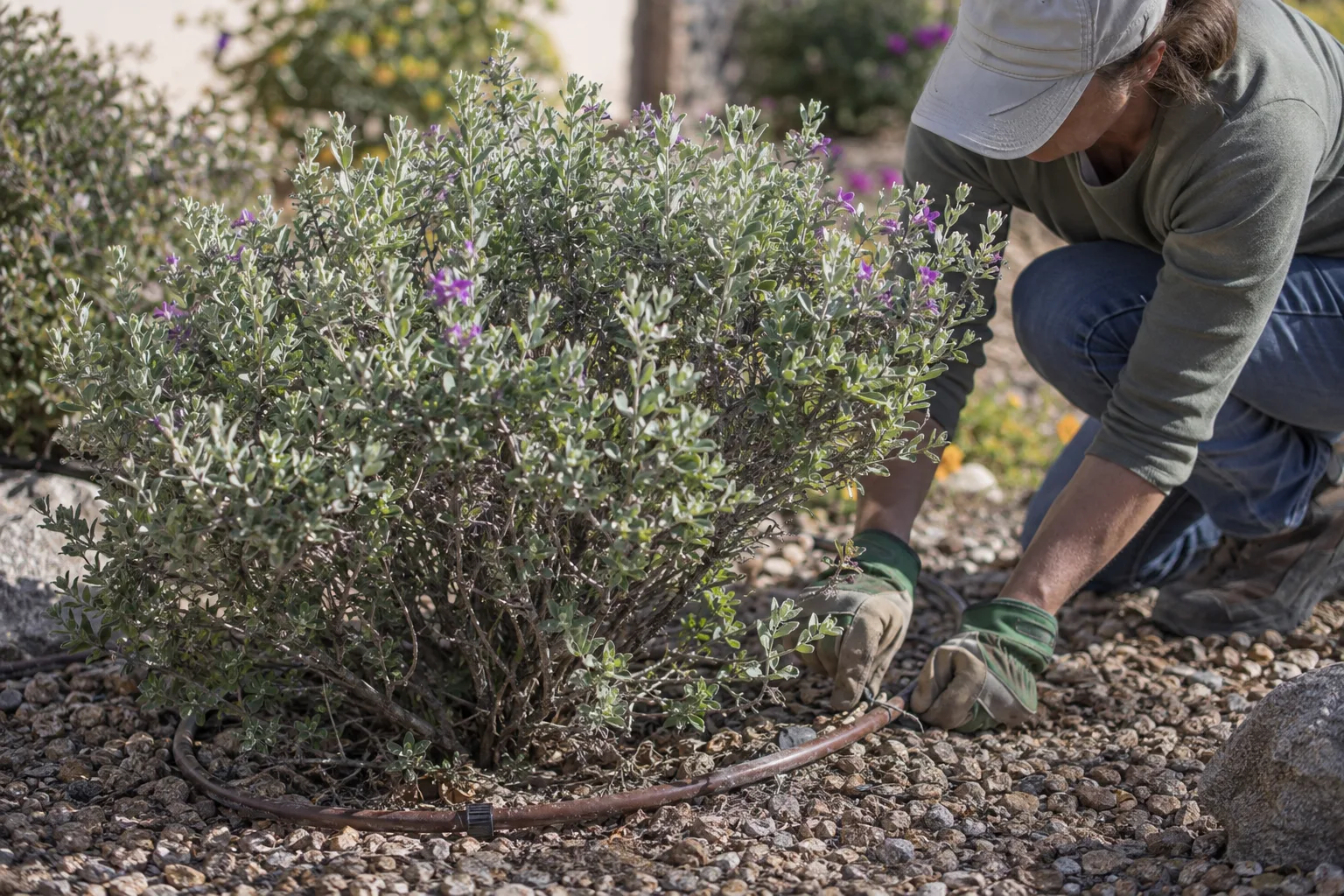
Water deeply once, then let the soil dry. A slow soak that reaches 12 to 18 inches down encourages deep roots. Alkaline soil and caliche can shed water sideways, so let a hose trickle at the base for 20 to 30 minutes rather than sprinkling the surface.
Between waterings the soil should dry out well, because Texas sage is prone to root rot in heavy or caliche-layered ground. In cool months an established shrub often needs water only every couple of weeks when there is no rain. Hard Valley water leaves salts behind, so deep soaks also help flush them below the roots.
Hold off on fertilizer for 4 to 6 weeks. If you feed at all, use a light, low-nitrogen product in mid-spring, since heavy nitrogen builds leaves at the expense of flowers. A 2 to 3 inch layer of mulch or decomposed granite keeps the soil steadier, as long as it stays a few inches away from the main stems.
What pruning mistakes cost the most blooms?
Five habits do most of the damage, and each has a simple fix.
- Pruning while the shrub is in bloom removes flowers. Wait until the flush fades, and save structural work for late winter.
- Cutting into bare wood often leaves dead stubs. Cut back to a point with leaves or buds.
- Removing more than one third at once stresses the plant, except in a planned hard reset.
- Watering extra to help recovery backfires, since the plant wants dry periods.
- Skipping dead-wood removal leaves a shaded, damp interior. Clear it out every winter.
Frequently asked questions
Can I prune Texas sage in summer?
Only lightly, and only in late May or early June. Remove no more than 10 to 15 percent to tidy stray stems. From July through October, the shrub is flowering or about to, so cuts take off buds and stimulate tender growth that struggles in 105 to 110°F heat.
Do I need to seal the cuts?
No. Wound sealants and pruning paints are generally not recommended for shrubs, and the plant seals its own cuts with callus tissue. Clean cuts matter more. Use sharp bypass pruners and cut at a slight angle just above a bud or side branch so the wound closes quickly.
How big does Texas sage get, and what if my space is small?
Most grow about 4 to 8 feet tall and wide, depending on the variety. For a small space, choose a compact type such as Leucophyllum zygophyllum ‘Blue Ranger’, which stays around 3 to 4 feet. Planting the right size from the start saves you from repeated heavy cutting.
Can I grow Texas sage as a formal clipped hedge?
You can, but expect fewer flowers. Clipping the surface repeatedly creates the dense shell that blocks light and shortens bloom. If you want a hedge look, shape by hand with selective cuts at different depths, or choose a different shrub. Our classes and events page lists upcoming workshops.
How long until it regrows after pruning?
New shoots usually appear within 3 to 4 weeks of a late-winter prune, once days warm up. A selectively pruned shrub often fills in by early summer and can flower after the first humid spell. A shrub cut hard may take a full growing season to rebuild its shape.
Is hand pruning Texas sage worth the effort?
Yes, if you want a shrub that flowers after summer humidity and keeps a natural, rounded shape. One careful session each late winter takes less time than it sounds. It is not worth the trouble if you want a tightly clipped hedge, because Texas sage will bloom poorly that way, and a different shrub suits that look better. Come visit us in Queen Creek and we will help you choose a size that fits your space.