

Prune desert willow (Chilopsis linearis) in late February or March, just before new growth starts. Remove deadwood, base suckers and crossing branches with clean cuts, and take no more than about a quarter of the canopy in one session.
Key takeaways
- Do major pruning from late February through March, once hard frost is unlikely and before the tree leafs out.
- Remove no more than about 25% of the canopy in one session, and spread heavy corrections over two or three years.
- Cut back to a lateral branch or just outside the branch collar, never leaving a stub.
- Skip significant pruning from August through January, when new growth is exposed to frost or heat stress.
- Never top the tree or shear it with a hedge trimmer, and skip wound sealant.

When should I prune desert willow in Arizona?
Late February through March is the best window for structural pruning in the East Valley. The tree is still bare or just starting to leaf out, so you can see crossing limbs, deadwood and suckers clearly. Frost risk is also mostly behind you by then.
Light work, such as snipping spent blooms or removing a broken branch, is fine in late spring and early summer. Avoid it on the hottest afternoons above 110°F. The monsoon runs roughly July through September, and a dense canopy can hold moisture, so thinning in winter helps.
Avoid heavy cuts from August through January. Late cuts push soft growth that frost can blacken in December and January. Frost damage is rarely fatal, but it sets the tree back and adds cleanup work.
| Months | What to do |
|---|---|
| Late February to March | Structural pruning, deadwood and sucker removal |
| April to May | Light shaping and sucker removal |
| June to July | Remove spent blooms and seed pods only |
| August to January | Leave alone except for broken or hazardous limbs |
What tools do I need to prune desert willow?
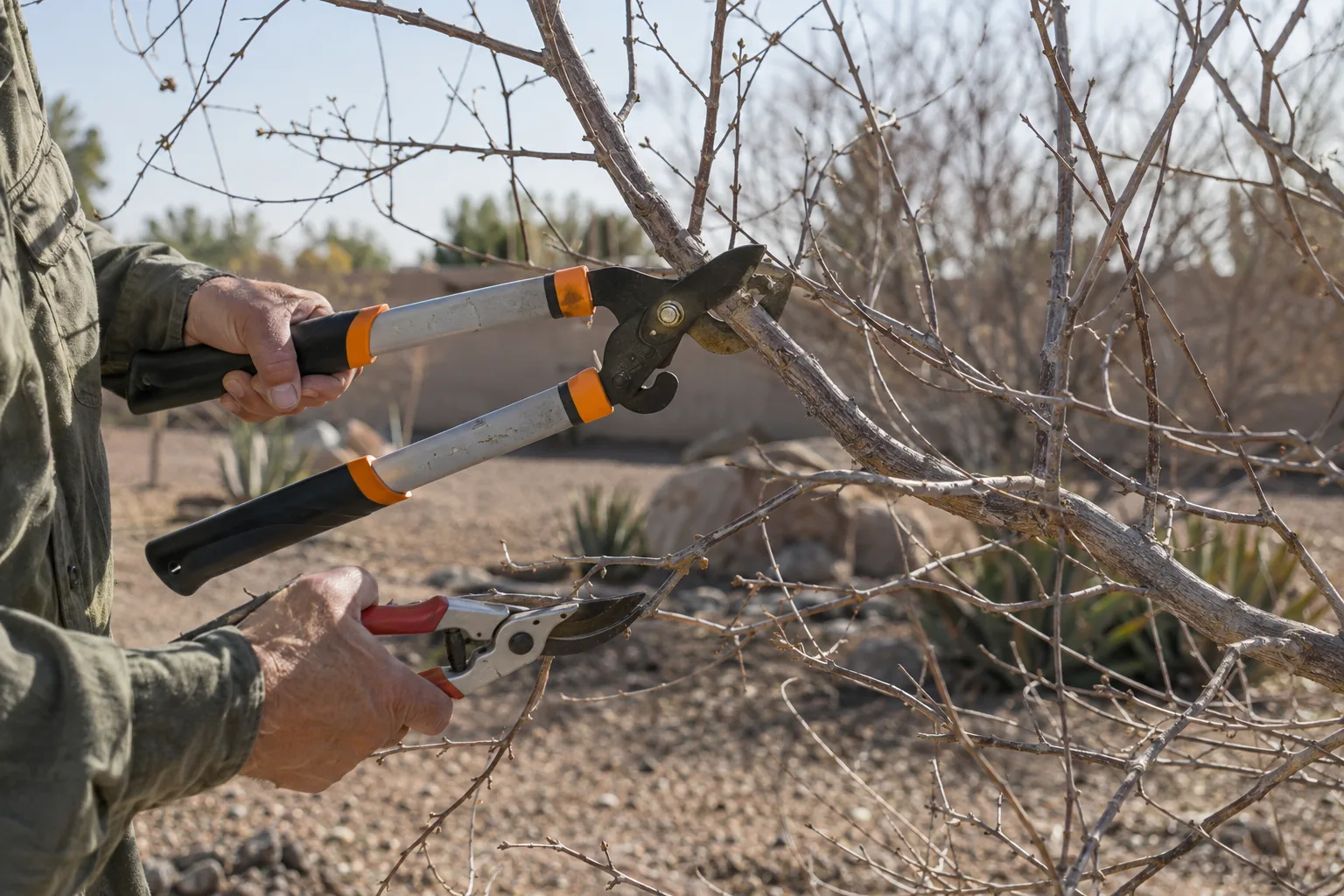
Bypass pruners, loppers and a pruning saw cover nearly every cut. Match the tool to the branch so the cut is clean rather than torn, because ragged wounds heal slowly and invite borers and fungus.
- Bypass pruners for stems up to about 3/4 inch.
- Loppers for stems from 3/4 inch to about 1.5 inches.
- Pruning saw for anything thicker. A folding pull saw fits into tight canopies.
- Rubbing alcohol or a diluted bleach solution to wipe blades after cutting diseased wood.
- Gloves and eye protection, since stubs at face height cause injuries.
Leave the hedge trimmer in the shed. Shearing leaves stubs that die back and turns an airy tree into a stiff ball.
How do I prune a desert willow step by step?
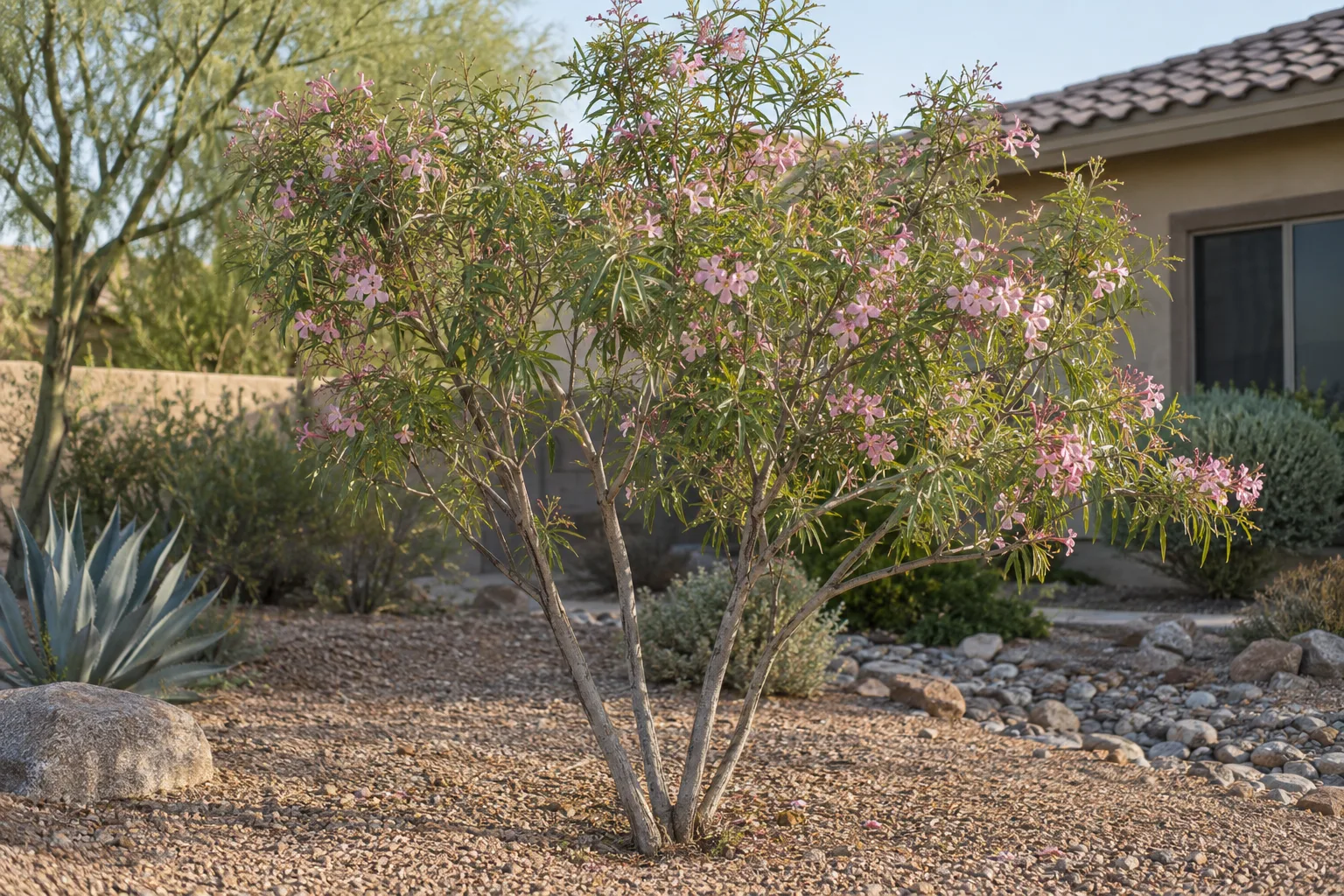
Work from the big picture down to the small cuts. A tree can reach 15 to 25 feet tall and 10 to 15 feet wide in its natural form, so look it over from several sides before you begin.
- Walk around the tree and pick the main branches you want to keep.
- Cut out all deadwood back to living tissue. Dead twigs snap instead of bending and show no green under the bark when scratched.
- Remove suckers at the base as close to their origin as you can.
- Take out the weaker branch wherever two limbs cross or rub.
- Thin a few small, inward-growing twigs so light and air reach the center.
- Step back and make final shaping cuts to a lateral branch or bud.
- Rake up the clippings and bag them.
- Water deeply afterward. Hold nitrogen fertilizer for about four weeks after a heavy prune.
How much can I remove at one time?
Keep it to about 25% of the canopy per session. Removing more stresses the tree and can expose bark to sunscald, which matters in a Queen Creek summer with highs above 110°F.
If the tree is badly overgrown, spread the work across two or three late winters. Each year, remove the deadwood and the worst crossing limbs first, then reshape gradually.
What mistakes damage desert willow?
Topping is the most harmful. Cutting every main branch to a stub at one height forces dozens of weak water sprouts and leaves wounds that rarely close. If a tree is too big for its spot, replacing it with a smaller selection works better than repeated topping.
Leaving stubs
Stubs die back and never seal. Cut to a lateral branch, a bud or just outside the branch collar, the slightly swollen ring where branch meets trunk. Cutting flush removes tissue the tree uses to close the wound.
Using wound sealant
Paints and dressings do not speed healing and can trap moisture against the cut. Clean cuts in dry desert air do fine on their own. Check this against current University of Arizona Cooperative Extension guidance.
Fertilizing and watering too heavily
Long, whippy stems with few flowers often point to too much nitrogen or too much water. Cut them back by about a third and ease off both.

How do I train a young desert willow?
Most of the shaping happens in the first two or three years. Decide early whether you want a single trunk or a multi-trunk form, and prune to match.
For a single trunk, keep the strongest upright leader and remove competing stems at the base. Keep the lowest permanent branches about 6 feet up if the tree shades a walkway or patio. For a multi-trunk tree, keep three to five well-spaced stems and remove the rest. In the first two seasons, stick to suckers, deadwood and obvious crossing limbs while the roots establish.
If space is tight, compare sizes when you choose a tree. Our flowering trees page is a good place to start, and our desert trees selection includes other low-water options. Varieties we commonly carry change by season, and named selections vary in mature size, so ask us which fit your space.
Can pruning increase desert willow blooms?
Yes, within limits. Desert willow flowers on new growth, so a light trim after the first flush can encourage another round. Remove only the spent tips, roughly 3 to 4 inches, and follow with a deep watering.
Do this on younger, vigorous trees and only when temperatures are manageable. Removing seed pods also keeps the tree tidy and limits volunteer seedlings. Blooms typically run from late spring into the monsoon.
Frequently asked questions
Can I prune desert willow in summer?
Only lightly. Deadheading, snipping a broken branch or cutting a sucker is fine on cooler mornings. Skip large cuts in summer because the combination of heat and pruning stress can set the tree back. Save structural work for late winter, when the tree is bare.
When should I cut back frost damage?
Wait until late February or early March. By then the line between dead and living wood is clear, so you can cut precisely. Pruning right after a freeze can expose protected tissue to the next cold night and extend the damage.
Should I use pruning sealant on cuts?
No. Sealants do not speed healing and can hold moisture against the wound. Make a clean cut just outside the branch collar and leave it open. Dry low-desert air helps the cut surface callus naturally over the following months.
How far from a house should I plant desert willow?
Plan for the mature size. Standard trees can spread 10 to 15 feet, so give them room from walls, walkways and pools. Smaller selections need less space. Check the tag for the mature width before you choose a spot.
Do I need to remove seed pods?
You do not have to. Removing them keeps the tree neater, prevents volunteer seedlings and may redirect energy to new growth and flowers. Snip them off after bloom flushes if you want a cleaner look.
Is pruning desert willow worth the effort?
Yes, if you want a tidy, well-shaped tree with more bloom. One late-winter session each year is usually enough once the tree is trained. Skip heavy pruning if the tree is healthy and fits its space, since the tree is happiest with light attention. If it has outgrown its site, replacing it beats repeated topping. Stop by our Queen Creek nursery and we will help you match a tree to your yard.