
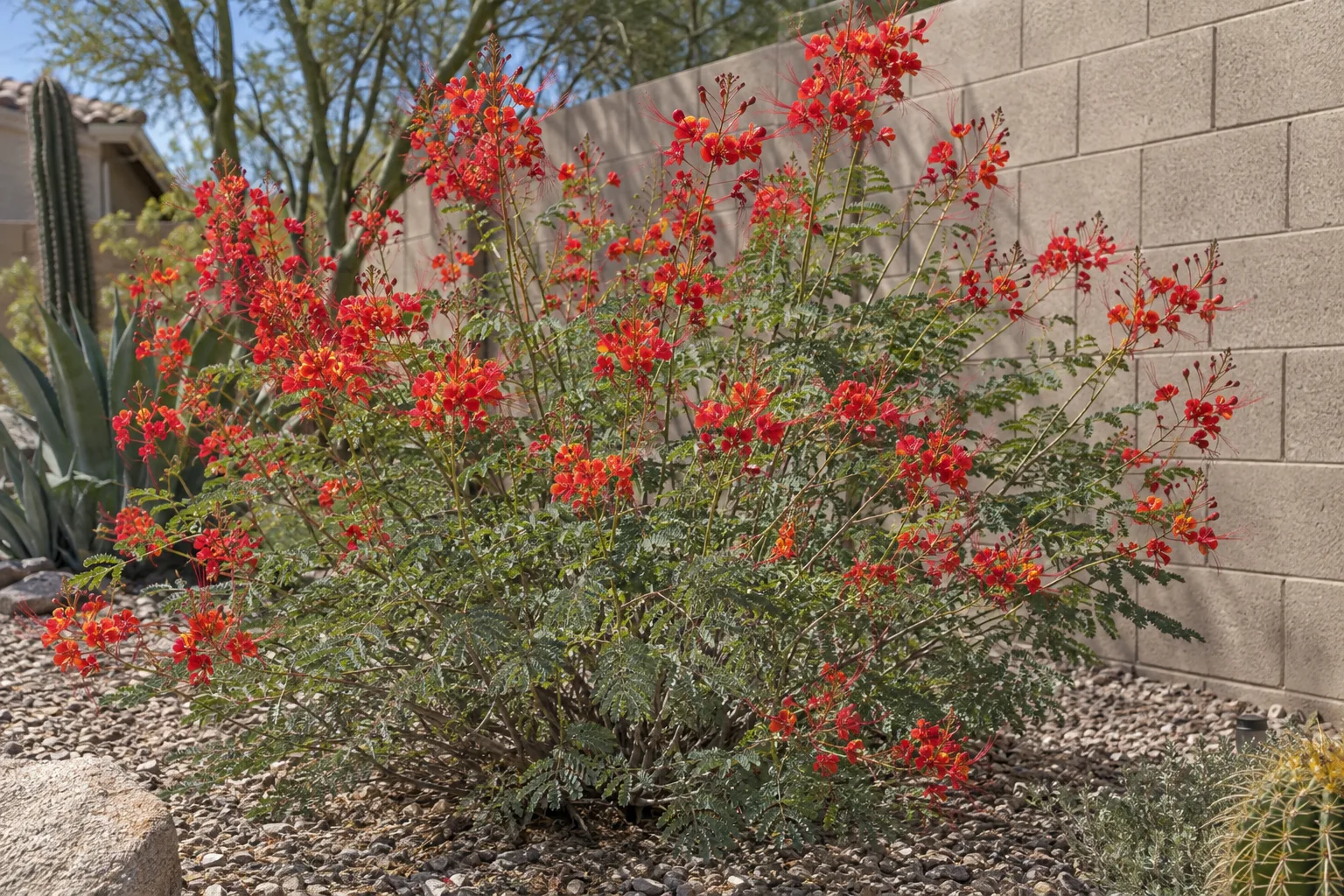
Prune bird of paradise in Arizona from late February through March, once the last frost has passed and before spring growth takes off. A moderate cutback at that point keeps the shrub full and flowering through the long Queen Creek summer.
Key takeaways
- Prune red, Mexican and yellow bird of paradise (Caesalpinia) from late February through March, after the last frost.
- If frost killed the canes, wait for green shoots at the base before you cut, which can mean waiting into late March or April.
- Remove no more than one-third of the plant in one session.
- Water deeply within a day or two of pruning, then every 7 to 10 days through spring.
- Skip heavy pruning from July through September, when the plant is blooming and the sun is hardest on exposed bark.
Which bird of paradise do you have?
Three shrubs sold as bird of paradise in the low desert are Caesalpinia species, and a fourth plant with the same common name is Strelitzia. Identify yours first, because the timing in this post applies to the woody Caesalpinia group. Check the flowers and the leaves.
Red bird of paradise (Caesalpinia pulcherrima)
This is the fast, fine-leaved shrub with orange-red flowers and long red stamens. It commonly reaches 6 to 10 feet and blooms from late spring into fall. In a cold winter it can freeze back hard and regrow from the base.
Mexican bird of paradise (Caesalpinia mexicana)
This one is larger and more tree-like, with clusters of yellow flowers, and it often grows 10 to 15 feet tall with several trunks. It usually holds its leaves through a mild winter. If you are choosing a larger accent, browse our flowering trees for similar shapes.
Yellow bird of paradise (Caesalpinia gilliesii)
Often called desert bird of paradise, it has yellow flowers with long red stamens and an open, airy shape, usually 6 to 10 feet tall. It handles alkaline soil and heat well. Its sticky, strongly scented foliage is a good identification clue.
Strelitzia (Strelitzia reginae)
If your plant has banana-like leaves and orange and blue flowers shaped like a crane’s head, it is a different plant with no woody canes. It needs no late-winter cutback. Trim spent flower stalks and tattered leaves at the base once the weather has settled.

When should I prune bird of paradise in Arizona?
Late February through March is the window for most of the East Valley, after the last hard frost and just as the plant starts to wake up. Pick a mild, dry day and check the ten-day forecast first.
The average last frost in much of the East Valley falls somewhere between mid-February and early March, and open ground in Queen Creek can run a few degrees colder than the city core on clear nights. Our gardening calendars are a good place to check what the season is doing before you cut. If a frost is forecast after you prune, drape frost cloth over the plant overnight.
Why wait until frost danger has passed?
Frost-browned canes shade the crown and the lower stems, and new growth triggered by an early haircut is tender and easy to burn. Leaving the brown material in place through January gives the plant some cover. It looks untidy for a few weeks, but it costs you nothing.
Cutting much later than March also has a price. These shrubs generally bloom on new growth, so heavy pruning in late spring removes shoots that would have carried flowers and pushes the bloom back by weeks.
If frost killed the plant back to the ground, be patient. Scratch a cane with a fingernail, and if you see green under the bark, the cane is alive. Gray, brittle wood that snaps cleanly is dead, and you can cut it out at any time. Red bird of paradise often waits until warm weather in March or April to show new shoots from the base, so a bare plant in February has not necessarily failed.
What should I cut and what should I leave?
Cut out dead, crossing and weak growth first, then shape what remains. Leave healthy, firm canes alone. Aim to take off no more than one-third of the plant in a single session, and spread a rescue job on an overgrown shrub over two springs.
Cut these
- Dead or frost-killed canes, back to healthy green wood or to the base
- Branches that cross and rub against each other
- Thin, spindly stems that never fill out
- Old seed pods left from last year
- Outer stems that reach past the space you want the shrub to fill
Leave these
- Firm, green or gray-brown canes that are alive
- New shoots coming from the base
- The natural arching shape, unless it blocks a walkway or window
A shrub that has grown to 10 feet and now covers a window can lose a third of its height in one spring and still bloom well. Taking it to a stump is a different matter, because the plant then spends its energy regrowing instead of flowering.
How do I prune bird of paradise step by step?
Work from dead wood to live wood, and from the inside to the outside. You need bypass pruners for small stems, loppers for canes up to about an inch thick, and a pruning saw for older trunks on Mexican bird of paradise. Wear gloves, long sleeves and eye protection.
- Check that no freeze is forecast for the next one to two weeks.
- Remove all dead canes at the base or back to live green wood.
- Cut crossing and weak stems back to the branch they grow from, so no stubs are left.
- Step back and look at the overall shape.
- Shorten overlong outer stems to a side branch, keeping the total cut under one-third.
- Remove old seed pods and gather all clippings.
- Water deeply within a day or two.

On sensitive topics, keep in mind that the seed pods of yellow bird of paradise are reported to be poisonous if eaten, and the foliage can irritate some people’s skin. Keep pods away from children and pets, and call the Arizona Poison and Drug Information Center or your vet if someone swallows one.
How should I care for the plant after pruning?
Water deeply, feed lightly and leave the rest to the plant. A deep soak helps roots reach below the caliche layer that sits a foot or two down in many Queen Creek yards.
Through March and April, a deep watering every 7 to 10 days is a reasonable starting point for an established shrub, and you can stretch the interval if the soil stays damp. Our hard water leaves salts at the soil surface, so a slow, deep soak that moves them down works better than frequent light sprinkling.
One light application of a balanced fertilizer in early spring is plenty. Heavy nitrogen produces lots of leaves and fewer flowers, and alkaline soil already ties up some nutrients. Stop feeding by May, because the plant slows down when highs pass 105°F. If you want to see cutting technique in person, check our classes and events page for anything scheduled.
What pruning mistakes should I avoid?
The common ones are cutting in the wrong month, shearing the plant like a hedge, and leaving stubs. Each shows up as sparse flowering or ragged wood a few months later.
Pruning in December or January. This removes frost protection and invites tender regrowth. Wait for late February.
Shearing the top with hedge trimmers creates a dense, twiggy cap with fewer flowers. Cut individual canes to a branch or to the base instead.
Stubs die back and give borers and decay an entry point, so cut back to a branch junction every time.
Heavy cuts from July through September are a poor idea. The shrub is in bloom, and canes suddenly exposed to summer sun above 110°F can scald. If the plant looks ragged in the monsoon, remove spent flower clusters and nothing else.
Frequently asked questions
Can I cut bird of paradise all the way to the ground?
Only red bird of paradise that frost has already killed back. It regrows from the base, so cutting dead canes low is fine. A healthy shrub cut to a stump loses a season of flowers. Mexican bird of paradise has woody trunks and should be thinned, not cut to the ground.
My bird of paradise looks dead after winter. Should I pull it out?
Not yet. Scratch a cane with your fingernail, and green tissue means it is alive. Then wait until warm weather in March or April for shoots at the base. Red bird of paradise is slow to restart, so a bare plant in February has not necessarily died.
How do I prune Strelitzia, the one with orange and blue flowers?
Cut spent flower stalks at the base and remove dead or tattered leaves where they emerge from the clump. It has no woody canes, so there is no late-winter cutback. Do any cleanup after the last frost, because the old leaves give the clump some protection.
Can I prune in fall instead?
A light tidy is fine, but save the real cutback for late winter. Fall pruning can trigger new growth just before the coldest nights, and fresh shoots burn easily in a frost. Removing dead flower stalks and seed pods in October is a safe task.
Why did my bird of paradise stop blooming?
The usual causes are too much shade, too much nitrogen, heavy pruning in late spring, or frost damage. These shrubs want full sun, which means at least six hours of direct light. If none of that fits, check that the roots are getting deep water instead of frequent light sprinkles.
Is bird of paradise worth the yearly pruning?
Yes, if you have a sunny spot and room for a 6 to 10 foot shrub, because the job takes under an hour and the payoff is months of color. Skip it if your yard is shady or you want a tidy plant under 4 feet, since constant cutting will cost you flowers. Come by the nursery in Queen Creek and ask about options that fit your space.