
The best privacy plants for an Arizona yard are oleander, Texas mountain laurel, Italian cypress, clumping bamboo, bougainvillea, Indian laurel fig, desert willow and podocarpus. Match the plant to the height you need to block, the water you can supply and the frost your yard sees.
Key takeaways
- Oleander and bougainvillea grow fastest, while Texas mountain laurel adds only about 1 to 2 feet per year.
- A neighbor’s second-story window needs 12 to 15 feet of screening, but a street-level view can be blocked by a dense shrub of 6 to 8 feet.
- Plant from October through March so roots settle in before summer highs above 110°F, and wait until frost danger passes for bougainvillea, bamboo and fig.
- Probe for caliche before you dig, then make the hole twice as wide as the root ball and no deeper.
- Oleander is toxic to people and pets, and Texas mountain laurel seeds are poisonous, so site both away from play areas.
How do I choose a privacy plant for my yard?
Start with the height of the view you want to block, then check water, soil, space and frost. A street-level view is usually handled by a dense shrub, while a two-story neighbor calls for a tall screen or a layered planting.
Soil comes next. Much of Queen Creek sits on alkaline soil with caliche, a cement-like mineral layer often found within a foot or two of the surface, and a plant set above it will circle its roots and stall. Hard irrigation water leaves salts behind, so deep, occasional watering works better than frequent light sprinkling. Check for overhead lines before planting anything that will pass 20 feet, and note where cold air settles in your yard. You can compare sizes and forms in our plant department.
Which plants give the best privacy in the Arizona low desert?
Eight shrubs and trees do the job well here, each with a trade-off you should know before buying. These are varieties we commonly carry, though availability changes week to week and season to season.
Oleander (Nerium oleander)
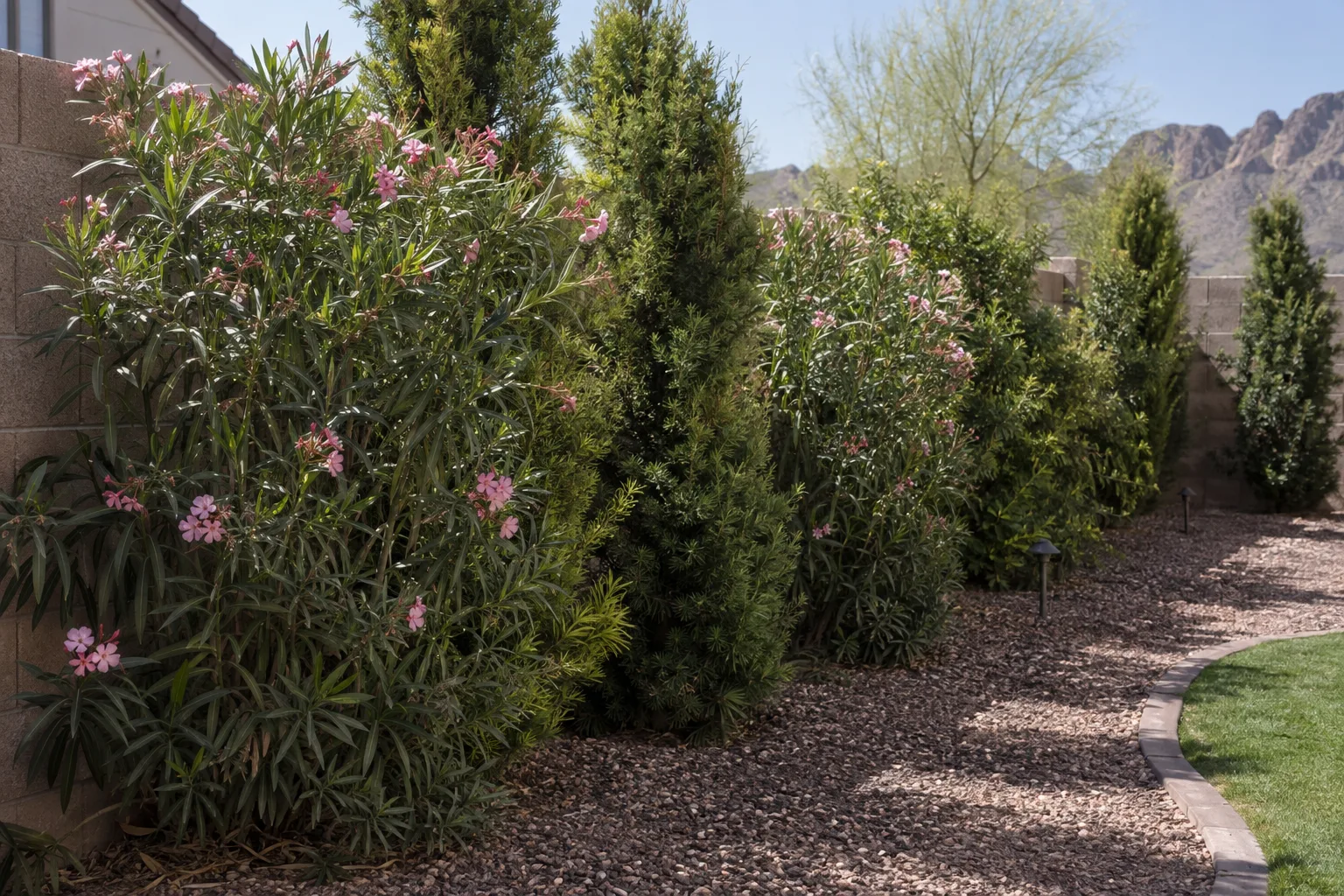
Oleander reaches 8 to 12 feet tall and wide in full sun, and it is one of the faster screens in the low desert, often adding roughly 2 to 4 feet per year when young. It handles reflected heat off a west-facing wall and needs low to moderate water once established. Dwarf types such as ‘Petite Pink’ stay near 4 to 6 feet. The drawback is serious. Every part of the plant is toxic to people and pets.
Texas mountain laurel (Sophora secundiflora)
Texas mountain laurel grows 10 to 20 feet tall and 6 to 10 feet wide in full sun to light shade, with glossy evergreen leaves. Clusters of purple, grape-scented flowers open in March in most years. It grows slowly and needs little water once established, so many gardeners pair it with a faster plant for the first few years. The seeds in its pods are poisonous if swallowed.
Italian cypress (Cupressus sempervirens)
Italian cypress forms a narrow column 30 to 50 feet tall and 3 to 5 feet wide, which suits a tight side yard where a wider shrub would crowd a walkway. It wants full sun and regular water, and it grows about 2 to 3 feet per year. It is not desert-adapted, so drip irrigation is a must. Drought stress browns the interior, and spider mites can thin the foliage in hot summers. See more tall, narrow forms among our evergreen trees.
Clumping bamboo (Bambusa multiplex)
Clumping bamboo grows 12 to 20 feet tall and forms a tight clump that widens only a few inches per year. It prefers morning sun with afternoon shade in the hottest spots and needs moderate to high water through summer. Frost can burn the leaves, and leaf litter is steady. Avoid running bamboo for screening, since its underground stems spread well past the planting bed.

Bougainvillea (Bougainvillea spectabilis)
Bougainvillea reaches 10 to 20 feet when trained on a trellis or wall, and it grows quickly in summer heat. It wants full sun and low water once established, with bracts in magenta, orange, red, yellow or white. The thorns discourage anyone from crossing it, which also makes it a poor neighbor for walkways. Frost burns it back, so plant it in a protected spot or cover it on freezing nights.
Indian laurel fig (Ficus microcarpa ‘Nitida’)
Indian laurel fig reaches 20 to 30 feet if left alone, or it can be sheared into a dense hedge held at 8 to 15 feet. It grows in full sun to part shade and needs moderate to high water. The foliage forms a nearly solid wall. Roots are aggressive and can lift pavement, so keep it well away from walkways, pools and foundations. Hard freezes can damage it.
Desert willow (Chilopsis linearis)
Desert willow is a native that reaches 15 to 25 feet tall with an airy canopy, and it is not a true willow but a relative of catalpa. Full sun and low water suit it, and pink, lavender or white trumpet flowers open from late spring through summer. It drops its leaves in winter, so screening is thinner in cold months. Look through our desert trees for similar native choices.
Podocarpus (Podocarpus macrophyllus)
Podocarpus grows 8 to 20 feet tall and takes shearing well, so it works as a formal hedge at almost any height. It grows slowly to moderately in part sun, or full sun with afternoon shade in hot spots, and needs moderate water. In alkaline soil the leaves can yellow from iron deficiency, and reflected heat from a bare wall can scorch them.
How do the eight plants compare?
Oleander and bougainvillea are the fastest, while desert willow, Texas mountain laurel and bougainvillea use the least water once established. The table lines up size, speed and the main drawback.
| Plant | Mature height | Growth | Water once established | Main drawback |
|---|---|---|---|---|
| Oleander | 8 to 12 ft | Fast | Low to moderate | Toxic |
| Texas mountain laurel | 10 to 20 ft | Slow | Low | Slow, poisonous seeds |
| Italian cypress | 30 to 50 ft | Moderate | Moderate | Spider mites, needs steady water |
| Clumping bamboo | 12 to 20 ft | Moderate to fast | Moderate to high | Leaf litter, frost burn |
| Bougainvillea | 10 to 20 ft | Fast | Low | Thorns, frost damage |
| Indian laurel fig | 20 to 30 ft (hedge 8 to 15 ft) | Moderate to fast | Moderate to high | Aggressive roots |
| Desert willow | 15 to 25 ft | Moderate | Low | Bare in winter |
| Podocarpus | 8 to 20 ft | Slow to moderate | Moderate | Yellowing in alkaline soil |
If you want a quick screen that also blooms, combine a fast shrub in front with a slower evergreen behind it. Mixing species also means one pest or frost event will not take out the whole row.
How far apart should I plant a privacy screen?
Space shrubs at about 50 to 60 percent of their mature width for a solid hedge. Wide spacing leaves gaps that stay open for years.
For Italian cypress that works out to 4 to 5 feet on center, and for oleander about 5 to 6 feet. Bougainvillea trained on a wall or trellis can sit 8 to 10 feet apart. Layering works better than a single row: tall plants such as cypress or Texas mountain laurel go in back, with medium shrubs such as oleander or podocarpus in front, which gives the screen depth and keeps it standing through monsoon wind.

How do I plant a privacy hedge in caliche soil?
Plant from October through March, probe for caliche first, and set each plant at the same depth it grew in its container. Frost-tender bougainvillea, bamboo and fig do better once spring frost danger has passed. Our gardening calendars show planting windows by month.
- Mark the planting line with a hose or paint, leaving room for each plant’s mature width.
- Push a steel rod or caliche bar about 18 inches down every 6 feet along the line.
- Break up any hard layer you hit, then dig each hole twice as wide as the root ball and no deeper.
- Backfill with the native soil, adding little or no compost, because a rich amended hole can hold water like a bathtub.
- Lay drip emitters on at least two sides, about 6 to 12 inches from the trunk.
- Set the top of the root ball at or slightly above the surrounding grade.
- Build a shallow soil ring around the plant and soak it slowly and deeply.
- Add 3 to 4 inches of mulch, keeping it a few inches away from the trunk.
How much water does a privacy screen need?
New plants need water every 2 to 3 days for the first month, then weekly through about month six, and after that a schedule set by species. Deep soaks push roots down and flush the salts in our hard water below the root zone.
In summer, established oleander, bougainvillea, Texas mountain laurel and desert willow often do well with a deep soak every 10 to 14 days. Italian cypress, fig, podocarpus and bamboo usually need water every 7 to 10 days. Run drip lines in the early morning so less water evaporates. Adjust for your own soil, since a plant in sandy ground dries out faster than one in clay.
What mistakes shorten the life of a privacy screen?
Most failures come from timing, depth and water, not from the plant itself.
- Planting in June through August, when highs pass 110°F and new roots cannot keep up.
- Setting the root ball below grade, which invites crown rot.
- Placing fig or other aggressive-rooted plants within a few feet of a pool, sidewalk or foundation.
- Installing a single species along the whole line, so one pest or frost event leaves a long gap.
- Skipping the caliche probe, then watching water pool and roots rot after every irrigation.
Frequently asked questions
How fast can I get 6 feet of privacy?
Oleander and bougainvillea can reach 6 feet in roughly 2 to 3 years when planted in fall and watered on a drip line. Slower plants such as Texas mountain laurel and podocarpus take longer, so many gardeners put a fast shrub in front and a slower one behind it. Skipped watering slows every plant on this list.
Which plant handles a hot west-facing wall?
Oleander and bougainvillea handle west-facing walls best, since both tolerate reflected heat that can push temperatures well above the air reading in July and August. Texas mountain laurel also works there once established, but it needs extra water during its first two summers. Podocarpus does better with some afternoon shade.
Are these plants safe around pets and children?
Oleander and Texas mountain laurel carry the clearest toxicity warnings, so keep them out of play areas. For the other six, check the ASPCA plant list or ask your veterinarian before planting, because we do not make safety claims for every species. Keep pets from chewing any landscape plant.
Can I grow privacy plants in containers?
Podocarpus, dwarf bougainvillea and clumping bamboo are the best candidates for large containers, at 25 gallons or more for anything meant to pass 6 feet. Soil in a sunny pot runs hotter than in-ground soil in summer, so choose light-colored pots and use a drip timer. See our pottery and planters for large containers.
Should I stake new plants before monsoon season?
Stake larger new plants loosely with two or three low stakes during their first season so the root ball does not rock in wind. Remove the stakes once roots anchor. After a July through September storm, straighten any leaning plant while the soil is still moist and check that drip emitters were not knocked loose.
Is a living privacy screen right for your yard?
A living screen is right for you if you have a planting strip at least 4 to 6 feet deep, a drip line you will maintain and the patience for 2 to 3 years of growth. It is a poor fit if you need full privacy within a few months, have a strip narrower than 3 feet, or will not water through the first two summers. In those cases a wall or a row of large containers does the job better. Stop by our nursery in Queen Creek and bring a photo of your sightline.