
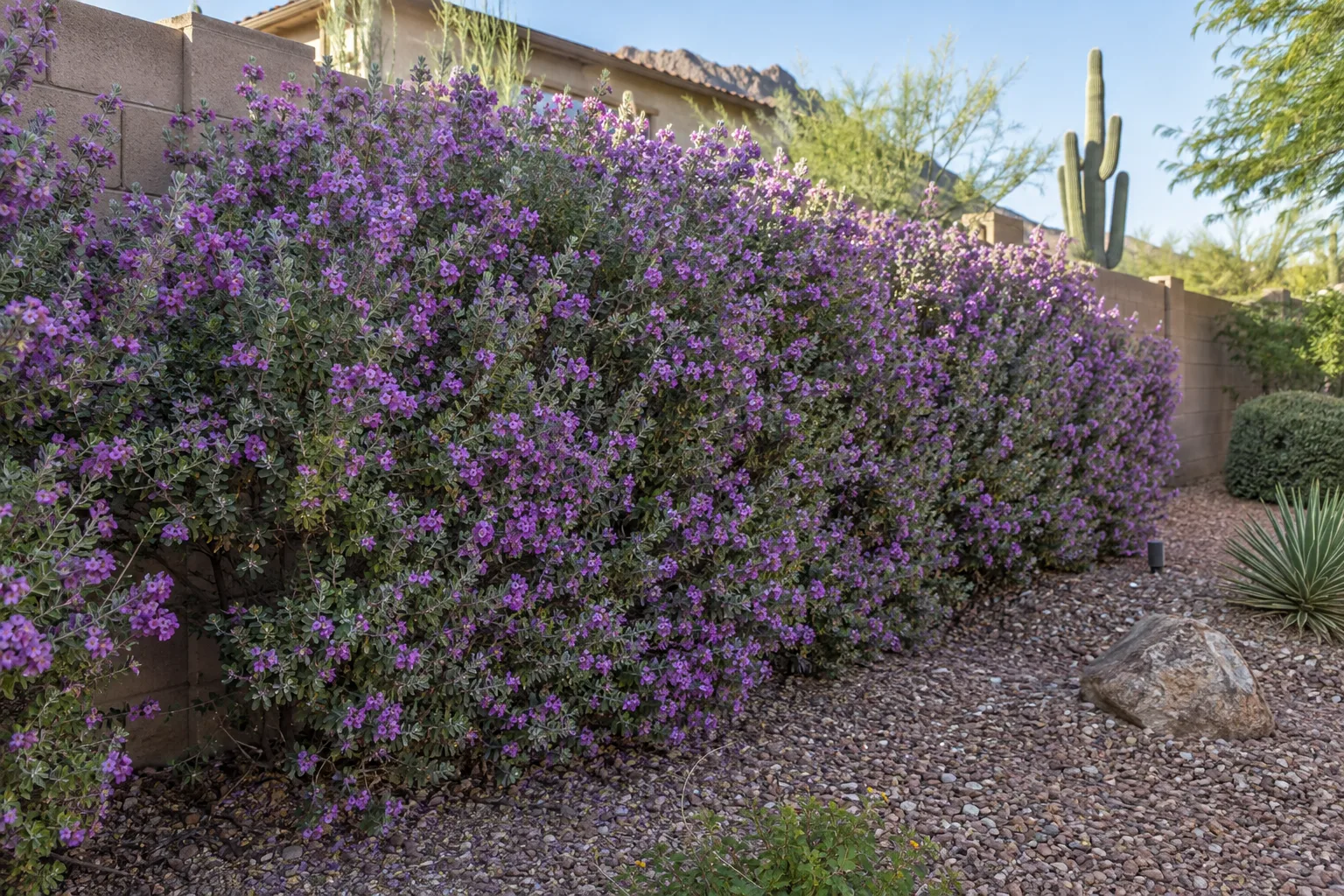
The best privacy hedges for Arizona gardens are Texas sage, Indian hawthorn, oleander, bougainvillea, natal plum, hopseed bush, Arizona rosewood and Italian cypress. Pick by mature width, frost exposure and how much water you are willing to give them.
Key takeaways
- Plant from September through November, or in February and March, so roots settle in before summer highs above 110°F.
- Oleander screens fastest, reaching 8 to 12 feet, but it is toxic if eaten, so skip it where children or pets chew on plants.
- Bougainvillea, natal plum and hopseed bush can be damaged by hard frost, so keep them out of low, cold pockets of the yard.
- Avoid heavy pruning from May through August, because fresh cuts expose inner stems to sunburn.
- Soak the root zone 18 to 24 inches deep with drip emitters instead of running short daily cycles.
What makes a good privacy hedge in the low desert?
A good low desert hedge handles summer highs above 110°F, alkaline soil and heat reflected off block walls, and it fills the width you can spare. Mature width matters as much as height, because a shrub that outgrows its strip needs constant cutting back.
Frost, caliche and hard water also narrow the list. Winter lows in the upper 20s°F are uncommon in Queen Creek but happen, and they damage frost-tender plants. Caliche, the cement-like mineral layer under much of the East Valley, stops water from draining, and hard irrigation water leaves salts that show up as brown leaf tips.
Which eight hedges work best in Arizona gardens?
These eight cover tall screens, low borders, narrow strips and wall-trained color. They are varieties we commonly carry, though availability changes week to week and season to season, so check with us before you plan a full row. You can browse the whole range on our plants page.
Texas sage (Leucophyllum frutescens)
Texas sage grows 5 to 8 feet tall and about as wide in full sun, and it needs very little water once established. Silvery foliage stays on the plant all year, and purple flowers often follow humid weather or monsoon rain. Space plants about 4 feet apart for a continuous screen. The drawback is that it looks best in a loose, rounded shape, and it declines quickly if lawn sprinklers keep its roots wet.
Indian hawthorn (Rhaphiolepis indica)
Indian hawthorn stays 3 to 5 feet tall and wide, grows in full sun to part shade, and wants low to moderate water. White or pink flowers open in late winter and spring. It suits low screens and borders. The drawback is height: it will not block sightlines at eye level, and it can show yellow leaves from iron chlorosis in alkaline soil.
Oleander (Nerium oleander)
Oleander reaches 8 to 12 feet tall and 6 to 10 feet wide in full sun, grows fast, and needs low water once established. Flowers come in white, pink, red and salmon from spring into fall. Its major drawback is toxicity. Poison control centers list oleander as poisonous if eaten, and the sap can irritate skin, so wear gloves when pruning and never burn the clippings.
Bougainvillea (Bougainvillea spectabilis)
Bougainvillea is a thorny vine that climbs 10 to 20 feet when tied to a wall, fence or trellis, and it blooms in magenta, orange, red, white and purple. It wants full sun and low water once established. Left alone it sprawls instead of forming a tidy hedge, so plan on tying and pruning it. Frost burns it back, and it dislikes root disturbance.
Natal plum (Carissa macrocarpa)
Natal plum grows 5 to 7 feet tall in its larger forms, with compact types staying much lower. It takes full sun to part shade, with low to moderate water. Glossy leaves, fragrant white flowers and red fruit make it attractive, and the spines discourage foot traffic. It grows slowly, and frost can damage it. Afternoon shade helps on the hottest west walls.
Hopseed bush (Dodonaea viscosa)
Hopseed bush grows 8 to 15 feet tall and 6 to 10 feet wide in full sun, with low water once established. Narrow, evergreen leaves make a soft, fast screen, and purple-leaf forms exist. It takes shearing well when young. The drawback is frost: young plants can be damaged in cold pockets, and unpruned plants grow leggy and open at the base.
Arizona rosewood (Vauquelinia californica)
Arizona rosewood is a native evergreen shrub that grows 10 to 15 feet tall and 6 to 10 feet wide in full sun to part shade. It uses little water once established and handles heat and alkaline soil well. Leathery dark leaves make a dense screen. It grows slowly, so expect several years before it fills a gap, and buy the largest plants your budget allows.
Italian cypress (Cupressus sempervirens)
Italian cypress is a columnar evergreen that reaches 20 to 40 feet tall but only 3 to 5 feet wide, which makes it useful for tight side yards and tall privacy against a second-story window. It likes full sun and moderate water. Spider mites and overwatering are its main drawbacks. Columnar evergreens like this one are grouped in our evergreen trees category.

How do the eight hedges compare?
This table shows mature size and water use side by side, so you can match a plant to the space you have.
| Plant | Mature height | Mature width | Water once established | Growth rate |
|---|---|---|---|---|
| Texas sage | 5 to 8 feet | 5 to 8 feet | Very low | Moderate |
| Indian hawthorn | 3 to 5 feet | 3 to 5 feet | Low to moderate | Slow to moderate |
| Oleander | 8 to 12 feet | 6 to 10 feet | Low | Fast |
| Bougainvillea | 10 to 20 feet | 6 to 10 feet | Low | Fast |
| Natal plum | 5 to 7 feet | 4 to 6 feet | Low to moderate | Slow |
| Hopseed bush | 8 to 15 feet | 6 to 10 feet | Low | Fast |
| Arizona rosewood | 10 to 15 feet | 6 to 10 feet | Low | Slow |
| Italian cypress | 20 to 40 feet | 3 to 5 feet | Low to moderate | Moderate to fast |
When is the best time to plant a hedge here?
September through November is the best window, with February and March a close second. Cooler air lets roots grow before the next summer arrives. Our gardening calendars show what else belongs in the ground each month.

- Mark the line and check spacing against each plant’s mature width, leaving at least half that width between the center of the plant and any wall or fence.
- Dig a test hole and fill it with water. If water is still standing after 24 hours, you have caliche or poor drainage, and the hole needs to be broken through or the spot moved.
- Dig the planting hole 2 to 3 times as wide as the root ball and exactly as deep.
- Backfill with the native soil you removed. Mix in compost sparingly, no more than about one part in four, so roots do not stay inside a rich pocket.
- Water thoroughly to settle the soil, then build a 3- to 4-inch berm around the plant to hold irrigation.
- Add 2 to 3 inches of mulch, pulled back a few inches from the stems.
How much water does a new hedge need?
New hedges need frequent, deep watering for the first few weeks, then a steady stretch toward longer gaps. A common pattern is every 2 to 3 days at first, every 5 to 7 days after a couple of months, and longer intervals once the plant is established. Adjust for soil, season and plant type.
Drip beats spray heads for hedges. Place emitters at the edge of the root ball first, then move them outward as the plant grows. Aim to wet the soil 18 to 24 inches deep, and check with a probe before watering again. Established plants still need water in winter, roughly every 2 to 3 weeks during dry spells. Overwatering is the most common way to lose a hedge.
When should I prune a privacy hedge in Arizona?
Prune structure in late February through March and again in September through October. Heavy cutting from May through August removes the leaves that shade inner stems, and the exposed wood can sunburn in 108°F heat. Light shaping is fine in any month.
- Trim young plants early. Cutting stem tips makes them branch, so the hedge fills in thicker.
- Shape the top slightly narrower than the base so sun reaches lower leaves.
- Let Texas sage and Arizona rosewood stay natural, with one or two light trims a year.
- Use sharp, clean tools to avoid ragged cuts.
If you would like hands-on help, see our classes and events page for what is currently scheduled.
What problems show up in desert hedges?
Most hedge problems here trace back to water, soil or heat. Learn which symptom you have, and the fix is usually clear. Persistent dieback or sudden collapse deserves a closer look, so bring a sample to us.

Yellow leaves with green veins
This pattern points to iron chlorosis, common in alkaline soil where iron is locked up. Apply a chelated iron product made for high-pH soil in spring, and repeat according to the label. Sulfur lowers soil pH slowly, so do not expect quick results.
Brown, crispy leaf tips
Brown tips come from heat stress, short watering or salt buildup from hard water. Water deeply and slowly to push salts below the roots. If the damage keeps coming back on a west wall, the spot may be too hot for that plant.
Sudden dieback and mushy stems
Leaves dropping all at once with soft stems at the base usually mean root rot from wet soil. Cut back on watering, check drainage and remove dead plants. Replace them with a low-water species such as Texas sage or hopseed bush.
Thin, see-through growth
Open growth means the plant needs earlier and more frequent tip pruning, or it is not getting enough sun. Hedges grown in heavy shade stretch toward light and rarely fill in.
Frequently asked questions
How far from a wall should I plant a hedge?
Plant the center of the root ball at least half the mature width from a wall. A shrub that grows 6 feet wide should sit 3 feet out. This gives roots room, keeps foliage off the masonry, and leaves a gap for trimming and airflow behind the plant.
Which privacy hedge grows fastest?
Oleander, hopseed bush and bougainvillea are the fastest of the eight, often adding 2 feet or more a year with regular water. Faster growth means more trimming later. Slower choices such as Arizona rosewood and natal plum take longer to fill in but need less cutting once they reach size.
Can I clip these into a formal shape?
Yes, hopseed bush and Indian hawthorn take shearing well, and natal plum tolerates light shaping. Texas sage and Arizona rosewood look best left natural. Do heavy shearing in the cooler pruning windows, and expect several light trims a year for a crisp edge.
What hedge works in a narrow side yard?
Italian cypress is the narrowest of the eight at 3 to 5 feet wide, and compact natal plum forms also fit tight strips. Both need full sun for best growth. Measure the strip first, because an under-sized space means regular pruning or a different plant.
Can I grow a privacy hedge in a pot?
A potted hedge is possible for compact plants like dwarf natal plum, but containers heat up and dry out fast in summer. Use a large pot with drainage, expect to water more often, and pick a spot out of the hottest afternoon sun.
Which privacy hedge is right for your yard?
Choose Texas sage for a low-water natural screen, hopseed bush or oleander for fast height, Arizona rosewood if you can wait, Indian hawthorn or natal plum for lower borders, and Italian cypress for narrow strips. Skip oleander with small children or pets that chew plants. Skip any hedge if you cannot run drip irrigation through the first two summers. Most hedges take two to four years to fully screen, so start early. Stop by our nursery in Queen Creek and we will help you match a plant to your wall.