

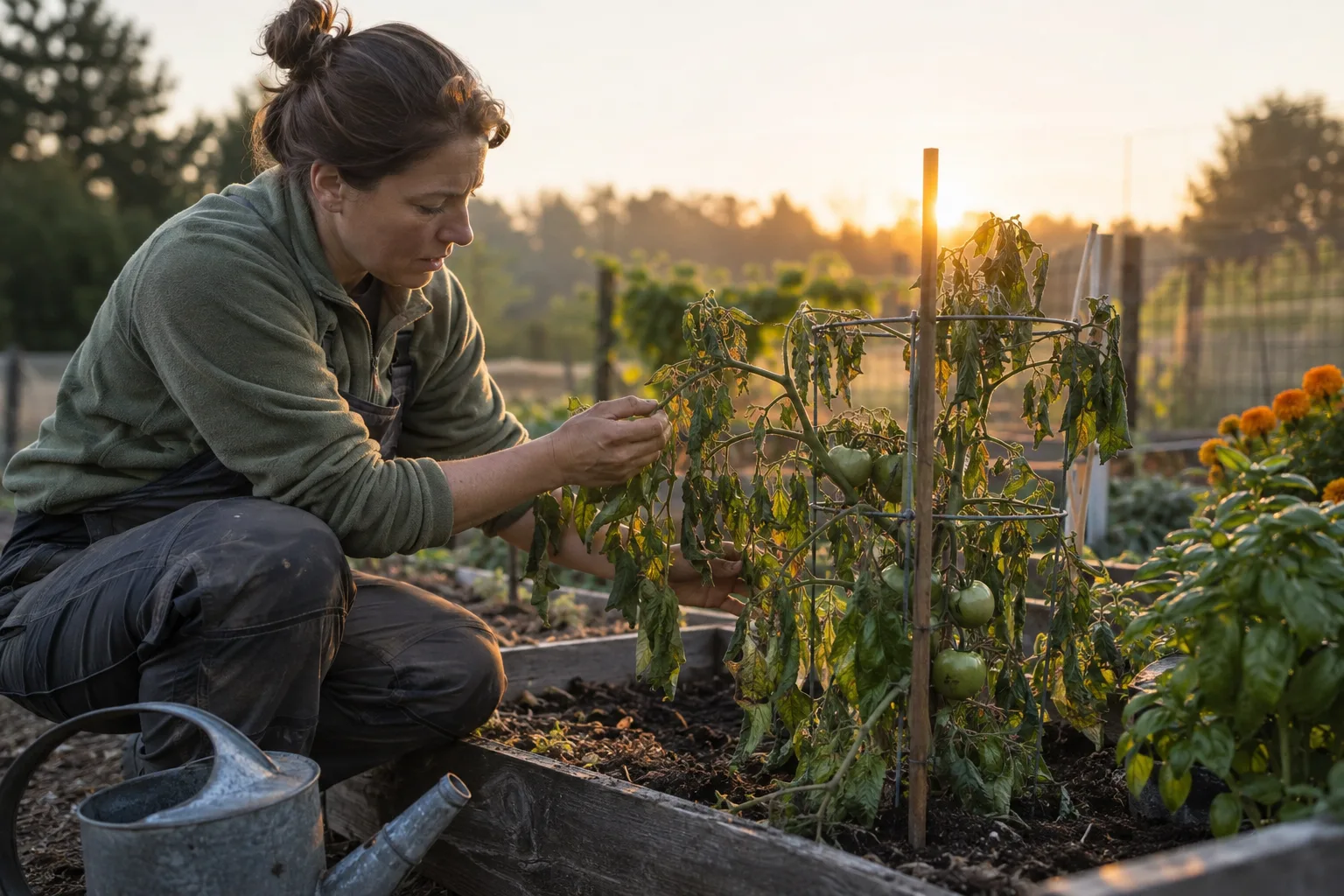
Arizona plants that need more water in April show it through leaf curl, wilting that lasts into the morning, dull color, dry soil below 2 inches, leaf drop, crispy edges, stalled growth and dropped flowers or fruit. Check them at sunrise, since morning symptoms are the most reliable ones.
Key takeaways
- Leaves that are curled or wilted at 7 AM, when the air is still below 80°F, point to a dry root zone.
- Push a screwdriver into the soil: dry below 2 inches for vegetables and annuals, or below 6 inches for established shrubs and trees, means it is time to water.
- Raise irrigation run times in steps of roughly 20 to 30 percent and recheck the plants after 2 days.
- Hard water clogs drip emitters, and a clogged emitter delivers no water at all.
- Caliche and salty soil can leave plants stressed even when the controller runs on schedule.
Why do plants in Queen Creek need more water in April?
Rising temperatures, low humidity and wind pull moisture out of leaves much faster in April than in February, so a winter irrigation schedule falls short. Highs in the East Valley commonly reach the 90s by mid-month and can touch 100°F, and afternoon humidity often drops into the teens. Leaves lose water faster than shallow roots can replace it.
Our soil adds to the problem. Alkaline soil, caliche layers and hard water all change how deep water travels and how much of it plants can use. A controller set in February and left alone is the first thing to check. Water needs also vary a great deal from plant to plant, so ask about a plant’s needs before you add it to your yard from our plant department.
What are the 8 signs a plant needs more water?
The eight signs below show up in roughly this order as April warms. One sign alone is a reason to check the soil. Two or three together mean the schedule needs to change.
1. Leaf curl or folding
Leaves that curl inward or fold lengthwise are cutting the surface they expose to sun and wind. Some curl on a 95°F afternoon is normal. Curl that is still there at sunrise means the plant did not rehydrate overnight and the root zone is dry. Hibiscus (Hibiscus rosa-sinensis), tomatoes (Solanum lycopersicum), peppers (Capsicum annuum) and citrus trees (Citrus species) show it early.

2. Wilting that lasts into the morning
A plant that is still drooping at 7 AM, when temperatures sit below 80°F, did not get enough water to recover. A well-watered plant looks firm at sunrise. Droop at 3 PM on a hot day is a normal response to heat. Basil (Ocimum basilicum) has shallow roots and wilts dramatically, so a sad basil plant at sunrise is a cue to check the rest of your herbs and vegetables.
3. Dull or gray-green color
Leaves that turn dusty, muted or gray-green have lost water from their cells. The change comes slowly, so photograph a plant in March and compare it with April. Judge each plant against its own baseline, because Texas sage (Leucophyllum frutescens) is silver-gray by nature. Look for a flat, washed-out look compared with how the plant appeared a few days after a deep soak.
4. Soil that is dry at depth
Soil that is dry below 2 inches around annuals and vegetables, or below 6 inches around established shrubs and trees, means the plant is short of water. The surface dries within hours in April wind, so it tells you little. The next section covers the test.
5. Yellowing and leaf drop
Plants shed leaves to cut water loss, usually the older interior leaves first. A stressed citrus tree often keeps foliage only at the branch tips. Desert willow (Chilopsis linearis) and palo verde (Parkinsonia species) also drop leaves in dry spells as a normal response, so check the soil before assuming something is wrong. Yellow new growth at the tips points to another cause, such as iron deficiency in alkaline soil. Our desert trees are a good place to look for trees suited to this climate.
6. Crispy leaf edges
Brown, dry margins with a clear line against the green tissue mean the outer edges of the leaf ran out of water. Lantana (Lantana camara), roses and broadleaf trees show this in April. Salt buildup can look identical, because salts from alkaline soil and hard water make it harder for roots to take up moisture. A long, slow soak moves those salts below the root zone.
7. Slow or tiny new growth
Plants that should be pushing new growth in April but sit still, or produce small, pale leaves, are often short on water. Tomatoes, squash and beans should add visible growth week to week. If growth stalls and the run times have not changed since winter, raise them in steps.
8. Dropped flowers and fruit
Plants abort buds and young fruit when water is short. A citrus tree naturally sheds many tiny fruit after spring bloom, so that alone is no warning. Larger fruit dropping alongside curled leaves is a warning. Tomatoes and peppers also drop blossoms when daytime highs pass the mid 90s or nights stay warm, and uneven watering adds to the loss.
How do I check soil moisture without guessing?
Use a long screwdriver or wooden dowel. Push it 6 to 8 inches into the soil near the drip line, the outer edge of the canopy, and not against the trunk.
If it slides in easily and comes out with damp soil on it, moisture is present. If it stops against hard, dry ground or comes out clean and dry, the roots have little to work with. A soil moisture meter gives a number instead of a feel, and either tool works. Test at 7 AM, then again 48 hours after a deep watering to learn how fast each bed dries out.

Why are my plants stressed when the irrigation is running?
Water often fails to reach the roots even when the system runs on schedule. Clogged emitters, emitters in the wrong place, caliche and salt buildup cause most cases.
Hard water leaves mineral deposits that clog drip emitters over time. Run each zone for a few minutes and look at every emitter. Any that is dry, dribbling weakly or spraying sideways needs cleaning or replacing.
Emitters set against a trunk wet the wrong ground. Roots spread out to the drip line, so move emitters outward as the plant grows. Short, frequent cycles wet only the top few inches, while a longer, slower cycle sends water deeper.
Caliche is a cemented layer of calcium carbonate that is common in Queen Creek soil, often a foot or two down. Water struggles to pass through it and roots stay shallow. If you hit a hard layer while planting, break through it before you backfill the hole.

How often should I water in April?
Established trees and shrubs need deep, widely spaced watering, while vegetables and containers need it every few days. The table gives starting points only, because soil texture, sun exposure and wind change them from one yard to the next. Use the screwdriver test to adjust, and see our gardening calendars for monthly tasks.
| Plant type | Starting interval in April | What to watch for |
|---|---|---|
| Established citrus | Every 7 to 14 days | Morning leaf curl, larger fruit dropping |
| Young trees and shrubs (first 2 years) | Every 3 to 7 days | Wilting, dry soil at 6 inches |
| Established desert trees and shrubs | Every 10 to 21 days | Dull leaves, early leaf drop |
| Vegetable beds | Every 2 to 4 days | Wilting, blossom drop |
| Containers, annuals and herbs | Daily to every 2 days | Wilting at sunrise, yellowing |
| Established cacti and succulents | Every 14 to 28 days | Wrinkling, soft or puckered pads |
How do I fix water stress step by step?
Confirm the problem with a soil test, repair the delivery system, then raise watering in measured steps. Changing everything at once makes it hard to tell what worked.
- Walk the yard at 7 AM and note every plant that is wilted, curled or discolored.
- Test the soil near each of those plants with a screwdriver or dowel and record how deep the dry layer goes.
- Run each drip zone for a few minutes, then clean or replace any emitter that is clogged or weak.
- Move emitters out to the drip line of trees and large shrubs.
- Raise run times by roughly 20 to 30 percent, favoring longer cycles over extra short ones.
- Recheck the plants 48 hours later. Morning firmness should improve if water was the cause.
When is it something other than a lack of water?
If symptoms continue 1 to 2 weeks after the soil stays moist at the right depth, look for another cause. Spider mites are common in hot, dry weather and leave a stippled, dusty look on leaves, sometimes with fine webbing on the underside. Yellow new leaves with green veins usually point to iron deficiency in alkaline soil. Soft, brown roots point to soil that stays wet too long.
Bring a photo or a leaf sample to the nursery, or contact us with a description. For disease and pest identification, the University of Arizona Cooperative Extension office in Maricopa County is also a reliable source.
Frequently asked questions
How can I tell overwatering from underwatering?
Overwatered plants sit in soil that stays wet 4 to 6 inches down, while underwatered plants sit in dry soil. Both can show yellow leaves, wilting and leaf drop. Overwatered soil may smell sour, and the roots turn soft and brown. Check the depth of moisture before each watering, and wait a day or two if the soil is still damp.
Do cacti and succulents need water in April?
Established cacti and succulents usually need water only every 2 to 4 weeks in April, and a deep soak works better than light sprinkles. Wrinkled barrel cactus or soft, puckered prickly pear pads show the plant is using stored water. Newly planted ones need water more often while roots establish. Let the soil dry fully between waterings to avoid root rot.
Does mulch reduce how often I need to water?
Yes, a 2 to 3 inch layer of wood chips or similar organic mulch slows evaporation and keeps the root zone cooler. Pull it back a few inches from trunks and stems to prevent rot. Mulch can hide dry soil, so keep testing with a screwdriver or dowel before you adjust the schedule.
What time of day should I water in April?
Early morning, ideally before 8 AM, is the best time to water. Cool air and light wind mean less evaporation, so more water reaches the roots. Evening watering leaves foliage and soil damp overnight, which can invite fungal problems on some plants. Midday watering loses more to evaporation, though a wilting plant should still get water right away.
Can I still plant in April?
It depends on the plant. The University of Arizona Cooperative Extension vegetable planting calendar for Maricopa County lists the planting window for each crop, and many warm-season crops are best started earlier in spring. Trees and shrubs usually do better planted in fall. Any April transplant needs water every few days while its roots establish.
Is your watering schedule ready for April?
If any of the signs above showed up at sunrise, it is not ready, and raising run times in steps while you test the soil is the right response. Owners of established native plants such as palo verde, on a deep and infrequent schedule, usually need only a light adjustment and can skip a big overhaul. Containers and new plantings need the most attention. Stop by our nursery in Queen Creek and bring a photo of whatever is struggling.