

Achillea millefolium ‘Desert Eve Yellow’ — a compact yarrow bred for hot climates, with flat golden flower heads over ferny foliage from spring into fall. Full sun, low water once established, and cut it back after each flush.
Yarrow is one of the few flowering perennials that genuinely prefers the conditions Queen Creek offers — full sun, alkaline soil, not much water — and ‘Desert Eve’ is the series bred for exactly this: shorter and tighter than old-fashioned yarrow, about a foot tall, with flat plates of small flowers that butterflies land on all spring and again in fall. The ferny gray-green foliage is aromatic and evergreen in a mild winter.
We commonly carry ‘Desert Eve Yellow’. Plant it in fall or spring, water it in, and then mostly leave it alone. Mildly toxic to pets. The rest of our perennials are on the Plants pages.
This is the Yarrow ‘Desert Eve’ we commonly carry. Availability changes week to week and season to season, so call (480) 987-3308 or stop in to see what’s on the bench today.
Achillea millefolium ‘Desert Eve Yellow’: a heat-tolerant compact yarrow, 12–14 inches, with bright yellow flat-topped flower heads from March through June and again in fall, over aromatic ferny foliage.
Looking for one that isn’t listed? Ask — we can usually suggest a close match or tell you when it tends to come around.
The care tag was written somewhere else. This is the Queen Creek version.
October through April is the easy window; fall plantings root through winter and bloom heavily the first spring. Container plants can go in through June with extra water. Yarrow is fully frost-hardy.
Any well-drained soil, unamended is fine; rich soil and generous water make it floppy and short-lived. Water every three to four days for the first month, then deep and infrequent: weekly in summer, every two to three weeks in winter, on drip. Established clumps are drought-tolerant. Wet soil in monsoon season is the one thing that kills it.
Yarrow spreads slowly by rhizomes into a clump a couple of feet across. Divide every three or four years in fall, replanting the vigorous outer pieces and discarding the woody center. It self-sows lightly.
Full sun, all day. Yarrow in shade flops and flowers poorly. It handles reflected heat off walls and gravel well.
Shear the whole plant back to the basal foliage when a flush of flowers browns — usually in June and again in November. It rebounds and reblooms within weeks in the growing season. Cut flowers for the vase or for drying when fully open; they last two weeks.
No fertilizer needed; a light dose in spring at most. Aphids on buds occasionally; powdery mildew in a crowded humid spot. Yarrow is mildly toxic to cats and dogs if eaten in quantity.
Snap a photo of the spot — sun, soil, what’s already there — and we’ll pick perennials that will still be alive in three summers. Advice is free.
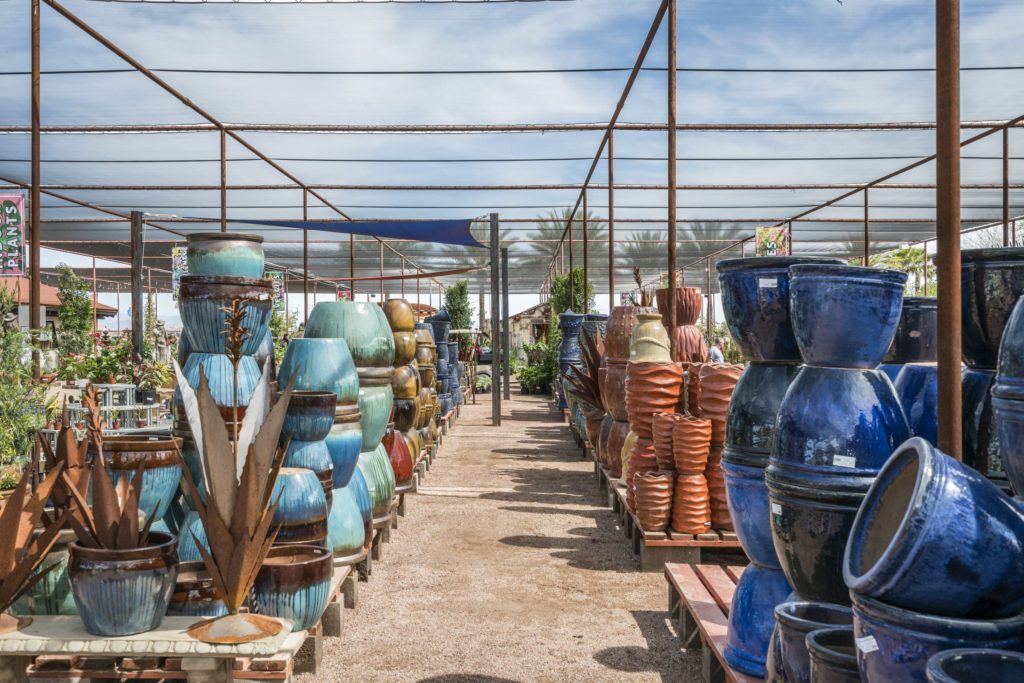
Perennials are a soil investment: we stock planting mix and compost to break up caliche-heavy beds, gypsum, slow-release and bloom fertilizers, drip fittings and bark or rock mulch. The pottery yard has large glazed and terracotta pots for the ones that live on a patio, and soil and mulch is sold by the bag or by the yard.

October through April is ideal. It is a hardy perennial and can go in from containers most of the year with water.
Weekly in summer and every two to three weeks in winter once established. It prefers dry to wet and dislikes soggy monsoon soil.
Too much water, too rich a soil, or too little sun. Cut it back, ease off the water and feeding, and give it full sun.
After each flush of flowers browns, to the basal foliage — usually June and November. It reblooms quickly in the growing season.
Slowly, into a clump a couple of feet wide. Divide every three or four years.
Mildly toxic to cats and dogs if eaten in quantity; usually left alone.
Yarrow ‘Desert Eve’ live on the perennial benches; any staff member can point you to them. Locally owned, and a short drive from San Tan Valley, Gilbert, Chandler and Mesa.