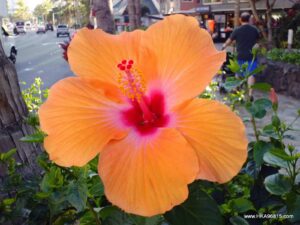

The best pink flowering plants for Arizona desert gardens are bougainvillea, autumn sage, fairy duster, desert willow, globe mallow, Parry’s penstemon, pink muhly grass and pink trumpet vine. Together they bloom from February through November in the low desert.
Key takeaways
- Plant in October and November or February and March, so roots settle in before temperatures pass 110°F.
- Desert willow is the only plant on this list that reliably flowers through July and August.
- Bougainvillea and pink trumpet vine can freeze back when winter lows drop into the upper 20s, so give them a warm wall.
- Use native soil to backfill the hole and keep the top of the root ball slightly above grade for drainage.
- Group three or five of one plant instead of one of everything, and the color reads as a plan.

Which pink flowering plants work best in the Arizona low desert?
These eight handle alkaline soil, reflected heat and hard water better than most pink bloomers sold for other climates. They are varieties we commonly carry, though availability changes week to week and season to season. Browse the full range on our plants page to see what is in right now.
Bougainvillea (Bougainvillea spp.)
Bougainvillea is a woody vine or sprawling shrub covered in magenta to pink bracts, which are modified leaves around small white flowers. Size ranges from 3 feet for compact types to 15 feet or more for climbers. It wants full sun and a hot wall, and it blooms hardest in spring and fall when the soil dries between deep waterings. The drawback is frost. Temperatures in the upper 20s will burn it back, and it dislikes root disturbance when planted.
Autumn sage (Salvia greggii)
Autumn sage is a compact shrubby perennial with tubular flowers in pink, coral and red. It reaches about 2 to 3 feet tall and wide. Give it full sun, or afternoon shade in the hottest spots. It needs moderate water at first and less once established, and it blooms in spring and again in fall. Plants turn woody and leggy without a cutback in late winter. Bloom slows in the peak heat of June and July.
Fairy duster (Calliandra eriophylla)
Fairy duster is a native shrub with fluffy pink powderpuff flowers that open from late winter into spring. Expect roughly 2 to 4 feet in height and width. It wants full sun, excellent drainage and very little water once established. It looks airy and slightly sparse, which suits a naturalistic yard but not a formal hedge. The foliage can thin out in the coldest and hottest weeks.
Desert willow (Chilopsis linearis)
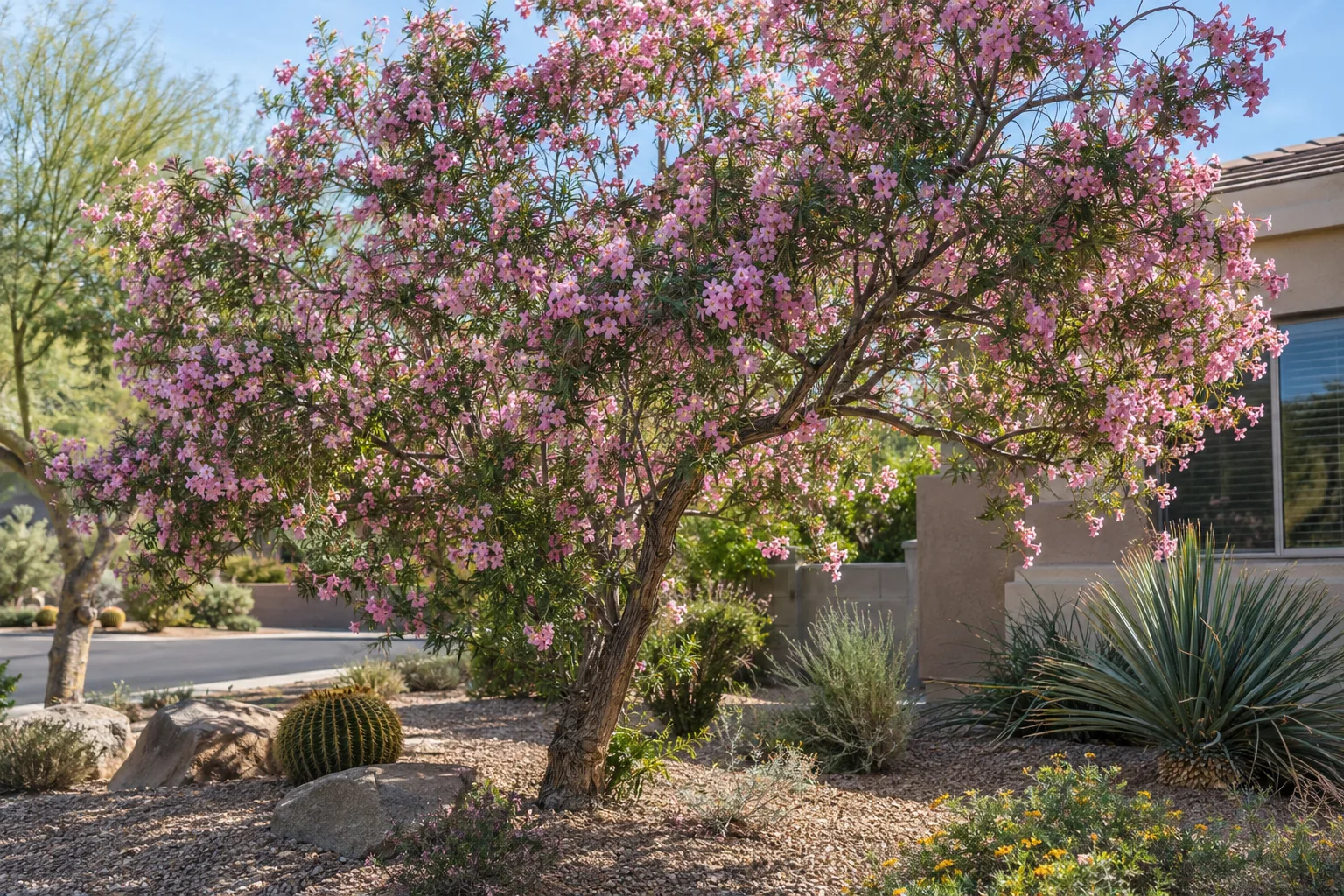
Desert willow is a small, multi-trunk native tree with trumpet flowers in white, pink, lavender and deep purple-pink, depending on the selection. Mature height is commonly 15 to 25 feet. It takes full sun, deep and infrequent water, and blooms from late spring into early fall. It is the best bet here for summer color. The drawback is mess, since it drops spent blooms and long seed pods. See more options in our flowering trees.
Globe mallow (Sphaeralcea ambigua)
Globe mallow is a native perennial with cup-shaped flowers, most often apricot to orange, with some pink-toned selections. It grows about 2 to 4 feet tall and wide and blooms heavily in spring, with lighter flushes after rain. Full sun and little water suit it. It looks ragged after bloom and reseeds freely, so pull the seedlings you do not want.
Parry’s penstemon (Penstemon parryi)
Parry’s penstemon sends up tall spikes of rose-pink tubular flowers from roughly February through April, and hummingbirds visit them. The flower stalks reach 3 to 4 feet over a low evergreen rosette. It needs full sun and sharp drainage. Overwatering in summer rots it quickly. It is also a short-lived plant that depends on reseeding to keep a colony going.
Pink muhly grass (Muhlenbergia capillaris)
Pink muhly grass forms a 3 to 4 foot clump that turns into a cloud of pink-purple plumes in October and November. It tolerates full sun and most soils, including alkaline ones. It uses more water than the natives above, so plan on regular deep watering through summer. It also does nothing for color until fall, so pair it with spring bloomers.
Pink trumpet vine (Podranea ricasoliana)
Pink trumpet vine is a fast climber with clusters of soft pink, red-veined funnel flowers from late spring through fall. It can cover a fence or pergola 15 feet or more across within a few seasons. Full sun and moderate water keep it going. It is aggressive, needs a strong support, and freezes back in hard winters before resprouting from the base.
When does each pink bloomer flower?
Bloom windows below are typical for the East Valley, and they shift a few weeks with each year’s weather. Mixing early, midseason and late bloomers is how a yard stays pink for most of the year.
| Plant | Main bloom months | Water once established |
|---|---|---|
| Parry’s penstemon | February to April | Very low |
| Fairy duster | February to April | Very low |
| Globe mallow | March to May | Very low |
| Autumn sage | March to May, again in fall | Low to moderate |
| Bougainvillea | March to May, again in fall | Low |
| Pink trumpet vine | May to October | Moderate |
| Desert willow | May to September | Low |
| Pink muhly grass | October to November | Low to moderate |
When should I plant pink flowering plants in Queen Creek?
Plant in October and November, or in February and March. A plant set out in fall has the whole mild season to build roots before the first 110°F stretch arrives.
Summer planting is possible but demands daily attention while the soil bakes. Our gardening calendars lay out what to do each month in the low desert, which helps you time the rest of the yard around these plantings.
How do I plant in caliche and alkaline soil?
Dig the hole two to three times as wide as the root ball and only as deep as it, then backfill with the native soil you removed. Heavy compost in the hole can hold water around the roots while the surrounding caliche stays dry.
Test drainage first by filling the hole with water. If it still holds water after several hours, break through the hardpan or plant on a low mound. Set the crown slightly above grade, build a basin around the plant and keep mulch a few inches away from the stem.

Most of these plants dislike wet crowns. Water slowly at planting to settle the soil, then let the top several inches dry before the next deep soak.
How much water do pink desert plants need?
Established desert natives need deep soaking every two to three weeks in summer and far less in winter. New plants need water more often for the first year, often every few days in summer and weekly in cooler months, tapering as roots spread.
Hard Valley water leaves mineral salts, so deep soaks that push salts below the root zone work better than frequent light sprinkling. Drip emitters set 12 to 18 inches from the crown encourage roots to reach outward. Watch the plant, because wilting in July can mean too little or too much water. Check the soil 6 inches down before you add more.
Monsoon storms from roughly July through September cover some of the work, so skip a scheduled watering after a good soaking rain.
How do I combine pink bloomers in a design?
Pair plants with different bloom windows, and repeat each in groups of three or five. Pink flowers show best against gray-green foliage, gravel and warm-toned walls.
- Parry’s penstemon, fairy duster and globe mallow give a native spring display with very little water.
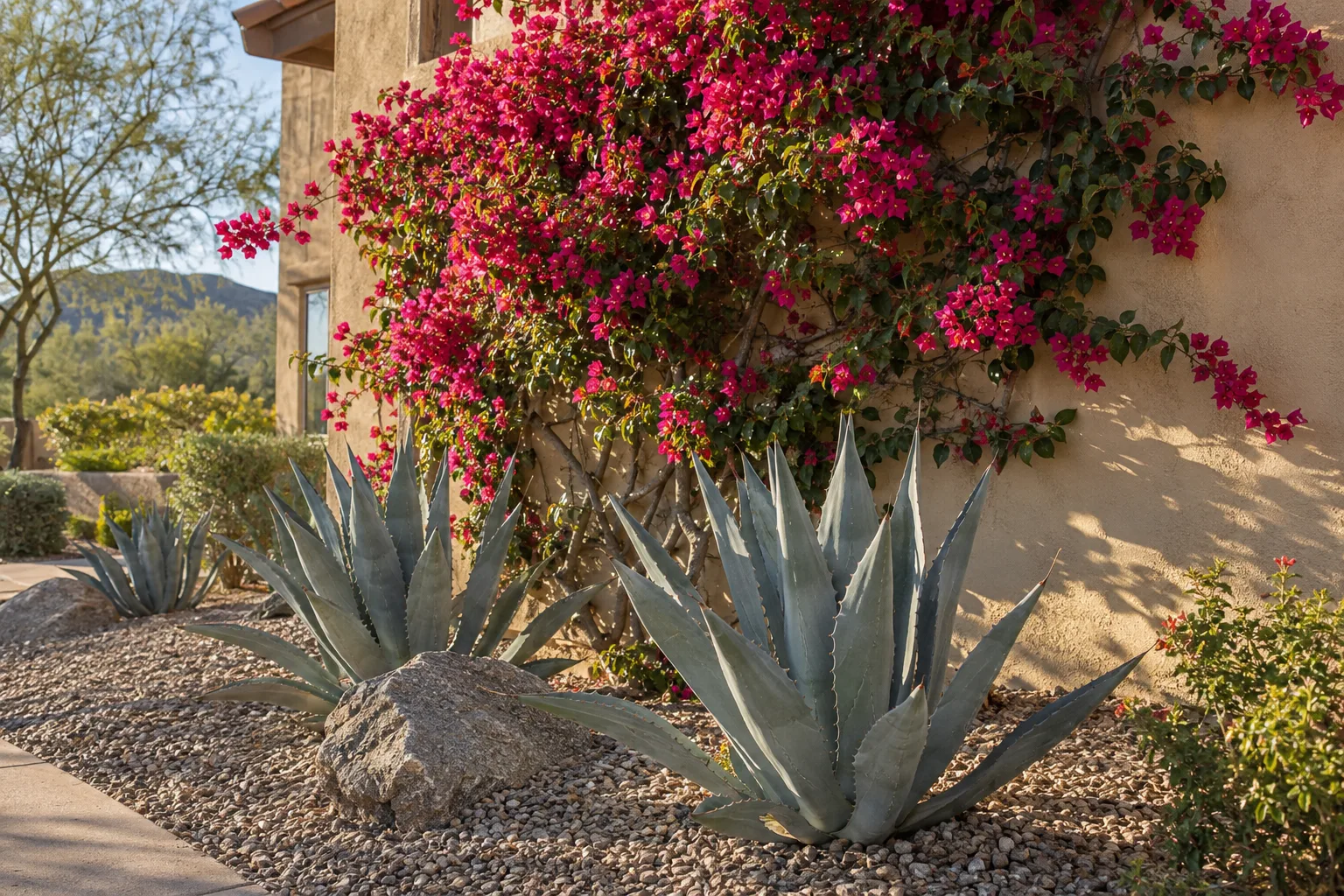
- Bougainvillea on a west wall with agave below it adds fall and spring color.
- Autumn sage in front of a desert willow keeps bloom going from spring into September.
- Pink muhly grass behind spring bloomers fills the gap in October and November.
If you want help matching plants to your light and soil, check our classes and events for upcoming desert gardening sessions.
Frequently asked questions
Which of these attract hummingbirds?
Parry’s penstemon, autumn sage and desert willow are the strongest draws, because their tubular flowers fit hummingbird bills. Fairy duster also attracts them, along with native bees. Planting two or three of these with different bloom times gives hummingbirds something to visit in most months of the year.
Which is easiest for a beginner?
Autumn sage and desert willow are forgiving choices. Autumn sage tolerates a missed watering and recovers from hard pruning. Desert willow needs deep watering only occasionally once established. Penstemon and fairy duster are easy too, but only if drainage is sharp and you resist the urge to water them often.
Will frost damage these plants?
Bougainvillea and pink trumpet vine are the frost-tender ones, and they can lose leaves or die back when temperatures drop into the upper 20s. Cover young plants on frost nights or plant them against a south or west wall, which holds heat. The natives and muhly grass handle ordinary East Valley frost.
When should I prune autumn sage and pink muhly grass?
Cut both back in late winter, around February, before new growth starts. Trim autumn sage by about a third to keep it full, and shear muhly grass to a few inches above the crown. Cutting later risks removing buds and delays spring flowering.
Can I grow pink bloomers in containers?
Autumn sage, compact bougainvillea and fairy duster do reasonably well in large pots with a fast-draining mix. Containers heat up and dry out quickly in summer, so check moisture often. Large, light-colored pots keep roots cooler than small dark ones. See our pottery and planters for sizes.
Which pink bloomer should you plant first?
Start with desert willow if you want summer color and have room for a small tree, or autumn sage if your yard is small and you want bloom in spring and fall. Choose Parry’s penstemon and fairy duster for a low-water native bed. Skip bougainvillea if your yard has no warm, protected wall, and skip pink muhly grass if you want a plant that needs no summer water. Come see what we have in Queen Creek and we will help you choose.