Lavender, Russian sage, desert willow, autumn sage, lantana, agapanthus and blanket flower are the perennials to keep out of containers in Arizona. Pot soil overheats and dries within hours, and each of these plants outgrows or outlasts a pot only briefly.
Key takeaways
- A pot in afternoon sun can heat its root zone well past 110°F in July, while ground soil a few inches down stays much cooler.
- Desert willow reaches 15 to 25 feet tall, so a pot is a holding spot for two or three years at most.
- Pots of 5 to 15 gallons can dry out in a single summer day, and hard water leaves salts behind in the mix.
- Move potted perennials into the ground in October through November or February through March, never in summer.
- Bougainvillea, dwarf citrus, agave and compact herbs handle containers far better than these seven.
Why do perennials struggle in pots in the Arizona low desert?
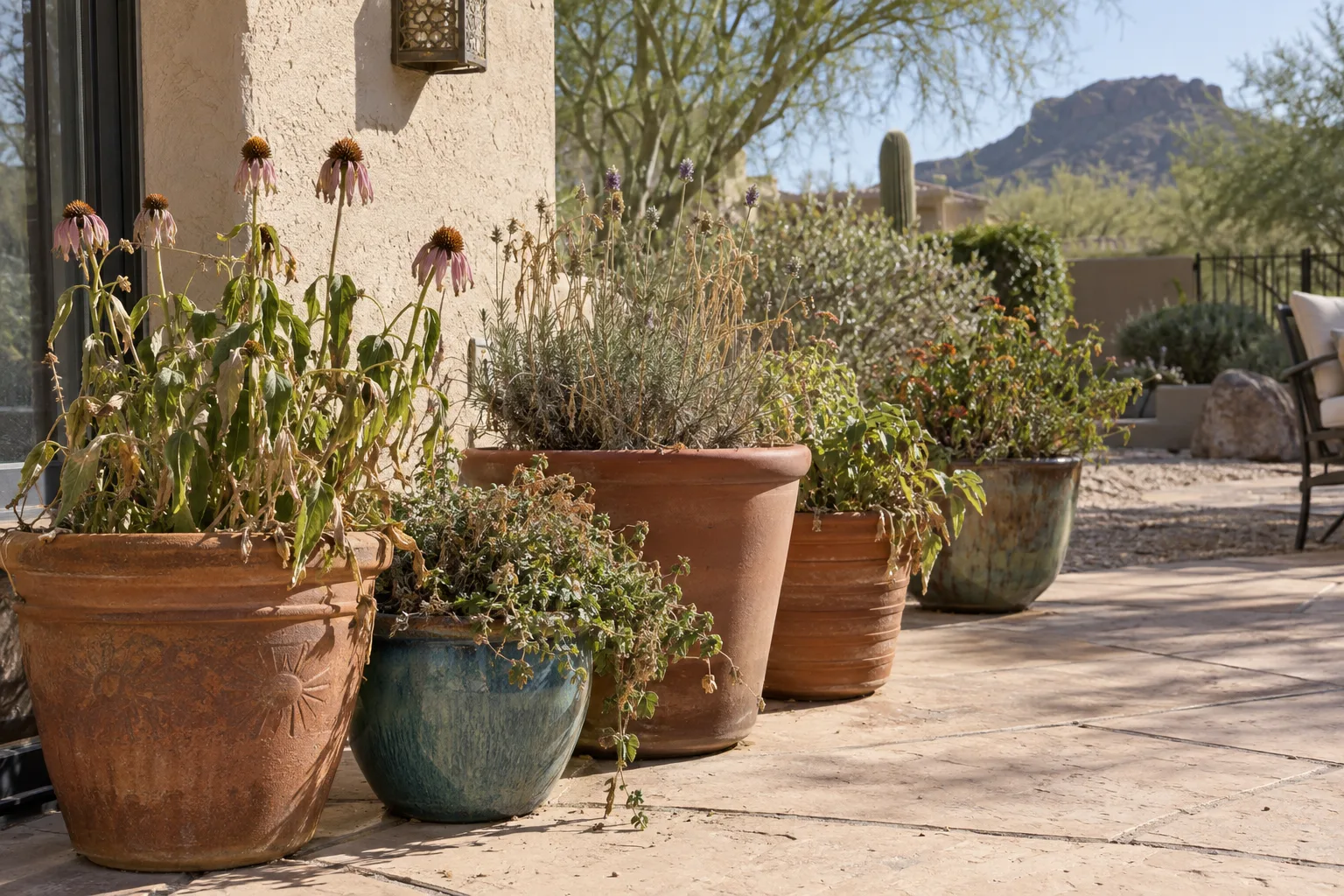
A pot gives roots a small volume of soil that is exposed to sun and hot air on every side. Ground soil is a huge, slow-heating mass, so roots in the ground sit in a steadier, cooler environment.
Summer highs above 110°F, heat reflected off stucco and concrete, and a dark pot on a west wall can push root-zone temperatures well past what most perennials tolerate. Small pots also run dry fast. A 5 to 15 gallon container may need water daily, or even twice a day, in July.
Our hard, alkaline water adds a second problem. Every watering leaves a little salt in the mix, and a pot has no deep soil to flush it away. Add monsoon humidity from roughly July through September, and drainage-loving plants sit in damp, hot soil.
Bigger, light-colored pots from our pottery and planters department soften the heat. They do not remove it.
Which seven perennials should stay out of pots?
These seven do their best work in the ground. Each one below lists size, sun, water and the main reason it struggles in a container.
1. Lavender (Lavandula stoechas and Lavandula dentata)
Spanish and French lavender reach about 2 to 3 feet tall and wide. They want full sun and little water once established. The drawback is drainage: roots rot in hot, damp pot soil during monsoon humidity, and English lavender (Lavandula angustifolia) struggles in the low desert even in the ground. Give any lavender a raised, gritty planting spot instead.

2. Russian sage (Perovskia atriplicifolia)
This airy perennial grows 3 to 5 feet tall and 3 to 4 feet wide in full sun. It needs sharp drainage and little water. The drawback is that it dislikes the heat and humidity of a low-desert summer even in the ground, and a pot makes both worse. Expect floppy, thin growth. Plant it in a raised bed or skip it.
3. Desert willow (Chilopsis linearis)
Desert willow is a small tree, not a true perennial, that reaches 15 to 25 feet tall and about as wide. It wants full sun and deep, infrequent water once established. The drawback is size. A young plant can sit in a pot for a short time, but it needs a ground spot within two or three years. Our desert trees page shows the kinds of trees that suit a yard here.
4. Autumn sage (Salvia greggii)
Autumn sage grows 2 to 4 feet tall and wide, in full sun or light afternoon shade. Water is low to moderate. The drawback is summer stress in a pot, where leaves drop and stems die back as the soil bakes. It blooms heavily in fall and spring, and it rebounds from frost much better in the ground than in a container.
5. Lantana (Lantana camara)
Lantana spreads 3 to 6 feet wide in full sun and handles heat well. Its water needs are low to moderate once established. The drawback is scale. It fills a pot with roots quickly, wilts by afternoon in July, and needs heavy pruning to stay in bounds. Compact and trailing types last longer in pots than the large ones. Even so, plan on one or two seasons.
6. Agapanthus (Agapanthus africanus)
Agapanthus forms clumps 2 to 3 feet tall and wide. In the low desert it prefers morning sun with afternoon shade and more regular water than the others here. The drawback is salt. Hard water leaves deposits in pot soil, leaf tips brown, and the fleshy roots decline in hot, soggy mix. Slightly crowded roots help flowering in mild climates, but our summers turn that crowding into stress.
7. Blanket flower (Gaillardia x grandiflora)
Blanket flower grows 1 to 2 feet tall and wide in full sun with low water. The drawback is its short life. It often lasts only two or three years, and in a pot it looks ragged by midsummer. A cool-season pot of blanket flower for color is fine. Treat it as a seasonal plant and replace it.
Can I still grow these perennials in a pot for a season?
Yes, for a limited time, if you accept that the plant is temporary. The largest pot you can handle, 20 gallons or more, holds moisture and heat more steadily than a small one.
Place the pot where it gets morning sun and afternoon shade, such as an east wall. Raise it on pot feet so air moves underneath and drainage does not stall on hot concrete. Water deeply until it runs out the bottom, and flush the pot every few waterings to move salts out of the mix.
Even with all that care, plan the move to the ground. A perennial held in a pot through its second summer usually declines, and the decline often looks like disease when it is heat and salt stress.
How do the seven compare in a pot?
The table below sums up size and the main container problem for each plant.
| Plant | Mature size | Main pot problem | Better home |
|---|---|---|---|
| Lavender | 2 to 3 feet | Root rot in damp, hot mix | Raised, gritty bed |
| Russian sage | 3 to 5 feet | Heat and drainage stress | Raised bed in full sun |
| Desert willow | 15 to 25 feet | Outgrows any pot | Open ground spot |
| Autumn sage | 2 to 4 feet | Summer root stress | In-ground, afternoon shade |
| Lantana | 3 to 6 feet wide | Dries fast, root-bound | In-ground with drip |
| Agapanthus | 2 to 3 feet | Salt buildup, heat | Shaded ground bed |
| Blanket flower | 1 to 2 feet | Short life, ragged in summer | Sunny bed, cool season |

What grows better in pots here?
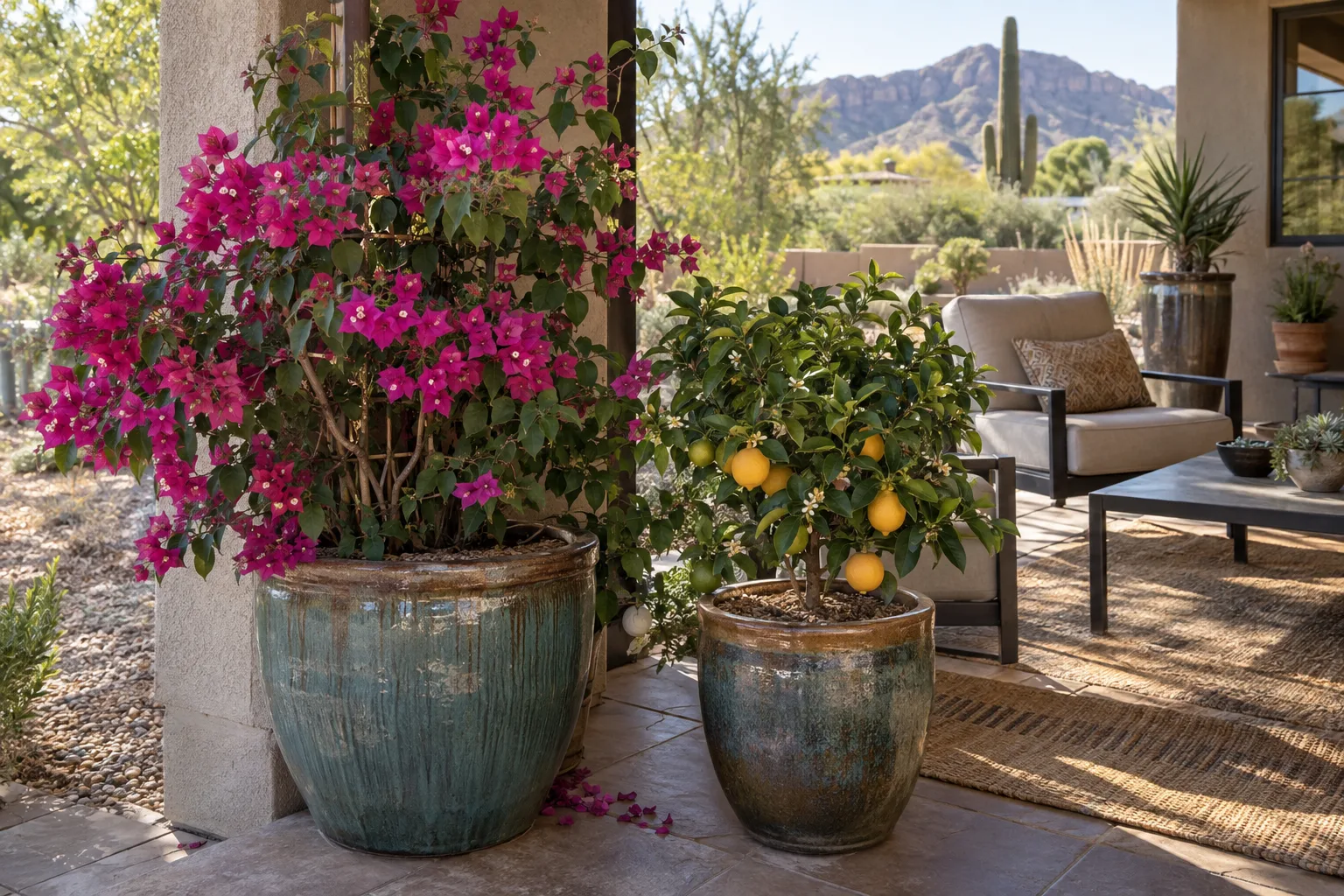
Plants with compact roots and a high heat tolerance do best in containers in the low desert. Bougainvillea, agave, aloe, fairy duster and dwarf citrus are all commonly grown in pots in the East Valley.
Citrus in a large pot needs steady feeding and deep watering, and the shade of a covered patio helps in July. Browse our citrus trees to see what is possible, and note that varieties we commonly carry change week to week and season to season.
Rosemary, thyme and many other herbs also suit pots, especially terracotta, with morning sun and an afternoon break. Look through our herbs, vegetables and berries for container-friendly choices. For flowering plants that suit the ground, our plant selection covers shrubs and perennials by sun and water need.
When should I move a potted perennial into the ground?
Move it in fall, from October through November, or in late winter, from February through March. Roots then have several weeks to settle before summer heat returns. Planting in June or July usually fails.
Dig the hole twice as wide as the pot and no deeper than the root ball. If you hit caliche, break through it so water can drain. Set the top of the root ball slightly above grade, backfill with the native soil, and water in slowly. Our gardening calendars list what to plant in each month.
Frequently asked questions
Does a bigger pot fix the problem?
A bigger pot helps, but it does not fix it. A 25-gallon or larger container holds moisture and cools more slowly than a small one. It still sits exposed to sun and hot air on every side, so root-zone stress returns in July and August, and desert willow still outgrows it.
Are terracotta or fabric pots better than plastic?
Terracotta and fabric pots breathe, so soil dries faster and stays slightly cooler than in dark plastic. That helps lavender and other plants that dislike wet roots. The drawback is more frequent watering in summer, sometimes daily. Light-colored glazed pots also reflect heat better than black plastic.
How can I tell a potted perennial is heat stressed?
Look for wilting that returns each afternoon even when the soil is wet, leaf drop from the lower stems, and browned leaf edges. Stress that appears during June through September points to root-zone heat. Moving the pot to morning sun and afternoon shade is the first fix.
Do potted perennials need frost protection?
Yes, on the rare nights near freezing. Roots in a pot have no soil insulation, so they can freeze when the same plant in the ground would not. Move pots against a south or east wall, or cover them with frost cloth on forecast cold nights, then uncover them the next morning.
Should you plant these perennials in pots or in the ground?
Plant them in the ground if you have any soil to spare, even a small bed beside the patio. Each of these seven lives longer, blooms more and needs less water there. If you garden on a balcony, rent, or have only paved space, skip them and choose bougainvillea, agave, herbs or dwarf citrus. They are built for pot life here. Stop in and visit us at the nursery in Queen Creek, and we will help you match plants to your space.