The best perennial flowers for Arizona heat are desert-adapted plants such as blackfoot daisy, desert marigold, globe mallow, penstemon, autumn sage, red bird of paradise and desert ruellia. Once established in well-drained soil, all seven handle summer highs above 110°F.
Key takeaways
- Blackfoot daisy, desert marigold, globe mallow, penstemon, autumn sage, red bird of paradise and desert ruellia are reliable in the low desert.
- Plant in October through November or February through March so roots establish before summer highs above 110°F.
- Set the crown level with or slightly above the surrounding soil, because a buried crown rots.
- Alkaline soil (often pH 7.5 to 8.5) and caliche favor fast drainage and a thin gravel mulch over heavy compost.
- Overwatering kills more established desert perennials than drought, so check the soil 4 to 6 inches down before irrigating.
Which perennial flowers handle Arizona summer heat?
Seven perennials stand out for the low desert, and each has a different size, bloom window and weakness. These are varieties we commonly carry, though availability changes week to week and season to season, so browse our plants page to see what is available. Here is how they compare.
Blackfoot daisy (Melampodium leucanthum)
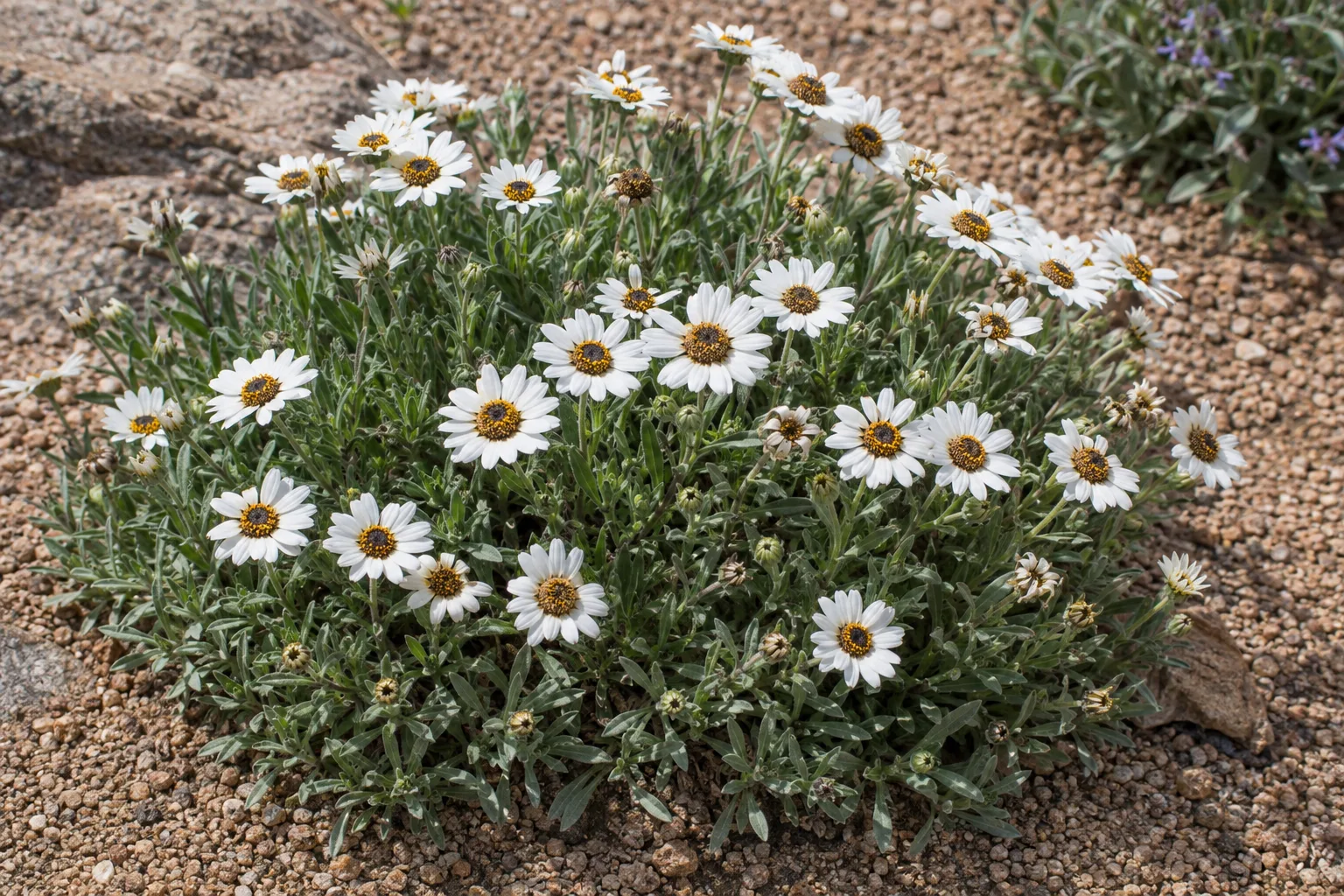
This native forms a mound 12 to 18 inches tall and about as wide, covered in white daisies with yellow centers. It wants full sun and gravelly, fast-draining soil, and it needs little water once established. Bloom runs from spring into fall, with a slower stretch in midsummer. The drawback is root rot in heavy or soggy ground.
Desert marigold (Baileya multiradiata)
Desert marigold grows 1 to 2 feet tall and wide, with silver-gray leaves and yellow, papery flowers on tall stems. Give it full sun and very little water. It handles reflected heat from block walls and pavement. Individual plants are often short-lived, so let it reseed to keep a patch going, and expect it to look ragged between bloom flushes.
Globe mallow (Sphaeralcea ambigua)
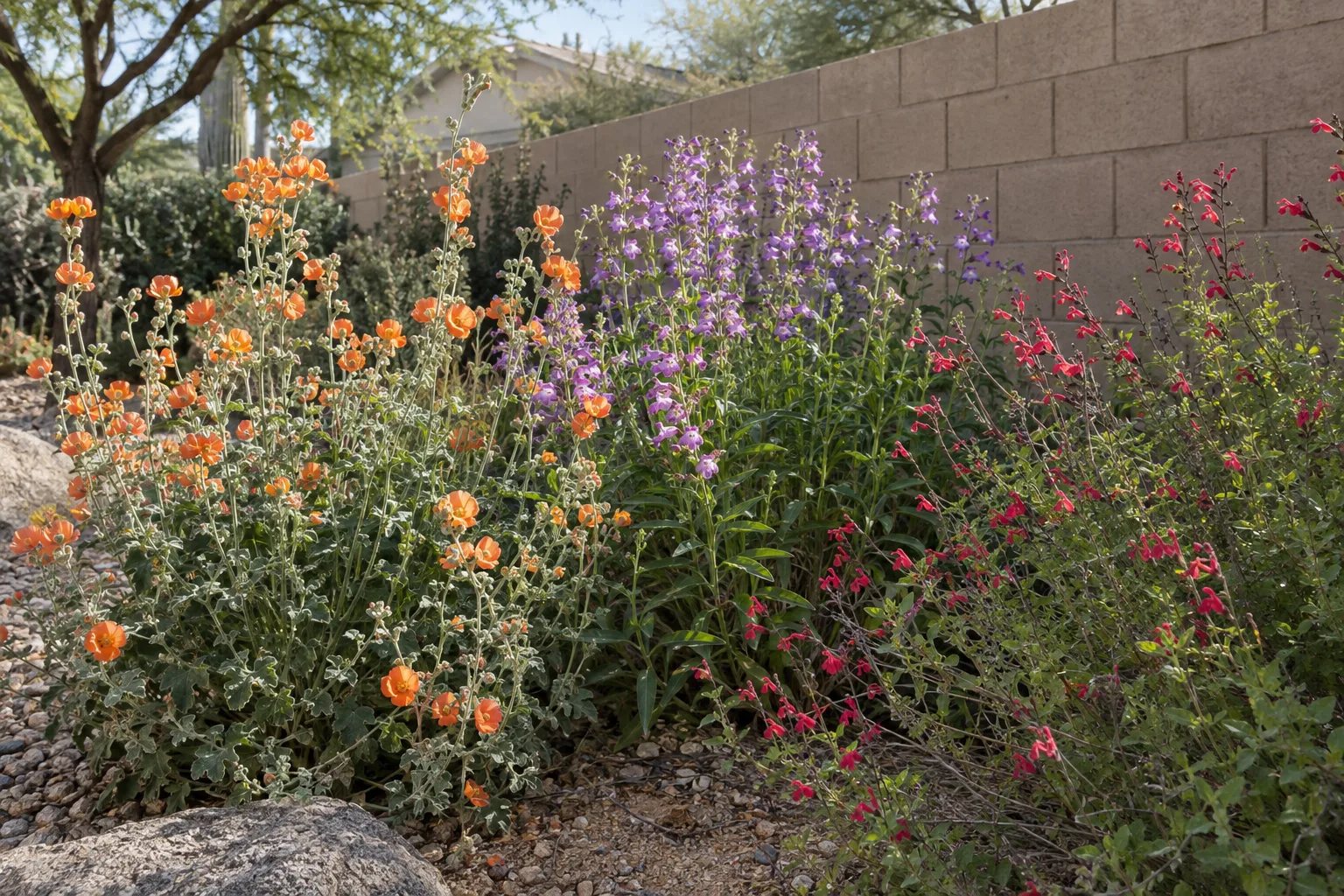
Globe mallow reaches 2 to 3 feet tall and wide, with apricot-orange flowers (sometimes pink or lavender) above gray-green leaves. It needs full sun and low water. Flowers appear from late winter into early summer and often again after monsoon rain. It can sprawl and look scraggly in midsummer, so cut it back after the main bloom.
Parry’s penstemon (Penstemon parryi)
Tall spikes of pink-magenta flowers rise 3 to 4 feet above a low rosette in late winter and spring, and hummingbirds visit them. Plant in full sun with gravelly soil and low water. The drawback is a short bloom window. Summer overwatering also rots the roots, so mound the planting area if your soil drains slowly.
Autumn sage (Salvia greggii)
Autumn sage grows 2 to 3 feet tall and wide and blooms in red, pink, coral, salmon or white. Bloom peaks in spring and fall, with lighter flowering through summer. It takes full sun, though afternoon shade helps on hot west-facing walls. Water needs are low to moderate. Without regular pruning it turns woody and leggy.
Red bird of paradise (Caesalpinia pulcherrima)
This large shrubby perennial reaches 5 to 8 feet tall and nearly as wide, with orange-red flower clusters that peak in the hottest months. It needs full sun and low water once established. Frost can freeze it to the ground, though it often regrows in spring. Its size is the main drawback, so give it room.
Desert ruellia (Ruellia peninsularis)
Desert ruellia is a rounded shrubby perennial 3 to 4 feet tall and wide, with purple-blue trumpet flowers from spring into fall. It grows in full sun or light shade on low to moderate water. Frost can burn the tops, and the stems get woody over time, so it needs periodic cutting back.
When should I plant perennial flowers in the low desert?
Plant in October through November or February through March. Roots need several cool months to spread before summer highs above 110°F arrive, and fall planting gives the longest runway. The University of Arizona Cooperative Extension planting calendar is a good reference for local timing.
Summer planting is possible but demands shade cloth and frequent watering while the roots settle. Winter frost can nip new growth in February, so keep frost cloth handy for the first season.
While your perennials fill in, annual flowers and foliage can cover bare ground with seasonal color. Our gardening calendars list what to do each month in the East Valley.
How do I prepare Queen Creek soil for perennials?
Dig a hole two to three times as wide as the pot but no deeper than the root ball. Queen Creek soil is alkaline and often sits on caliche, a cement-like layer of calcium carbonate that blocks roots and drainage. Compost-rich beds hold too much water for most desert perennials.

Test drainage before planting by filling the hole with water. If water is still standing the next morning, the hole drains poorly. You can break through the caliche with a digging bar, or you can plant on a mound or in a raised bed. Mulch with about 2 inches of decomposed granite, keeping it off the crown.
How often should I water desert perennials?
Water new plants every 2 to 3 days in summer heat and every 5 to 7 days in cooler months for the first two to three months. After that, water deeply and far less often. Established plants usually need a deep soak every 7 to 14 days in summer and every 2 to 3 weeks in winter.

Use your finger or a trowel to check the soil 4 to 6 inches down. If it is still damp, wait. Drip emitters placed at the edge of the canopy reach the active roots, and you can move them outward as the plant grows.
After a monsoon storm, skip the next scheduled irrigation. Hard water leaves mineral buildup in the soil over time, so an occasional deep soak helps flush salts below the roots.
When should I prune and feed perennial flowers?
Prune in late January through February, once the worst frost risk is passing. Cut autumn sage and desert ruellia back by about one-third to encourage fresh growth. Trim globe mallow after its main bloom, and remove spent penstemon flower stalks in late spring.
Red bird of paradise waits until you can see new growth in spring. Leaving winter-damaged branches in place protects the crown from later frost.
Feed lightly. One application of slow-release fertilizer in early spring is plenty for most of these plants, and none should be fertilized in midsummer. Yellow leaves with green veins point to iron chlorosis, common in alkaline soil, and chelated iron applied to the soil is the usual fix.
Frequently asked questions
Which of these perennials bloom in midsummer?
Red bird of paradise and desert ruellia bloom most reliably through July and August. Desert marigold keeps flowering with occasional deep watering. Globe mallow often reblooms after monsoon rain. Blackfoot daisy and penstemon slow down or pause in peak heat and return when temperatures ease in fall or spring.
Will these perennials survive frost in Queen Creek?
Most come through typical East Valley winters without protection. Red bird of paradise and desert ruellia are the most frost-sensitive and can burn back to the ground. Leave damaged growth in place until spring, then prune to healthy wood. Frost cloth over young plants on nights forecast near freezing helps the first winter.
Can I grow perennial flowers in containers?
Yes, with fast-draining mix and afternoon shade in summer. Blackfoot daisy, autumn sage and desert marigold suit pots best because of their size. Pot soil heats up quickly and dries faster than ground soil, so check moisture often. Browse pottery and planters with a drainage hole.
Do these plants attract hummingbirds and bees?
Penstemon and autumn sage are popular with hummingbirds, and globe mallow, desert marigold and blackfoot daisy draw native bees and other small pollinators. Overlapping bloom windows mean something is flowering for more of the year. Avoid spraying insecticides on flowering plants so pollinators are not harmed.
Can I plant them together in one bed?
Yes, if you group them by water and sun needs. All seven prefer full sun and low water, so they pair well. Put red bird of paradise and desert ruellia at the back, autumn sage and globe mallow in the middle, and blackfoot daisy and desert marigold along the front edge.
Are desert perennials right for your yard?
Desert perennials suit sunny beds with well-drained soil and gardeners happy to water deeply and rarely. They are a poor match if you want lush, lawn-like green or a bed that gets daily sprinkler water. Deep shade and soggy clay also work against them. If you have the sun and a little patience, they return each year. Stop by our Queen Creek nursery and we will help you choose.