
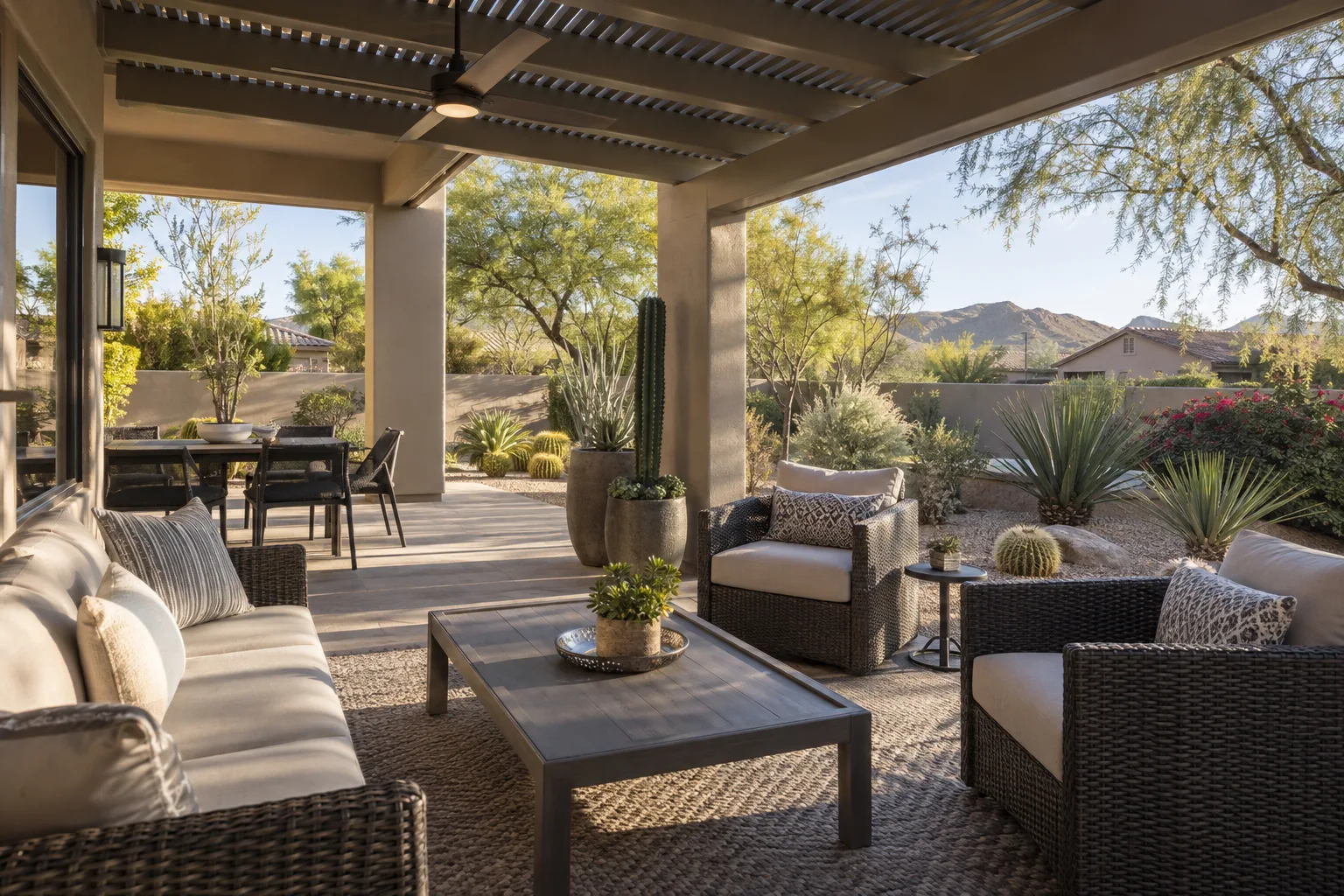
The best patio decorating ideas for Arizona start with shade, a cool floor and moving air, then add plants and lighting. Get those three working first, and the furniture, containers and color you add afterward will stay comfortable through the low desert summer.
Key takeaways
- Shade fabric rated for 90% UV block or higher outlasts canvas, and a solid cover over the west side of the patio does more for comfort than furniture, plants or lights.
- Light-colored pavers, tile and coatings stay cooler underfoot than dark concrete, dark pavers or decomposed granite.
- A damp or wet rated ceiling fan with a blade span of 52 inches or more moves air under a covered patio.
- Misters work best from April to June and again in September and October, because monsoon humidity (roughly July to September) cuts their cooling.
- Container plants dry out faster than plants in the ground, so check pots every 2 to 3 days in peak summer.
What should I fix first on an Arizona patio?
Shade comes first. A patio with no overhead cover is hard to use from late morning through the evening in summer, because concrete in afternoon sun on a west or southwest exposure soaks up heat until it is far hotter than the air, often well above 140°F.
You have three main options: a solid patio cover or pergola, a retractable awning, or a shade sail. A solid cover attached to the house also gives you a place to mount fans and lights. Shade sails are lighter and easier to put up, and you can layer triangles at different heights. Choose HDPE shade fabric rated for 90% UV block or higher, since canvas fades and breaks down faster under our sun.
Exposure changes the plan. East-facing patios get gentle morning sun and fall into shade before the worst heat arrives. West-facing patios need solid overhead cover plus a vertical screen on the west edge, such as a row of tall planters from our pottery and planters or a vine on a trellis. A desert tree planted on the west side will shade the patio as it matures, though that takes several years.
What flooring stays coolest on an Arizona patio?
Light-colored, porous materials stay coolest, and travertine pavers are the usual choice for that reason. Saltillo tile behaves in a similar way and suits Southwestern architecture. If you already have a slab, a light-colored reflective coating made for concrete lowers the surface temperature without a tear-out.
Dark pavers and black river rock absorb heat all day and give it back after sunset, so keep them away from seating, and use decomposed granite for paths and plant beds where nobody walks barefoot. Skip dark colors near seating.
| Surface | Heat in afternoon sun | Best use |
|---|---|---|
| Travertine pavers | Stay noticeably cooler | Seating and dining areas |
| Saltillo tile | Cooler when light in color | Covered patios |
| Light reflective coating on concrete | Cooler than bare dark concrete | Updating an existing slab |
| Dark sealed concrete | Absorbs and holds heat | Shaded areas only |
| Decomposed granite | Runs hot | Paths and plant beds |
| Composite decking | Runs hotter in darker colors | Shaded raised platforms |
Which patio furniture holds up in Arizona sun?
Powder-coated aluminum is the best frame material for our conditions. It is light, does not rust, and does not hold heat the way steel or wrought iron does. Teak performs well but weathers to silver gray unless you oil it each season. Resin wicker cracks in direct sun. HDPE wicker over an aluminum frame lasts noticeably longer in full exposure.
Cushions should be solution-dyed acrylic, where the color runs through the whole fiber and resists UV fading. Light and medium colors stay more comfortable to sit on than dark ones during the afternoon. During monsoon season, store cushions in a deck box, because fine dust cakes into fabric quickly.
How do I keep a patio cool enough to use in summer?
Combine shade with moving air, then add evaporative cooling in the dry months. A ceiling fan under a covered patio makes 95°F feel noticeably cooler through wind chill, so choose a damp or wet rated model with a blade span of 52 inches or more. Fans work best under a roof.
Misting systems cool by evaporation, so they work best in dry air. In April through June, and again in September and October, humidity is low and misters can lower the temperature around you by roughly 10 to 20°F. From about July through September, monsoon humidity weakens that effect and leaves furniture damp. High-pressure systems make finer droplets that evaporate before they land on surfaces.
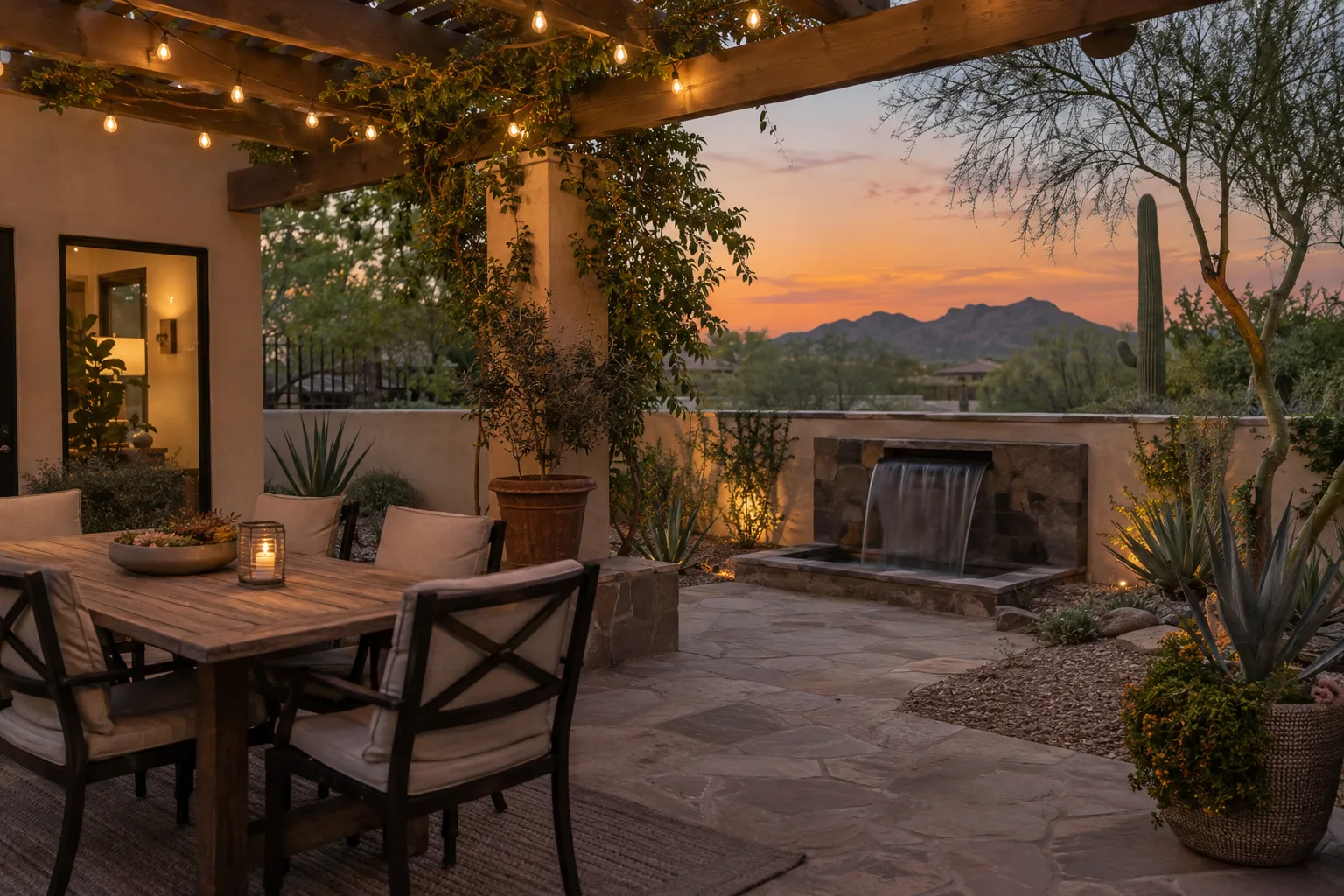
Moving water adds a second kind of comfort. A bowl or wall fountain masks street noise and sounds cooler even when it does not change the temperature. Browse our fountains for self-contained styles that need only an outlet for the pump. Top off the reservoir every few days in summer because evaporation is fast, and keep the pump running, since standing water can breed mosquitoes.
Which plants work in containers on a low desert patio?
Heat-tolerant shrubs, perennials and succulents in large containers work best, because walls and paving reflect extra heat onto them. These are varieties we commonly carry, though availability changes week to week and season to season, and you can browse all plants to match your exposure.
Bougainvillea (Bougainvillea spp.) blooms from spring into fall in full sun and covers a pergola or trellis with color. It is frost-tender, so cover it or move the pot when a freeze is forecast, and its thorns make it a poor choice beside seating.
Lantana (Lantana camara) flowers almost continuously in warm weather and handles reflected heat from walls. Cut it back hard in late winter. It spreads wide, so give it room.
Desert spoon (Dasylirion wheeleri) forms a spiky rosette of narrow leaves with sharp edges, so place it away from walkways. It suits a large pot and asks for little water.
Mexican sage (Salvia leucantha) sends up purple flower spikes in fall, when many other plants are winding down. It sprawls several feet wide and needs a hard cutback in late winter.
Trailing rosemary (Salvia rosmarinus) spills over the edge of a raised planter and gives you an herb for the kitchen. Overwatering is its usual downfall, so use a fast-draining mix.
Queen Victoria agave (Agave victoriae-reginae) is a compact, slow-growing agave with white-edged leaves that makes a focal point in a big pot. It needs a gritty, well-drained mix and very little water.
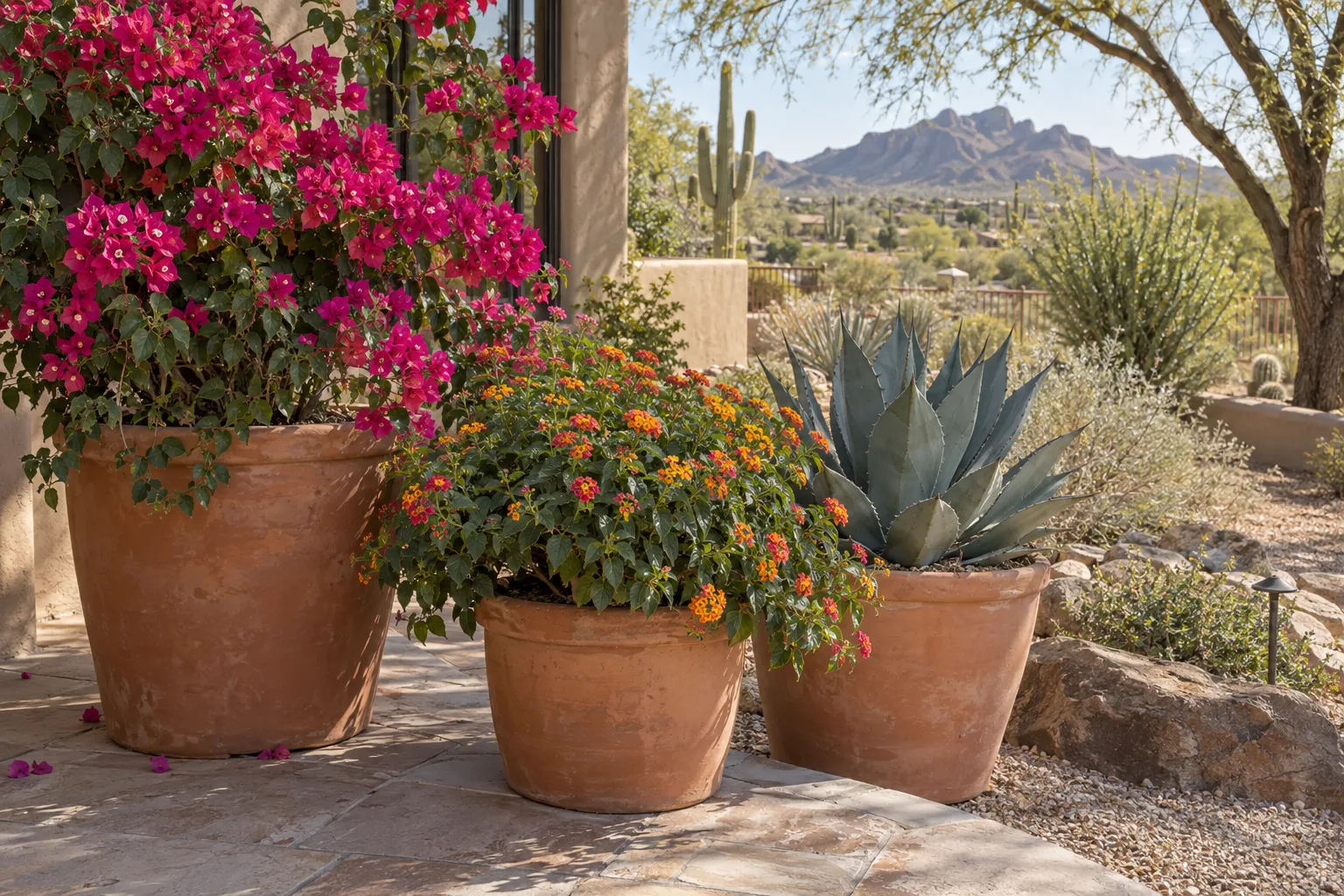
Pots dry out faster than ground soil, so check them every 2 to 3 days in peak summer and water deeply until it runs out the bottom. Hard irrigation water can leave a white crust on pots and soil, and flushing with plain water now and then helps. Choose heavy terracotta or concrete containers with a wide base so monsoon gusts do not tip them.
How do I light a patio and protect it from monsoon wind?
Use layered, warm lighting for evenings and heavy, anchored decor for storm season.
Lighting for evenings
Layer three kinds of light: ambient overhead light for the whole space, task light near dining and seating, and accent light that washes over plants and walls. Warm LED string lights at 2700K to 3000K give a soft glow, while cool white looks harsh outdoors. Solar path lights work well in our sun, and low-voltage fixtures cover plants and walls. Timers are worth the effort.
Monsoon wind and dust
The monsoon runs roughly from July through September, and storms can bring gusts of 60 mph or more with little warning.
- Anchor shade sails with hardware rated for high wind, and add a quick-release so you can drop the fabric before a storm.
- Keep cushions and lightweight decor in a deck box you can reach in a minute or two.
- Choose planters with wide, low bases over tall, narrow ones.
- Fasten string lights to fixed structures instead of letting them hang loose.
- After a dust storm, rinse hard surfaces and shake out rugs before the dust sets.
How do I refresh a patio step by step?
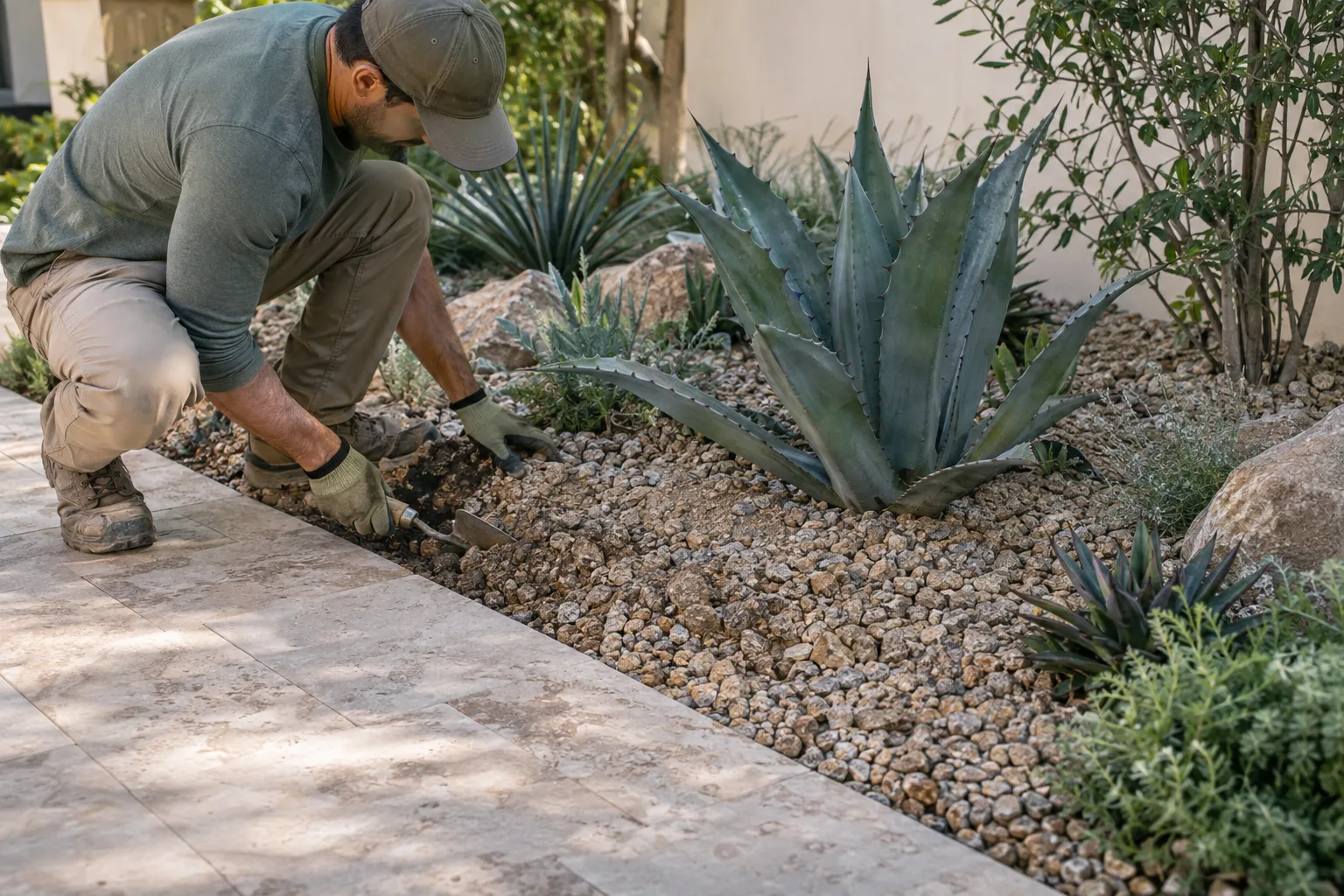
Work from structure to decoration, starting with shade and finishing with accessories. October through April is the most comfortable time to build, install and plant, and our gardening calendars show when to set out different plants. You need a tape measure, a notebook for tracking where the sun falls, and a clear list of what to buy first.
- Map the sun. Note which way the patio faces and where direct sun lands at morning, noon and 4 p.m. in summer.
- Add shade. Install a cover, pergola, awning or sail before buying anything else.
- Fix the floor. Coat or overlay hot, dark or cracked concrete before furniture goes down.
- Place the seating. Leave walking room around the furniture, and face the main group toward the best view.
- Install a fan and misters. Mount the fan first, then run a misting line along the outer edge of the covered area.
- Set the containers. Use three to five plants of different heights, with tall ones in corners and trailing ones at the edges, and add annual flowers and foliage for seasonal color.
- Layer the lighting. Hang string lights, add path and accent lights, and put everything on timers.
- Finish with soft goods. Add a flat-weave, UV-stable rug, pillows and side tables, then walk the space and note what would need securing before a storm.
Which patio decorating mistakes cost the most?
Buying furniture and decor before solving shade is the costliest, because cushions fade and surfaces stay too hot to use no matter how good they look. The same money spent on a cover first goes much further.
- Putting dark paving or river rock next to seating, where it radiates heat into the evening.
- Choosing lightweight plastic pots that blow over in the first strong gust.
- Buying a rug that is too small, which leaves the seating group looking scattered.
- Designing a lush, water-hungry green garden look. A palette of terracotta, sage, tan and turquoise accents suits our surroundings and uses far less water.
Frequently asked questions
How big should an outdoor rug be for a patio seating area?
Large enough that at least the front legs of every chair and sofa sit on it. An undersized rug makes the seating group look scattered, so measure the group and size up. Choose a flat-weave, UV-stable style that you can shake out or hose off after a dust storm.
Are solar lights reliable on an Arizona patio?
Yes, solar path and accent lights charge well in our strong sun as long as the panel gets several hours of direct light. Use them along walkways and plant beds. Put main seating and dining areas on a timer-controlled wired circuit so they do not depend on battery charge after a cloudy monsoon day.
What color of light bulb is best for a patio?
Warm white, 2700K to 3000K, suits most patios. It gives a soft amber glow that flatters plants and people, while cool white above about 4000K looks harsh outdoors. Choose damp or wet rated fixtures and LED bulbs, which run cooler than older bulbs and last for years.
Can succulents sit in full afternoon western sun?
Some can, but aloe and echeveria usually cannot. They bleach and sunburn in direct afternoon sun on a west exposure, especially next to a hot wall. Give them morning sun or filtered afternoon light, and save the hottest spot for agaves or bougainvillea that tolerate reflected heat.
How do I clean a patio after a dust storm?
Rinse hard surfaces with water first, then wipe furniture with a damp cloth so dry dust does not scratch it. Shake out rugs and cushions before washing them, and rinse plant leaves so dust does not block light. If you have a fountain, check the pump intake for grit.
Is a patio makeover worth it in the Arizona low desert?
Yes, if you want to use the patio in the cooler months and on summer mornings and evenings, because shade, fans and cool surfaces stretch those hours. Skip the big spending if your patio faces west and you cannot add overhead cover, since pots and a rug will not fix that. Renters can start with movable pieces such as pots, a rug and lighting. Stop by our Queen Creek nursery to talk through plants and pots for your patio.