
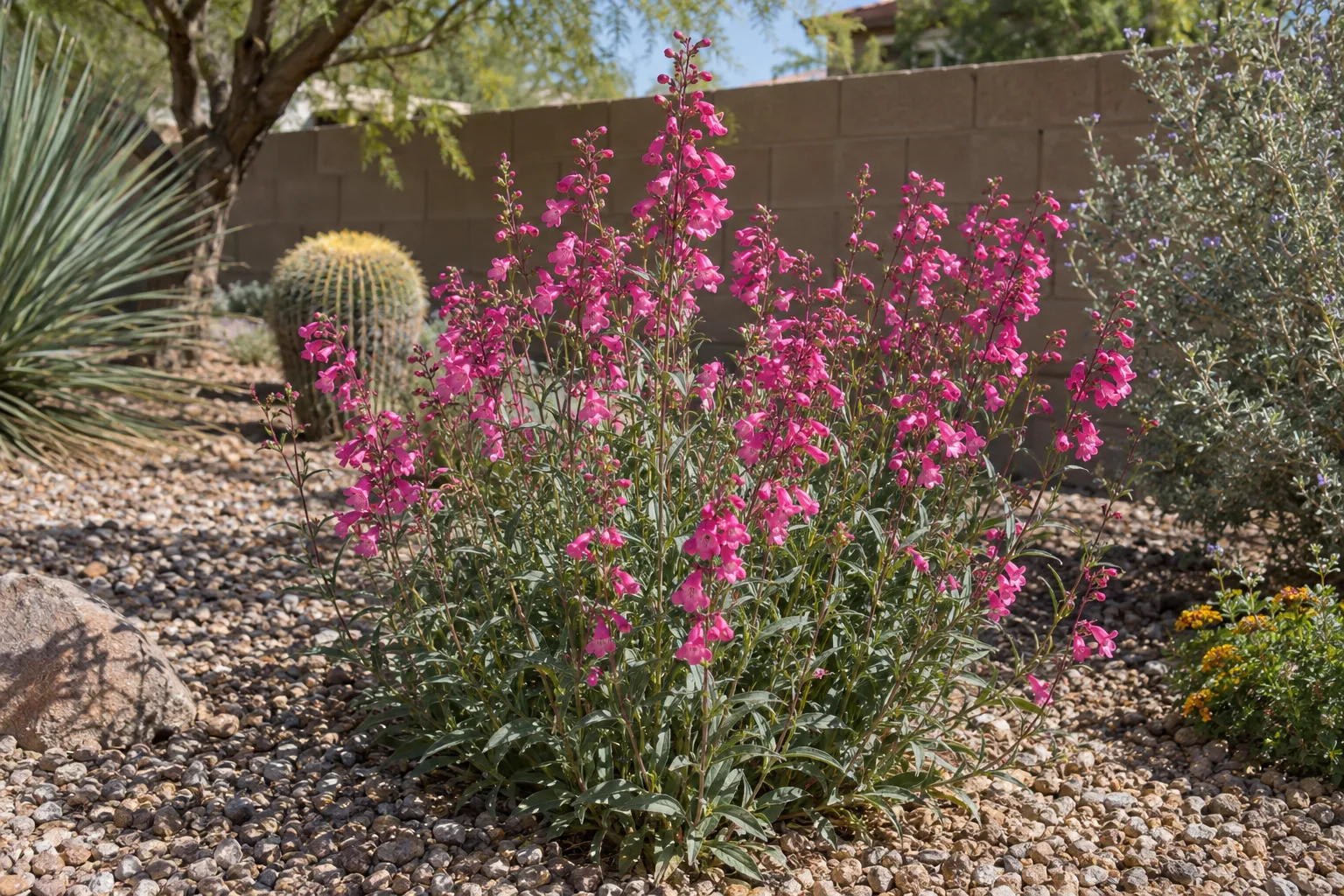
Parry’s penstemon (Penstemon parryi) is the Arizona native flower that blooms as temperatures rise, sending up hot pink spikes from late February into April. Days in the 70s and 80s bring it on, and it finishes before summer heat arrives.
Key takeaways
- Parry’s penstemon blooms from late February into April in the low desert, on flower stalks that commonly reach 2 to 4 feet.
- Plant it in October or November so the roots settle in before spring, and avoid May through August.
- It needs at least 6 hours of sun and fast drainage, so break through caliche or plant on a mound 6 to 8 inches high.
- Water new plants every 7 to 10 days in cool weather, then every 2 to 3 weeks in summer once they are established.
- Expect a life span of a few years, and leave the dry seed stalks in place so plants reseed into gravel.
Why does Parry’s penstemon bloom as the weather warms?
Warming days after winter moisture tell the plant to push up its bloom stalk. Through the cool months it stays a low rosette of gray-green leaves, and when daytime highs settle into the 70s and 80s the stalks climb and open rows of pink tubular flowers.
Many gardeners assume a plant that blooms in rising heat will keep flowering all summer. Parry’s penstemon finishes well before then: bloom peaks in March and April, and by May, when highs approach 100°F, the plants are setting seed and sliding back to a rosette. Plan on one spring show.
A mature plant forms a rosette roughly 1 to 2 feet wide, and the flower stalks commonly reach 2 to 4 feet, so it works as a vertical accent among lower plants. The color runs from hot pink to magenta, which stands out against gravel and block walls.
Where does Parry’s penstemon grow best in Queen Creek?
It grows best in full sun with fast-draining, gravelly soil, away from lawn overspray and low spots where water stands. Six or more hours of direct sun keeps the stalks upright and the flowers heavy, and a south or west exposure near a wall or rock suits a plant native to dry, rocky ground in Arizona.
Alkaline soil suits it. Caliche, the cemented calcium layer that sits a foot or two down in many East Valley yards, is the main hazard, because water collects on top of it and rots the roots. Probe the planting spot with a steel rod before you buy anything.
You can look through low-water perennials, including native penstemons, in our plant department. Penstemons are a type we commonly carry, but availability changes week to week and season to season, so check with us before making a special trip.

When should I plant Parry’s penstemon in the low desert?
October and November are the best months, and planting through February still works. Roots grow well in cool soil, so the plant is settled in before its first spring bloom. Avoid May through August, when new plants cannot root in fast enough to handle highs above 105°F. Our gardening calendars show what else is worth planting each month.
Drainage decides whether the plant lives, so test it first.
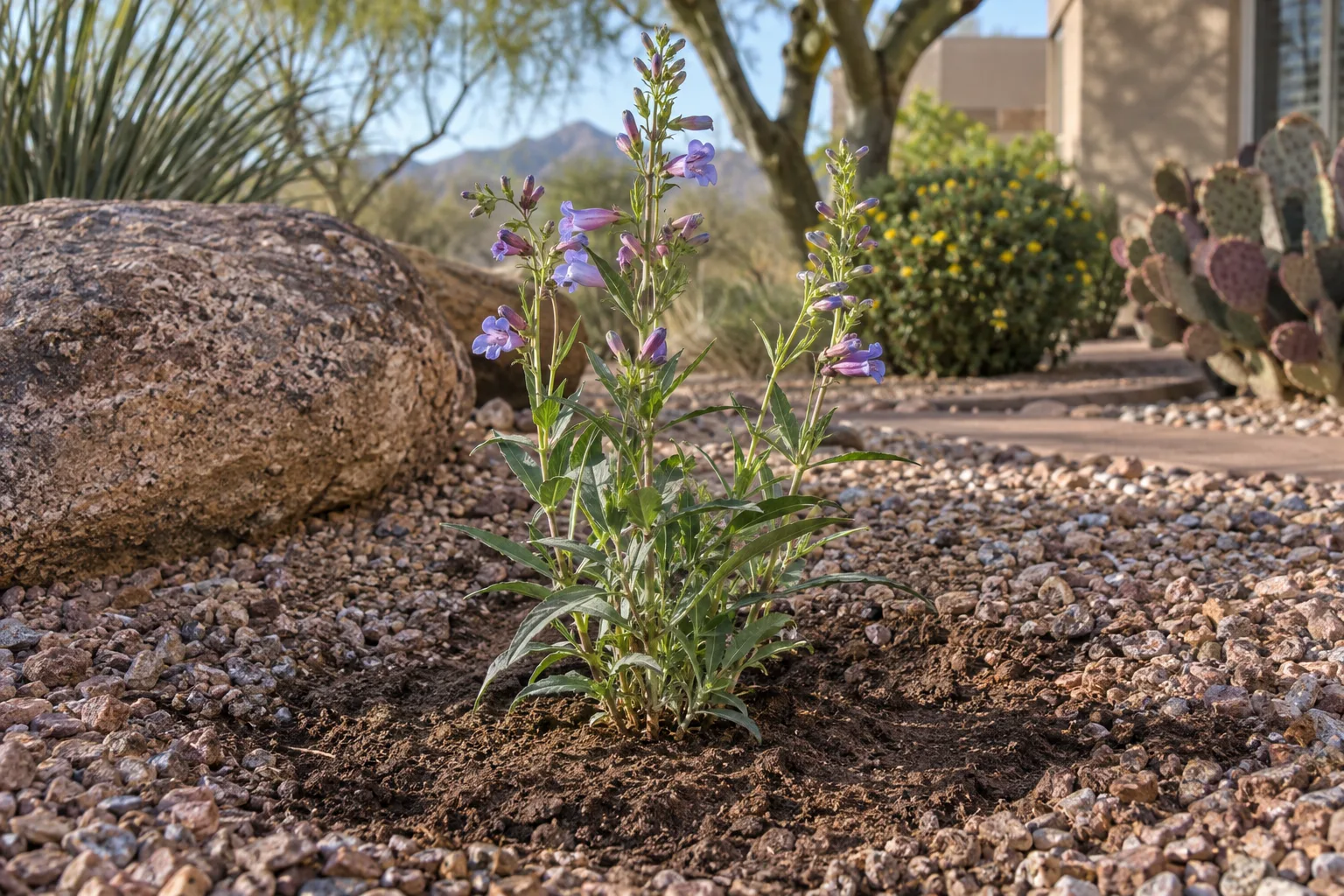
- Dig the hole 2 to 3 times as wide as the pot and no deeper than the root ball, then fill it with water. If water is still standing after a day, break through the caliche, move the plant, or build a gentle mound 6 to 8 inches high.
- Backfill with the soil you dug out. Skip heavy compost, which holds water around the roots in a lean desert soil.
- Set the crown, where the leaves meet the roots, about 1 inch above the surrounding soil so water runs away from it.
- Water slowly until the whole root zone is wet, then add 2 to 3 inches of gravel or decomposed granite, pulled back a few inches from the crown.
- Water every 7 to 10 days in cool weather for the first couple of months.
How often should I water Parry’s penstemon?
New plants need water every 7 to 10 days in cool weather, and established plants need far less. After one full year in the ground, rain covers most of the cool months. Check the soil 3 to 4 inches down before you water, and if it is damp, wait.
| Season | New plants | Established plants |
|---|---|---|
| Fall (October and November) | Every 7 to 10 days | Every 3 to 4 weeks if there is no rain |
| Winter (December to February) | Every 10 to 14 days | Rain alone is usually enough |
| Spring (March to May) | Every 7 days as it warms | Every 2 weeks during bloom |
| Summer (June to September) | Avoid planting | Every 2 to 3 weeks, less after monsoon soaks |
Water slowly so the moisture reaches 12 to 18 inches deep rather than wetting only the surface. Drip emitters at the edge of the rosette do this well. Winter overwatering is the most common cause of root rot, because cold, wet soil leaves the roots without air.
Do I need to prune or fertilize Parry’s penstemon?
Pruning takes one cut a year, and fertilizer is usually unnecessary. Leave the stalks in place after the flowers fade until the seed capsules turn brown and dry, usually by late spring or early summer, then cut the stalks to the base and shake the seed over bare, gravelly ground. Seedlings tend to appear the following fall or winter.
This penstemon grows naturally in lean soil. Rich feeding, especially with high-nitrogen products, pushes soft, leggy growth that flops before it blooms. If a plant looks weak, check drainage and sun first. Fertilizer is rarely the answer.
What are the drawbacks of Parry’s penstemon?
The biggest problem is root rot from wet soil, and the biggest drawback is a short life span. Plants typically last a few years, so the bed needs reseeding or replacement. Wet roots show up as yellowing lower leaves, a soft crown and wilting while the soil stays damp, and once the crown turns mushy the plant rarely recovers.
Shade causes a different problem. Plants that get less than about 6 hours of sun stretch, lean and flower less. After bloom, the dry stalks and a plain rosette are not much to look at, so pair it with plants that carry the bed through summer.
Heavy monsoon downpours on poorly drained soil can finish off a plant that did fine all spring. A slightly raised planting spot protects against that.
Which native flowers bloom after penstemon fades?
Desert marigold, globe mallow and brittlebush pick up where penstemon leaves off. Each handles alkaline soil and low-desert heat.
- Desert marigold (Baileya multiradiata) has yellow, daisy-like flowers on woolly gray foliage and blooms from spring, often continuing through summer and fall with occasional deep watering.
- Globe mallow (Sphaeralcea ambigua) carries apricot, coral, and sometimes lavender or white flowers on a shrubby plant, heavy in spring and often again after monsoon rain.
- Brittlebush (Encelia farinosa) has silver foliage and yellow flowers from about February to May, and it drops leaves in summer, which is normal.

For annual color between May and the monsoon, look through our annual flowers and foliage and check the heat tolerance on each tag. Taller desert trees such as palo verde (Parkinsonia species) give the bed structure, but keep penstemon at the sunny edge of their canopy, not in dense shade.
Frequently asked questions
Does Parry’s penstemon attract hummingbirds?
Yes, the tubular pink flowers suit hummingbirds, which visit penstemons in the low desert during spring bloom, and native bees work the flowers too. Plant three to five together so the color reads from across the yard, and place them where you can watch from a window or patio chair.
What is the difference between Parry’s and firecracker penstemon?
Parry’s penstemon has pink to magenta flowers, while firecracker penstemon (Penstemon eatonii) has bright red ones. Both are low desert natives with tubular flowers, a spring bloom, and a need for full sun and sharp drainage. Planted side by side in a gravel bed, they give a pink and red display.
Can I grow Parry’s penstemon from seed?
Yes, though a nursery plant flowers sooner. Scatter seed on bare, gravelly soil in October or November and press it in lightly without burying it. Germination can be slow and uneven, and some penstemon seed responds to winter cold, so fall sowing matches what happens in nature. Expect a first bloom a year or more after sowing.
Can I grow Parry’s penstemon in a pot?
Yes, in a large pot with drainage holes and a fast-draining, gritty mix. Pots dry out faster than ground soil, so check the moisture every few days in spring and more often as summer heat builds. Browse our pottery and planters for a wide, deep container with room for the roots.
Will Parry’s penstemon bloom again in fall?
Usually it gives one main spring flush. Some plants send up a few late flowers after a wet monsoon, but you should not count on a second show. For color later in the year, pair it with desert marigold or globe mallow, which can bloom more than once between spring and fall.
Is Parry’s penstemon right for your yard?
Parry’s penstemon suits you if you have a sunny, well-drained spot and want a tall, hummingbird-friendly accent that flowers in March and April on little water. Skip it if your yard is mostly shade, if the planting bed sits low or catches lawn overspray, or if you want flowers all summer. It gives one spring show and lives a few years, so plan to let it reseed or replace it. Come see us at the nursery in Queen Creek and we will help you pick a spot.