
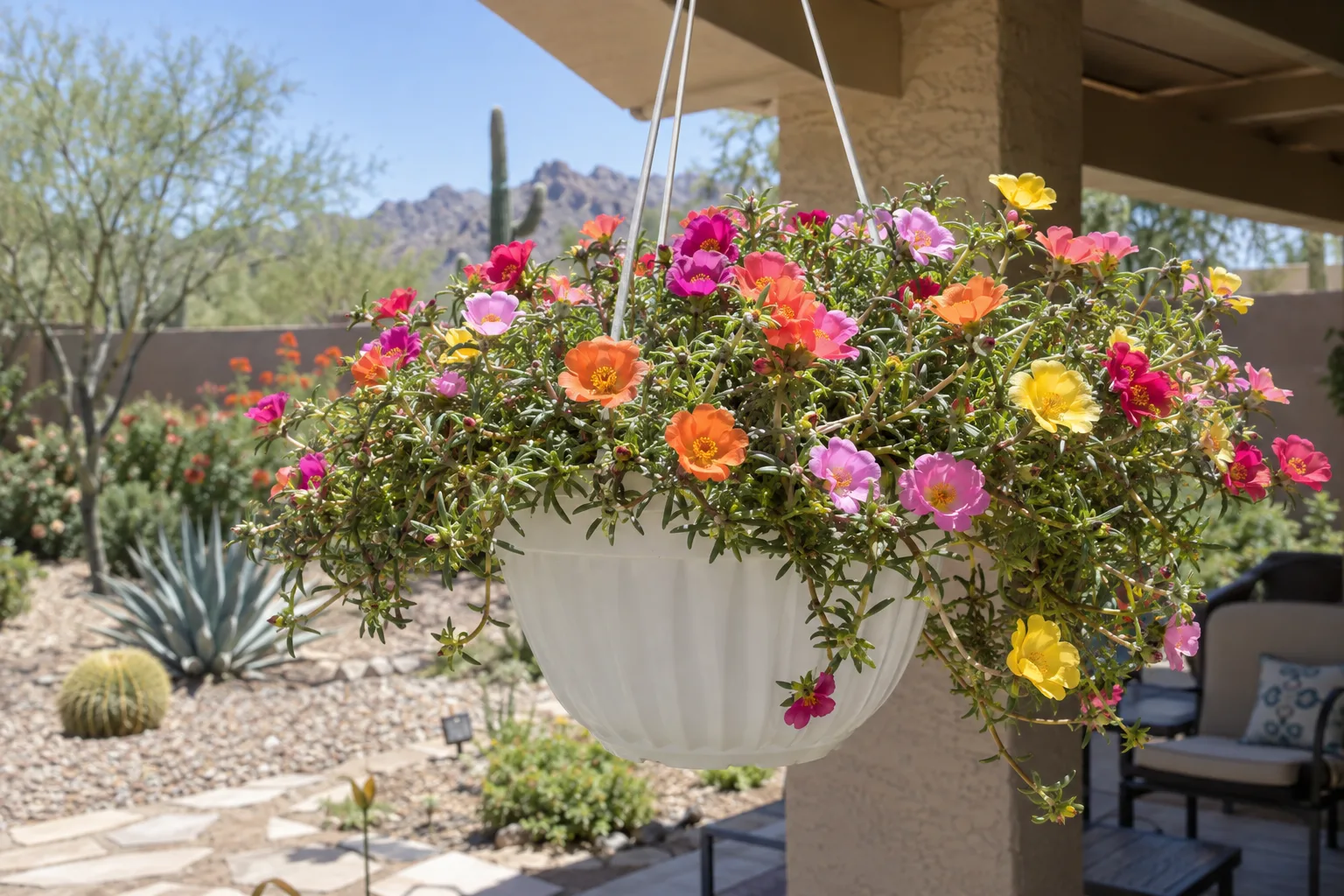
The best outdoor hanging plants for an Arizona patio are portulaca, trailing lantana, dwarf bougainvillea and dichondra for summer sun, with petunias and calibrachoa for the cooler months. Match the plant to your patio’s exposure, then give it a large basket and daily water in summer.
Key takeaways
- Portulaca, trailing lantana, dwarf bougainvillea and dichondra ‘Silver Falls’ are the summer choices for full sun, with highs above 110°F.
- Petunias and calibrachoa bloom best from roughly September through May and fade once summer heat settles in.
- A basket 14 inches wide or larger holds more soil and dries out more slowly than a 10 inch basket.
- From June through September, check every basket daily and water in the early morning.
- Hang summer baskets in March or April so roots are established before 100°F days arrive.
Which outdoor hanging plants handle full summer sun?
Portulaca, trailing lantana, dwarf bougainvillea and dichondra handle full sun and highs above 110°F better than most basket plants. A west-facing wall adds reflected heat on top of the air temperature, so these four are the safest picks there, and even they need a large basket and steady water. These are varieties we commonly carry in our annual flowers and foliage department. Availability changes week to week and season to season.
Portulaca (Portulaca grandiflora)
Moss rose stays low, about 4 to 8 inches tall, and spreads 12 to 18 inches over the rim. It wants full sun and a fast-draining mix. The succulent stems hold water, so let the top inch dry between waterings. Flowers open in red, orange, yellow, pink and white from spring into fall. The drawback is that blooms close in shade and late in the day, so a basket with fewer than about 6 hours of sun looks sparse.
Trailing lantana (Lantana montevidensis)
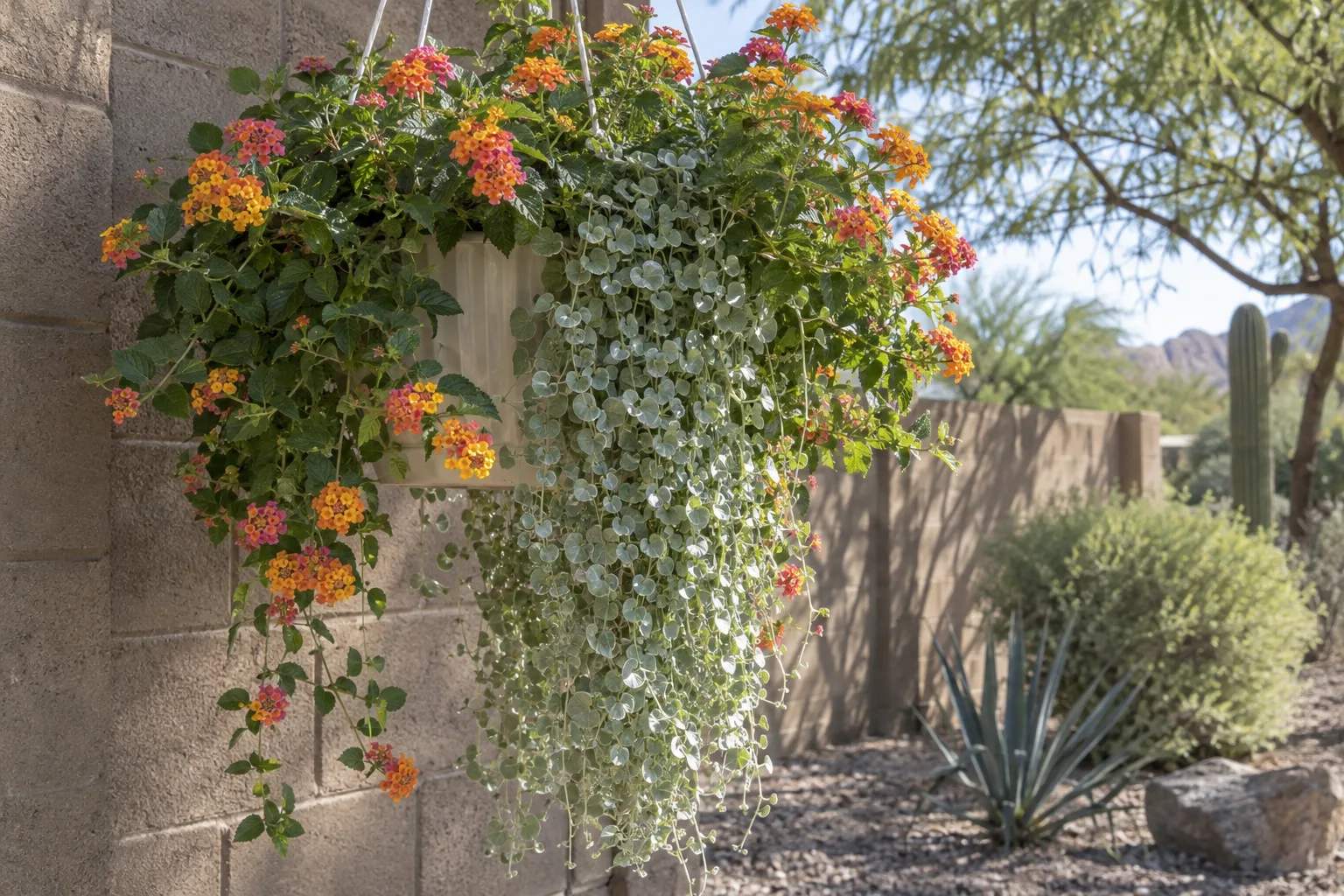
Trailing lantana grows 1 to 2 feet tall and trails 2 to 3 feet, with purple or white flowers and other trailing hybrids in yellow and orange. It takes full sun and heat, and water is best given deeply when the top inch of mix is dry. Butterflies visit the blooms. The drawback is that stems turn woody and leggy by late summer, and frost damages the foliage.
Dwarf bougainvillea (Bougainvillea hybrids)
Compact bougainvillea stays about 2 to 3 feet across in a basket when pruned, and it needs a basket at least 16 inches wide. Give it full sun and water when the top 2 inches of mix are dry. It flowers more heavily when it is not overwatered. The papery bracts last for months. The drawback is sharp thorns and a heavy, wind-catching basket, and frost burns the tips.
Dichondra ‘Silver Falls’ (Dichondra argentea)
Silver Falls sends out silvery, coin-shaped leaves on vines that reach 3 to 5 feet. It handles full sun to part shade, and it looks good alone or under an upright flowering plant. Water when the top inch is dry. The drawback is that the thin stems crisp quickly if the mix dries out completely in July, so it needs more attention than portulaca.
Which hanging plants suit morning sun or shade?
Sweet potato vine, asparagus fern and scaevola do best with morning sun and afternoon shade, such as an east-facing patio or a covered ramada. Deep shade is too dim for good flowering, and summer heat still reaches shaded spots through reflected light off concrete. Check your patio at 3 p.m. in summer to see how much sun it really gets.
Sweet potato vine (Ipomoea batatas)
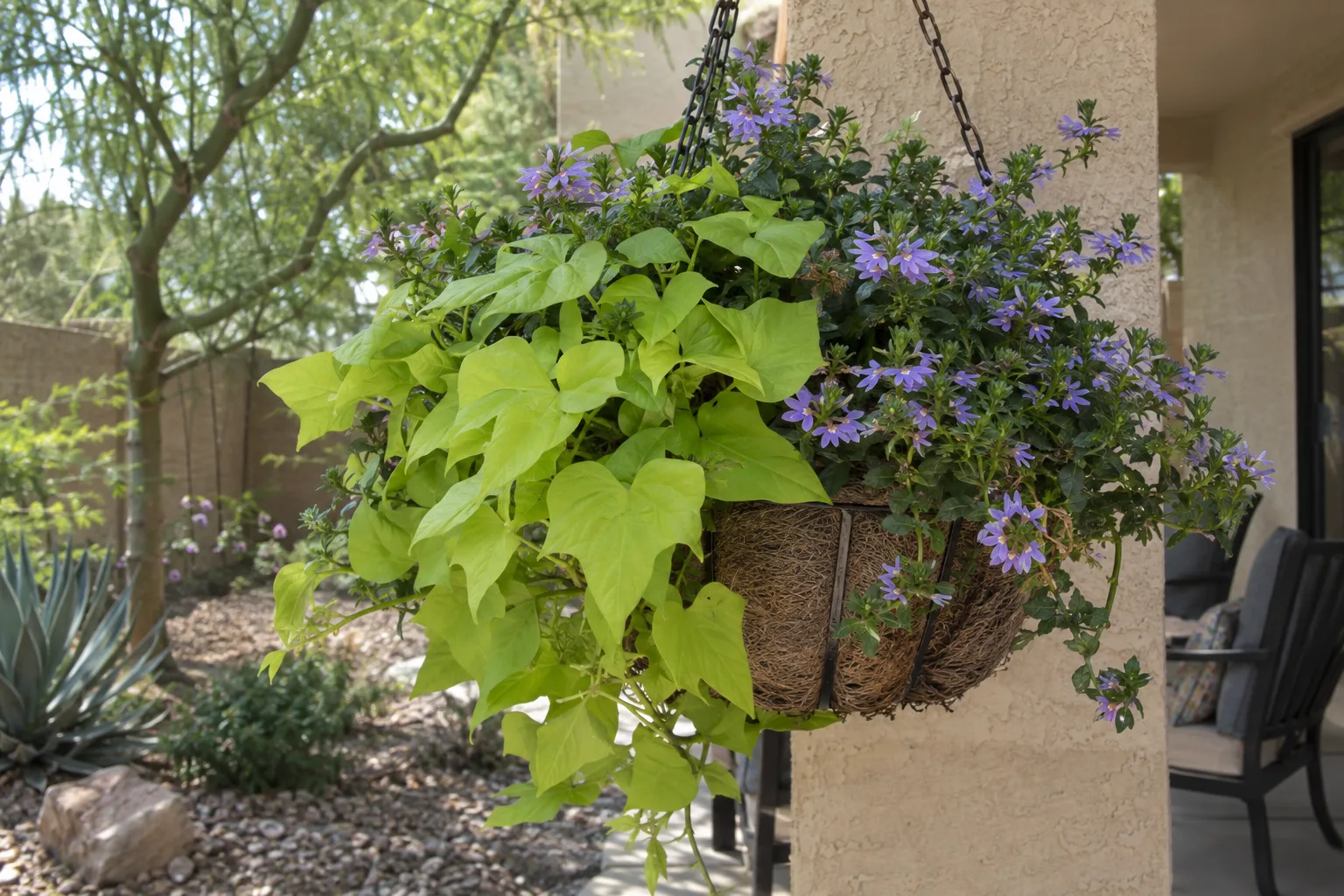
This foliage plant trails 3 to 6 feet and fills a 14 inch basket quickly. The chartreuse types hold their color in brighter light, while purple types turn greener in low light. It prefers morning sun with afternoon shade in midsummer, though established plants take more sun with steady water. The drawback is vigor, since it will smother slower companions, and frost kills the top growth.
Asparagus fern (Asparagus densiflorus)
Despite the name, it is not a true fern, and it copes with low desert conditions far better than woodland ferns do. Expect arching stems 1 to 2 feet tall that trail 2 to 3 feet. It likes filtered light or morning sun and even moisture. Thick roots store some water. The drawback is small thorns on the stems, and a hard freeze can brown the foliage.
Scaevola (Scaevola aemula)
Fan flower grows 6 to 12 inches tall and trails 2 to 3 feet, with fan-shaped blooms in blue-purple or white. It gets full sun in cooler months and morning sun with some afternoon shade in summer. Water regularly and feed every few weeks. The drawback is that flowering slows in peak heat, and the plant can look tired in July and August.
Which hanging plants fill baskets from fall through spring?
Petunias and calibrachoa bloom heaviest from roughly September through May, and both fade in summer heat, so treat them as seasonal plantings. They give the most color for the least work in the cooler months. Plan to replace them around June.
Trailing petunias (Petunia x hybrida)
Trailing and Wave-type petunias reach 6 to 12 inches tall and spread 2 to 3 feet. They want full sun to part shade and water when the top inch is dry. Pinch them back once or twice to encourage branching, and feed with a water-soluble bloom fertilizer about every two weeks. The drawback is that they get stringy and stop blooming once highs stay above 95°F.
Calibrachoa (Calibrachoa hybrids)
Often sold as million bells, calibrachoa grows 6 to 12 inches tall and spreads 1 to 2 feet, and it covers itself in small petunia-like flowers. Give it full sun and a well-draining mix. The drawback is a tendency toward iron deficiency in alkaline mixes and hard water, which shows as yellow leaves with green veins.
How do I set up a hanging basket for the low desert?
Choose a basket 14 to 16 inches wide in a light color, fill it with a fast-draining mix, and plant in the right season. Size and color matter most because they control how hot the roots get. For sizes and light finishes, see our pottery and planters department.
- Pick a basket 14 to 16 inches wide, since more soil volume dries out more slowly and swings less in temperature.
- Choose white, cream or light tan. Black and dark brown plastic absorb heat in full sun.
- Blend a quality container mix with perlite, roughly one part perlite to three or four parts mix, for drainage.
- Mix in a slow-release fertilizer that includes micronutrients such as iron.
- Plant summer baskets in March or April, and cool-season baskets from late September into October.
- Soak the basket until water runs from the bottom, then hang it where the plant’s light needs match the exposure.
How often should I water hanging baskets by season?
Water daily from June through September, and less often the rest of the year. Baskets lose water from every side and have no cooler soil beneath them, so they dry out faster than any ground planting. Use this table as a starting point and adjust by touch.
| Season | Typical highs | Watering |
|---|---|---|
| Winter (December to February) | 60 to 70°F | Every 3 to 5 days |
| Spring (March to May) | 75 to 100°F | Every 1 to 2 days |
| Summer (June to September) | 105 to 115°F | Daily, twice on hot days for small baskets |
| Fall (October to November) | 75 to 95°F | Every 2 to 3 days |
Push a finger 1 to 2 inches into the mix. If it is dry at that depth, water until it drains from the bottom, and if it is still damp, wait. Early morning watering gives roots time to take up moisture before the afternoon heat. Overwatering in winter rots roots, so cut back when nights cool.
What soil and fertilizer work for desert baskets?
A loose, well-draining container mix with perlite, plus a slow-release fertilizer containing iron, works best here. Local soil is alkaline, often above pH 7.5, and our irrigation water is hard, so container mixes drift alkaline over time and lock up iron.
Yellow leaves with green veins point to iron chlorosis. A chelated iron soil drench usually greens up new growth within a couple of weeks. Avoid mixes heavy in peat or bark, because they repel water once fully dry, and a basket in July can dry out in hours. Feed with a balanced liquid fertilizer every 2 to 3 weeks during active growth, since frequent watering flushes nutrients out the bottom. Our classes and events page lists upcoming workshops.
How do I protect hanging baskets during monsoon storms?
Use sturdy hooks, and take baskets down or set them on the ground when a storm is forecast. The monsoon runs from roughly July through September, and gusts can tear baskets from their hooks and throw them across a patio.
- Use hooks and hardware rated well above the basket’s wet weight, which can reach 15 to 20 pounds.
- Check drainage holes after storms for washed-in debris.
- Skip evening watering during humid spells, because wet foliage overnight encourages fungus.
- Expect a flush of new growth when humidity rises.
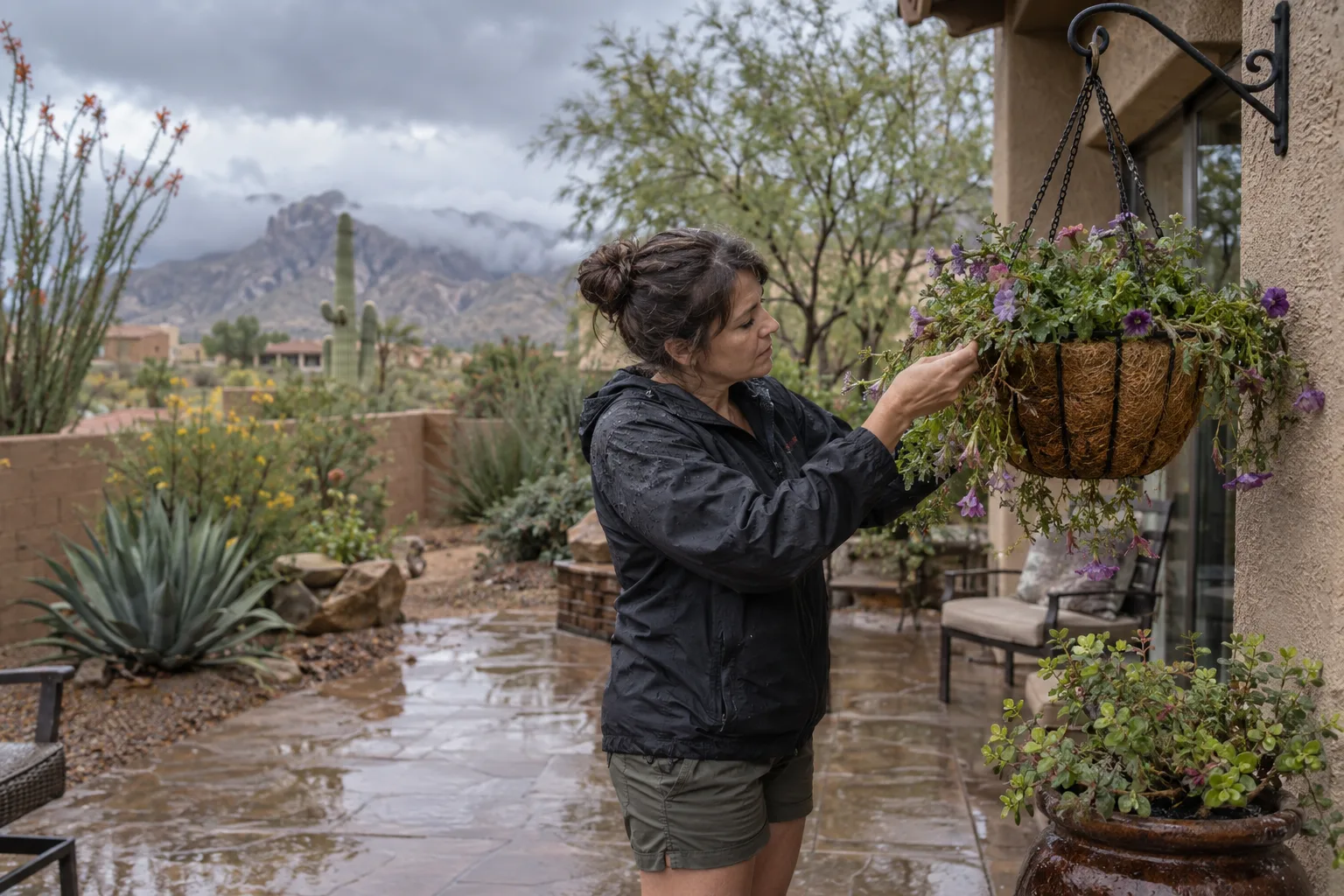
Frequently asked questions
Can hanging baskets stay up through a frost?
Most can stay up if you cover them or move them on nights forecast near 32°F. Bougainvillea, lantana, sweet potato vine and dichondra are frost tender, while petunias and calibrachoa handle cool nights better. Move baskets under a patio cover, or drape frost cloth over them in the evening and remove it the next morning.
Can I put hanging baskets on drip irrigation?
Yes, one drip emitter per basket on a timer takes most of the daily chore out of summer. Run it in the early morning and check the soil by hand weekly, since emitters clog with hard-water minerals. Small baskets in full sun may still need a second hand watering on the hottest days.
When should I swap summer baskets for cool-season ones?
Swap in late September to October, once highs stay below roughly 95°F. Pull heat-stressed plants, refresh the top few inches of mix, and replant with petunias or calibrachoa. Our gardening calendars list planting windows by month, which helps you time the change for your part of the East Valley.
Is shade cloth worth it on a west patio?
Yes, 30 to 50 percent shade cloth on the west side cuts afternoon sun and lowers water demand in July and August. It lets you grow sweet potato vine and scaevola in spots that would otherwise be too harsh. Leave enough airflow so heat does not build up behind the cloth.
Can I plant several kinds in one basket?
Yes, if they share the same light and water needs. Lantana with dichondra works in full sun, and sweet potato vine with scaevola works in morning sun. Avoid pairing portulaca, which likes to dry out, with thirsty plants such as petunias. Use one upright or bushy plant in the center and trailers around the edge.
Are hanging baskets worth the daily summer watering?
They are worth it if you can check them every morning from June through September or put them on a drip timer. Portulaca, lantana and dichondra give the best summer payoff in full sun. If you travel often in summer or your patio has a bare west wall and no shade, a large ground-level pot holds more soil and forgives missed days. Visit us at the nursery in Queen Creek and we will help you match plants to your patio.