The most common mistakes Arizona gardeners make with olive trees are overwatering, planting into caliche, planting in summer, choosing the wrong variety, pruning in heat, overfeeding, skipping frost cover and missing early pests. Each one is easy to avoid once you know what to look for.
Key takeaways
- Water a new olive deeply, then let the top several inches of soil dry before the next watering, because constantly wet soil leads to root rot.
- Plant between late September and early March so the roots have months to grow before summer highs reach 110°F.
- Break through caliche and set the root ball level with or slightly above the surrounding soil.
- Prune in February or early March, and remove no more than about a quarter of the canopy in one year.
- Cover young trees with frost cloth when the forecast drops to about 30°F during their first two winters.
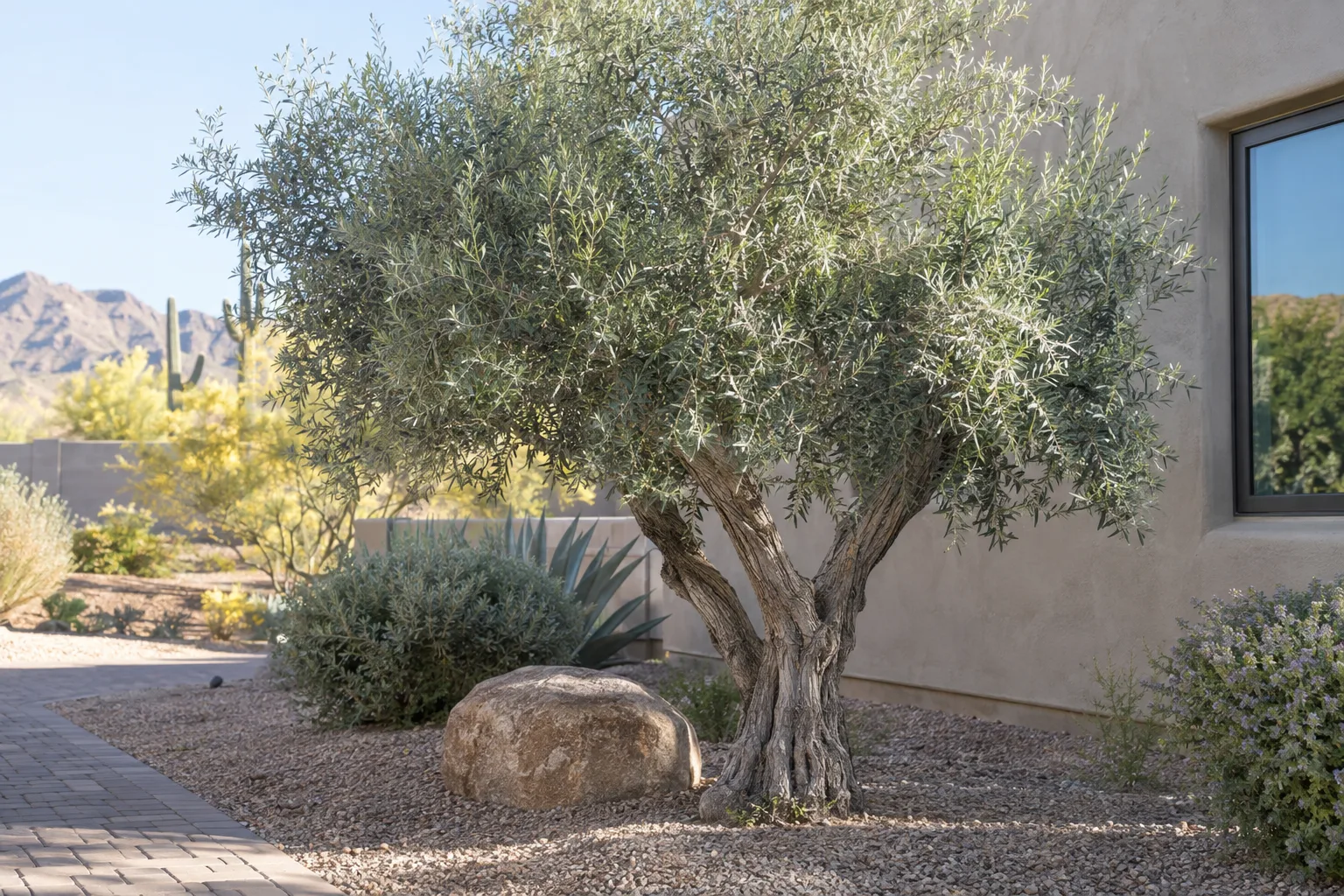
How much water does a new olive tree need in the low desert?
A new olive needs deep soaking every few days through its first summer, then less each year as the roots spread. Mistake 1 is giving it a little water every day, which keeps the root zone saturated and leads to root rot.
Olives come from dry Mediterranean hillsides, and their roots grow deeper when the top layer of soil dries between waterings. Constant moisture does the opposite. It keeps roots shallow and starves them of oxygen. Before every watering, push a trowel or screwdriver 6 inches down. If the soil feels damp, wait another day or two.
As a rough guide, water a newly planted tree deeply two to three times a week in its first summer, once or twice a week in its second, and every 7 to 14 days in summer once it is established, with less in winter. Soil type, exposure and tree size change these numbers, so let the 6 inch check overrule the calendar. Our hard water leaves salts behind, and long, slow soaks push those salts below the roots better than frequent light sprinkles.
Olives sit with the other evergreen trees in our trees department, and the first two or three years decide how well they settle in.
Can olive trees grow in caliche and alkaline soil?
Olives tolerate alkaline soil well, but they cannot grow in a hole that holds water. Mistake 2 is planting straight into caliche, the cemented calcium layer that often sits 1 to 2 feet down in Queen Creek yards and blocks both roots and drainage.
Probe the planting spot with a length of rebar before you dig. If it stops hard, break through with a digging bar until you reach looser soil below. Then fill the hole with water. If it is still standing the next day, plant on a mound 6 to 12 inches above the surrounding grade instead.
Dig the hole 2 to 3 times as wide as the root ball and no deeper than it. Set the top of the root ball level with or slightly above the surrounding soil, and backfill mostly with the native soil you dug out. A little compost, up to about a quarter of the volume, is plenty. Heavy amendments hold water around the roots.

When is the best time to plant an olive tree in Arizona?
Plant olives from late September through early March, with October and November the easiest months. Mistake 3 is planting in April through June, when the tree has only a few weeks before highs pass 105°F to 110°F.
A fall-planted olive gets six or more months of mild weather to grow roots before summer arrives. The soil is still warm in October, which encourages that growth, and cool days cut down how often you need to water. Our gardening calendars lay out what else to plant and do each month.
If you must plant in summer, expect more work. Shade cloth rated around 30 to 40 percent for the first several weeks, deeper watering and planting in the cooler early morning all help. Establishment is still slower and riskier than in fall, so treat a summer planting as a last resort.
Which olive variety should I plant, and what about pollen?
For most yards, choose a fruitless or low-fruit olive (Olea europaea) such as Swan Hill, Wilsonii or Little Ollie. Mistake 4 is buying whichever olive looks nicest without checking fruit, pollen, mature size and local rules.
Olive pollen is widely listed as a seasonal allergen, and some Arizona cities have had rules about which olives can be planted or sold. We cannot tell you what applies at your address. Check with your city or town before you buy, and keep the variety name from the plant tag on record.
Fruitless and low-fruit selections
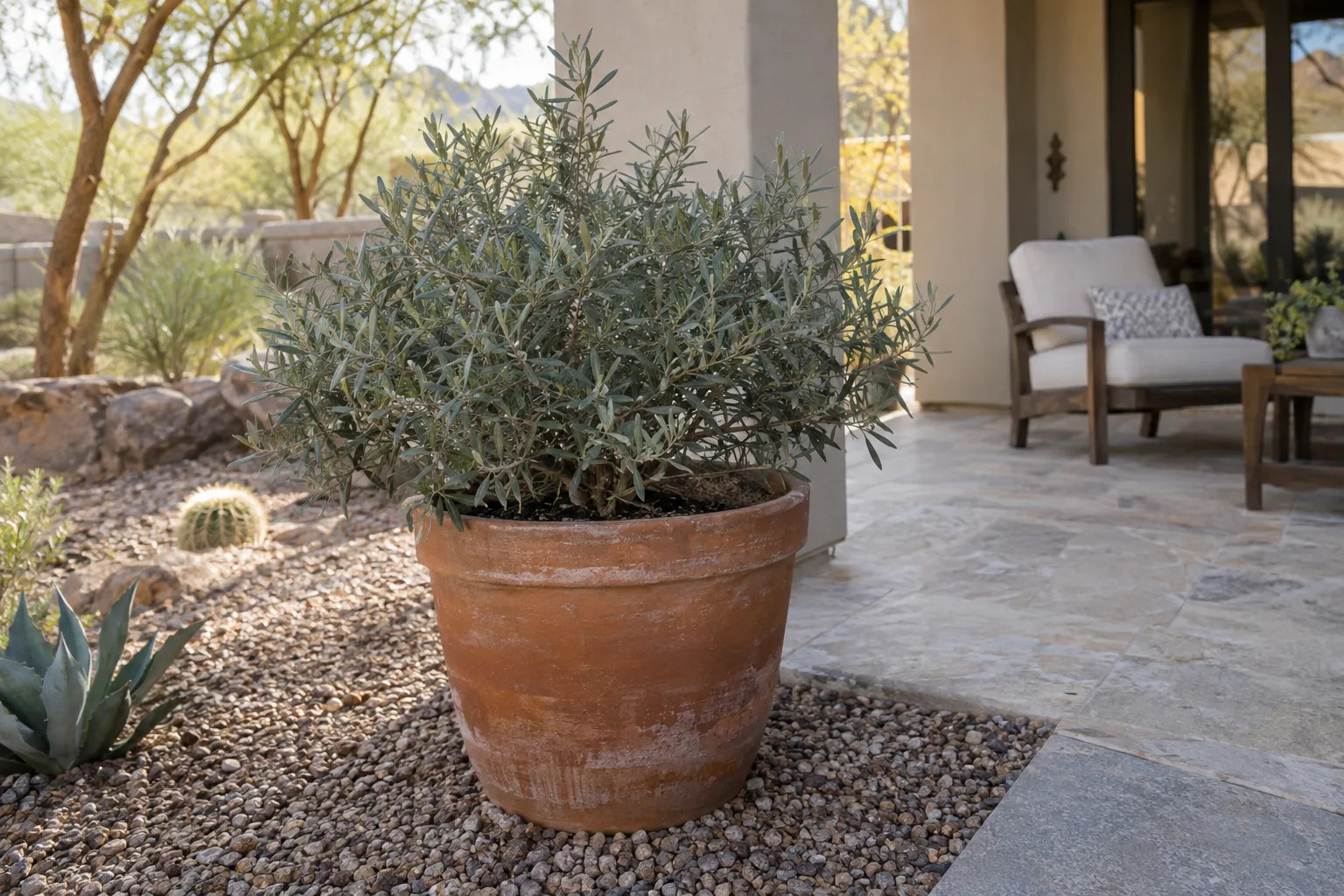
Swan Hill is sold as a fruitless, low-pollen olive that reaches roughly 25 to 30 feet tall and wide. Wilsonii is another fruitless selection, often a little smaller. Little Ollie is a dwarf that usually stays shrub sized, around 4 to 8 feet, and works as a hedge or in a large container. Fruitless does not always mean pollen free, so read the tag. These are varieties we commonly carry, though availability changes week to week and season to season.
Fruiting selections
Arbequina and Manzanillo produce olives you can cure or press, but the fruit drops in fall and stains pavers, walkways and pool decks. Plant them away from hardscape and expect a few weeks of cleanup. Browse our fruit trees if an edible harvest is the goal.
When should I prune an olive tree in Arizona?
Prune olives in late winter, from February to early March, after the worst frost danger and before spring growth speeds up. Mistake 5 is cutting hard in summer or removing too much of the canopy at once.
Fresh cuts in June through August expose bark that was shaded by leaves to 110°F sun, and sunscald and dieback can follow. Removing dead wood or a crossing branch is fine at any time of year. Save larger structural cuts for late winter.
Keep each year’s pruning to about a fifth to a quarter of the canopy. Removing more triggers a flush of fast, upright water sprouts that you then have to cut again. Light cuts every year work better than a heavy cut every few years. Make cuts just outside the branch collar with sharp, clean tools, and skip topping the tree.
Does an olive tree need fertilizer in the low desert?
Most established olives need little or no fertilizer. Mistake 6 is feeding with a high nitrogen product, which pushes soft, fast growth that attracts aphids and scale and competes with root development.
Olives grow in lean soils in their home range, and a tree watered correctly in reasonably prepared soil usually keeps good color without help. If a young tree looks pale and slow, a balanced fertilizer or a fruit tree blend applied once in early spring at the label rate is a reasonable step. Skip fall feeding, since it encourages tender growth right before frost.
Lawn fertilizer is a hidden source of nitrogen, so an olive at the edge of a lawn often gets more than it needs. Check the label. A thin top dressing of compost in fall or spring adds organic matter without a nitrogen surge.
How do I protect a young olive tree from frost?
Cover young olives with frost cloth on nights forecast near 30°F during their first two winters. Mistake 7 is assuming a desert tree never needs protection.
Established olives tolerate lows of roughly 15°F to 20°F, often with some leaf and twig damage. Young trees, and any tree carrying soft growth from late watering or feeding, are far more vulnerable. Queen Creek has open, low ground where clear, still nights can run several degrees colder than the readings reported for central Phoenix.
Drape the cloth over the whole canopy in the evening, reaching to the ground, and remove it the next morning once temperatures climb. Plastic sheeting that touches the leaves can transmit cold and cook foliage on a sunny day, so use frost cloth. Wait until spring growth shows before cutting out frost-damaged branches.

What pests and diseases affect olive trees here?
Scale insects and olive knot are the two problems most often reported on olives in Arizona yards. Mistake 8 is ignoring the early signs, because both are far easier to manage when caught small.
Scale insects
Sticky honeydew on leaves or the ground below, black sooty mold and ants climbing the trunk all point to scale. Light infestations often respond to horticultural oil applied in cooler weather, and not above about 90°F, because oil can burn leaves. Read the product label for the rate and timing before you spray.
Olive knot
Olive knot is a bacterial disease (Pseudomonas savastanoi) that causes rough, woody galls on twigs and branches. Prune affected branches out during dry weather, and disinfect your pruners between cuts with rubbing alcohol or a diluted bleach solution. Water splash spreads it, so drip irrigation beats overhead spray. There is no cure for infected tissue.
For widespread dieback, many galls or heavy scale, call a certified arborist or your county’s University of Arizona Cooperative Extension office for a diagnosis.
Frequently asked questions
Can I grow an olive tree in a pot in Arizona?
Yes, a dwarf olive such as Little Ollie can live in a large pot for years. Container soil dries much faster than ground soil, so expect to water far more often in summer and give the pot afternoon shade. Choose a wide pot with drainage holes and a fast-draining mix. Our pottery and planters are a good place to start.
Why are my olive tree’s leaves turning yellow?
Overwatering is the most likely cause, followed by iron deficiency in alkaline soil. Waterlogged roots cause general yellowing that often starts at the branch tips, while iron deficiency yellows the tissue between the veins and leaves the veins green. Check soil moisture 6 inches down first. If the soil is dry, ask us about chelated iron.
How big does an olive tree get in a yard?
Full-size selections like Swan Hill reach roughly 25 to 30 feet tall and about as wide, so they need room away from walls, pools and power lines. Dwarf types stay under about 10 feet. Check the mature size on the plant tag, because a tree that outgrows its spot needs the heavy pruning described above.
Do olive trees need full sun?
Yes, olives grow best in full sun, at least 6 to 8 hours a day. A young tree against a west wall can scorch in July and August, so give it shade cloth for its first summers. Established olives handle reflected heat from walls and pavement well when they receive deep watering at the right intervals.
Should I stake a newly planted olive?
Only if the site is windy or the tree leans. Use two stakes with flexible ties that let the trunk sway, since movement builds trunk strength. Remove the stakes after about 12 months so the ties do not girdle the bark. A tree that stands on its own from day one needs no stake at all.
Is an olive tree the right choice for your yard?
An olive is a good fit if you have full sun, room for a 25 to 30 foot tree or a spot for a dwarf, and the patience to water carefully for the first two or three years. It is a poor fit for a shady yard, a spot with standing water, or a tight space beside a pool or patio if you pick a fruiting selection. If you are unsure which selection suits your yard, we are happy to talk it through when you visit us in Queen Creek.