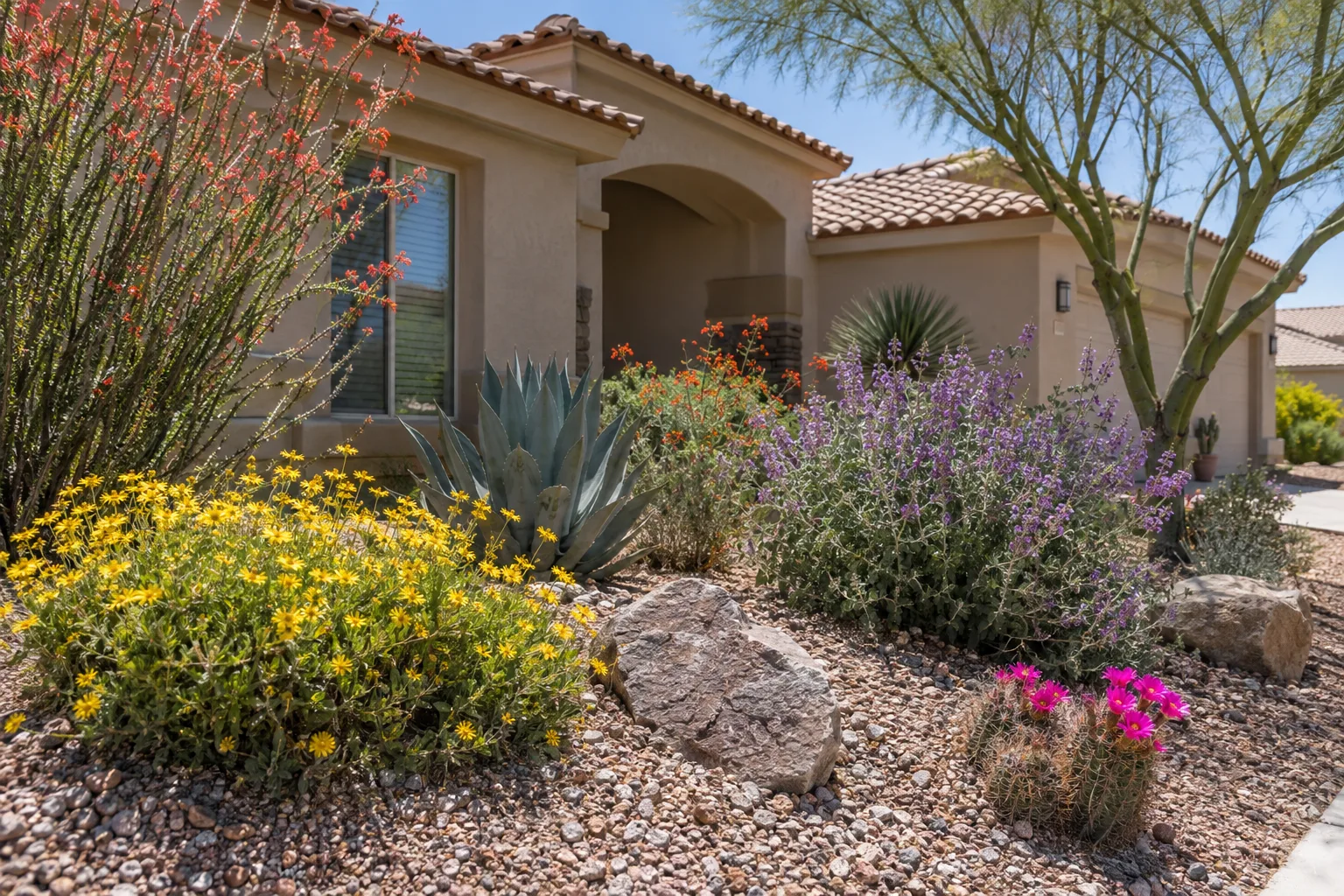
Brittlebush, globe mallow, desert marigold, blackfoot daisy, penstemon, pink fairy duster, hopbush and desert willow are native plants for Arizona front yards that settle in best when planted in March, before summer highs pass 100°F.
Key takeaways
- March planting gives natives about 10 to 12 weeks to root before summer highs pass 100°F.
- Dig each hole 2 to 3 times wider than the root ball and no deeper, with the crown level with or slightly above the soil.
- Backfill with the soil you dug out, because compost in the hole encourages roots to circle instead of spreading.
- Water new plants every 2 to 3 days for the first 2 weeks, then stretch toward once a week by late spring.
- If water still stands in the planting hole after 2 hours, break through the caliche or plant on a low mound.
Why should I plant natives in March in Arizona?
March gives native plants about 10 to 12 weeks to root before summer heat arrives. Soil in the 60s°F pushes root growth without the stress of June, and the risk of frost drops sharply, though a late cold night in early March is still possible in Queen Creek.
A plant that spends spring sending roots 18 to 24 inches down enters July with a reserve that a May planting lacks. Natives set out in May or June can survive, but they need much more water and attention through their first summer. Our gardening calendars show what else belongs in the ground each month, and you can browse our plant selection before you plan the bed.
What should I check in my yard before I buy plants?
Check sun, reflected heat and drainage first, because those three decide where each plant goes. South and west exposures bake against driveways and block walls, and brittlebush, globe mallow and desert marigold handle those spots well. North and east exposures are gentler.
Dig a hole about 18 inches deep in two or three places. Caliche, the pale, cement-like calcium carbonate layer common across the East Valley, blocks both roots and drainage, so if you hit it within 12 inches, break through it with a digging bar before planting. Then fill the hole with water and watch it. Standing water after 2 hours is a drainage problem.
Soil here is usually alkaline, often a pH of 7.5 to 8.5. Natives evolved in it, so they rarely need amendments.
Which native plants work best in Arizona front yards?
These eight fit a typical front yard in size and care. They are varieties we commonly carry, though availability changes week to week and season to season. Sizes are mature ranges and vary with soil and water.
Brittlebush (Encelia farinata)
Brittlebush grows 3 to 4 feet tall and wide in full sun, with silvery leaves and yellow daisy flowers that peak from about February through April. Once established it needs very little water. Plant it 3 to 4 feet apart for a mass along a walkway. The drawback is that it looks ragged in summer, dropping leaves in heat, and hard freezes can burn the tips.
Globe mallow (Sphaeralcea ambigua)
Globe mallow reaches 2 to 3 feet tall and wide in full sun and blooms in orange, with a main flush in spring and another after rain. It handles reflected heat from concrete. Cut it back after a bloom cycle to keep it tidy. Expect it to turn leggy and to self-seed into places you did not plant it.

Desert marigold (Baileya multiradiata)
Desert marigold stays 12 to 18 inches tall and wide, carries yellow flowers on slender stems for much of the year, and wants full sun and low water. It suits street borders and the edges of paths. The drawback is a short life. Individual plants fade after a few years, so you rely on seedlings to keep the patch going, and spent seed heads look untidy.
Blackfoot daisy (Melampodium leucanthum)
Blackfoot daisy forms a mound about 8 to 12 inches tall and 12 to 18 inches wide, covered in white daisies with yellow centers from spring into fall. It needs full sun and sharp drainage, and it fits between boulders or at the front of a bed. Its drawback is rot. Frequent watering or heavy soil will kill it faster than heat will.
Parry’s penstemon (Penstemon parryi)
Parry’s penstemon sends up pink flower spikes, often 3 to 5 feet tall, in March and April above a low rosette of leaves, and hummingbirds visit them. It likes full sun to light shade and low water. Plant it in groups of 3 to 5. It is a short-lived perennial, so plan on reseeding or replanting every few years, and the foliage looks plain after bloom.
Pink fairy duster (Calliandra eriophylla)
Pink fairy duster grows 2 to 3 feet tall and often wider, with fluffy pink powderpuff flowers from late winter through spring. It takes full sun and low water once established. Its fine, airy foliage works at the middle of a bed. The drawback is a modest bloom season, since most flowers come in a few spring weeks, and growth is slow.

Hopbush (Dodonaea viscosa)
Hopbush is the screening shrub here, growing 8 to 12 feet tall in sun to part shade, with dense evergreen foliage. It works along a property line or as a backdrop to smaller flowering plants. The purple-leafed form adds color. Hopbush wants more water than the daisies and mallows while it establishes, and a hard freeze can damage its foliage. Left alone, it gets large.
Desert willow (Chilopsis linearis)
Desert willow is a small, airy tree that grows 15 to 25 feet tall in full sun, with pink, lavender or white trumpet flowers from late spring into summer. Water needs are low once established, and March is a good time to set it out. It loses its leaves in winter and drops flowers and long seed pods, so it is not a tidy choice beside a pool. See more options in our desert trees.
How do I plant natives in March?
Plant them high, in native soil, with a basin to hold water. The steps below work for all eight plants.
- Water the plant in its container the evening before planting.
- Dig the hole 2 to 3 times wider than the root ball and only as deep as the root ball.
- Break through any caliche at the bottom and sides with a digging bar so water can drain.
- Loosen any circling roots and point them outward.
- Backfill with the native soil you removed, firming it gently, with the crown level with or slightly above the surrounding grade.
- Build a low berm 6 to 8 inches out from the stem to form a watering basin.
- Fill the basin two or three times so water soaks 18 to 24 inches down, then add 2 to 3 inches of decomposed granite, keeping it a couple of inches off the stem.

Planting too deep is the most common error, and it invites crown rot. A second error is adding compost or potting mix to the hole. Roots hit the soft zone and stay in it, and the plant never anchors into the soil around it. Buying the largest size also does not guarantee better results, because timing matters more than container size.
How often should I water new natives?
Water every 2 to 3 days for the first 2 weeks, then ease off toward once a week by late spring. Fill the basin each time so moisture reaches the deeper roots. Short, frequent sprinkles keep roots near the surface.
As temperatures climb through May and June, water deeply once or twice a week, and run drip emitters long enough to soak the root zone instead of wetting the top inch. Through the first summer, watch for plants that stay wilted into the morning, which is a sign of thirst. Wilting on a 110°F afternoon that recovers by evening is a normal heat response. During the monsoon, roughly July through September, cut back on irrigation after a good soaking rain.
After the first year, most of these natives can go 1 to 2 weeks between summer waterings and longer in cool months. Desert willow and hopbush usually want a bit more.
How do I arrange natives so a front yard looks planned?
Layer by height and plant in groups of odd numbers. Put hopbush or desert willow at the back or corners, brittlebush, globe mallow, penstemon and pink fairy duster in the middle, and desert marigold and blackfoot daisy along the front edge.
Groups of 3 or 5 read as intentional, and a drift of 7 globe mallows along a driveway looks bold. Bloom times differ, so mix early bloomers like brittlebush, penstemon and pink fairy duster with longer bloomers like desert marigold and blackfoot daisy to keep color going from late winter through fall.If you want a second opinion on your layout, check our classes and events for planting workshops.
Frequently asked questions
Can I grow these natives in containers?
Globe mallow, blackfoot daisy and desert marigold manage in large pots with excellent drainage, but they dry out much faster than plants in the ground. In July, a pot on a hot patio may need water daily. Brittlebush, hopbush and desert willow have sizes and root systems better suited to planting in the ground.
Do native plants need fertilizer?
Most of these natives need little or no fertilizer. Rich feeding pushes soft, fast growth that handles heat poorly. If leaves yellow between the veins, a sign of iron chlorosis common in alkaline soil, a chelated iron product used as the label directs is the usual fix. Skip high-nitrogen products.
Will they survive summer without extra water?
Established brittlebush, desert marigold, blackfoot daisy and globe mallow can often get by on rainfall alone, but a deep watering every few weeks through June and July keeps them looking better. Desert willow and hopbush usually want occasional summer water too. Established here usually means 12 to 18 months in the ground.
What if frost is forecast after I plant?
Cover small plants overnight with frost cloth or an upside-down box when a hard freeze is forecast. Brittlebush, hopbush and new desert willow growth are the most tender. Remove the cover in the morning so plants do not overheat. Established plants of this group tolerate light winter frost, though hopbush can show tip damage.
When is it too late to plant natives?
By late May the window is closing, because new roots meet soil that warms quickly toward summer highs. February through April works for most of these plants, and October through November is the other good window. If you plant in early summer, expect to water more often and shade new plants for the first few weeks.
Is a native front yard right for you?
Yes, if you want color across most of the year, lower water use once plants are established, and a yard that looks like the desert around Queen Creek. Start with three or four plants that fit your space. It will not suit someone who wants a clipped, uniformly green look, or who cannot resist watering on a fixed daily schedule. Stop by the nursery in Queen Creek and we will help you match plants to your yard.