

Desert willow, palo verde, velvet mesquite, sweet acacia and Arizona rosewood are native Arizona trees you can plant instead of crape myrtle. They tolerate our alkaline soil and 110°F summers, and most need far less water once established.
Key takeaways
- Crape myrtle prefers slightly acidic soil, while Queen Creek soil often tests between pH 7.5 and 8.5, so yellow leaves with green veins (iron chlorosis) are common.
- Desert willow is the closest swap for long summer flowers, blooming roughly May through September.
- Palo verde and sweet acacia bring yellow spring bloom, from about February to May depending on the species.
- Plant in October or November, or in February and March, to give roots a mild season before summer.
- Every tree here drops something, whether pods, flowers or leaflets, so match the tree to the space around it.

Why does crape myrtle struggle in Queen Creek yards?
Crape myrtle (Lagerstroemia indica) struggles mostly because of alkaline soil, which locks up iron and turns new leaves yellow between the veins. Our hard irrigation water adds to the problem over time.
Heat is the second factor. Block walls and concrete reflect sunlight onto a tree, and leaf edges scorch when highs pass 110°F. Powdery mildew can also appear on susceptible varieties during humid monsoon weeks, roughly July through September.
Crape myrtle does grow in the East Valley, and plenty of yards have healthy ones. They just need iron applications, regular water and a spot away from reflected heat. The trees below ask for less of all three.
Which native trees can replace crape myrtle?
Seven trees cover most needs, from small flowering accents to large shade trees. These are varieties we commonly carry, though availability changes week to week and season to season, so check with us before you plan around one.
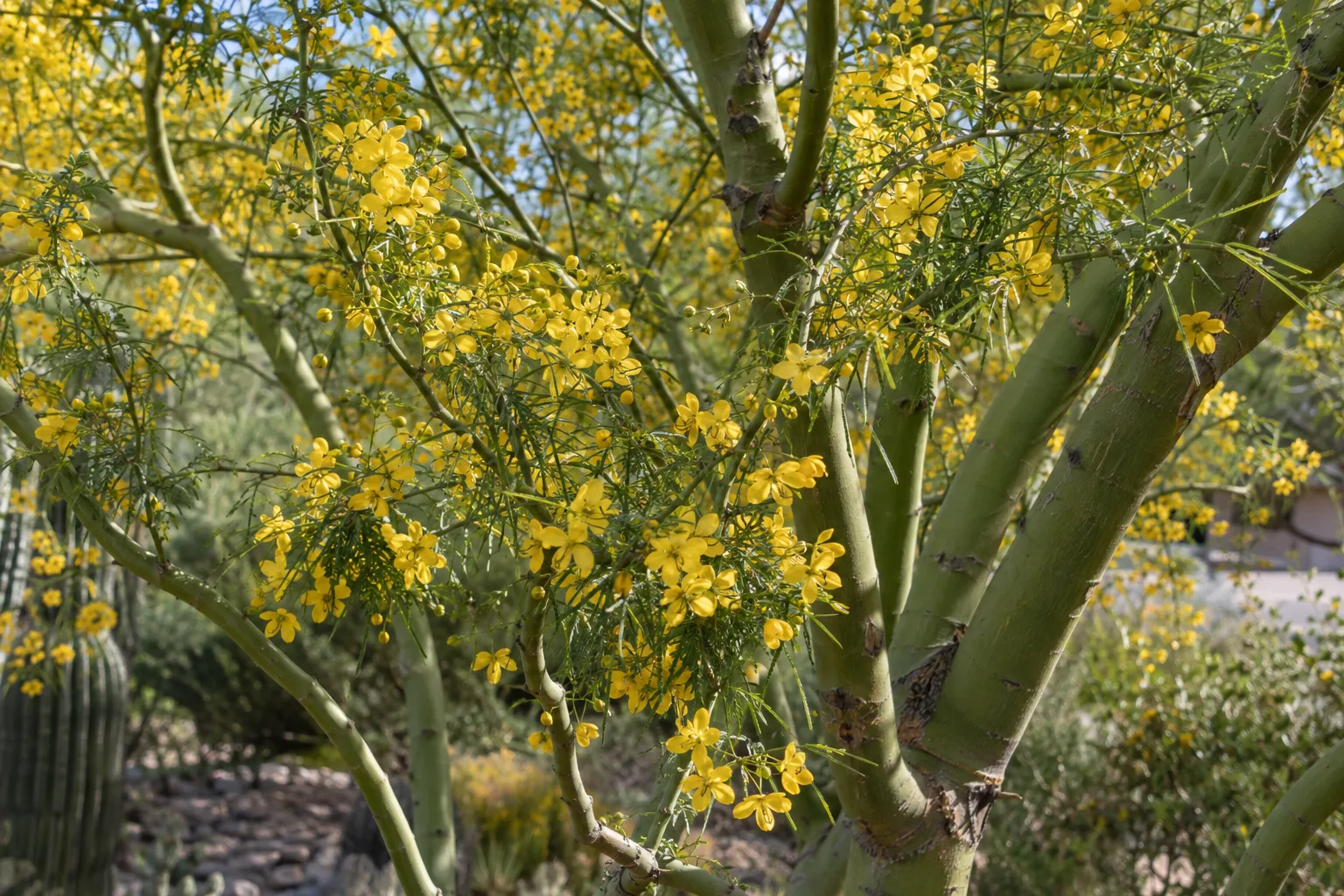
Desert willow (Chilopsis linearis)
Desert willow is the nearest match for crape myrtle’s summer color, with trumpet-shaped flowers in pink, lavender, white or burgundy. It reaches about 15 to 25 feet tall, wants full sun, and needs deep water roughly every two to three weeks in summer once established. Despite the name, it is not a true willow. The drawback is a loose, open shape that benefits from light pruning, plus seed pods and bare winter branches.
Blue palo verde (Parkinsonia florida)
Blue palo verde covers itself in yellow flowers in spring, usually from March into April. Expect 20 to 30 feet tall and a similar spread, in full sun, with deep watering about once a month in summer after the first two years. The blue-green bark does the work of leaves when the tree sheds them in dry spells. The drawback is litter from flowers and seed pods, and branches can snap in monsoon wind if the tree was watered shallowly and often.
Foothills palo verde (Parkinsonia microphylla)
Foothills palo verde stays smaller and tighter, around 15 to 20 feet, with pale yellow spring flowers and green-yellow bark. It likes full sun and very little water once established, often a deep soak every three to four weeks in summer. It suits smaller yards and entry courtyards. The drawback is slow growth. Expect to wait several years for real shade.
Desert Museum palo verde (Parkinsonia hybrid)
Desert Museum palo verde is a hybrid selection known for large yellow blooms and few seed pods. It grows 20 to 30 feet tall and wide in full sun, and needs deep water about every two to three weeks in summer. It grows faster than the pure species. The drawback is that it is not a straight native, it still has thorns, and the flowers drop in a yellow carpet in spring.
Velvet mesquite (Prosopis velutina)
Velvet mesquite is a true Sonoran Desert tree that builds a wide, airy canopy of dappled shade. It grows 20 to 30 feet or more, often wider than tall, in full sun, and needs a deep soak every three to four weeks in summer once established. The drawback is size and mess. Thorns, seed pods and heavy leaflet drop make it a poor choice near a pool or a small patio.
Sweet acacia (Vachellia farnesiana)
Sweet acacia produces fragrant yellow pompom flowers in late winter, usually February into March. It stays about 15 to 20 feet tall, wants full sun, and handles caliche and alkaline soil with a deep soak every two to three weeks in summer. Bees visit it heavily. The drawback is sharp thorns, so keep it away from walkways and play areas, and expect pods and occasional suckers.
Arizona rosewood (Vauquelinia californica)
Arizona rosewood is the evergreen on this list, with narrow, leathery dark green leaves and small white flower clusters in late spring. It reaches roughly 10 to 15 feet in full sun or light afternoon shade, with deep watering every two to three weeks in summer. It works for privacy and near walls. The drawback is slow growth, so a larger starting tree costs more patience or more money later.
| Tree | Mature height | Main bloom | Leaves | Best use |
|---|---|---|---|---|
| Desert willow | 15 to 25 ft | May to September | Deciduous | Summer color |
| Blue palo verde | 20 to 30 ft | March to April | Mostly bare bark and tiny leaflets | Large yards |
| Foothills palo verde | 15 to 20 ft | April to May | Mostly bare bark and tiny leaflets | Small yards |
| Desert Museum palo verde | 20 to 30 ft | Spring, some rebloom | Mostly bare bark and tiny leaflets | Fast shade and color |
| Velvet mesquite | 20 to 30 ft or more | Spring catkins | Deciduous | Big shade |
| Sweet acacia | 15 to 20 ft | February to March | Semi-deciduous | Fragrance |
| Arizona rosewood | 10 to 15 ft | Late spring | Evergreen | Screens and walls |
You can browse our full range of desert trees to compare sizes and forms in person.
When is the best time to plant a native tree in Queen Creek?
Plant in October or November, or in February and March. Roots grow well in warm soil while the air is mild, so the tree gets months of easy weather before its first 110°F summer.
Summer planting is possible but demands far more watering and shade protection. For a month-by-month view of what to do in the garden, our gardening calendars are a handy reference. Avoid planting right before a hard freeze, since young trees can lose tender growth below about 28°F.
How do I plant a native tree in caliche soil?
Dig the hole wide and shallow, then check that water drains out of it. Caliche is a hard calcium layer that can sit anywhere from a few inches to several feet down, and it holds water in the hole like a bowl.
- Dig two to three times as wide as the root ball and no deeper than its height.
- Fill the hole with water and watch it drain. If it is still standing after a few hours, break through the caliche with a digging bar or auger.
- Set the tree so the root flare sits at or slightly above the surrounding soil.
- Backfill with the soil you dug out. Heavy amendments make roots circle inside the hole.
- Build a soil berm 4 to 6 inches high around the planting area to hold water.
- Soak slowly and deeply right after planting.
- Add 3 to 4 inches of wood chip mulch, kept a few inches back from the trunk.
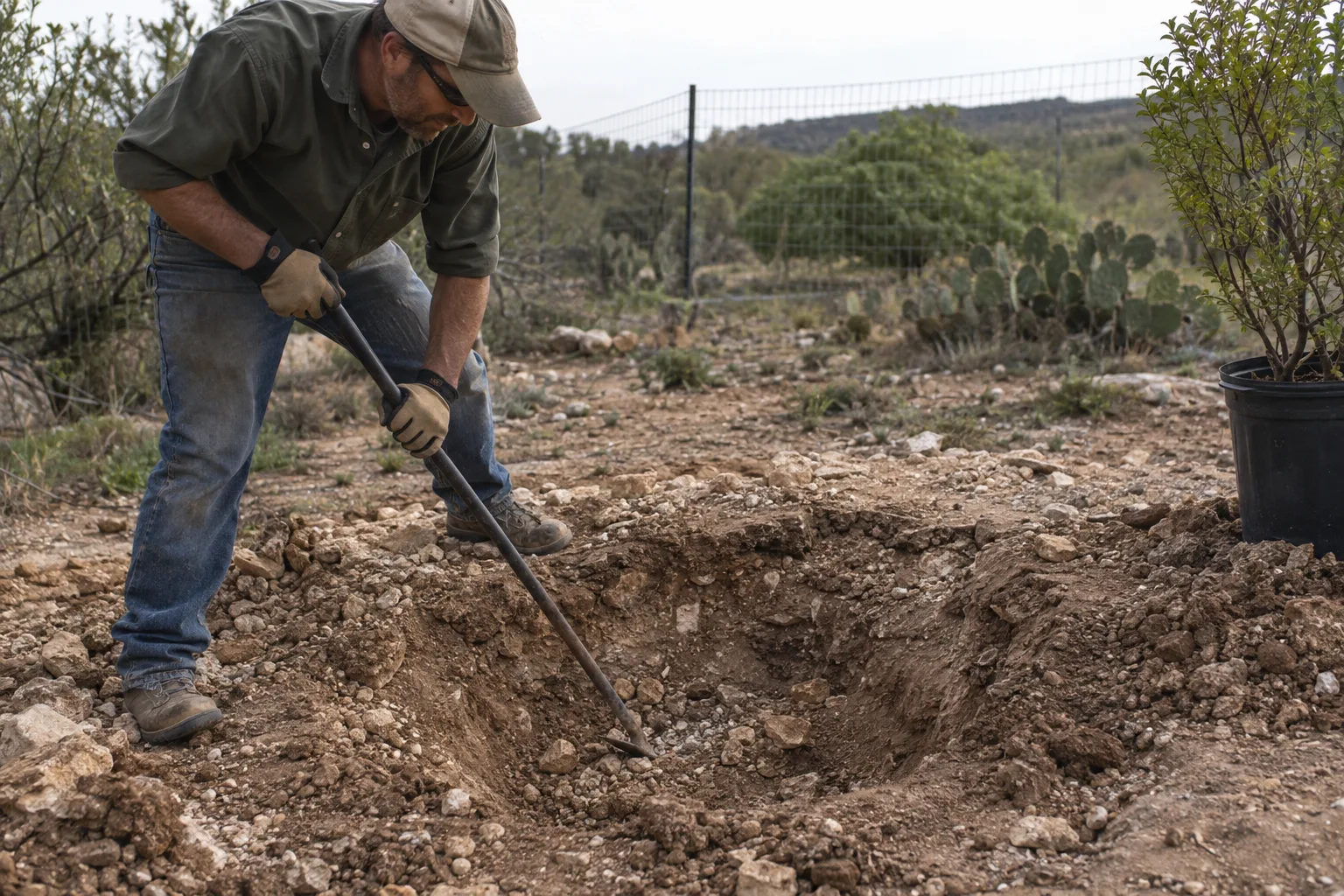
Water deeply about once a week through the first summer, then stretch the interval each season. Frequent shallow watering is the most common cause of weak, shallow roots and root rot in these trees. A soil probe or long screwdriver pushed 8 to 12 inches down tells you whether the root zone is still damp.
Skip soil acidifiers. Our irrigation water is alkaline too, and the trees above tolerate it.
Which native tree fits my yard?
Match the tree to the space and the job. Mature size is the first thing to check, since a 30-foot canopy planted 8 feet from a wall becomes a pruning chore.
For a small yard or entry, foothills palo verde and Arizona rosewood stay compact. If you want privacy all year, look at our evergreen trees. For summer flowers, desert willow is the pick, and our flowering trees page shows other options. If you want winter sun on a south wall, a leafless-in-winter tree helps, and our deciduous trees are worth a look. Large lots can take velvet mesquite or blue palo verde.

Frequently asked questions
How far from the house should I plant these trees?
Plant small trees at least 8 to 10 feet from a wall and large ones such as mesquite and blue palo verde 20 feet or more away. Canopies spread wide, and branches rubbing a roof or wall cause damage and invite pests. Keep pools several feet beyond the dripline to limit leaf and pod fall into the water.
How fast do native desert trees grow?
Most grow at a moderate pace, often 1 to 3 feet a year once established, with Desert Museum palo verde and desert willow near the faster end. Foothills palo verde and Arizona rosewood are slower. Growth depends on regular deep watering in the first two or three years, so plan on patience before judging results.
Will these trees survive a Queen Creek frost?
Established mesquite, palo verde and Arizona rosewood usually handle our occasional light frosts. Young trees, and desert willow in particular, can lose tender growth when temperatures fall below about 28°F. Cover small trees with frost cloth on forecast nights, and avoid heavy pruning or fertilizing in late fall, since new growth is the part that freezes.
Should I remove my existing crape myrtle?
Keep a crape myrtle that looks healthy and blooms well. Remove one that stays yellow, loses leaves every summer, or needs constant iron and water to hold on. Replacing it in fall lets the new tree root in before heat. Plant the new tree a few feet away if you can, since old root systems can compete.
Is a native tree right for your yard?
A native tree is the better choice if your crape myrtle has turned yellow every summer, you want shade or bloom with less watering, and you can accept some litter and thorns. Skip these trees if you want a spotless patio, a tree that blooms all summer with no seed drop, or a tight spot with no room for 20 feet of canopy. Stop by our nursery in Queen Creek and we will help you match a tree to your yard.
