

You can multiply snake plants in Arizona homes seven ways: division, pups, water cuttings, soil cuttings, leaf sections, rhizome cuttings and pumice rooting. Division and pups are the most reliable. Spring and early summer give the fastest rooting.
Key takeaways
- Division and pup separation keep the yellow edges on variegated types like ‘Laurentii’. Leaf cuttings of those plants grow back solid green.
- March through June is the best window, when rooms stay above about 70°F.
- Let every cut end dry for one to three days before it touches soil or water.
- Root cuttings in a gritty mix, about half cactus mix and half perlite or pumice, and water only every 10 to 14 days.
- Expect roots on leaf cuttings in 4 to 8 weeks and visible new shoots a month or more after that.

When should I propagate snake plants in Arizona?
March through June is the best window. Snake plants root faster when the room stays above about 70°F, and a house kept at 74°F to 78°F in spring suits them well. In winter, cuttings in a cool room can sit idle for months, so indoor work is possible in any month but slower from November through February.
Outdoors, cuttings need shade. Summer highs above 110°F can dry a fresh leaf cutting in hours, so keep outdoor propagation to March through May and use full shade. Use our gardening calendars alongside this guide to plan the rest of your yard.
What supplies do I need to multiply snake plants?
You need a clean blade, a gritty mix and a pot with drainage holes. Everything else is optional.
- A sharp knife or pruning shears, wiped with rubbing alcohol before each cut
- Cactus mix blended with perlite or pumice, about half and half
- Pots 3 to 4 inches wide with drainage holes
- A clear glass jar, for water cuttings only
- Rooting hormone powder, optional for soil cuttings
Cactus mix, perlite and pumice are the kind of supplies we commonly carry, although availability changes week to week and season to season. Peat-heavy potting soil holds water around a cutting and is a frequent cause of rot, so blend it with at least half perlite or pumice if it is all you have. If you are still choosing a mother plant, browse our houseplants department. Pots that fit a new cutting are easy to find among our pottery and planters.
Which of the seven methods should I use?
Use division or pups when you want a full plant quickly, and leaf sections when you want the most plants from the least material. The table compares all seven.
| Method | Best for | Keeps variegation | Typical wait |
|---|---|---|---|
| 1. Division | Clumps that have filled the pot | Yes | New growth in about 4 to 8 weeks |
| 2. Pups | Plants with shoots 3 to 4 inches tall | Yes | New growth in about 4 to 8 weeks |
| 3. Water cuttings | Watching roots form | No | Roots in 4 to 8 weeks |
| 4. Soil cuttings | Easy, low-fuss rooting | No | Roots in 6 to 8 weeks |
| 5. Leaf sections | Many plants from one leaf | No | 2 to 3 months or longer |
| 6. Rhizome cuttings | Large, crowded plants | Usually | 6 to 10 weeks or longer |
| 7. Pumice rooting | Gardeners who tend to overwater | No | Roots in 4 to 8 weeks |
Variegated types such as ‘Laurentii’ lose their yellow edges when grown from leaf cuttings, because the edge pattern does not carry through the leaf tissue that forms the new plant. If the striping matters to you, stick to methods 1, 2 and 6.
How do I divide a snake plant or separate pups?
Divide a snake plant when it has filled its pot, and separate a pup once it stands 3 to 4 inches tall. Both methods start with a plant that already has roots, so they are the least likely to fail.
Method 1: Division
Tip the plant out of its pot and look for thick, pale rhizomes joining separate clumps. Cut or pull the clump apart so each piece keeps at least two or three leaves and a healthy share of roots. Let the cut surfaces dry for one to three days in shade, then pot each division in fresh cactus mix and water lightly. Snake plants that sit in a pot for two or more years often have enough crowding to divide.
Method 2: Pups
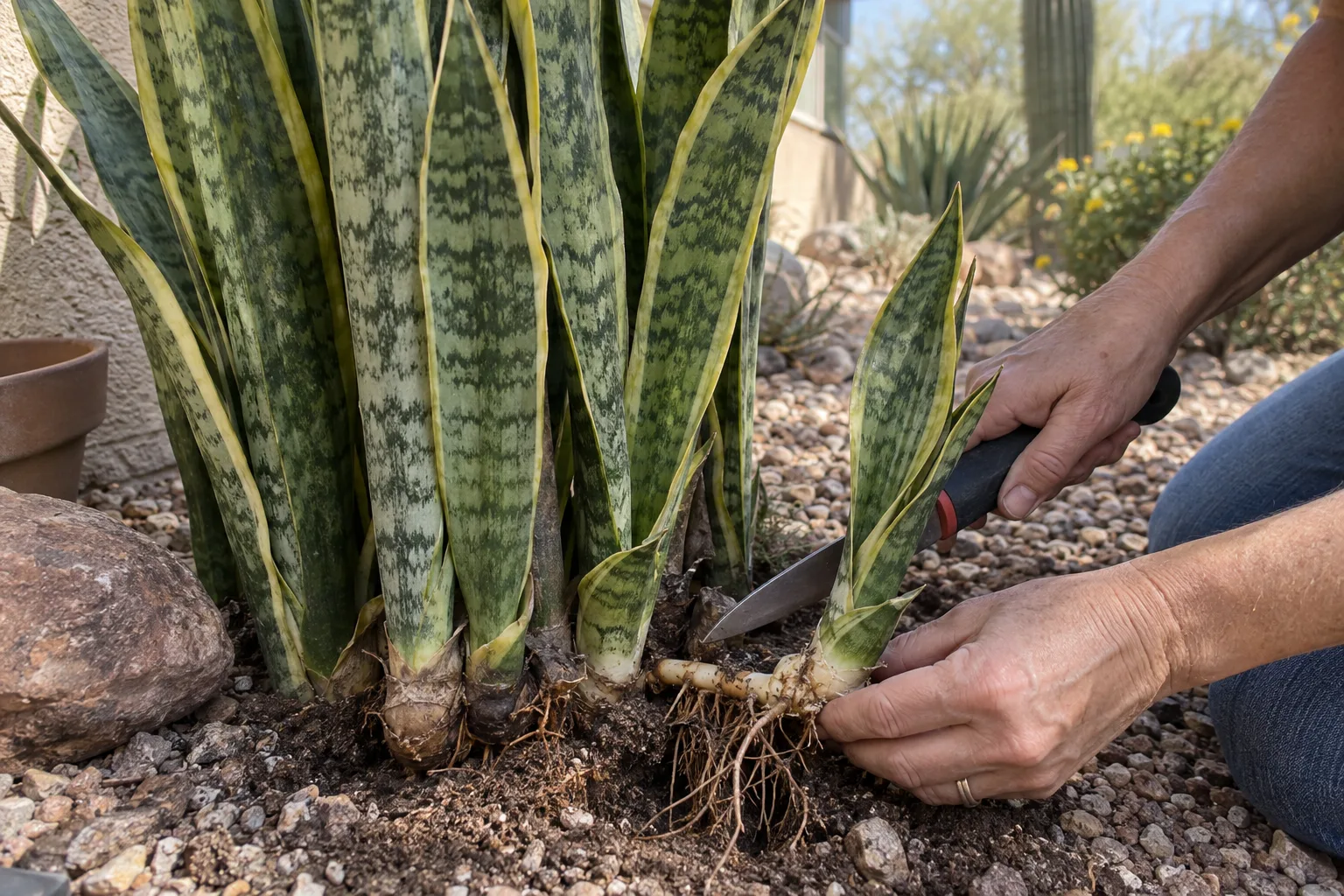
A pup is a small shoot that rises from the rhizome a few inches from the main plant. Smaller ones have little stored energy, so wait until the pup is 3 to 4 inches tall. Dig along the rhizome, cut it cleanly from the mother plant, and let the cut end dry for a day or two. Pot it in cactus mix, water lightly and set it in bright indirect light.
How do I root snake plant leaf cuttings?
Cut a firm leaf at its base, let the cut dry, then root it in water, soil or short sections. All three leaf methods produce solid green plants from variegated parents.
Method 3: Water cuttings
Stand the dried leaf, cut end down, in about an inch of water in a clean jar. Keep it in bright indirect light, such as an east window, and change the water every week. Hard tap water leaves a mineral crust on the glass, and filtered water keeps the jar cleaner. Pot the cutting in cactus mix once the roots reach 1 to 2 inches.
Method 4: Soil cuttings
Soil cuttings need less attention than water cuttings, and the dry air in Arizona homes lowers the chance of rot. Follow these steps.
- Choose a firm, upright leaf with no yellowing or soft spots and cut it off at soil level with a clean blade.
- Let the cut end dry in shade for one to three days.
- Fill a pot with the cactus mix and perlite blend and moisten it until it is barely damp.
- Dip the cut end in rooting hormone if you are using it.
- Push the cut end about an inch deep, with the leaf standing upright.
- Set the pot in bright indirect light, away from afternoon sun through a west or south window.
- Water lightly every 10 to 14 days, letting the mix dry almost completely in between.
- After 6 to 8 weeks, tug the leaf gently. Resistance means roots have formed.
Method 5: Leaf sections
One leaf can make several plants when you cut it into pieces 3 to 4 inches long. Mark the bottom edge of each piece with a notch or pen dot, because a piece planted upside down will not root. Let the pieces dry for one to three days, then plant each one about an inch deep, bottom end down. Cut a few extra, since not every piece succeeds.

How do rhizome cuttings and pumice rooting work?
Rhizome cuttings use the thick underground stem, and pumice rooting swaps soil for a gritty medium that cannot stay soggy. Both suit gardeners with a larger plant or a habit of watering too often.
Method 6: Rhizome cuttings
When you repot a crowded plant, you will find thick horizontal rhizomes at or just under the soil line. Cut a piece at least 2 inches long, let it dry for a day or two, and lay it flat on barely damp cactus mix, pressing it in until about half of it is covered. Keep it in a warm spot above 70°F. Shoots can take 6 to 10 weeks or more.
Method 7: Pumice rooting
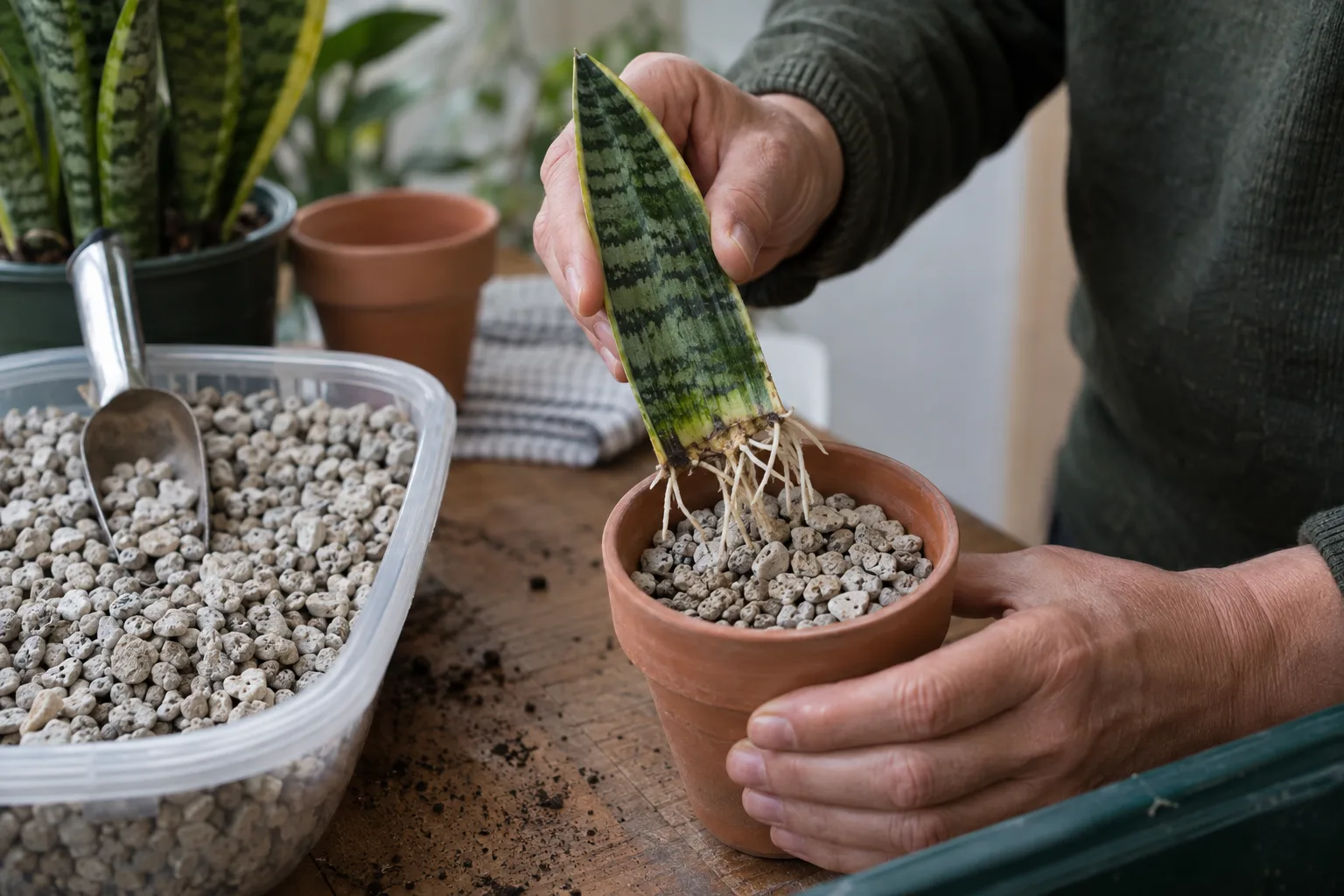
Plant dried leaf cuttings or pups in plain pumice or perlite and keep it only slightly damp. Water drains straight through, so the base of the cutting stays aerated. Once roots reach 1 to 2 inches and a new shoot appears, move the plant into cactus mix with a little organic matter blended in.
What mistakes kill snake plant cuttings in Arizona?
Too much water is the most frequent cause of failure. A cutting sitting in wet mix rots from the cut end upward, and it will not recover.
- Watering on a fixed schedule instead of checking that the mix has dried out.
- Planting leaf sections upside down.
- Putting unrooted cuttings in direct afternoon sun, which dries and burns them.
- Tugging on cuttings every few days to check for roots, which snaps new ones.
- Expecting yellow or white edges from a variegated leaf cutting.
- Ignoring a white crust on the soil, which comes from hard water. Flush the pot with filtered water now and then.
If you would rather learn by doing, see what is scheduled on our classes and events page.
Frequently asked questions
Can I propagate snake plants outdoors in Queen Creek?
Yes, in full shade from March through May. Direct sun can dry leaf cuttings before they root, and pots outside dry out faster than indoors. Set them under a patio or a tree, check moisture weekly, and bring them in if a frost is forecast, since cold below about 40°F can damage new growth.
Do I need rooting hormone?
No, snake plants root without it. Hormone powder may speed up soil cuttings slightly, but clean cuts, dry cut ends and a gritty mix make a bigger difference. Skip it for water cuttings, where it washes off, and for division and pups, which already have roots or rhizome tissue.
How do I know a cutting has rooted?
Gentle resistance when you tug the cutting means roots have anchored it. A small green spear pushing up beside the leaf is a stronger sign. For water cuttings, wait for roots 1 to 2 inches long. Check no more than once every couple of weeks, because repeated pulling breaks fresh roots.
What size pot should a new plant go into?
Choose a pot only 1 to 2 inches wider than the root ball. Extra soil in an oversized pot stays wet for a long time and invites rot. Make sure the pot has drainage holes, and move up a size only after the roots fill the container.
Does dividing hurt the mother plant?
Usually not, if you leave at least two or three leaves and some roots on the original. Repot it in fresh mix and expect growth to pause for a few weeks. Take leaf cuttings from the outer, older leaves so the plant keeps its newest center growth.
Is propagating a snake plant worth the wait?
For most people, yes. Division and pups give you a full plant in a single season, and leaf cuttings turn one leaf into several plants if you can wait a few months. Skip leaf cuttings if you own a ‘Laurentii’ and want the yellow edges, because only division and pups keep them. Skip propagation if the mother plant has soft, mushy leaves, since rotting tissue will not root. Stop by the nursery in Queen Creek and we will talk through your plant and your windows.