

The early signs of mesquite leafing out in Arizona are swelling buds at the branch tips, followed by a faint green haze across the canopy. In the East Valley this usually begins between late February and April, depending on the species and how cold the winter was.
Key takeaways
- Look for swollen buds on several branches, then a light green haze, usually between late February and April in the East Valley.
- Chilean and Argentine types generally leaf out first, honey mesquite follows, and native velvet mesquite is often last, sometimes by several weeks.
- Scratch a twig with a fingernail: green tissue underneath means it is alive, and a dry brown layer means it is dead.
- Increase deep watering gradually as leaves expand, roughly every 2 to 3 weeks in March and April for an established tree.
- Leaf-out is a loose seasonal cue, so confirm the frost outlook before planting tender plants nearby.

When do mesquite trees leaf out in Queen Creek?
Most mesquites here begin leafing out between late February and April. After a mild winter, fast-growing Chilean-type hybrids can show new growth in February, while a cold winter can hold native velvet mesquite back until April.
The stretch from first bud swell to a mostly full canopy commonly takes a few weeks, and cool nights stretch it out. Your own tree’s pattern from year to year tells you more than any calendar, so take dated photos from the same spot. Mesquites sit comfortably among the desert trees that handle summer highs above 110°F and alkaline soil, which is why they are so common in Queen Creek, San Tan Valley, Gilbert and Chandler yards.
What do the first signs of mesquite leafing out look like?
Look for four stages in a rough order: swollen buds, a green haze, unfurling leaves and pale flower spikes. They overlap, and the whole sequence runs over a few weeks.
Swollen buds at the branch tips
Dormant buds at the ends of twigs round out and pick up a faint yellow-green tinge while staying tightly closed. This is the earliest sign, and it is easy to miss unless you stand close and compare a twig with how it looked a week earlier. Check several branches.
A green haze over the canopy
Before single leaves show from the ground, the whole crown takes on a soft green-gold cast. Look at the tree against a clear morning sky. The haze comes from thousands of tiny leaf clusters pushing out of their bud scales.

Feathery leaves unfurling
Mesquite leaves are compound, made of many small leaflets, and they start out small and pale before lengthening and darkening as nights warm. The new growth looks soft against the rough, dark bark of older limbs.
Pale flower spikes
Many mesquites also produce cream to yellowish, finger-shaped flower spikes (catkins) alongside the new leaves or shortly after. Bees visit them, and the spikes later develop into bean pods. Flower spikes on the tree are a sign it has fully broken dormancy.
Which mesquite species leaf out first?
Chilean and Argentine types usually leaf out first, honey mesquite comes next, and native velvet mesquite tends to be last. Many yard trees are hybrids, so treat the order below as a general guide for your own tree rather than a rule.
| Type | Typical leaf-out order | Thorns | Notes |
|---|---|---|---|
| Chilean (Prosopis chilensis) and Argentine (Prosopis alba) types | Earliest, often February after a mild winter | Often fewer, varies by tree | Fast growers that may stay partly leafed in mild winters |
| Honey mesquite (Prosopis glandulosa) | Middle of the group | Thorny | Native to the region |
| Velvet mesquite (Prosopis velutina) | Latest, often March to April | Thorny | Native Sonoran Desert tree with softly hairy leaflets |
Where a tree stands changes the date as well. A mesquite beside a south-facing block wall can run a couple of weeks ahead of one in an open, exposed yard.
What makes a mesquite start leafing out?
Warming soil, longer days and a run of mild nights work together to wake the tree. No single trigger sets the date.
- Soil warmth: Soil warms more slowly than air, so a few warm afternoons in February rarely produce leaves on their own.
- Day length: Lengthening days after the winter solstice send a steady signal, even during cool stretches.
- Accumulated warmth: A winter with few hard cold snaps lets the tree start sooner than one with repeated freezes.
- Soil moisture: Deep moisture from winter rain or irrigation helps, while a very dry winter can slow the process.
- Microclimate: Heat held by walls and paving pushes growth earlier.
Because those factors combine differently each year, two neighbors with the same species can see leaf-out dates that differ by a few weeks.
Is my mesquite dead or just late to leaf out?
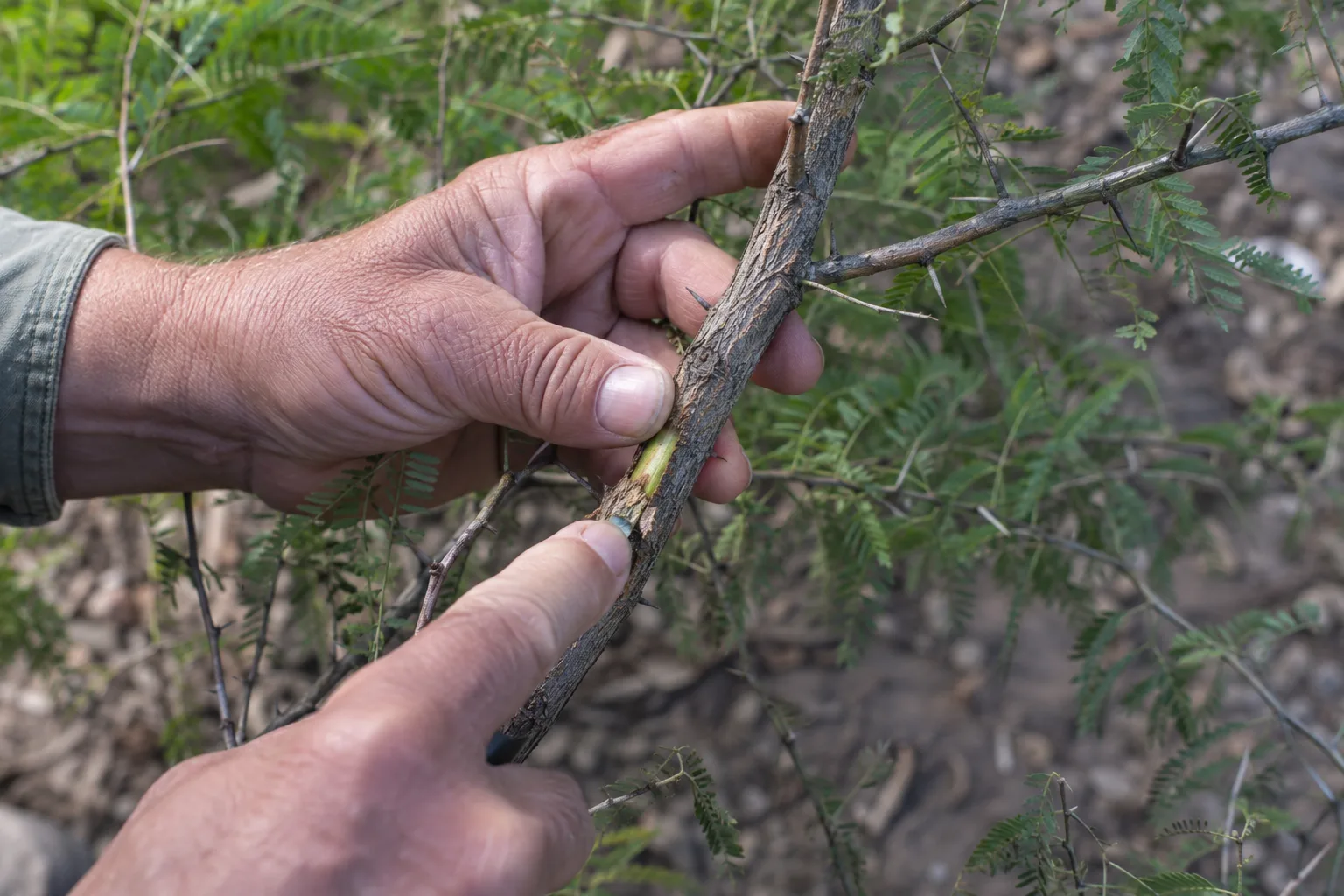
A mesquite that is still bare in March is often just late, especially if it is a native velvet type. Scratch the bark of a few twigs with a fingernail. Green tissue underneath means the twig is alive, and dry brown tissue means that branch has died back.
If part of the canopy stays bare while the rest fills in, look for a cause on that limb or its roots:
- Freeze damage: Branch tips hit by a hard frost turn dark and shriveled, and the dead wood is easier to identify once the rest of the tree has leafed out.
- Wet winter soil: An irrigation system left on a summer schedule can keep soil soaked, and root problems show up as sparse, yellowish spring growth.
- Root disturbance: Grading, trenching or compaction near the trunk can cut or crush roots, and the damage often appears a season later.
- Borers: Wood-boring beetles favor stressed trees, and small round or D-shaped holes in the bark of a bare limb point to them.
If most of the canopy has not leafed out by May, ask a certified arborist to look at it.
How should I water a mesquite as it leafs out?
Water deeply and slowly, and increase the frequency gradually as the leaves expand. For an established tree, roughly every 2 to 3 weeks in March and every 10 to 14 days by late April or May is a reasonable starting point, adjusted for soil, rain and weather.
Each soak should wet the soil 18 to 24 inches down, and the water should land around the outer edge of the canopy (the drip line), where the feeder roots are. Shallow daily watering builds surface roots that suffer in summer and leave the tree less stable in monsoon winds. Caliche or heavy clay slows penetration, so water in several shorter cycles if you see runoff. After a soaking monsoon storm, skip the next scheduled cycle. Young trees need more frequent water than established ones for their first couple of years.
When should I prune a mesquite in Arizona?
Hold off on structural pruning until the tree has leafed out and frost danger has passed, which in the East Valley is often late spring. Cutting while the tree is pushing its first flush of growth sends energy to wound response, and freeze-damaged tips are hard to judge before then.
Thinning a crowded canopy before the monsoon, which runs roughly July through September, lowers the sail effect on branches in strong wind. Remove dead wood any time. Large cuts and tree-height work are jobs for a certified arborist. Our classes and events page is the place to check whether any tree care workshops are scheduled.
Does mesquite leaf-out mean it is safe to plant?
Leaf-out is a loose cue that spring is arriving, and it does not guarantee that frost has passed. Mesquites are tough enough to leaf out and then take a late cold night on the tips, while tomatoes and basil would not survive the same night.
Plan warm-season vegetables with the University of Arizona Cooperative Extension vegetable planting calendar for Maricopa County, and use our gardening calendars for month-by-month reminders. If you want companions beneath the canopy, browse our plants for ones that accept filtered shade and low water, and keep new planting beds out of the trunk area and away from the tree’s wide root zone. Availability changes week to week and season to season.

Frequently asked questions
Should I fertilize a mesquite when it starts leafing out?
Most established mesquites do not need fertilizer. They are legumes that work with soil bacteria to fix nitrogen, so extra nitrogen mostly pushes soft, fast growth that attracts pests. A light feeding can help a young tree in its first few years, but deep watering and mulch out to the drip line do more for most trees.
Do mesquites lose their leaves in winter?
Yes, many do, fully or partly, and it is normal. Mesquites here are semi-deciduous, and the amount of leaf drop depends on the species and how cold the winter gets. A bare tree after a frost can still be alive, so scratch a few twigs in spring before assuming damage. New leaves follow once the weather warms.
When do mesquite flowers and pods show up?
Flower spikes usually appear in spring, often April and May, around the time leaves fill in. Timing follows the same species and weather pattern as leaf-out. Bees use the blooms, and bean pods form afterward and ripen later in the year. Expect some litter from flowers and pods under the tree.
Why is my mesquite thorny when my neighbor’s is not?
They are probably different types. Native velvet and honey mesquite carry noticeable thorns, while many Chilean and Argentine hybrids sold for landscapes have fewer, though thorniness varies tree to tree. Wear thick gloves and eye protection when you handle any mesquite, because even small thorns can cause painful punctures.
How much room does a mesquite need?
Give it a lot. Many landscape mesquites spread roughly 25 to 40 feet wide at maturity, and the roots reach well past the canopy. Keep the trunk well away from walls, pools, septic lines and paving, and plan for the crown at full size instead of the size of the nursery pot.
Is a mesquite the right shade tree for your yard?
A mesquite suits you if you have open space and full sun and want filtered shade from a tree that handles summer highs above 110°F and alkaline soil. Skip it if your yard is small, if you want an evergreen canopy that never thins, or if you dislike sweeping flowers, pods and leaf litter near a pool. Place it where the wide crown has room, and water it deeply through its first couple of summers. If you are weighing it against other desert trees, come talk it through with us at our nursery in Queen Creek.
