
The plants to trim in March in Arizona are lantana, bougainvillea, autumn sage, deer grass and desert willow. Wait on palo verde and desert marigold until they finish blooming.
Key takeaways
- Cut lantana back to about 6 to 12 inches once frost danger has passed, and expect new growth within a few weeks.
- Trim frost-damaged bougainvillea and yellow bells after new leaves show where live wood begins, usually by mid to late March.
- Cut deer grass to roughly 6 to 10 inches before the new blades start to push.
- Leave palo verde and desert marigold uncut until their spring flowers fade, often April to May.
- Take no more than about one-third off a shrub in one session, except lantana and ornamental grasses that are meant to be cut hard.
Is March a good time to prune in the Arizona low desert?
Yes, for the plants listed below, as long as frost danger has passed. March brings warm days and active spring growth, so cuts heal fast and new stems have time to harden before summer highs climb above 110°F. A frost in early March is still possible in some winters. Check the forecast first, and wait for a stretch of lows above freezing before you start.
Frost-browned branches shield the living wood below them from the next cold night. Use the scratch test to find out what is alive: nick the bark with a fingernail, and green tissue underneath means the stem is still good. Brown and dry all the way through means it can come out. Our gardening calendars page is a good place to see what else belongs on the March list.
Which plants should I trim in March?
Lantana, bougainvillea, autumn sage, deer grass and desert willow all take a March cut well. Each one pushes new growth in spring warmth, and most of them flower on that new growth. These are varieties we commonly carry, and availability changes week to week and season to season, so browse our plant selection for what is available.
Lantana (Lantana camara)
Lantana usually looks like a pile of brown sticks after winter. Cut it back to about 6 to 12 inches above the soil once frost danger is over, and new growth typically appears within a few weeks. Skipping this cut leaves a woody, leggy plant that blooms mostly at the stem tips instead of across a full mound. Scratch a stem near the base first to confirm it is green.

Bougainvillea (Bougainvillea hybrids)
Bougainvillea blooms on new growth, so a March trim sets up the spring color flush. Cut dead and frost-burned canes back to live wood once new leaves show where it begins, then shorten long canes to a side branch or bud. Heavy cuts delay flowering by several weeks, so shape lightly unless the plant is badly overgrown. Wear thick gloves and long sleeves, because the thorns are sharp.
Autumn sage (Salvia greggii)
Cut autumn sage back by one-third to one-half, shortening stems to a pair of healthy leaves. Remove old flower stems and winter-damaged tips as you go. Avoid cutting into bare, thick old wood, since it may not leaf out again. A yearly trim keeps the plant from opening up in the center and blooming only at the outer tips.
Deer grass (Muhlenbergia rigens)
Cut deer grass to about 6 to 10 inches before the new blades start pushing, using hedge shears on large clumps. The cut removes the dead material that builds up in the center and lets the clump refill with fresh green growth over the next several weeks. Neat edges are not needed. Wear gloves, because the old blades are sharp.
Desert willow (Chilopsis linearis)
Desert willow flowers on new growth, so a March cleanup supports a heavier bloom. Remove dead wood and crossing branches, then shorten overly long stems by up to one-third. Keep the tree’s natural form instead of topping it, because topped branches regrow as weak, fast shoots. If you are choosing a tree that needs little shaping, look through our desert trees.
Which plants should I leave alone in March?
Leave palo verde and desert marigold uncut while they bloom, go light on Texas sage, and hold off on any frost-damaged tender plant until new growth appears. Cutting at the wrong moment removes flower buds or exposes stems to a late cold night.
Palo verde (Parkinsonia species)
Palo verde varieties flower from roughly March through May, depending on the variety. Pruning during bloom removes the flowers that make the tree worth growing. Wait until the flowers fade, then do any structural thinning in late spring or early summer.

Desert marigold (Baileya multiradiata)
Desert marigold flowers for months on stems that formed over winter. Deadheading in March removes buds that are about to open. Once the main spring bloom fades, trim spent stems lightly. The plant often reseeds, and it may bloom again after summer rain.
Texas sage (Leucophyllum frutescens)
Texas sage flowers in bursts after humid weather or summer rain. Shearing it into a tight ball removes its natural shape and much of the growth that carries those flowers. A light shaping is fine. Skip hard shearing in March.
Frost-damaged tender plants
Yellow bells (Tecoma stans) and other frost-tender shrubs often look dead in early March. Wait until new leaves show where live wood begins, then cut back to just above it. Cutting earlier risks removing wood that was still alive and exposes fresh cuts to another cold night.
How do I prune shrubs in March without hurting them?
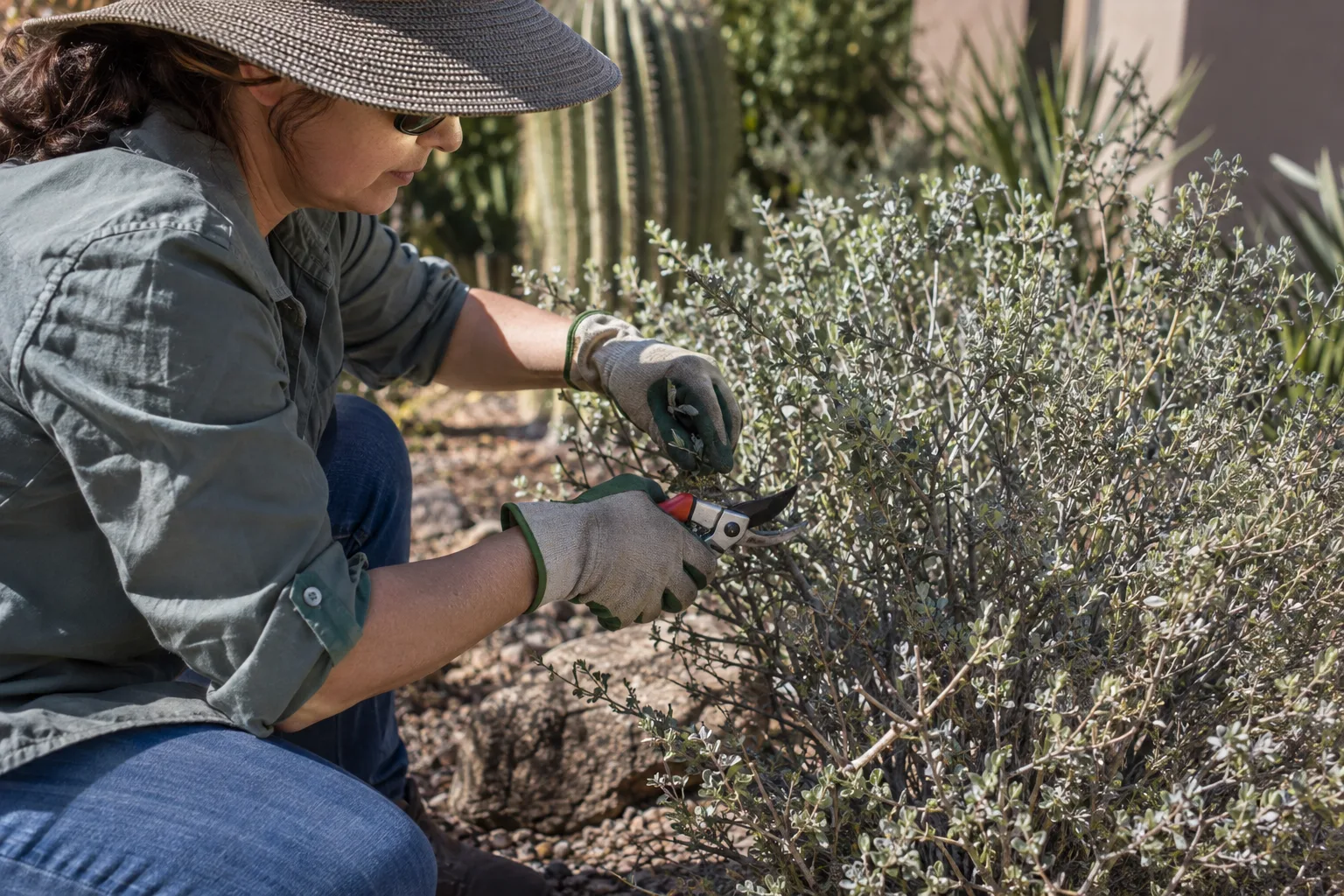
Work in a set order of dead wood first, then thinning, then shaping, and stop before you have taken more than a third of the plant. Bring bypass pruners, loppers, a pruning saw for branches thicker than about 2 inches, and gloves.

- Walk the yard and note which plants are blooming or budding, then skip those.
- Wipe blades with rubbing alcohol between plants.
- Cut out dead, damaged and crossing branches first.
- Shorten stems back to a leaf pair, bud or side branch, cutting just above it.
- Step back after every few cuts to check the shape.
- Rake up and bag clippings, especially from any plant with signs of disease.
Three mistakes cause most of the damage. Shearing everything into a ball thickens the outside and shades out the inside, cutting more than a third off a shrub stresses it (lantana and grasses are the exceptions), and cutting into bare old wood can leave stems that never resprout. Go slowly, and spread the work over two or three weekends.
Which plants get cut in March, and which wait?
The table sums up the plants above. Use it as a checklist, and adjust for your own yard, since cold air settles in low spots and bloom timing varies with the plant’s exposure and variety.
| Plant | Prune in March? | How much, or when instead |
|---|---|---|
| Lantana | Yes | Back to 6 to 12 inches after frost danger passes |
| Bougainvillea | Yes, lightly | Remove frost damage once new growth shows, shorten long canes |
| Autumn sage | Yes | One-third to one-half |
| Deer grass | Yes | Down to 6 to 10 inches |
| Desert willow | Yes | Dead wood plus up to one-third of long stems |
| Palo verde | No | After flowers fade, late spring or early summer |
| Desert marigold | No | Light trim after the main spring bloom |
| Texas sage | Light only | Shape lightly, skip hard shearing |
What care do plants need after a March trim?
Give pruned plants a deep soak at their usual interval, and let new growth appear before you fertilize. Pruning removes leaf area, so soil stays wet longer than usual. Check a few inches down before you water again.
Once new leaves are an inch or two long, a light feeding of slow-release fertilizer helps lantana, bougainvillea and autumn sage. Desert willow, deer grass and other desert-adapted plants need little, and heavy feeding pushes soft growth. Hard water and alkaline soil leave salts behind, so an occasional deep soak helps flush them below the roots.
Frequently asked questions
What if a frost hits after I prune?
Cover tender new growth with frost cloth or an old sheet overnight, and remove the covering the next morning. Damaged tips can be trimmed once the weather settles. Plants with healthy roots usually push out new growth again, but a late frost sets back spring color by a few weeks.
Can I prune citrus in March?
Light shaping and removing dead wood are fine in March once frost danger has passed. Skip heavy cuts that open the canopy, since exposed bark and fruit can sunburn once summer highs pass 110°F. A late cold night is the main risk to fresh spring growth. Our citrus trees page shows varieties we commonly carry, and availability changes.
What tools do I need for March pruning?
Bypass pruners, loppers and a pruning saw cover nearly every job here, plus hedge shears for grasses. Wipe blades with rubbing alcohol between plants, especially after cutting out dead or diseased wood. Wear thick gloves and long sleeves for bougainvillea. Our classes and events page lists what is scheduled if you want hands-on help.
Can I prune everything in one weekend?
You can, but spreading the work over two or three weekends is easier on the plants and on you. Cutting many shrubs at once exposes a lot of stem to sun and wind, and it is easy to misjudge shape. Start with frost damage and dead wood, then shape, and step back often between plants.
Is it too late if my lantana already has new leaves?
No, cut it back anyway, to 6 to 12 inches above the soil. Lantana recovers quickly in spring warmth, and new leaves on old wood point to a plant ready to regrow. Expect flowers to start a little later than on a plant cut earlier. After cutting, water deeply, and the mound fills back in over a few weeks.
Should you prune everything in your yard in March?
No. Prune the lantana, bougainvillea, autumn sage and deer grass that look rough after winter, and leave bloomers like palo verde and desert marigold for later. A yard of mostly native desert plants needs very little March work, so if that describes yours, a quick check for dead wood is enough. Anyone unsure about a plant should wait a week and watch for buds. Stop by our Queen Creek nursery with a photo of the plant you are unsure about, and we will help you decide.