March is one of the best months for landscaping in Arizona. Soil is warming, frost risk is mostly behind us, and new plants get roughly 8 to 10 weeks to root before summer highs pass 105°F in the low desert.
Key takeaways
- Plant trees, shrubs and perennials in March so roots get 8 to 10 weeks of mild weather before highs climb above 105°F.
- Wait to prune frost-damaged bougainvillea, lantana and red bird of paradise until the last cold night has passed, often late February or early March in Queen Creek.
- Run every irrigation zone in March and replace emitters clogged by hard-water mineral deposits before summer.
- Dig planting holes 2 to 3 times as wide as the root ball and no deeper, and break through caliche so water can drain.
- Spread 3 to 4 inches of mulch over beds and keep it a few inches back from trunks and stems.

Why is March a good month to plant in the low desert?
March pairs mild air with warming soil, and new roots need both. Daytime highs in the East Valley usually run from the 70s into the mid 80s, and soil 4 inches down warms into the 60s°F, the range where most desert-adapted trees and shrubs start active root growth.
A tree planted in June has to build roots while the soil surface bakes well past 120°F in full sun. March avoids that problem. The mild weather is also easier on you, since digging through caliche at 75°F beats digging through it at 105°F. Our gardening calendars lay out the East Valley schedule month by month if you want to plan the rest of the season.
What should I plant in March in Queen Creek?
Plant desert trees, flowering shrubs, perennials and warm-season vegetable transplants. Each of these roots quickly in spring soil.
Trees
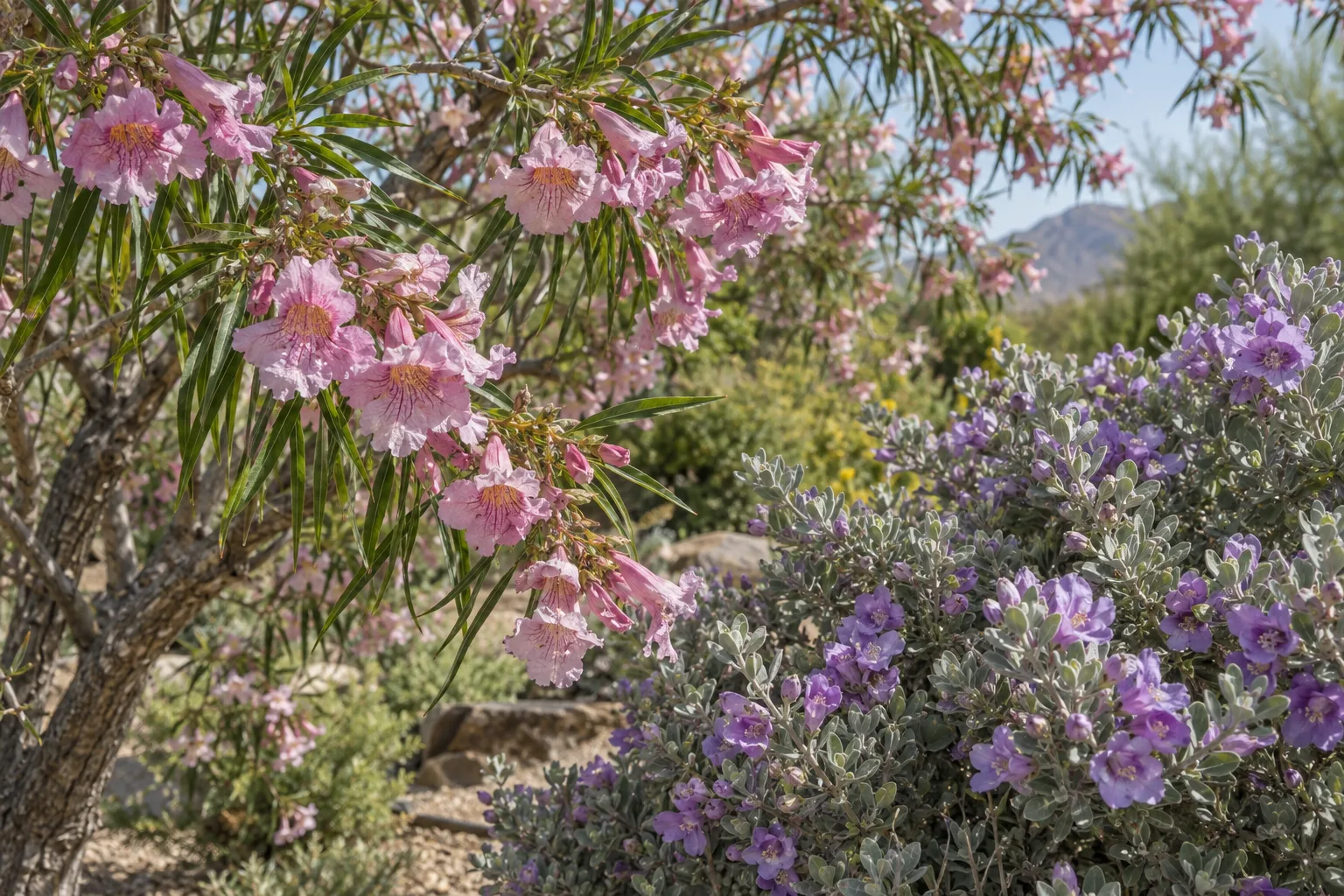
Native and desert-adapted trees such as mesquite (Prosopis species), palo verde (Parkinsonia species) and desert willow (Chilopsis linearis) push new growth in March and April, so they start rooting almost immediately. These are varieties we commonly carry in our desert trees department, though availability changes week to week and season to season. All three drop litter, such as leaflets, pods or seed, so keep them back from pools.
Shrubs and perennials
Texas sage (Leucophyllum frutescens) has silver foliage and purple blooms, and it rots quickly if it is watered too often. Red bird of paradise (Caesalpinia pulcherrima) and Mexican bird of paradise (Caesalpinia mexicana) bloom through summer heat, though red bird of paradise can freeze back in a cold winter. Lantana (Lantana camara) grows fast and blooms heavily, but it also takes frost damage. Desert spoon (Dasylirion wheeleri) is slow and tough.
Bougainvillea (Bougainvillea hybrids) flowers best in warm weather, so plant it once frost danger has passed and go easy on nitrogen if you want blooms over leaves. You can browse these and other choices in our plants department.
Vegetables
Warm-season transplants such as tomatoes and peppers can go in during March, while cool-season crops like lettuce and broccoli are close to finished as days warm. The University of Arizona Cooperative Extension publishes a vegetable planting calendar for Maricopa County with dates for each crop. Our herbs, vegetables and berries page shows what we offer.
How do I plant a tree or shrub in caliche and alkaline soil?
Dig wide, not deep, and make sure water can drain through the bottom of the hole. Caliche is a cemented calcium carbonate layer that can sit anywhere from a few inches to several feet below the surface, and a hole that ends on caliche holds water like a bowl. Roots sitting in it suffocate.

- Choose the spot using the plant’s mature size, leaving room from walls, walkways and other plants.
- Dig the hole 2 to 3 times as wide as the root ball and only as deep as the root ball is tall.
- If you hit caliche, break through it with a digging bar or a rented electric breaker.
- Fill the hole with water. If it is still standing the next day, break through further or plant on a slightly raised mound.
- Set the plant with the top of the root ball level with or just above the surrounding soil, and backfill with the native soil you removed.
- Build a shallow basin around the plant and water slowly and deeply.
- Add 3 to 4 inches of mulch and keep it a few inches away from the trunk or stems.
Backfilling with native soil encourages roots to leave the hole instead of circling in a pocket of richer soil. Most desert-adapted plants tolerate alkaline soil without heavy amending.
When can I cut back frost-damaged plants?
Cut back frost damage once the last cold night has passed. The browned growth insulates the healthy tissue below it, so removing it early exposes the plant to the next frost. In Queen Creek that point often arrives between late February and early March, and some years bring a cold night later than that.
Bougainvillea, lantana and red bird of paradise are the usual casualties. Cut each stem back to green tissue. Scratching the bark with a fingernail shows green underneath if the branch is alive, and new growth often appears within a few weeks.
March also suits structural pruning on desert trees. Remove dead, crossing and low branches before the heavy spring flush, and keep most of the canopy because it shades the trunk and root zone. Never top a tree. Topping forces weak, fast regrowth and leaves large wounds. Hard pruning a spring bloomer such as palo verde in March also removes its flower buds.
How do I get my irrigation ready for summer?
Run every zone in March and fix what you find, because a failed emitter in July can stress a tree within days. Walk the line while the system runs and look for clogged, missing or shifted emitters, leaks and pooled water. Hard water leaves mineral buildup that blocks small emitter openings.

Check emitter placement against plant size. A tree planted a few years ago needs its emitters moved outward toward the edge of the canopy as the roots spread. Then raise run times gradually through April and May instead of waiting for the first 100°F week. For hands-on help, see our classes and events page for current workshops.
How often should I water new plants in March?
New plants usually need water every 2 to 3 days in March, then less often as their roots spread. Let the soil decide. Push a screwdriver 4 to 6 inches into the ground near the root ball, and water if it meets dry resistance.
If the soil is damp at that depth, wait. Overwatering is a real risk in heavy soil or soil sitting on caliche, where water drains slowly. As daytime highs pass 80°F in late March, the interval between waterings shortens, so keep checking. Established desert trees and shrubs need far less, and they do best with deep, infrequent watering.
What should I leave alone in March?
Skip the jobs that cause more trouble than they solve this month. Most of these mistakes show up in summer, when a plant struggles and the cause traces back to a spring decision.
- Frost-tender tropicals: hold them until nights are reliably warm, or cover them on cold nights.
- Tree topping: cutting branch ends leaves weak regrowth and large wounds.
- Heavy nitrogen on native desert shrubs, which respond with soft, floppy stems.
- Tight spacing: a red bird of paradise planted 2 feet from a walkway can reach across it by late summer, so plan for mature size.
- Mulch piled against trunks, which holds moisture on the bark and invites rot.
Frequently asked questions
Can I still plant cool-season vegetables in March?
Only in early March, and only for quick crops. Lettuce, spinach, cilantro and broccoli bolt (flower and turn bitter) once days stay in the mid 80s, which can happen by late March or April. Shade cloth can stretch the harvest by a couple of weeks. After that, switch to tomato, pepper and basil transplants.
Is March a good time to plant citrus?
Yes, once frost danger has passed. Young citrus is frost tender, so a late cold night can damage new growth on a tree planted too early. March planting gives the roots time to establish before summer, and you can look through our citrus trees department for varieties we commonly carry, though availability changes with the season. Protect small trees with frost cloth if a cold night is forecast.
Should I fertilize in March?
Feed plants that are actively growing, and skip the rest. Citrus, palms and flowering shrubs respond to a slow-release fertilizer as spring growth starts, following the label rate. Native desert trees and shrubs such as Texas sage and palo verde need little, and extra nitrogen pushes soft, floppy growth. Newly planted trees generally do not need fertilizer at planting.
Is March too early for Bermuda grass?
Late March works for Bermuda sod, but seed usually does better later in spring when soil stays warm. Bermuda grows slowly until soil temperatures stay above roughly 65°F, and a soil thermometer takes the guesswork out. If winter ryegrass is in your lawn, it fades on its own as temperatures rise.
Can I plant cacti and agaves in March?
Yes, March works well for most cacti, agaves and other succulents. Soil is warming, and a plant that goes in before summer has time to settle. Plant in fast-draining soil at the same depth it grew in, and water sparingly while it establishes. Plants raised in shade can sunburn, so move them into full sun gradually. Wait until frost danger has passed for tender types.
Is March the right time to start your yard project?
For most Queen Creek yards, yes. Trees, shrubs, perennials and warm-season vegetables all get their longest runway before summer when they go in during March. Wait if you plan to plant frost-tender tropicals while cold nights are still possible, or if you cannot water new plantings every few days for the first several weeks. Those plants do better in April or in fall. Visit us at Desert Horizon Nursery in Queen Creek and we will help you match plants to your yard.