
The groundcovers to plant in March in Arizona are trailing rosemary, trailing lantana, desert marigold, verbena and blackfoot daisy. Purple heart, bougainvillea, dwarf ruellia and Mexican heather need warmer soil, so wait until late April or May.
Key takeaways
- March soil in the East Valley usually runs 55 to 65°F, enough for rosemary, verbena and blackfoot daisy to root but too cool for purple heart, which wants roughly 65 to 70°F.
- You have about 10 to 12 weeks between early March and mid-May to build roots before summer highs pass 100°F.
- Dig each hole twice as wide as the pot and no deeper, and space plants 18 to 36 inches apart (3 to 4 feet for trailing rosemary).
- Water every 2 to 3 days for the first two weeks, then deeply every 5 to 7 days, easing to weekly by May.
- Cover the root zone with 2 to 3 inches of mulch to slow evaporation and cool the soil.
Why is March a good month to plant groundcovers in Arizona?
March gives new groundcovers about 10 to 12 weeks of mild weather to root before summer highs climb above 100°F. Daytime highs in the East Valley run from the 70s to the low 80s, and soil 4 to 6 inches down is often 55 to 65°F, warm enough for cool-tolerant plants to push roots yet cool enough that transplants do not wilt. The runway is short.
Frost is the one risk. Queen Creek can run colder on clear nights than the middle of the Phoenix metro area, and a late frost in early March is possible. Watch the forecast and keep frost cloth on hand for the first few weeks.
Soil temperature is the other half of the timing question. Plants from the Mediterranean and the Sonoran Desert root at 55°F, while tropical and subtropical plants stall until the soil reaches 65 to 70°F. Start with our plants department to see what categories we grow. Most of the groundcovers below are varieties we commonly carry, though availability changes week to week and season to season.
Which groundcovers can go in the ground in March?
Five low-water groundcovers root well in March soil: trailing rosemary, trailing lantana, desert marigold, verbena and blackfoot daisy. All five want full sun and lean, fast-draining ground, and all handle the alkaline soil common across Queen Creek and the East Valley.
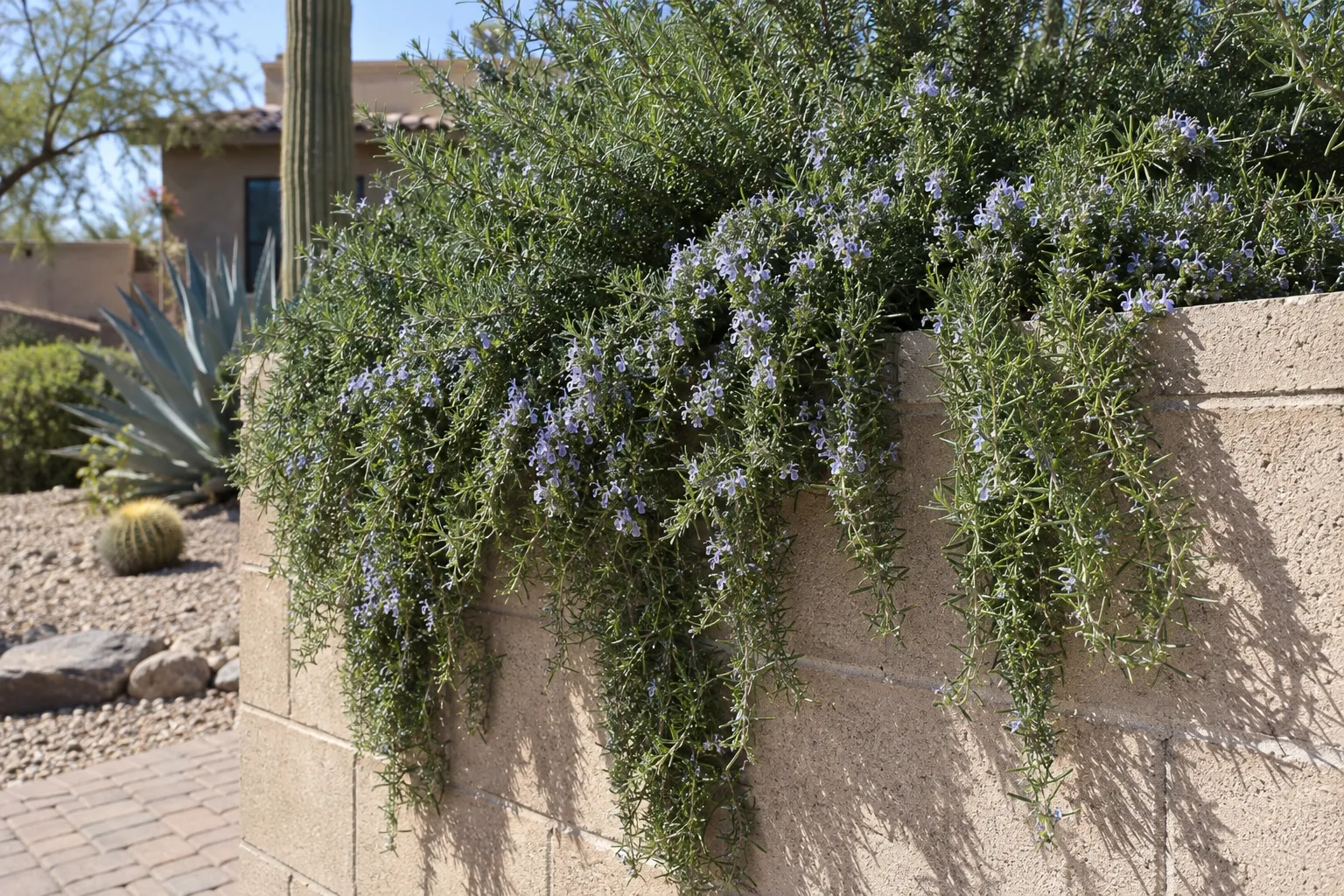
Trailing rosemary (Salvia rosmarinus ‘Prostratus’)
Trailing rosemary grows 1 to 2 feet tall and spreads 4 to 6 feet, spilling over walls and down slopes with fragrant gray-green foliage. It needs full sun and little water once established. Space plants 3 to 4 feet apart. The drawback is slow coverage in the first year, and soggy soil will kill it faster than drought will.
Trailing lantana (Lantana montevidensis)
Trailing lantana forms a low mat 1 to 2 feet tall and 3 to 5 feet wide, with lavender or white flowers from spring into fall. It tolerates reflected heat from walls and pavement, which makes it useful along driveways. Plant 24 to 36 inches apart. The drawback is frost damage, so the plant looks ragged in winter and needs cutting back once frost danger has passed.

Desert marigold (Baileya multiradiata)
Desert marigold is a native wildflower that grows 1 to 2 feet tall and wide, with bright yellow blooms on tall stems from spring through much of the year. It needs full sun, very little water and lean soil. It is short-lived, so it fills in by reseeding rather than by spreading a mat. Rich soil and frequent watering shorten its life.
Verbena (Verbena rigida and spreading hybrids)
Verbena grows 6 to 18 inches tall and spreads 2 to 3 feet, with purple, pink or red flowers that start in spring. Verbena rigida tolerates heat and drought better than many hybrids and often resprouts from the roots after summer slows it down. Give it full sun and good drainage. Expect it to look tired in July.
Blackfoot daisy (Melampodium leucanthum)
Blackfoot daisy forms a neat mound 6 to 12 inches tall and 12 to 24 inches wide, covered in small white daisies with yellow centers for much of the year. It needs full sun, very little water and sharp drainage, and it does well in rocky, alkaline soil. Plant about 18 inches apart. It knits together slowly, so expect a full season before the gaps close.
Which groundcovers should wait until late April or May?
Bougainvillea, purple heart, dwarf ruellia and Mexican heather should wait until mid-April to early May. All four are frost tender and prefer warm soil, so a March planting tends to sit still, or take cold damage, instead of rooting before summer.
Bougainvillea (Bougainvillea spp., spreading types)
Spreading bougainvillea can cover a slope with color, reaching 3 to 6 feet wide depending on the variety. It wants full sun and roots best once the soil stays above 65°F. A cold snap can cut back a young plant hard. It is also thorny and drops papery bracts, so it suits slopes better than walkways.
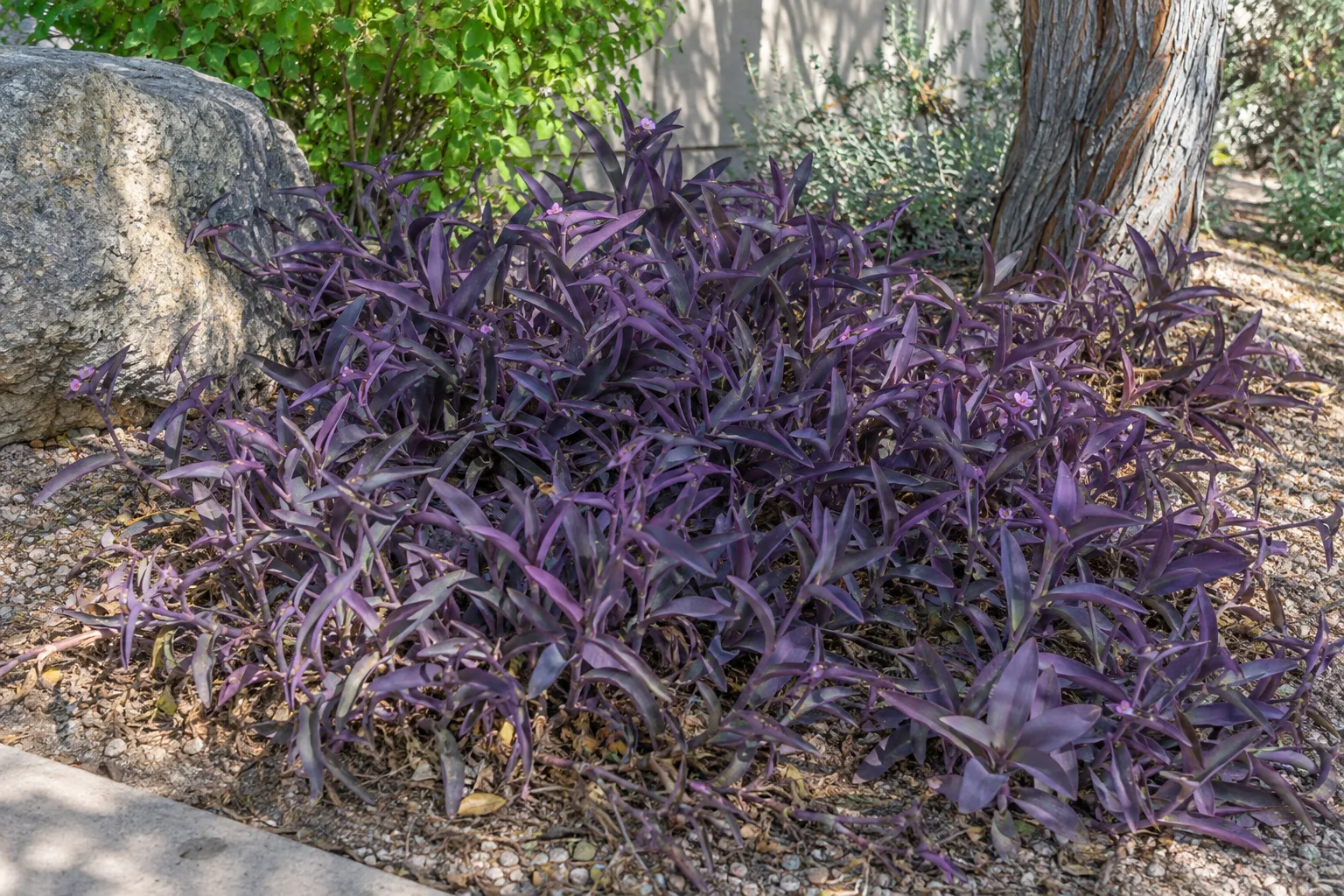
Purple heart (Tradescantia pallida)
Purple heart grows 12 to 18 inches tall and spreads 2 to 3 feet, with deep purple foliage that stands out against gravel. It tolerates full sun but looks best with afternoon shade in the hottest exposures. It stalls in cool soil and then grows fast in warm weather. The drawback is a moderate water need, higher than the March plants above.
Dwarf ruellia (Ruellia simplex ‘Katie’)
Dwarf ruellia stays 6 to 12 inches tall and spreads 1 to 2 feet, producing purple flowers over a long season. It grows in sun or part shade and wants regular water. Frost burns the foliage, which then regrows from the base. Plant it after the chance of frost has passed.
Mexican heather (Cuphea hyssopifolia)
Mexican heather makes a fine-textured mound 1 to 2 feet tall and wide, with tiny purple or white flowers. It does best in morning sun and afternoon shade with moderate water. Afternoon sun on a west wall scorches it, and frost damages it. Wait for warm soil, then plant it where it gets relief from the hottest hours.
| Groundcover | Plant in March? | Best window | Sun | Water once established |
|---|---|---|---|---|
| Trailing rosemary | Yes | February to April | Full sun | Low |
| Trailing lantana | Yes | March to May | Full sun | Low to moderate |
| Desert marigold | Yes | February to April | Full sun | Very low |
| Verbena | Yes | March to April | Full sun | Low to moderate |
| Blackfoot daisy | Yes | February to April | Full sun | Very low |
| Bougainvillea | Wait | Mid-April to May | Full sun | Low |
| Purple heart | Wait | Late April to May | Sun to part shade | Moderate |
| Dwarf ruellia | Wait | Late April to May | Sun to part shade | Moderate |
| Mexican heather | Wait | Late April to May | Morning sun | Moderate |
How do I plant a groundcover in March?
Plant in lean, well-drained soil, set the plant at the same depth it grew in the pot, and water deeply right away. The prep matters most in the East Valley, where caliche (a cement-like mineral layer) can sit a few inches to several feet below the surface and trap water around the roots.
- Test drainage. Dig a hole about 12 inches deep, fill it with water and check it the next morning. Standing water points to caliche or compacted soil.
- Probe for caliche with a steel bar at several spots, since depth varies across one yard. Break through it with a digging bar wherever it sits within 12 inches of the surface.
- Keep the soil lean for the natives. If drainage is slow, mix in a little decomposed granite or coarse sand, and skip heavy compost around rosemary, desert marigold and blackfoot daisy.
- Soak each plant in its pot before planting so the root ball slides out intact.
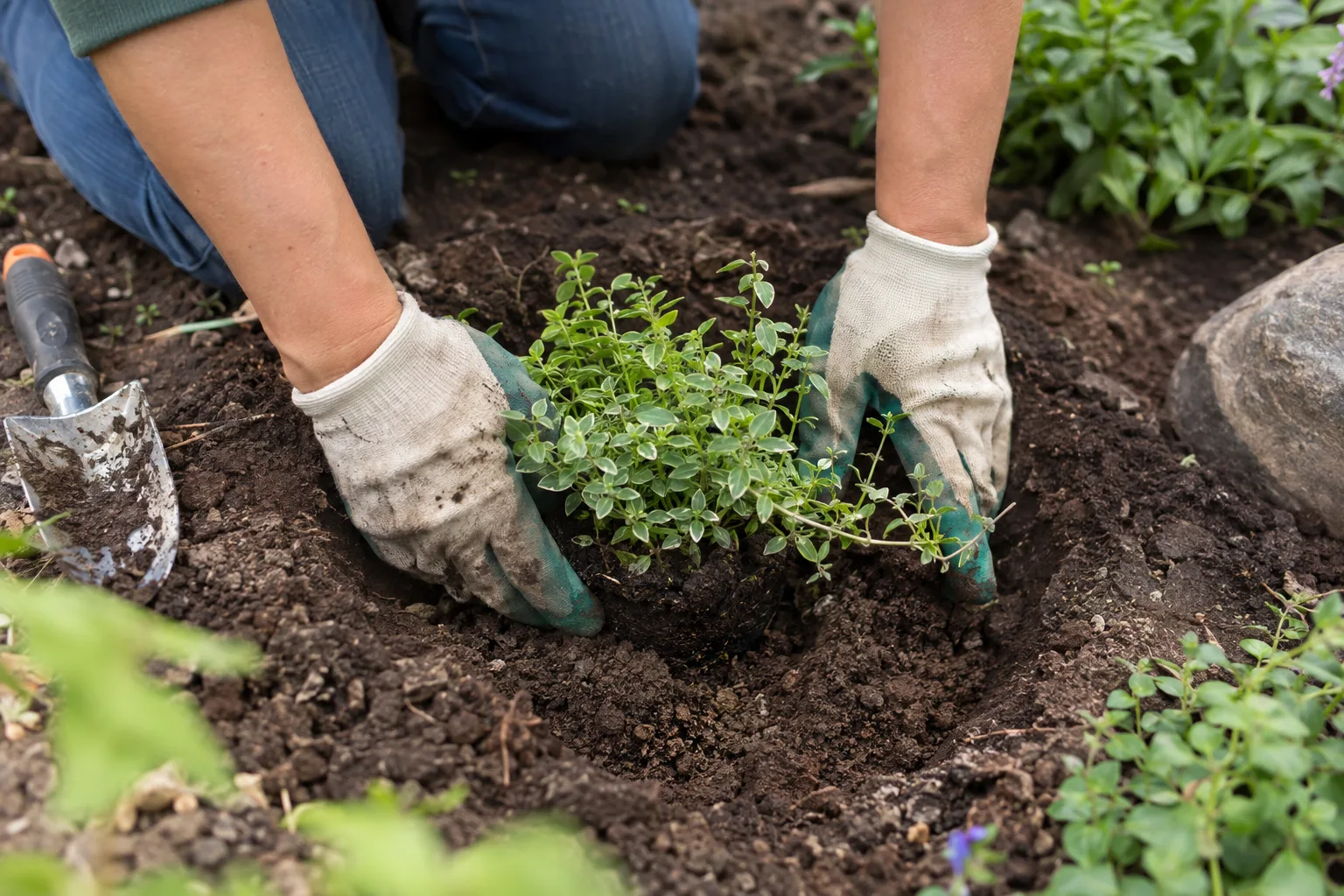
- Dig the hole twice as wide as the root ball and exactly as deep. Planting too deep invites crown rot.
- Space plants for their mature spread, from 18 inches for blackfoot daisy to 3 to 4 feet for trailing rosemary.
- Backfill, firm the soil with your hands to remove air pockets, and build a shallow basin around each plant.
- Water slowly until moisture reaches 12 inches or more down.
- Spread 2 to 3 inches of mulch over the root zone and keep it a couple of inches from the stems.
Alkaline soil (pH roughly 7.5 to 8.5) suits every March plant on the list. Plants that want acidic soil show yellow leaves with green veins, called chlorosis, and watering will not correct that.
How often should I water new groundcovers before summer?
Water every 2 to 3 days for the first two weeks, then deeply every 5 to 7 days through April, and about weekly by May. Desert natives like blackfoot daisy and desert marigold can stretch to every 10 to 14 days once they have rooted in.
Deep watering means slow irrigation that wets the soil 12 to 18 inches down, which pulls roots lower and away from the hot surface. Drip lines do this better than overhead sprinklers. They put water at the roots, lose less to evaporation in dry air, and keep foliage dry during monsoon humidity.
Our irrigation water here is hard, so salts collect at the surface of each basin. An occasional long soak moves them below the roots. Our gardening calendars show how watering needs change as the months warm up.
What should I leave alone in March?
Leave the four warm-soil plants for later, and resist the urge to feed, crowd or overwater the ones you do plant. A few jobs are better left until the weather settles.
- Do not trim frost-damaged lantana until new growth appears and frost danger has passed. The brown growth protects the crown.
- Do not fertilize desert natives. Rich feeding makes them leggy and short-lived.
- Do not plant closer than the spacing above. Crowded plants compete for water and stay damp after monsoon rain.
- Do not keep up establishment watering past 6 to 8 weeks. Established plants kept on a first-week schedule develop root rot.
For hands-on help, see our classes and events page for what is on the schedule.
Frequently asked questions
How do I protect new groundcovers from a late frost?
Cover them at dusk with frost cloth or an old sheet, draping it to the ground, and remove it the next morning. Plastic touching the leaves can transfer cold, so use fabric. Water the soil during the day before a frost night, since moist soil holds heat longer than dry soil.
How long do groundcovers take to fill in?
Fast spreaders like trailing lantana and verbena can cover most of their space in one growing season at correct spacing. Slower plants such as trailing rosemary and blackfoot daisy often need a season and a half to two years. Plant at the spacing on the plant tag, then give them time before adding more.
Is there a groundcover that tolerates foot traffic?
Frogfruit (Phyla nodiflora), also sold as lippia, tolerates light foot traffic and is used as a low-water lawn alternative. It browns after frost and returns in warm weather. None of the March plants above are meant for walking on, so keep them to beds and borders.
Do groundcovers need fertilizer?
Desert natives such as blackfoot daisy and desert marigold need none. Lantana and verbena can take a light feeding once new growth starts in spring. Too much nitrogen gives soft, leafy growth that wilts in heat. Compost or a slow-release organic fertilizer, used lightly, is a safe choice.
Are groundcovers the right March project for your yard?
Yes, if you have sunny bare ground, a gravel area you want to soften or a slope that needs cover, and you can water on schedule through the first summer. Skip it if the spot is deep shade, if you want a surface for kids and dogs to play on, or if you cannot irrigate for the first 8 weeks. Stop by our nursery in Queen Creek and we will help you match plants to your yard.