The best low-maintenance shrubs and perennials for Arizona yards are desert-adapted plants such as Texas sage, autumn sage, red bird of paradise, lantana, desert marigold and blackfoot daisy. Plant them in fall, water deeply but rarely, and prune once or twice a year.
Key takeaways
- Plant from late September through early November, or in February and March, so roots settle in before summer highs above 110°F.
- Once established, most plants on this list need a deep soak every one to three weeks in summer and far less from November through February.
- Set each plant slightly high in native soil, because soggy roots in caliche and clay are a leading cause of failure.
- Space plants by mature width, such as 4 to 6 feet for Texas sage, not by the size of the pot.
- Bougainvillea, lantana and red bird of paradise can freeze back in a hard frost, so wait until late February to cut away dead growth.

What makes a shrub or perennial low maintenance in the Arizona low desert?
A low-maintenance desert plant handles summer highs above 110°F and alkaline soil, then gets by on deep watering every week or two and one or two prunings a year. Many plants labeled Zone 9 fail that test.
A Zone 9b tag describes winter cold only. It says nothing about reflected heat from block walls, soil with a pH of 7.5 or higher, or the caliche layer that sits 12 to 24 inches down in many East Valley yards. Look for plants with a record in the Sonoran Desert or similar arid climates, which is the standard behind every plant below.
These are varieties we commonly carry, though availability changes week to week and season to season. Browse the plants department for the general range we offer.
Which shrubs give the most for the least work in Arizona?
Four shrubs give the most structure for the least work in the East Valley. Each one holds up in full sun, and none needs regular spraying or feeding.
Texas sage (Leucophyllum frutescens)
Texas sage reaches 4 to 8 feet tall and wide, and compact selections stay closer to 3 to 5 feet. It wants full sun and fast drainage. Once established, a deep soak every two to three weeks in summer is usually enough, with less in winter. Silvery leaves stay on all year, and purple blooms often follow humid weather or monsoon storms. The drawback is dieback in soil that stays wet, and a sheared ball shape cuts the bloom.
Bougainvillea (Bougainvillea hybrids)
Bougainvillea grows as a shrub or sprawling vine, 6 to 15 feet depending on the variety and how you train it. Magenta, orange, red and purple bracts cover it from spring into fall, and it blooms best in full sun on the dry side, with a deep soak every one to two weeks in summer once established. Frost below roughly 30°F can burn it back, and the thorns are sharp. Plant it in spring, after frost danger passes, because cold-damaged young plants recover slowly.
Autumn sage (Salvia greggii)
Autumn sage forms a mound 2 to 3 feet tall and wide, with red, pink, coral or white flowers from spring into fall. It takes full sun, though afternoon shade helps against a west-facing wall. Water deeply every week to ten days in summer. Hummingbirds visit it often. The drawback is a woody, leggy habit if you skip the late-winter cutback, and blooms may slow in the hottest weeks.
Red bird of paradise (Caesalpinia pulcherrima)
Red bird of paradise grows 5 to 10 feet tall and nearly as wide, and its orange-red flowers keep opening through July and August when many plants stall. It needs full sun and a deep soak every one to two weeks once established. The drawback is frost. A hard freeze can kill the top growth, and the plant may regrow from the base in spring, so leave room for its full size.

Which perennials handle Arizona heat with the least care?
Lantana, desert marigold and blackfoot daisy all tolerate full sun and infrequent watering. Perennials in the low desert behave differently from those in cooler climates, and some pause in July heat and rebound in September, so judge them over a full year rather than one month. They fill the spaces between shrubs, and annual flowers and foliage can cover the gaps in winter.
Lantana (Lantana hybrids)
Lantana grows 2 to 4 feet tall and 3 to 6 feet wide, with trailing types staying lower. Clusters of yellow, orange, pink and red bloom from spring until frost. It wants full sun and a deep soak every one to two weeks once established. Frost often cuts it to the ground, and it sprawls and turns woody without a hard late-winter cutback. Choose a compact selection for small beds.
Desert marigold (Baileya multiradiata)
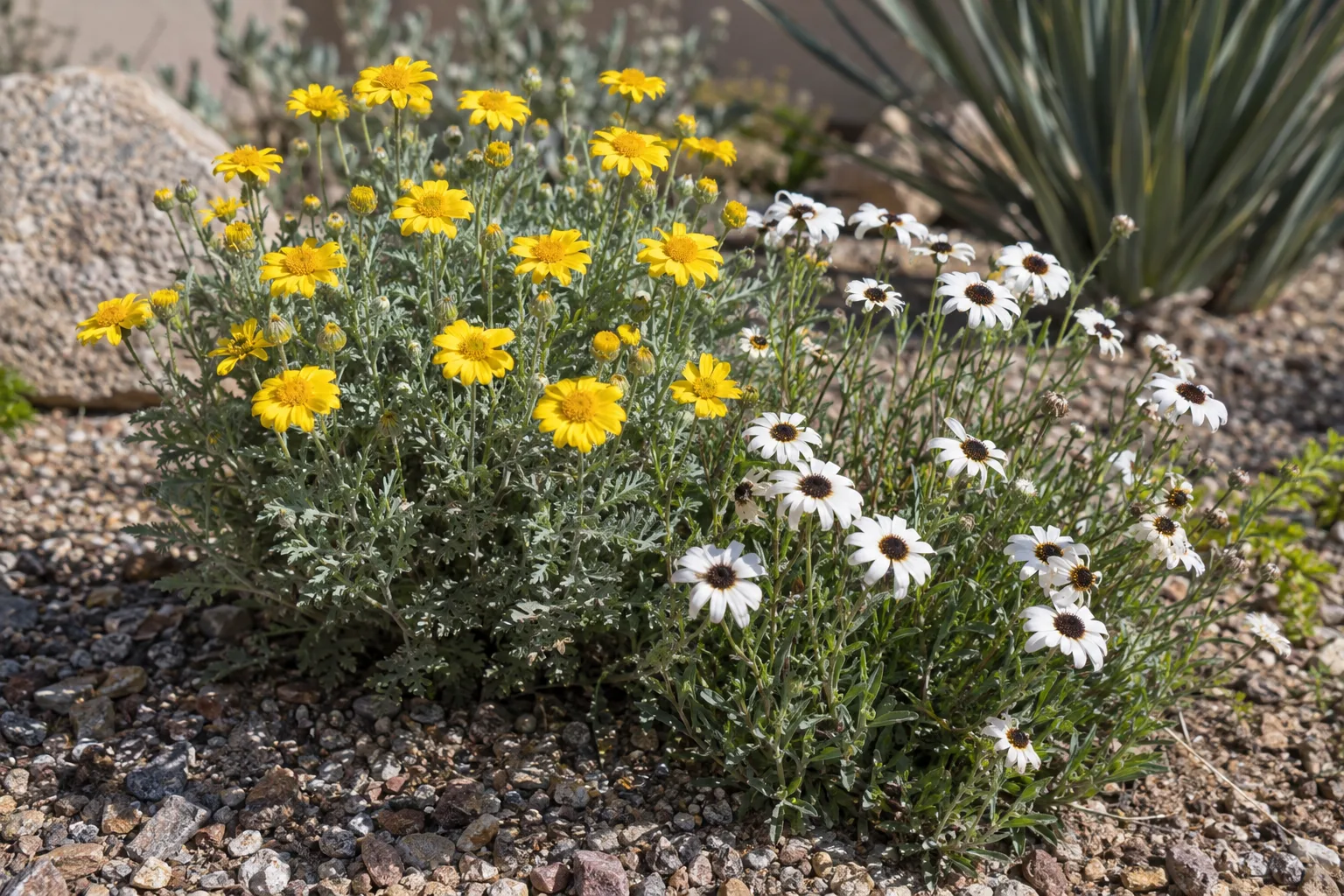
Desert marigold is a Sonoran Desert native that makes a silvery clump 1 to 2 feet tall and wide, topped with yellow daisy flowers on tall stems from spring into fall. It needs full sun, gravelly or sandy soil, and a deep soak every two to four weeks once established. It is short-lived, but it reseeds, so leave a few spent stalks in place. Overwatering rots it quickly.
Blackfoot daisy (Melampodium leucanthum)
Blackfoot daisy forms a neat mound 8 to 12 inches tall and 12 to 18 inches wide, covered in white daisies with yellow centers. It takes full sun, very little water, and alkaline soil. Bloom may slow in midsummer and pick up again in fall. The drawback is root rot where irrigation keeps the soil damp, so put it on a drier zone than your shrubs.
When is the best time to plant shrubs and perennials in Queen Creek?
Plant from late September through early November, with February and March as the second-best window. Fall soil is still warm enough for root growth while air temperatures drop, and plants get six or seven months to settle in before the first 110°F summer. Spring plantings get only a few months of head start.
Avoid May through August for new plantings, since young roots cannot keep up with the heat. Bougainvillea is the exception to the fall rule and does better planted in spring once frost danger is behind you. Our gardening calendars list monthly tasks for the low desert.
How do I plant in caliche and alkaline soil?
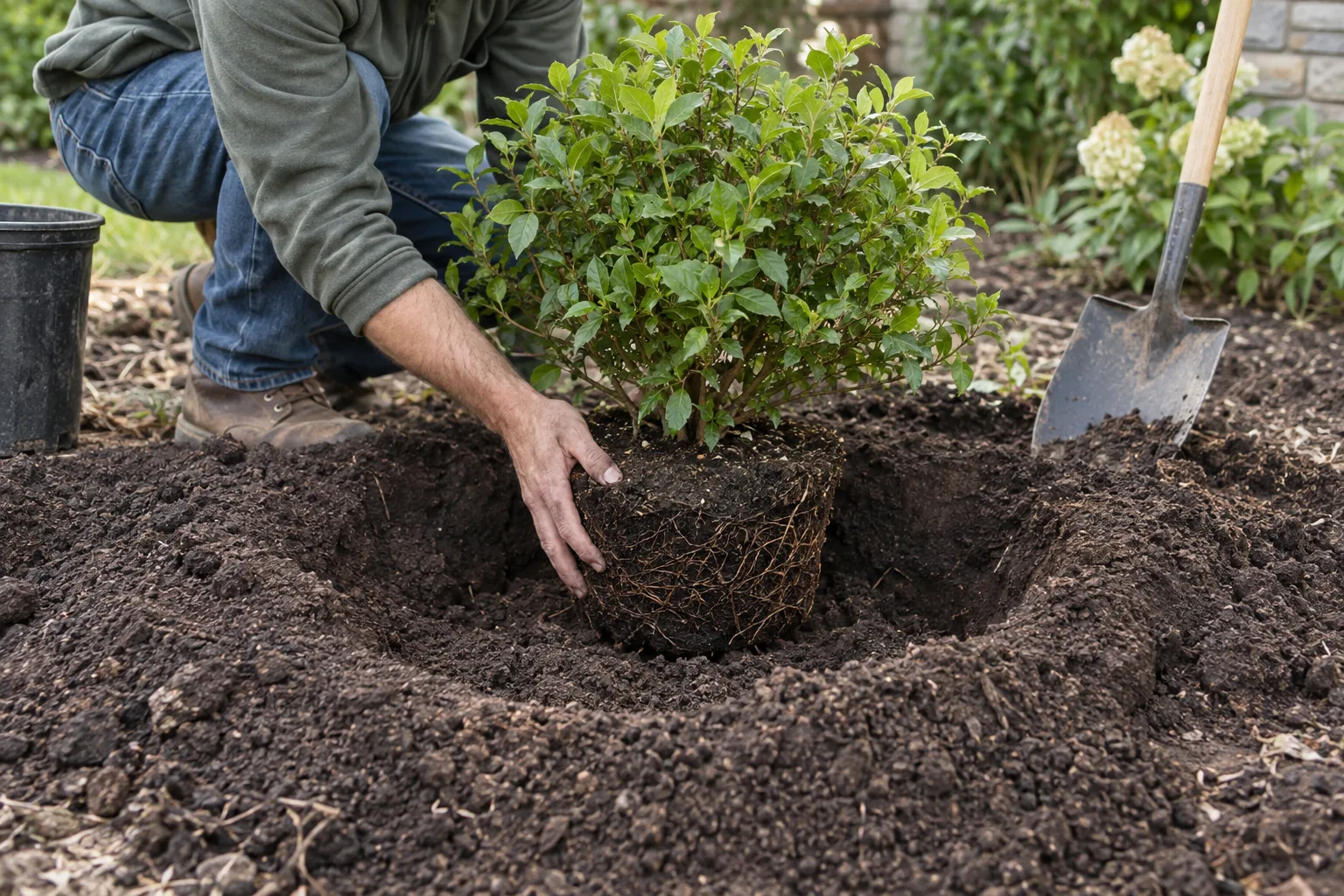
Dig wide rather than deep, backfill with the native soil, and set the plant slightly high. Caliche is a hardened calcium carbonate layer that blocks drainage, and water collects above it even in a dry climate.
- Dig the hole, fill it with water, and let it drain. If water still stands after 24 hours, break through the caliche layer or plant on a low berm.
- Make the hole 2 to 3 times as wide as the root ball and no deeper than the root ball.
- Backfill with native soil. Heavy amendments create a pocket where water collects around the roots.
- Set the top of the root ball 1 to 2 inches above the surrounding grade so the crown stays dry.
- Build a watering basin, soak the plant deeply, and spread 2 to 3 inches of mulch, keeping it a few inches from the stems.
Alkaline soil locks up iron, and leaves that turn yellow while the veins stay green point to that problem. Chelated iron gives a quick fix, while elemental sulfur lowers pH slowly and works best in measured amounts. Hard irrigation water adds salts over time, which is one reason to water deeply instead of in frequent sips.
How often should I water established desert shrubs and perennials?
Once established, most plants on this list need a deep soak every one to three weeks in summer and much less in winter. New plants are different. Water them every few days for the first two to three weeks, then stretch to weekly through the first season.
Aim to wet the root zone, roughly 18 to 24 inches deep for shrubs, and check by pushing a long screwdriver into the soil. Drip irrigation delivers water slowly and keeps leaves dry during monsoon humidity. From October through February, cut back sharply, and skip a cycle after a good monsoon storm from roughly July through September.
The most common failure is a timer set in June and never touched again. Check your schedule at each season change. Our classes and events page lists upcoming gardening sessions.
When should I prune each plant?
Most of these plants need one main pruning in late winter, after the worst frost risk has passed. Cutting in October removes the buds that would bloom the next season, and cold can damage fresh cuts.
| Plant | When to prune | How |
|---|---|---|
| Texas sage | Late winter, or after a bloom flush | Shape loosely and avoid tight shearing |
| Autumn sage | Late February | Cut back by about one third |
| Red bird of paradise | Late winter to early spring | Remove frost-killed stems low on the plant |
| Lantana | February to March | Cut back frost damage to healthy growth |
| Bougainvillea | After each bloom flush | Trim long shoots and wear thick gloves |
| Desert marigold | After blooms fade | Remove spent stalks but leave a few to reseed |
| Blackfoot daisy | Late winter | Trim dead growth lightly |
Frequently asked questions
Do these plants need fertilizer?
Most need very little. A light feeding of balanced slow-release fertilizer in spring is enough for the shrubs, and desert marigold and blackfoot daisy often need none. Heavy nitrogen pushes soft growth that heat and pests damage easily. Yellow leaves with green veins call for iron, not more fertilizer.
How far apart should I space them?
Space by mature width, not by pot size. Texas sage can reach 4 to 6 feet across within a few years, autumn sage about 2 to 3 feet, and lantana 3 to 6 feet. Crowded plants hold humidity during the monsoon and compete for water, which invites leaf spot and dieback.
Will frost kill these plants?
Bougainvillea, lantana and red bird of paradise are the frost-tender plants on this list. A hard frost can cut them to the ground, and they often resprout from the base in spring. Leave the brown growth until late February, since it shelters lower stems. The other four handle typical East Valley winters.
Do I need drip irrigation?
Drip irrigation is the easiest way to water deeply and slowly, and it keeps leaves dry during monsoon humidity. Hand watering works for young plants if you keep to the schedule. Established desert marigold and blackfoot daisy may need only an occasional deep hand soak.
Which of these plants attract hummingbirds and pollinators?
Autumn sage draws hummingbirds, and red bird of paradise often does too. Lantana attracts butterflies, while desert marigold and blackfoot daisy are visited by native bees and other small pollinators. Planting a mix that blooms across spring, summer and fall keeps something in flower for most of the year.
Are low-maintenance desert shrubs and perennials right for your yard?
Yes, if your yard gets full sun and you are willing to water deeply but rarely. These plants suit exposed side yards, curb strips and block-wall borders where lawns and roses struggle. They are a poor match for deep shade, for anyone who wants a lush green lawn look all year, and for a yard where a daily irrigation timer will run untouched. If that describes you, plan on more watering and more replanting. Stop by our nursery in Queen Creek to talk through your sun, soil and space.