
Low-maintenance perennial grasses for the Arizona low desert are the native and Southwest-adapted types that return every year on little water once they are established, which takes about one growing season. Eight reliable choices are covered below.
Key takeaways
- Plant from October through November, or late February through March, so roots settle before summer highs pass 110°F.
- Water regularly through the first growing season, then switch to a deep soak every 7 to 14 days in summer.
- Set the crown level with or slightly above the soil, because buried crowns rot during monsoon storms.
- Cut warm-season clumps back to 6 to 8 inches in late January or early February.
- Avoid buffelgrass, an invasive grass named on Arizona’s noxious weed list.
Which low-maintenance perennial grasses work best in the Arizona low desert?
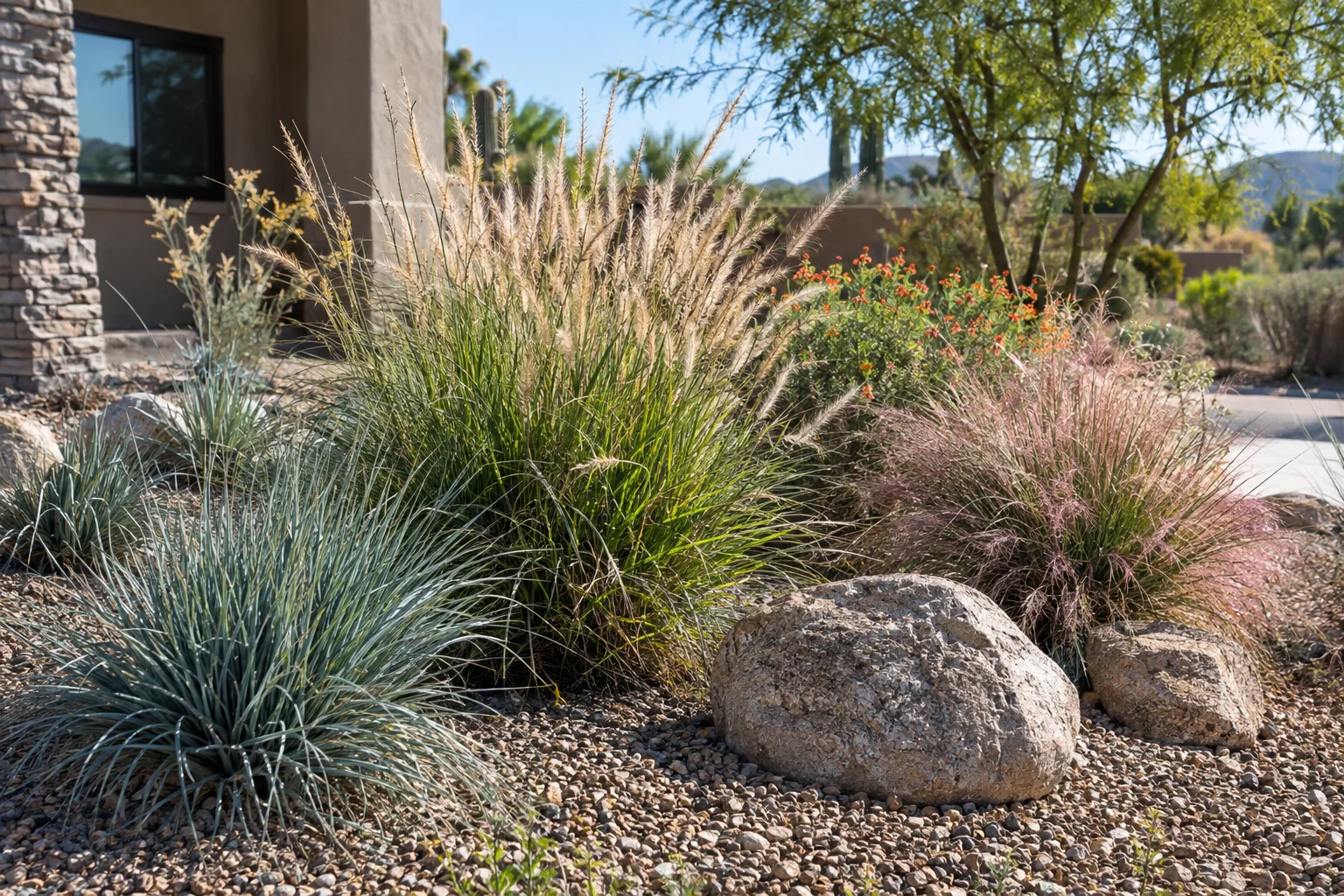
These eight handle full sun, alkaline soil and summer highs above 110°F once their roots are established. They are the kinds of grasses we commonly carry, though availability changes week to week and season to season, so check our plants department or ask before you plan a bed around one. Sizes below are mature ranges and vary with soil, water and exposure. Pick by size first, then by bloom.
Deer grass (Muhlenbergia rigens)
Deer grass forms an arching mound about 3 to 4 feet tall and wide, and it is native to the Southwest. Narrow seed spikes rise above the foliage in late summer and fall. Give it full sun or light shade and a deep soak every 1 to 2 weeks in summer once established. The drawback is bulk: it looks shaggy until you cut it back each winter and needs room to spread.
Pink muhly (Muhlenbergia capillaris)
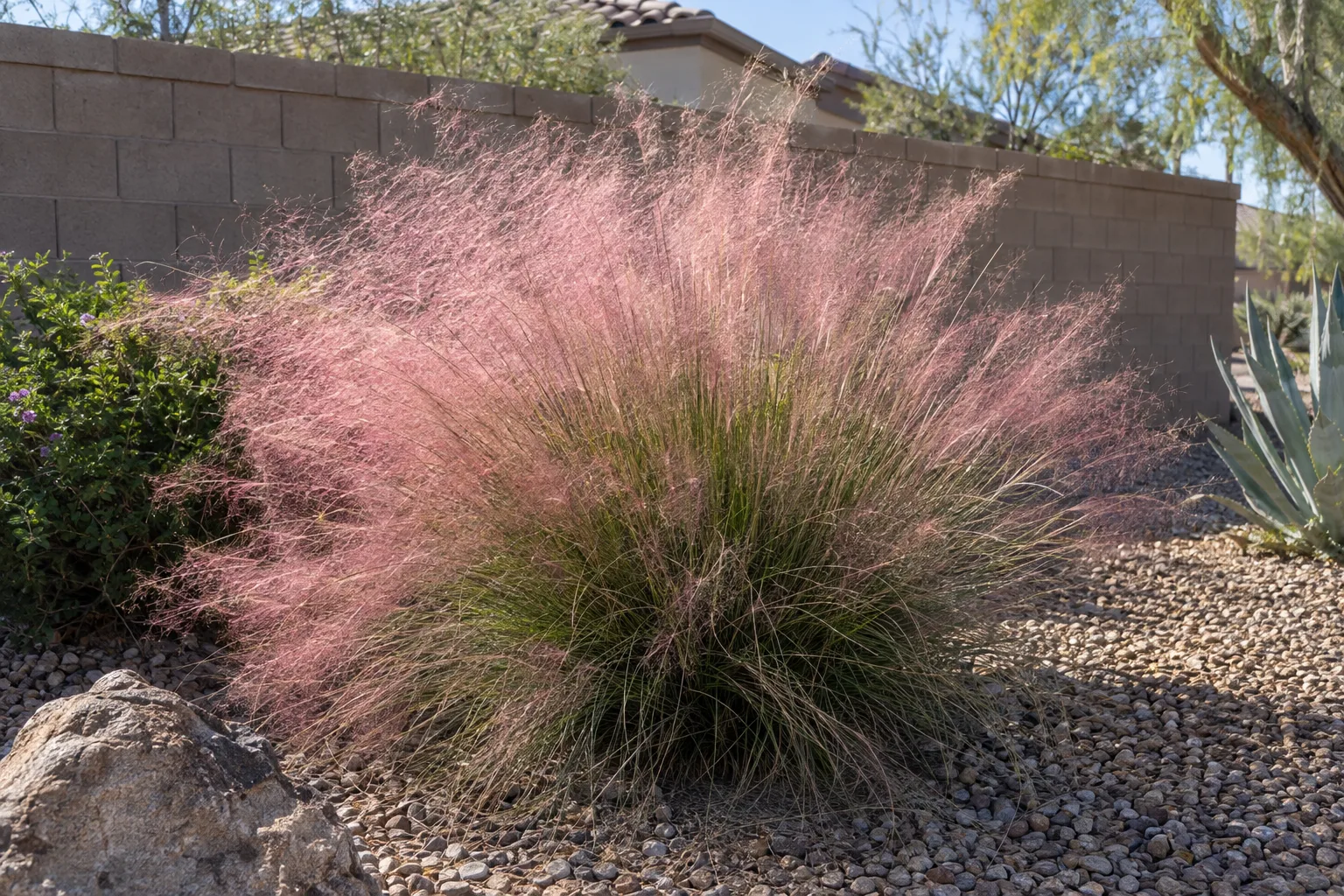
Pink muhly makes a fine-textured green clump 2 to 3 feet tall and wide. In October and November it sends up clouds of rosy pink plumes. Plant it in full sun with well-drained soil, and expect to water it a little more often than the desert natives. The drawback is timing, because the clump looks plain green outside its bloom season of a few weeks.
Giant sacaton (Sporobolus wrightii)
Giant sacaton builds a blue-green fountain 4 to 6 feet tall and nearly as wide. It is native to Southwestern grasslands and tolerates both occasional flooding and long dry spells, so it suits swales and slopes. Full sun suits it best, and established plants need only occasional deep water. The drawback is size. It will overwhelm a small bed.
Blue grama (Bouteloua gracilis)
Blue grama stays low, about 1 to 2 feet tall, with seed heads that resemble small eyelashes held sideways on the stem. It works well in drifts in full sun. Water it lightly once established. The drawback is summer, when it can go semi-dormant and straw-colored through the hottest weeks until monsoon rains green it up again.
Mexican feather grass (Nassella tenuissima)
Mexican feather grass has thread-fine leaves that move in the lightest breeze, in a clump 18 to 24 inches tall. Give it sun and modest water. It looks best in the cooler months and often browns in summer heat. The drawback is self-seeding, which can fill a bed with seedlings unless you remove the seed heads before they drop.
Purple three-awn (Aristida purpurea)
Purple three-awn is a wispy native grass 1 to 2 feet tall, with purple-tinged seed awns in spring and early summer. It needs full sun and very little water once established, and its seeds feed native birds. The drawback is the seeds themselves: the sharp-tipped awns catch in pet fur and socks, so keep it away from paths and dog runs.
Lindheimer’s muhly (Muhlenbergia lindheimeri)
Lindheimer’s muhly is an upright blue-green clump about 2 to 3 feet tall that reaches 3 to 5 feet when silvery plumes rise in fall. Plant it in full sun, including spots with reflected heat, and water deeply every 1 to 2 weeks in summer. The drawback is that the plumes fade to tan by winter and the clump needs a few feet of width.
Bamboo muhly (Muhlenbergia dumosa)
Bamboo muhly is a feathery, fine-textured grass 4 to 6 feet tall that makes a soft screen. It grows in sun or light shade with low to moderate water. The drawback is cold: a hard winter freeze can brown the tips, and the clump looks ragged if you skip the late-winter cutback.
When should I plant ornamental grasses in Queen Creek?
Plant from October through November for the best results, or from late February through March as a second choice. Fall soil is still warm, so roots keep growing while air temperatures drop, and the plant has several mild months to settle in before its first summer. Spring planting leaves less time before highs pass 100°F, so plan on closer watering. Avoid May through August. Our gardening calendars are a good place to match other plantings to the month.
How do I plant grasses in caliche and alkaline soil?
Dig the hole two to three times wider than the pot but no deeper, and confirm that water can drain before you plant. Grasses prefer lean soil, so skip heavy compost. Caliche, the cement-like calcium layer common across the East Valley, can turn a planting hole into a bowl that holds water against the crown during monsoon storms.
- Fill the empty hole with water. If it is still standing after 24 hours, break through the caliche with a digging bar or pick, or move the plant to a spot that drains.
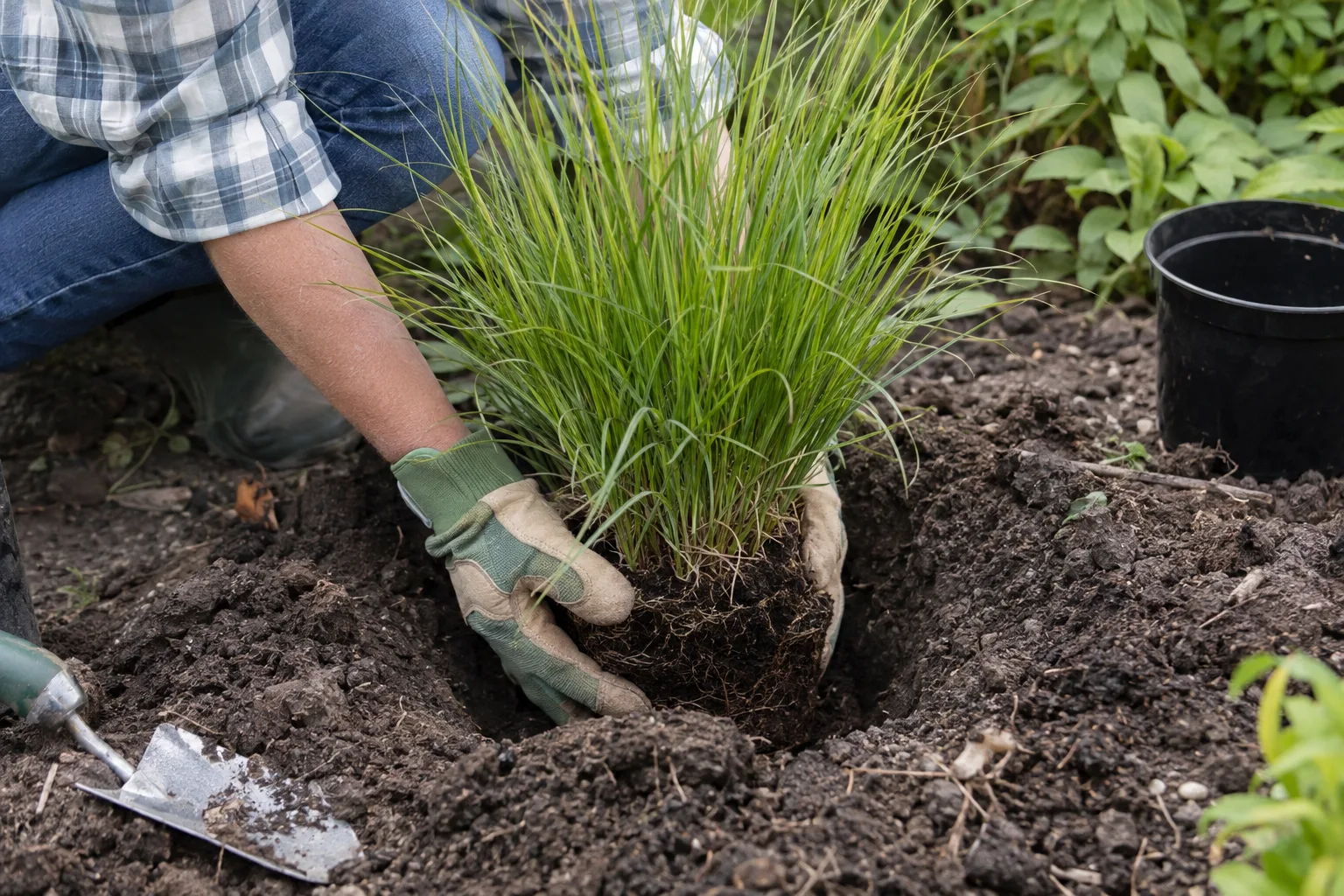
- Dig the hole two to three times wider than the container and exactly as deep as the root ball.
- Slide the plant out and loosen any circling roots with your fingers.
- Set the crown level with or slightly above the surrounding soil, then backfill with the native soil you dug out.
- Soak slowly until water reaches the bottom of the root ball.
- Spread 2 to 3 inches of decomposed granite or organic mulch, keeping it a few inches from the crown.
The common mistakes are planting too deep, over-amending the soil, and sprinkling lightly every day, which keeps roots near the surface. For the first several weeks, water every 2 to 4 days, then taper to about once a week by the end of the first season. Mulch cools the soil.
How often should I water established ornamental grasses?
Established grasses usually need a deep soak every 7 to 14 days in summer and every 2 to 3 weeks in winter, adjusted for soil, exposure and rainfall. Deep, infrequent watering pushes roots down, while frequent shallow sprinkling keeps them near the surface where summer heat stresses them. Hard irrigation water also leaves salts near the surface, and a deep soak helps move them below the main root zone. Soil tells you more than a calendar.
| Season | Established plants | Notes |
|---|---|---|
| December to February | Every 2 to 3 weeks | Skip a watering after a soaking rain |
| March to April | Every 10 to 14 days | New growth resumes |
| May to June | Every 7 to 10 days | Hottest, driest stretch, so soak deeply |
| July to September | Every 10 to 14 days | Water less after a soaking monsoon rain |
| October to November | Every 10 to 14 days | Taper as temperatures drop |
When and how should I cut back ornamental grasses?
Cut warm-season clumps back in late January or early February to about 6 to 8 inches, before new growth starts. That covers deer grass, giant sacaton, pink muhly, Lindheimer’s muhly and bamboo muhly. Tie a large clump with twine first, then cut through the bundle with hedge shears so the cuttings come out in one tidy piece for easy cleanup. Skip a year and nothing dies.

Blue grama and purple three-awn need only light grooming, so comb out the dead blades by hand. Mexican feather grass is a cool-season grass, and a hard cut can set it back, so comb it or trim it lightly instead.
Which ornamental grasses should I avoid in Arizona?
Avoid buffelgrass (Cenchrus ciliaris), an invasive African grass that spreads across the Sonoran Desert, crowds out native plants and fuels wildfire on hillsides. It appears on Arizona’s official noxious weed list, which sorts listed plants into classes A, B and C, and the list is updated periodically, so check the current version before planting a grass you cannot identify. Skip it entirely.
Mexican feather grass self-seeds readily, so cut off its seed heads before they drop. If you are unsure what a grass in your yard is, reach out through our contact page with a photo.
How do I use ornamental grasses in a Queen Creek yard?
Group the smaller grasses in drifts of 5 to 9 plants and use the large ones as single specimens or in groups of 2 to 3. Blue grama, purple three-awn and Mexican feather grass look sparse as singles but read as intentional in a group, while giant sacaton and bamboo muhly need room to show their full size. Give each clump roughly its mature width.
Plant deer grass or Lindheimer’s muhly at the base of a desert tree, where the soft texture contrasts with the trunk and canopy. Giant sacaton and deer grass suit swales and drainage paths, since their deep roots help hold soil during monsoon downpours. Against a west-facing block wall, try deer grass or Lindheimer’s muhly and leave 2 to 3 feet between the wall and the clump so air can move.
Frequently asked questions
Do ornamental grasses need fertilizer in Arizona?
Most need very little. A light application of low-nitrogen, slow-release fertilizer in early spring is enough, and many clumps do fine without any. Extra nitrogen produces soft, fast growth that flops over by midsummer. Skip fertilizer in the first year so the plant puts its energy into roots.
Can I grow ornamental grasses in containers?
Yes, the smaller types such as blue grama, purple three-awn and Mexican feather grass can grow in large pottery and planters with drainage holes. Containers heat up and dry out faster than ground soil in summer, so expect to water more often and place pots where they get some afternoon shade. Large grasses like giant sacaton belong in the ground.
How far apart should I space ornamental grasses?
Space each clump about as far apart as its mature width, measured center to center. That means roughly 2 to 3 feet for pink muhly or Lindheimer’s muhly and 4 to 6 feet for giant sacaton. Closer planting fills in sooner but crowds the clumps and makes the winter cutback harder. Wider spacing keeps the plants easier to maintain.
Will frost damage ornamental grasses in Queen Creek?
Light frost usually browns the foliage of warm-season grasses without killing them, and the cutback in late winter removes the damage. Bamboo muhly is the most likely of the eight to show tip burn in a hard freeze. Plant it near a south-facing wall in colder pockets, and expect new growth in spring.
Why is the center of my grass clump dying?
Older clumps often die out in the center as they age, and the fix is division. Dig up the clump in early spring or fall, cut away the dead center, and replant the healthy outer sections at the same depth. Water them in well. Each divided piece becomes a new plant.
Are low-maintenance grasses right for your yard?
Yes, if you have a sunny spot with soil that drains and you can water deeply through the first year. Grasses give movement and texture for modest water, and most need only one cutback each winter. They are a poor fit if you want a uniform green lawn, a plant that looks the same in every month, or a spot that stays soggy or sits in deep shade. If you are leaning toward one or two, visit us in Queen Creek and we will help you match a grass to your exposure.