

Lizards gather near garden walls in Arizona yards because the masonry offers heat for warming up, insects to eat, cracks to hide in, and slightly damp soil at the base. A wall meets all four needs within a few feet.
Key takeaways
- Lizards are cold-blooded, so they warm up on sun-heated block and stucco: east faces in the morning, west faces into the evening.
- Wall bases hold leaf litter, moisture and insects such as beetles, ants and roly-polies, so lizards can hunt there without roaming far.
- Weep holes, footing gaps and low plants give lizards a quick escape from hawks, roadrunners and cats.
- Lizards are busiest from about March through May, and shift to dawn and dusk when summer highs pass 110°F.
- Spraying insecticide along wall bases removes their prey and is a common reason lizards disappear.

Why do lizards bask on block walls?
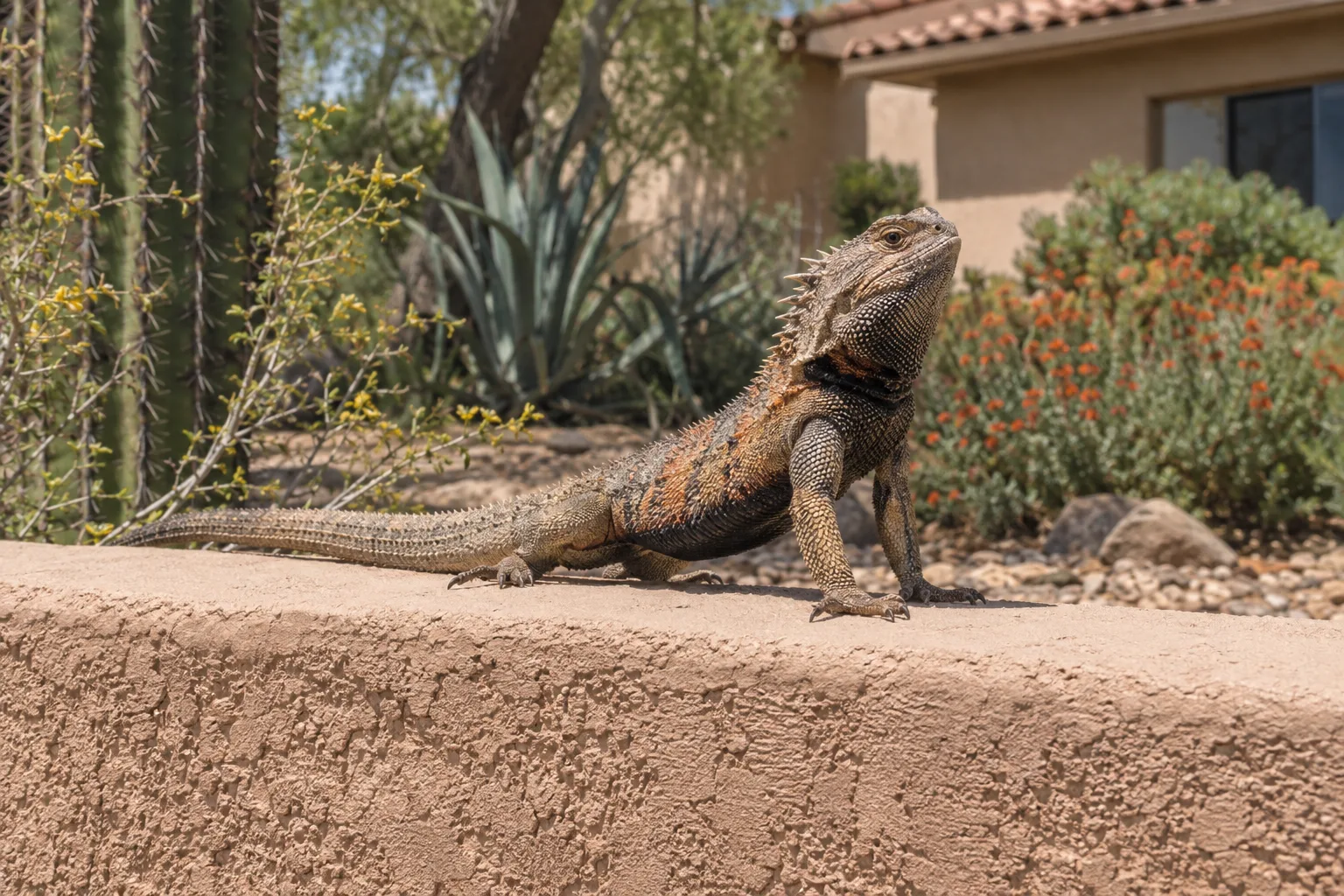
Lizards bask on block walls because they are cold-blooded and need outside heat to get moving. Concrete block and stucco soak up sun all day and release the heat slowly, so a wall gives a lizard a warm surface at hours when the open ground is still cool or already cooling.
East-facing walls warm first, so you often see lizards there soon after sunrise. West-facing walls hold heat into the evening and stretch the hunting day. Walls give them choices. When summer highs climb above 110°F, lizards leave sun-baked surfaces by midday and rest in shade at the wall base or along the cooler north side. A lizard pressed against a shaded wall on a 110°F afternoon is cooling off. In July and August most activity shifts to early morning and dusk.
Which lizards are you seeing on your walls in the East Valley?
Most wall lizards in Queen Creek and the surrounding East Valley are desert spiny lizards, western whiptails or side-blotched lizards. Each one uses a wall in its own way, and telling them apart explains much of what you see.
Desert spiny lizard (Sceloporus magister)
This is the large, rough-scaled lizard that climbs block walls and fence posts and does push-ups from the top. Males show blue patches on the belly during displays, and they favor high perches that give a clear view of the whole territory along the wall.
Western whiptail (Aspidoscelis tigris)
This slender, long-tailed lizard forages on the ground along wall bases and through leaf litter, searching for insects and other small prey. It rarely stops moving, and it seldom climbs.
Side-blotched lizard (Uta stansburiana)
Small, with a dark blotch behind each front leg, this lizard slips into cracks and gaps in older masonry. It is often the one you notice on a low wall or a garden border.
What do lizards find to eat at the base of a wall?
Lizards find beetles, ants, crickets, roly-polies, earwigs and spiders, because all of them collect where a wall meets the soil. Leaf litter and fallen seed pile up there since wind slows against the wall, and the decaying material feeds the small insects that lizards eat.
Irrigation adds to it. Water from drip lines and sprinklers runs along footings, and in our alkaline, caliche-heavy soil it often spreads sideways instead of draining straight down, which keeps a narrow strip damp longer than open ground. Insects follow the moisture. After monsoon storms from roughly July through September, winged ants and termites often emerge, and lizards feed on them heavily.
Flowering shrubs and perennials planted near a wall bring in bees, moths and beetles, which adds to the food supply. You can browse our plant selection for low-water natives that suit the job.

How do walls protect lizards from predators?
Walls protect lizards by putting cover within a few inches of wherever they are. Weep holes, gaps along the footing and dense plants against the wall let a lizard vanish in a second from a Cooper’s hawk, a roadrunner or a snake.
Cats that roam outdoors hunt lizards by instinct, even when they are well fed, and a wall with no cover gives a lizard little defense against one.
Walls also help with reproduction. Females lay eggs in loose, warm soil, and the sunny base of a wall often offers exactly that. Digging there in spring can disturb a nest, so go easy with a shovel.
What do lizards do from month to month?
Lizards in the low desert stay active through most of the year and slow sharply during the coolest weeks of winter. The table shows what to expect around your walls, and our gardening calendars help you plan planting around those months.
| Months | Lizard activity | What you will see at the wall | Garden note |
|---|---|---|---|
| December to February | Low, on warm sunny afternoons | Basking on south-facing walls around midday | Good time to prune and plant near walls |
| March to May | High, breeding and egg-laying | Push-up displays and hunting along wall bases | Go easy on digging in sunny wall-base soil |
| June to September | Dawn and dusk, shade at midday | Feeding bursts after monsoon storms | Water early in the morning |
| October to November | Declining as nights cool | Long basking sessions on warm walls | Good window for wall repairs and planting |
How can I make my garden walls better lizard habitat?
You can make a wall better lizard habitat by cutting back on perimeter spraying, leaving openings in the wall, and adding warm rocks and low plants. Spread the work over a season or two.
- Spot-treat pests instead of spraying the whole wall base. Insecticides applied along walls and foundations remove the insects lizards feed on, so follow the product label and ask your pest-control provider what they apply near your walls.
- Lay decomposed granite or small gravel, about 2 inches deep, along the wall base. It warms quickly and drains well. Keep thick, fine bark mulch away from the wall itself.
- Set a few flat rocks on the sunny side of the wall with one edge propped up slightly. Lizards bask on top and shelter underneath.
- Leave weep holes and natural gaps open. In walls that have them, weep holes also drain water, so they do double duty.
- Plant a foot or two out from the wall. The wall face stays clear for basking, and the plants supply cover and insects.
- Put a shallow water dish at ground level in the shade, and rinse it every few days so mosquitoes cannot breed. A shallow saucer from our pottery and planters works well.
- Leave one corner a little untidy, with some leaf litter and dried seed heads.
Low-water plants that suit a wall edge include brittlebush (Encelia farinosa), desert marigold (Baileya multiradiata), chuparosa (Justicia californica), Parry’s penstemon (Penstemon parryi) and agave. These are varieties we commonly carry, though availability changes week to week and season to season.
The west wall takes the most heat in summer. A shade tree planted well away from the footing can cool it, and you can compare options in our desert trees section. Check the mature width before you pick the spot.

What drives lizards away from a wall?
Perimeter insecticide, a bare raked wall base, sealed gaps and roaming cats are the usual reasons lizards leave. Each one removes food, cover or both.
- Perimeter spraying removes the insects lizards eat, and some products can also harm animals that cross treated surfaces. The label and your provider can tell you what is applied.
- Bare, raked gravel with no leaf litter holds few insects, so very little food.
- Filled cracks and sealed weep holes take away shelter and nest sites.
- Thick bark mulch piled against the wall buries the warm surface lizards need for basking.
- Outdoor cats hunt lizards whether or not they are hungry, and keeping cats indoors protects birds as well.
If your lizards vanished after a change, such as a new pest-control treatment, a new cat on the block or a fresh layer of mulch, start by reversing that change. Lizard numbers often recover over a season or two when food and cover return. For ideas on planting beside a wall, check our classes and events for gardening workshops.
Frequently asked questions
Are the lizards on my garden wall dangerous?
No, the spiny lizards, whiptails and side-blotched lizards seen on East Valley walls are harmless to people. A spiny lizard may bite if you grab it, so leave it alone. The Gila monster is the only venomous lizard native to Arizona, it is a protected species and rare in yards, and the Arizona Game and Fish Department can advise if you find one.
Why do lizards do push-ups on my wall?
Push-ups are a display, mostly by males, that warns rival males off a territory and signals to females. The top of a wall offers a high, open spot where the display is visible from a distance. Different species use different rhythms, so the pattern can help you identify which lizard is on your wall.
Will lizards control pests in my garden?
They reduce numbers of small insects but cannot clear a serious infestation. A termite problem, for example, needs a licensed pest-control company, not a lizard. Think of lizards as one helpful part of a garden that has plenty of insect variety and few chemical sprays.
Can I bring lizards in from somewhere else?
Check with the Arizona Game and Fish Department before collecting or moving any wild lizard, since that agency sets Arizona wildlife rules. Moving lizards is also a poor way to build numbers, because relocated animals often try to return to their original territory. Better habitat in place draws lizards from nearby over time.
What should I do if I dig up lizard eggs?
Re-cover them right away at the same depth and in the same spot, handling them as little as possible. Lizard eggs are small and soft-shelled, and they need the warmth of the soil to develop. Plan any digging near a sunny wall for late fall or winter, when nesting is over.
Should you invite lizards to your garden walls?
Yes, if you have a sunny wall, can live with a little leaf litter and are willing to cut back on perimeter spraying. Lizards cost nothing, eat a steady supply of insects and add life to a block-wall yard. Skip the effort if your cats roam outdoors, if you want a bare, freshly raked wall base, or if you expect lizards to solve a heavy pest problem. If you want help choosing plants for the strip beside your wall, visit us at the nursery in Queen Creek.