
Lantana at the entry gives Arizona homes steady color from spring through frost, handles reflected heat above 110°F, and needs little water once established. Its mounding form softens doorways and stands out against tan stucco and gravel.
Key takeaways
- Lantana blooms from spring until the first hard frost, often eight months or more in the East Valley.
- Plant in March through May or in September and October, with the top of the root ball level with the soil.
- Established plants need a deep soak about every 7 to 10 days in summer and far less in winter.
- Cut plants back by one-third to one-half in late February, after frost danger has passed.
- Lantana berries are toxic if eaten, so think twice about it if toddlers or plant-chewing dogs use the entry.

Why does lantana look so good against Arizona stucco?
Lantana gives strong color contrast against the beige, tan and warm gray exteriors common across Queen Creek and the East Valley. A mass of gold, orange, magenta or lavender flowers draws the eye to the front door without any added hardscape. The upright shrub form, Lantana camara, reaches roughly 3 to 5 feet tall and wide, so one plant on each side of a door frames the entry.
Trailing lantana (Lantana montevidensis) spills over walls, steps and planter edges instead of mounding. Both types bloom from spring until frost. Individual flower clusters change color as they age, so one plant can show two or three shades at once. Seasonal annuals rarely match that depth once summer highs pass 105°F. Lantana keeps going. Our annual flowers and foliage make good cool-season companions around a lantana bed.
How does lantana handle heat at the front door?
Established lantana keeps blooming through summer highs above 110°F, including beside south and west walls that reflect heat back onto the plant. It comes from tropical regions of the Americas and tolerates drought once its roots have spread, usually after 6 to 8 weeks in the ground.

Alkaline soil does not bother it. Poor drainage does, particularly during monsoon storms from roughly July through September, when a bed that holds water can rot the roots. Caliche, the hard calcium layer under many East Valley yards, is the usual cause. Break through it or plant in a raised bed. If you are choosing shrubs for other spots, our plant selection covers more heat-tolerant options.
Which lantana varieties suit a front entry?
Choose by mature size first, then by color. Size matters most. A plant that outgrows its spot needs constant cutting back, while a small plant in a wide bed leaves bare soil showing for most of its first year. The table lists common types and their typical sizes in the low desert.
| Variety | Height | Spread | Flower color | Best entry use |
|---|---|---|---|---|
| ‘New Gold’ | 2 to 3 ft | 3 to 4 ft | Bright yellow | Low borders and massing |
| ‘Dallas Red’ | 3 to 4 ft | 3 to 4 ft | Red and orange | Flanking a doorway |
| ‘Miss Huff’ | 4 to 5 ft | 4 to 6 ft | Orange, pink and yellow | Large anchor planting |
| Trailing lavender | 1 to 1.5 ft | 4 to 6 ft | Lavender-purple | Spilling over walls |
| Compact ‘Bandana’ types | 1.5 to 2 ft | 1.5 to 2 ft | Mixed warm tones | Small entries and pots |
These are varieties we commonly carry, though availability changes week to week and season to season. ‘Miss Huff’ is the largest and widest of the group and can crowd a narrow walkway.
When and how do I plant lantana near the door?
Plant in March through May or in September and October. Roots need several weeks to spread before 110°F days arrive, so skip midsummer. Set each plant 18 to 24 inches back from the threshold, which keeps foraging bees out of the walking path and gives the mature plant room to mound. Our gardening calendars show planting windows by month.
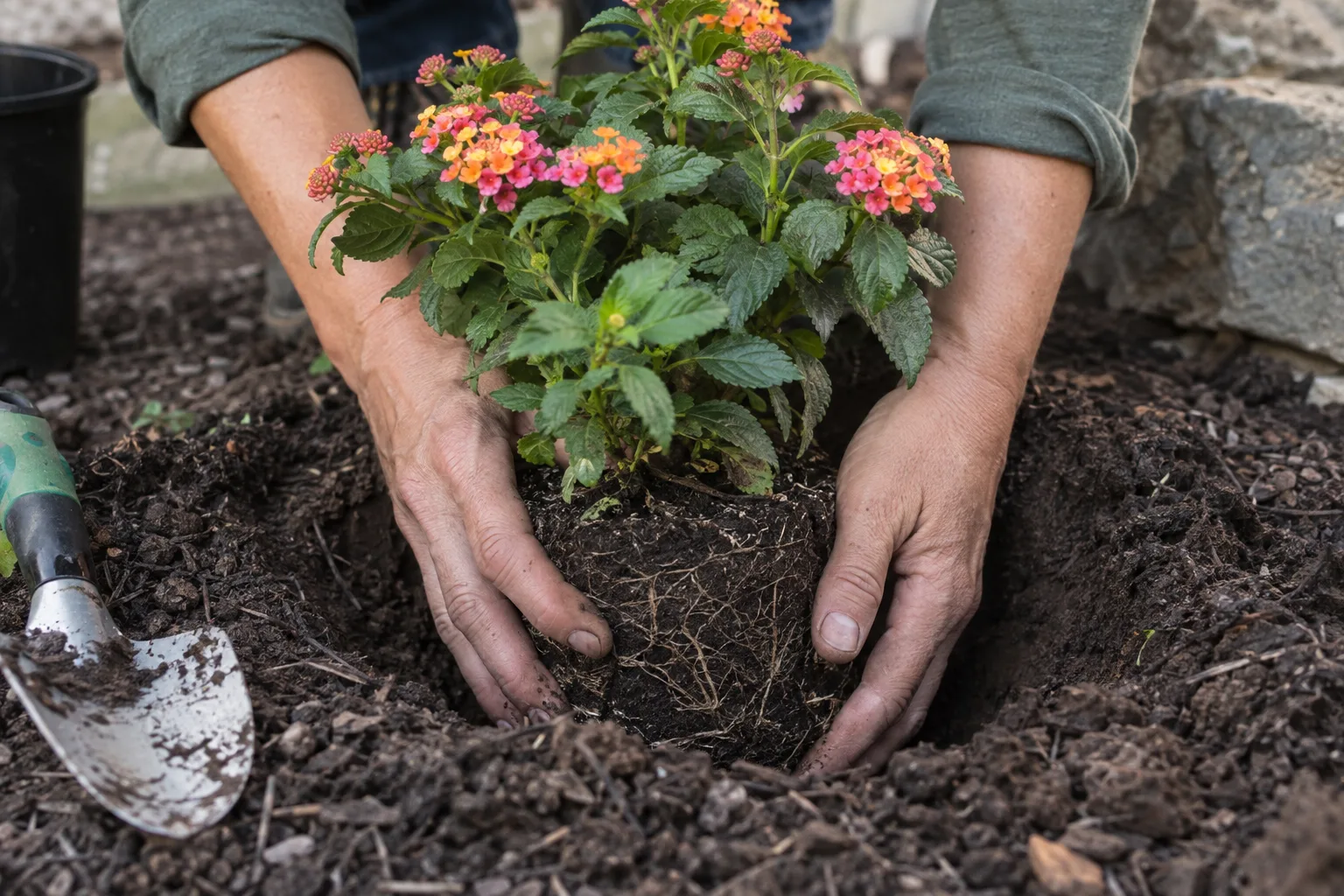
- Dig a test hole about 18 inches deep. A hard white or gray layer that your shovel bounces off is caliche, and it needs a digging bar to break through before anything goes in the ground.
- Dig the planting hole at least twice as wide as the container and the same depth.
- Backfill mostly with the native soil, mixed with no more than about one-quarter compost.
- Set the top of the root ball level with or slightly above the surrounding soil.
- Water slowly and deeply, then build a low ring of soil around the plant to hold water over the roots.
- Spread 2 to 3 inches of mulch, keeping it a few inches from the stems.
- Water every 2 to 3 days for the first couple of weeks, then taper to weekly over the next 6 to 8 weeks as new growth appears.
Three mistakes cause most early failures. Planting too deep invites crown rot, especially after monsoon storms. Heavy compost in the hole can turn it into a bowl that holds water. Skipping the test hole leaves caliche undiscovered until the plant starts to yellow.
How often should I water established lantana?
Water established lantana deeply about every 7 to 10 days in summer, every 10 to 14 days in spring and fall, and only occasionally from November through February. Each soak should wet the soil 12 to 18 inches down. Frequent shallow sprinkling keeps roots near the surface, where they suffer first at 110°F.
Watch the plant. Leaves that curl or droop in the early morning mean it needs water, while afternoon wilting in summer heat is normal. Hard irrigation water leaves salts in the soil over time, so an occasional deep soak pushes them below the root zone. Drip emitters placed at the plant’s drip line put water where the roots are.
What soil and fertilizer does lantana need?
Lantana grows in ordinary native desert soil as long as water drains, and it needs very little fertilizer. One light application of a balanced slow-release product in March, and a second in late summer if growth looks pale, is usually enough. Follow the label rate.
Heavy nitrogen feeding produces leafy growth with fewer flowers. If new leaves turn yellow between green veins, the plant likely has iron chlorosis, which is common in alkaline soil. Chelated iron, applied as the label directs, is the usual fix.
When should I prune lantana in Arizona?
Cut lantana back by one-third to one-half in late February, once frost danger has passed. Flowers form on new growth, so this reset removes woody stems and sets up the spring bloom. Leave frost-browned growth in place until then, since it shelters the crown from the next cold night.
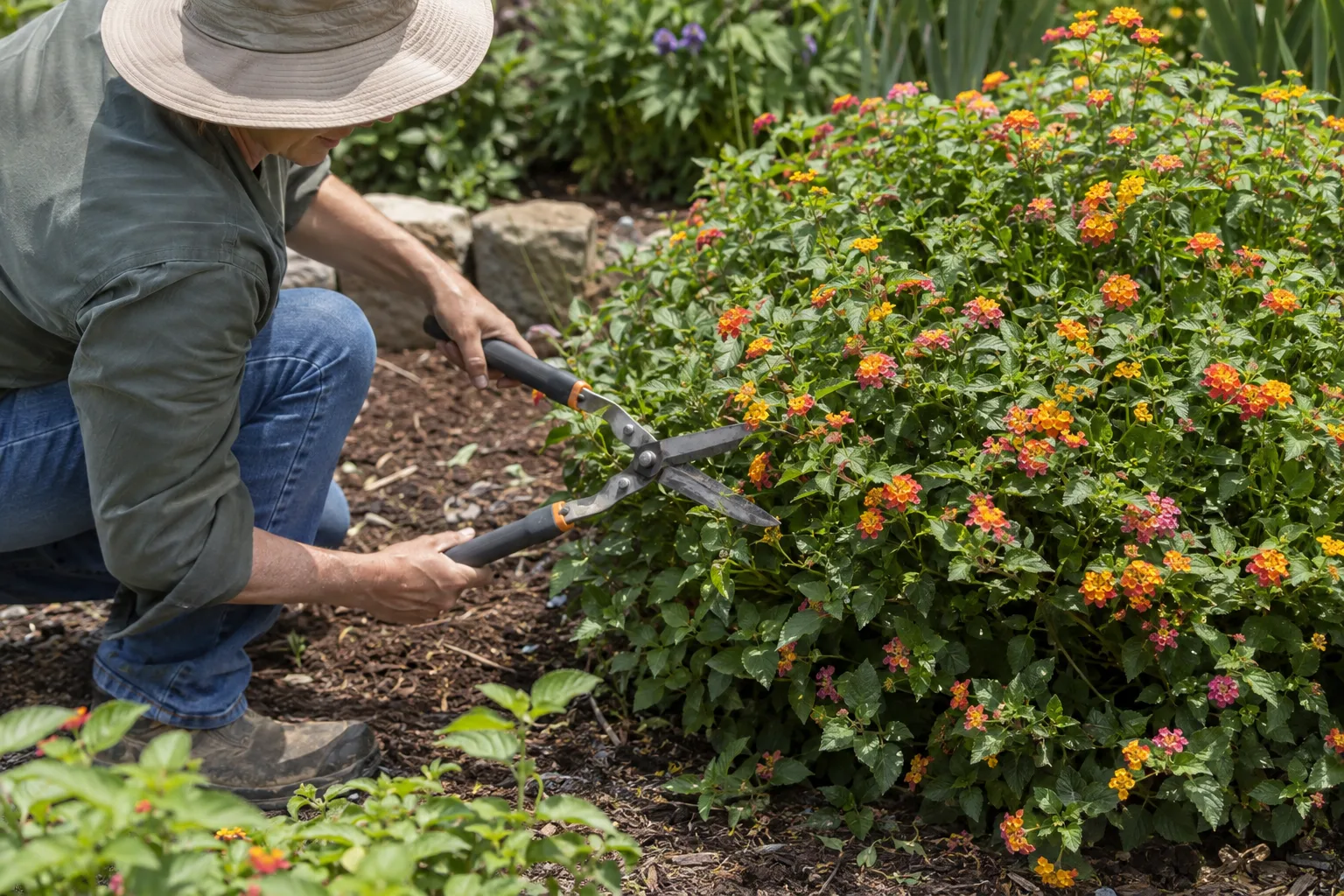
From March through October, shear the outer 4 to 6 inches of the plant every 4 to 6 weeks. This removes spent clusters and keeps the mound tidy. A shaped plant looks planned at an entry. A neglected one looks overgrown.
What problems and safety concerns come with lantana?
Lantana has few serious pests. The issues worth knowing are whiteflies, lace bugs, root rot and toxic berries.
Whiteflies and lace bugs
Whiteflies are tiny white insects on leaf undersides that leave yellowing, speckled leaves. Lace bugs cause silvery or bronze stippling on the upper leaf surface. A strong spray of water in the morning knocks back light infestations. For heavier ones, insecticidal soap or neem oil are common choices, applied in the cooler part of the day and exactly as the label directs. The University of Arizona Cooperative Extension publishes pest guidance for the low desert.
Root rot and leggy growth
Beds that hold water after monsoon storms can rot lantana roots. Fix drainage before replanting by breaking through caliche or raising the bed a few inches. Leggy plants with few flowers usually have too much shade, too much nitrogen or a skipped late-winter cut. Lantana flowers best in full sun.
Are lantana berries safe around kids and pets?
No. The berries are toxic if eaten, and the ASPCA lists lantana as toxic to dogs and cats. Keep it away from toddlers and dogs that chew plants. If a child or pet eats any, call Poison Help or your veterinarian right away.
Frequently asked questions
Will lantana come back after a frost?
Yes, established lantana usually regrows from the base after a light frost. Cold can brown the leaves and stems, but the roots survive most East Valley winters, with top growth at risk below roughly 25 to 28°F. Wait until late February to cut back damaged growth, then expect new shoots as days warm.
Can I grow lantana in a pot by the front door?
Yes, a container 14 to 18 inches wide with drainage holes works well, especially on tile or concrete entries where nothing can go in the ground. Pots dry out quickly, so check them every day or two in summer. Compact and trailing types fit best. Browse our pottery and planters to find a container with room for roots.
Will lantana bring bees near my front door?
Yes, lantana draws butterflies, native bees, honeybees and hummingbirds. Foraging bees stay focused on the flowers and rarely bother people walking past. If someone in your household has a serious bee allergy, plant lantana to the side of the entry or along a low wall several feet from the door instead of directly beside it.
What grows well next to lantana?
Plants with the same full-sun, low-water needs pair best with lantana. Good partners include desert marigold (Baileya multiradiata), globe mallow (Sphaeralcea ambigua), autumn sage (Salvia greggii) and trailing rosemary (Salvia rosmarinus). Their flowers and gray-green foliage add contrast in texture and bloom time.
How fast does lantana grow?
Lantana grows fast in warm weather. A small nursery plant set out in March can reach 2 to 3 feet across by fall with regular watering, then slows in winter and speeds up again the next spring. By its second or third year it fills its space and needs shaping more than watering.
Is lantana right for your front entry?
Lantana is a good fit if your entry gets at least 6 hours of direct sun and the soil drains. It delivers months of color for modest water and light pruning. Skip it if the entry sits in deep shade, if you have toddlers or a dog that chews plants and cannot keep them away from the berries, or if you want a formal evergreen look year-round. Stop by our nursery in Queen Creek to see what is blooming and talk through your entry.