
Arizona gardeners choose indoor food growing because summer highs above 110°F, alkaline caliche soil and short outdoor planting windows limit what survives outside. A spare room with a grow light and a few containers gives you greens and herbs in every month, including August.
Key takeaways
- Most leafy greens and herbs grow well indoors at 65 to 80°F, a range most air-conditioned East Valley homes hold all year.
- Plan on 14 to 16 hours of light a day from a full-spectrum LED panel for greens and herbs, run by a plug-in timer.
- Microgreens are ready in 7 to 14 days, and baby-leaf lettuce in roughly 3 to 5 weeks, so one shelf produces many harvests a year.
- Fill containers with fresh potting mix that drains well, and leave outdoor caliche soil outside.
- Hydroponic reservoirs do best at pH 5.5 to 6.5, and hard East Valley tap water often needs testing and adjusting first.

Why is outdoor vegetable gardening so hard in the Arizona low desert?
Summer highs above 110°F, alkaline soil and short planting windows leave outdoor vegetable beds idle or struggling for much of the year. Tomatoes, beans and cucumbers stall when daytime temperatures stay that high, and tomato blossoms often drop before they set fruit.
Soil is the second hurdle. Across Queen Creek and the East Valley, native ground is alkaline (often pH 7.5 to 8.5) and sits on caliche, a cemented mineral layer that slows drainage and stops roots from reaching deeper. Raised beds with imported soil fix part of the problem, but they still bake in July sun and need frequent watering.
The UA Cooperative Extension vegetable planting calendar for Maricopa County shows that most crops get two windows, one from late winter into spring and another in fall. The monsoon, roughly July through September, adds humidity, fungal pressure and storms that flatten trellised plants. Indoors, none of that applies.
What does indoor food growing look like in a regular home?
It means growing edible plants under artificial light in a controlled indoor space, such as a spare bedroom corner, a closet, a laundry room or a kitchen shelf. Most setups are a wire shelf, one or two LED panels, a timer and a few containers.
The range runs wide. A pot of basil on a bright windowsill sits at one end, and a grow tent with a recirculating hydroponic unit sits at the other. Most beginners land in the middle with a shelf, one light and soil-filled containers. Your air conditioning does much of the climate work, since indoor temperatures of 72 to 78°F suit leafy greens and herbs while it is 115°F outside.
Which crops grow best indoors in Arizona?
Leafy greens, culinary herbs and microgreens are the most reliable indoor crops, and compact tomatoes and peppers work when they get stronger light. Herbs and vegetable starts are varieties we commonly carry in our herbs, vegetables and berries department, though availability changes week to week and season to season.
Leafy greens
Lettuce (Lactuca sativa), spinach, arugula, kale and chard have shallow roots that suit shallow containers, and they tolerate the modest humidity of an air-conditioned house. Baby-leaf lettuce is ready to cut in roughly 3 to 5 weeks, while full heads take about 45 to 55 days. Cut the outer leaves and the plant keeps producing from the center. Drawback: greens turn bitter and bolt if the space runs above about 80°F.
Culinary herbs
Basil (Ocimum basilicum), parsley, chives, oregano and mint all grow well under lights. Cilantro (Coriandrum sativum) bolts quickly once outdoor temperatures climb in spring, but steady indoor temperatures let you keep cutting it for far longer. Mint spreads fast, so give it its own pot. Drawback: most herbs need bright light, and a dim shelf gives leggy, weak growth.
Microgreens
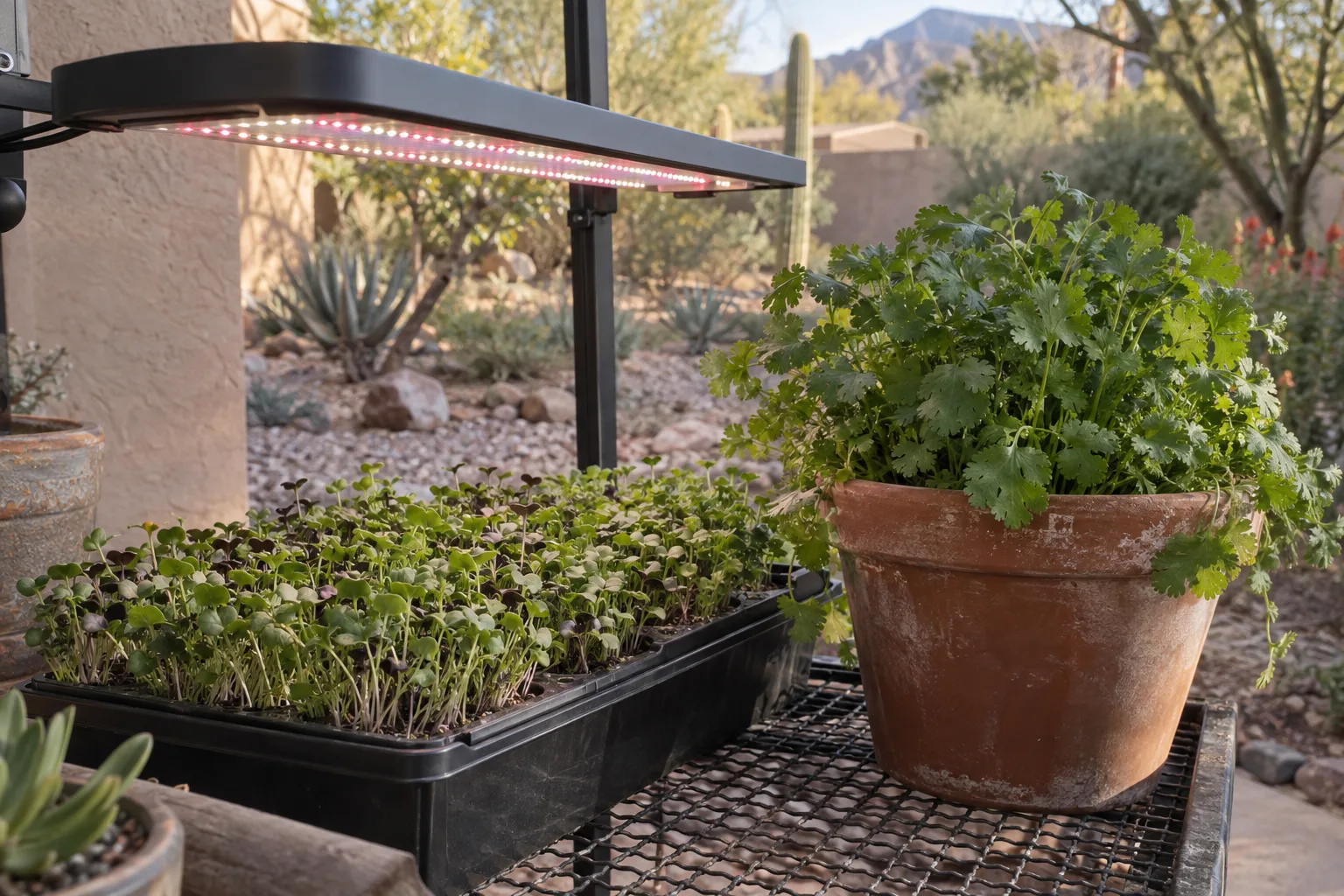
Sunflower, radish, pea and broccoli microgreens go from seed to harvest in about 7 to 14 days on a shallow tray of potting mix, making them the fastest indoor crop. Drawback: each tray gives one cutting, so you reseed every week or two to keep a steady supply.
Cherry tomatoes and peppers
Compact cherry tomatoes (Solanum lycopersicum) and small-fruited peppers such as Thai chiles (Capsicum annuum) can fruit indoors, though they need noticeably stronger light than greens, often 400 to 600 micromoles of PPFD at the canopy for 14 to 18 hours a day. With no wind or insects indoors, tap the flowers or run a fan to move pollen. Drawback: they take more space and electricity and give less food per square foot than greens.
What do you need to start an indoor food garden?
You need a light, a timer, containers, fresh potting mix and a small fan, set in a spot with an outlet. None of it is complicated, and most of it fits on a single shelf.
- A space with an outlet and steady temperatures between 65 and 80°F.
- A full-spectrum white LED panel sized for your shelf or tent. White light makes leaf color easy to judge, and quality LEDs run cooler than older lighting.
- A plug-in timer so the lights run 14 to 16 hours a day without you.
- Containers with drainage holes, plus trays or saucers underneath.
- Fresh potting mix with perlite for drainage.
- A small fan for airflow.
For greens, aim for roughly 200 to 400 micromoles of PPFD at leaf level, and use the manufacturer’s hanging-height chart to get close. Browse the pottery and planters for containers with drainage holes, or set a plastic nursery pot inside a decorative one to protect shelves from water.
Leave outdoor soil outdoors. Caliche-based native soil compacts in a container, drains slowly and can carry weed seed and pests indoors.
How do you set up an indoor food garden step by step?
Setup takes an afternoon, and your first cuttings of baby greens arrive in about 3 to 5 weeks.
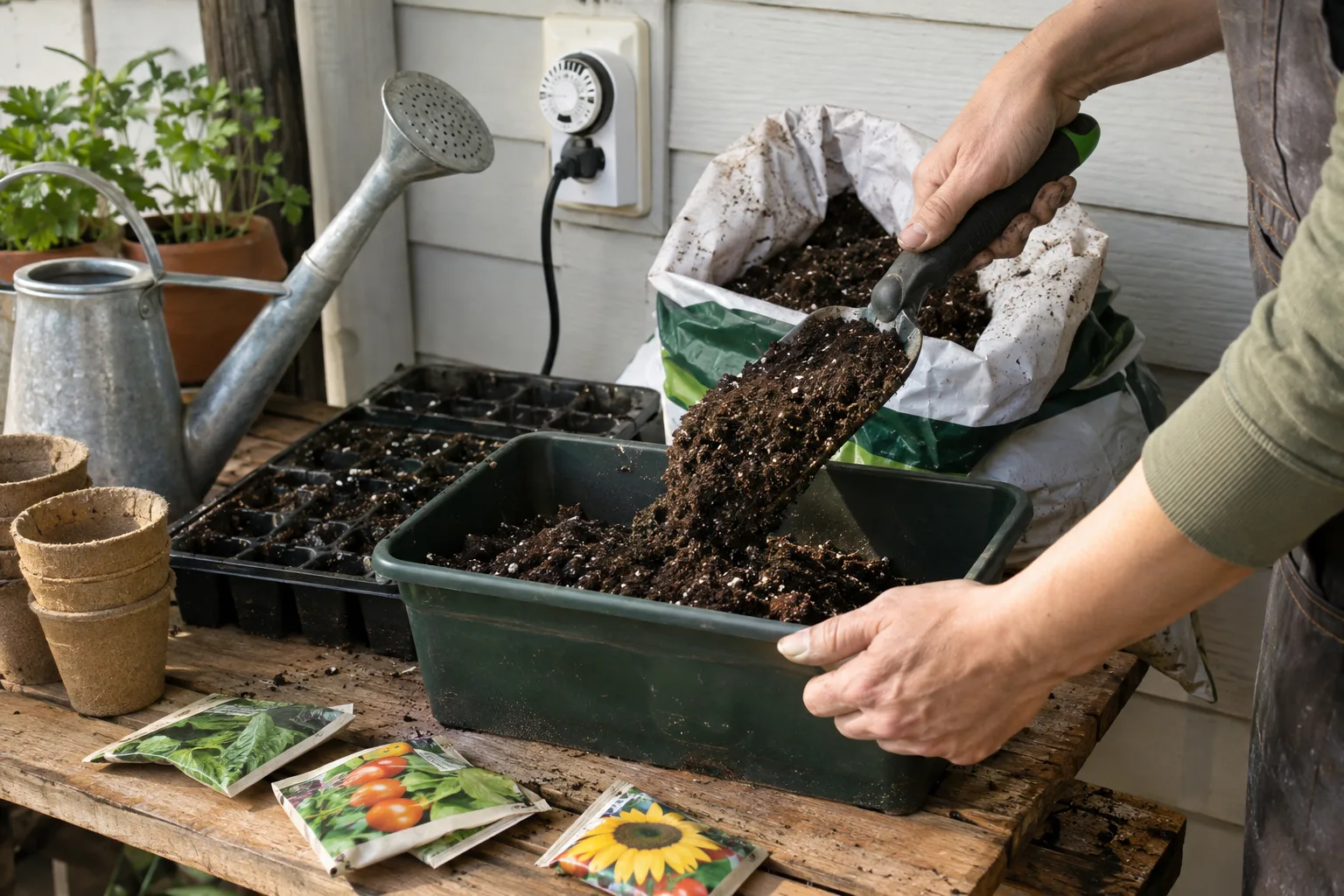
- Pick a spot with an outlet, room for air to move and steady temperatures between 65 and 80°F.
- Hang the light at the height the manufacturer lists for your plants, and plug it into the timer.
- Set the timer for 14 to 16 hours of light a day for greens and herbs.
- Fill containers with fresh potting mix, moisten it evenly and sow seeds at the depth printed on the packet.
- Run a small fan on low for a few hours a day to strengthen stems and reduce damping off, a fungal problem that collapses seedlings.
- Water when the top inch of mix feels dry, and empty any water left in the saucers.
- Start harvesting outer leaves once plants have several sets of leaves, and cut microgreens when the first true leaves open.
Does indoor food growing save water and money?
It saves water, and it saves money on herbs, greens and microgreens more than on tomatoes and peppers. Containers under lights lose far less water to evaporation than a sunny bed in July, and recirculating hydroponic reservoirs lose water mostly through plant uptake and a little evaporation.
Extension programs at universities generally report large water savings from hydroponics, though the exact figure depends on the system. Electricity is the cost to plan for. A 150-watt panel running 16 hours a day uses roughly 72 kilowatt-hours a month, which comes to about $9 to $15 at typical East Valley rates.
Per ounce, packaged fresh herbs and microgreens are among the priciest produce in the store, so a shelf of them pays back fastest. Home-grown tomatoes rarely beat grocery prices, and most people grow them for flavor. Outdoor beds keep their place too, and our gardening calendars show when the spring and fall planting windows open.
Which indoor growing system fits your space?
Soil containers suit most beginners, and passive hydroponics such as the Kratky method suit people who want leafy greens with no pump. The table compares the common choices.
| System | Best for | Water use | Skill level | Main drawback |
|---|---|---|---|---|
| Soil containers | Herbs, greens, microgreens | Moderate | Beginner | Easy to overwater |
| Kratky (passive hydroponics) | Lettuce, basil | Low | Beginner | Poor fit for long-season crops |
| Deep water culture | Lettuce, basil, fast greens | Low | Beginner to intermediate | Needs an air pump and reservoir checks |
| Nutrient film technique | High-volume greens | Low | Intermediate | Channels clog and pumps fail |
| Grow tent with soil | Tomatoes, peppers, mixed crops | Moderate | Intermediate | Needs ventilation and floor space |

Hydroponic reservoirs do best near pH 5.5 to 6.5. East Valley tap water is hard and often alkaline, so test a sample before filling a reservoir and adjust with a pH-down product made for hydroponics, following the label directions.
What mistakes should you avoid with indoor food growing?
The most common problems are overwatering, weak airflow and starting too big. Each one has a simple fix.
Overwatering
Indoor containers lose none of their moisture to sun and wind, so mix stays damp for days. Yellowing leaves and fungus gnats point to wet mix. Let the top inch dry between waterings and tip out standing water.
Skipping airflow
Still air encourages powdery mildew and damping off. A small fan on low for a few hours a day moves enough air to help and strengthens stems at the same time.
Starting too big
A single shelf with two or three crops teaches you how your space handles light, temperature and watering. Add a second shelf or a hydroponic unit after your first few harvests.
Frequently asked questions
Do I still need a grow light with a sunny window?
Yes, for most crops. Light intensity drops quickly a few feet from the glass, and greens, herbs and fruiting plants need more hours of bright light than most windows give. Chives and a few other herbs can survive on a windowsill, but growth is slower and stems stretch toward the glass.
How do I control fungus gnats in indoor containers?
Let the top inch of mix dry out between waterings, since gnat larvae need constantly damp soil. Yellow sticky traps catch adults and show you how bad the problem is. Empty saucers after watering, and avoid overwatering new transplants, because soggy mix invites the whole cycle to restart.
Can I grow food indoors in an apartment or condo?
Yes. A countertop hydroponic unit, a wall-mounted shelf with LED strips or a closet grow tent all fit small spaces. You need an outlet, a surface that tolerates moisture and a lease that allows the setup. Most compact systems need no permanent changes to the unit.
Should I bring my outdoor plants inside for summer?
Usually not. Plants grown in full sun outdoors struggle in the lower light indoors, drop leaves and attract pests. Starting fresh from seed or small transplants under a grow light gives better results, and you avoid carrying outdoor insects into the house.
Where can I learn more about growing food indoors?
Start with our classes and events page, which lists workshops as they are scheduled. You can also bring photos of your space and your questions to the nursery, and we will help you match crops, containers and light to what you have.
Is indoor food growing right for your home?
Yes, if you want fresh greens, herbs and microgreens through July and August and can spare a shelf, an outlet and a few minutes every other day. Skip it if you expect to replace a large summer vegetable garden, since indoor setups produce salad greens and seasoning herbs, with no bushels of squash or melons, and fruiting crops need stronger lights and more room. Start with one shelf and two or three crops.
Visit us in Queen Creek to talk through your space and pick your first crops.