
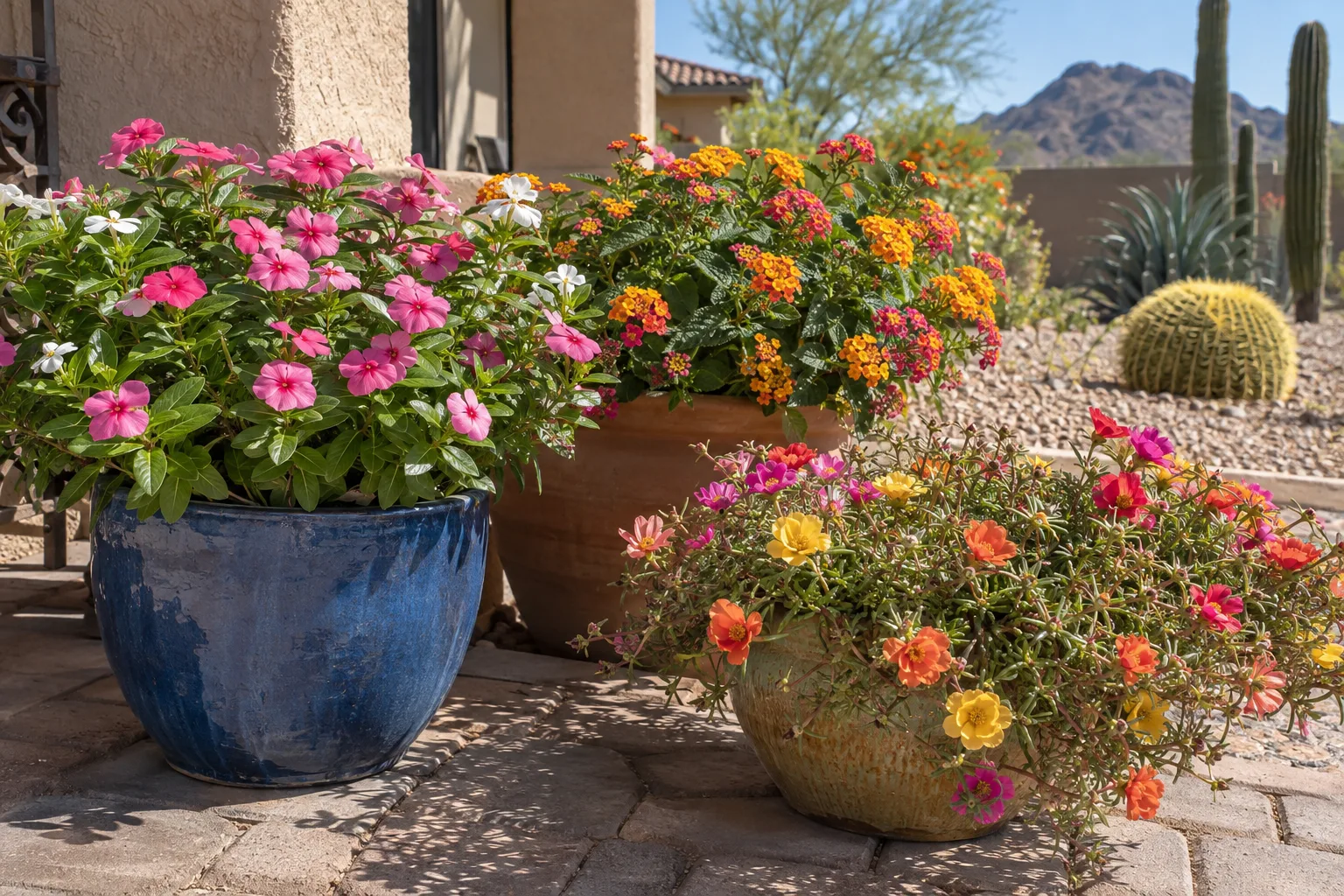
The best heat-tolerant flowers for Arizona pots are vinca, portulaca, pentas, lantana, gaillardia and angelonia. Plant them from March through April so roots settle before highs pass 100°F, and use a large, light-colored container with good drainage.
Key takeaways
- Plant summer containers from March through April, so roots have about four to six weeks to establish before regular 100°F days.
- Choose pots 12 to 14 inches wide or larger, in light colors, with drainage holes.
- Vinca, portulaca, pentas, lantana, gaillardia and angelonia all bloom through low desert summers when planted in the right spot.
- Expect to water daily in May and June, and check the soil 1 to 2 inches down before each watering.
- Morning sun with afternoon shade cuts water use and protects roots in July and August.
When should I plant summer flowers in Arizona pots?
Mid-March through April is the best window in Queen Creek and the East Valley. Days are mild then, with highs in the 80s, and roots can spread before the heat builds.
A plant set into a pot in early May has to recover from transplanting while temperatures climb every week. It puts its energy into survival instead of blooms. Our annual flowers and foliage department is where most of these plants live, and varieties we commonly carry change from week to week and season to season.
For timing on other plantings, the gardening calendars page is a good companion.
What kind of pot works best in the Arizona heat?
A light-colored pot, 12 to 14 inches wide or larger, with at least one drainage hole. More soil volume holds moisture longer and buffers the temperature swings that stress roots.
Terracotta
Unglazed terracotta breathes and looks good, but a small pot can dry out in a day during June. Slipping it over a plastic nursery pot with an air gap slows moisture loss. Terracotta that sits in direct afternoon sun still needs daily checks.
Glazed ceramic, fiberglass and resin
These hold water longer than bare clay and are lighter to move. White, cream and pale gray reflect heat. Dark navy or black pots in direct afternoon sun can overheat the root zone, even for heat-tolerant plants. Our pottery and planters selection includes many sizes and colors, and what is in stock changes often.
Avoid pots under 10 inches for outdoor summer use.

What potting mix should I use for desert containers?
Use a quality potting mix amended with perlite or pumice for drainage and coconut coir for moisture retention. A rough starting point is about 60 percent potting mix, 20 percent perlite or pumice and 20 percent coir.
Dry mix repels water, so moisten it before filling the pot until it clumps slightly when squeezed. Skip the gravel layer at the bottom, because it can hold water higher in the pot instead of improving drainage. A small amount of slow-release fertilizer mixed in at planting feeds young roots without burning them.
Which flowers handle summer heat best in Arizona pots?
Six reliable choices are vinca, portulaca, pentas, lantana, gaillardia and angelonia. All are varieties we commonly carry, though availability changes week to week and season to season.
Vinca (Catharanthus roseus)
Vinca grows 8 to 18 inches tall and wide, wants full sun, and blooms heavily as temperatures rise. Water moderately. The drawback is that it dislikes soggy soil and can fail in pots that stay wet after monsoon storms.
Portulaca (Portulaca grandiflora)
Portulaca, or moss rose, stays 4 to 8 inches tall and spreads. Its succulent leaves store water, so it needs little. The drawback is that it needs at least six hours of direct sun, and the flowers close in shade and at night.
Pentas (Pentas lanceolata)
Pentas reaches about 2 to 3 feet tall and wide, grows in full sun to part shade, and draws hummingbirds and butterflies with its star-shaped clusters. Water moderately to often. The drawback is that it wilts quickly when a pot dries out, so give it a larger container.
Lantana (Lantana camara)
Lantana grows 1 to 4 feet depending on variety, needs full sun and little water once established, and trailing types spill nicely over pot edges. The drawback is that the berries are toxic if eaten, so be careful around pets and small children.
Gaillardia (Gaillardia pulchella)
Blanket flower grows about 1 to 2 feet tall and wide, wants full sun, and handles missed waterings well. Its red and yellow daisy-like blooms last a long time. The drawback is that it dislikes wet soil, so drainage matters a great deal.
Angelonia (Angelonia angustifolia)
Angelonia, sometimes called summer snapdragon, grows 1 to 2 feet tall in full sun to part shade, with spikes of purple, pink or white flowers. Water moderately. The drawback is that it looks sparse when it is crowded or underwatered.

| Plant | Sun | Water | Suggested pot size |
|---|---|---|---|
| Vinca | Full sun | Moderate | 10 inches or larger |
| Portulaca | Full sun | Low | 8 inches or larger |
| Pentas | Full sun to part shade | Moderate to high | 12 inches or larger |
| Lantana | Full sun | Low to moderate | 12 inches or larger |
| Gaillardia | Full sun | Low | 10 inches or larger |
| Angelonia | Full sun to part shade | Moderate | 10 inches or larger |
How do I plant a heat-ready container step by step?
Fill a clean, light-colored pot with pre-moistened mix, plant at the same depth as the nursery pot, and water until it drains freely. The steps below take about 30 minutes per pot.
- Cover the drainage hole with a small piece of window screen so soil stays in.
- Moisten your mix and fill the pot to 2 to 3 inches below the rim, leaving room for water to pool.
- Tip the plant out of its nursery pot and loosen any circling roots with your fingers.
- Set taller plants toward the center or back, and trailing plants at the edges, leaving space for mature size.
- Backfill and press gently to remove large air pockets without packing the mix tight.
- Water deeply until it runs from the bottom.
- Place the pot in its summer spot. If plants came from a shaded area, give them 5 to 7 days of morning sun first.
Crowded pots trap humidity, which invites fungal problems during monsoon.
How often should I water flowers in pots during summer?
Expect to water every 2 to 3 days in March and April, then daily in May and June. Check the soil 1 to 2 inches down in the morning, and water deeply if it is dry.
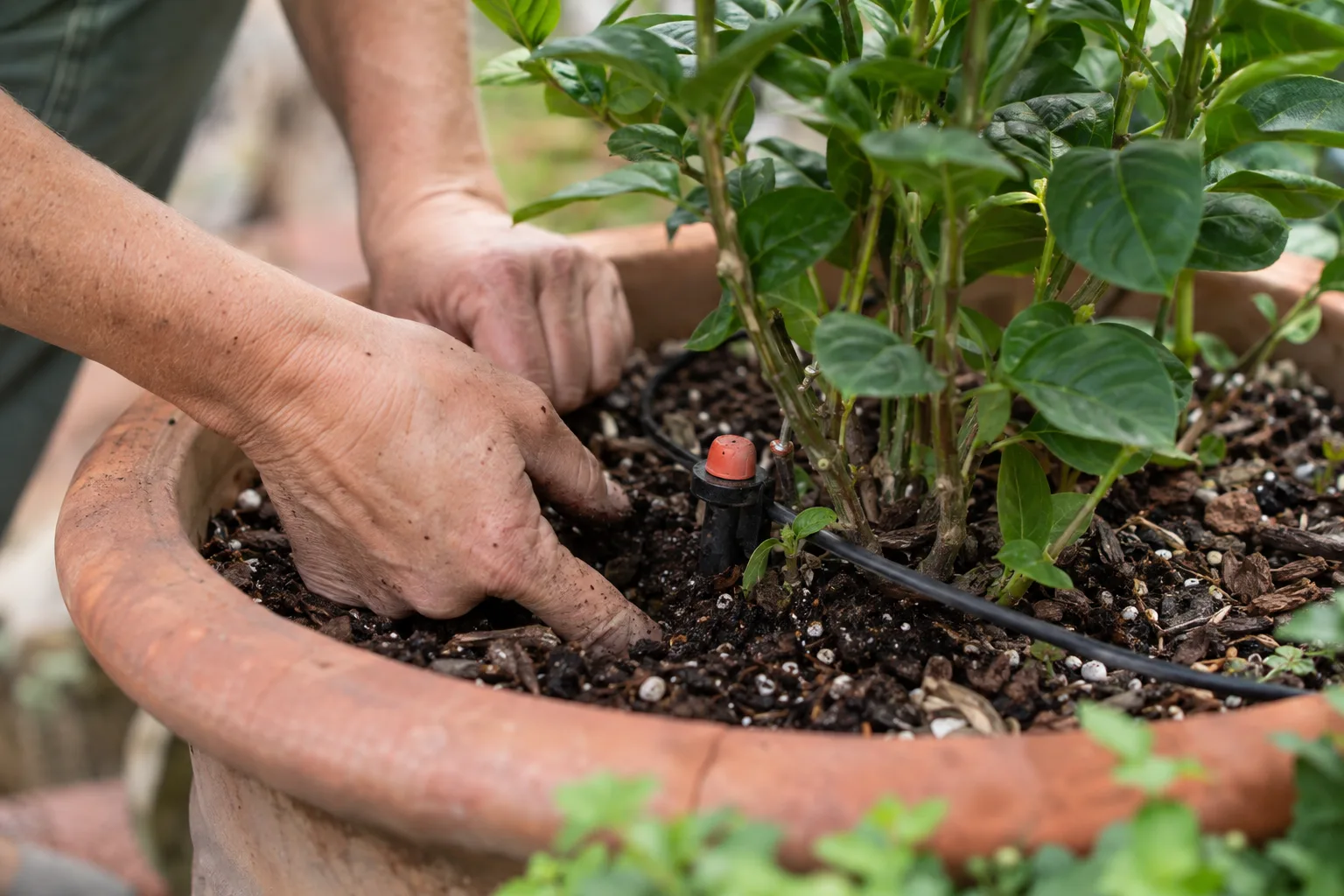
Small pots in full sun may need water twice a day when highs pass 108°F. In July through September the monsoon adds rain, but do not count on it, and tip out saucers after storms so roots never sit in water. A drip emitter on a timer is a dependable way to cover a weekend away. You can find tubing and emitters in our plant department staff area, so ask when you visit.
How should I feed container flowers in the low desert?
Mix slow-release fertilizer into the soil at planting, then add a balanced liquid feed every two to three weeks during active growth. Pots lose nutrients quickly because frequent watering flushes them out.
Yellow leaves with green veins often point to iron deficiency, which hard, alkaline irrigation water can make worse. Chelated iron applied once or twice a season can help. Water before and after liquid feeding on hot days to avoid root burn.
How do I protect pots from afternoon sun and monsoon storms?
Move pots to a spot with morning sun and afternoon shade if you can. Most of the flowers above bloom well with four to six hours of sun and use noticeably less water.
If a west-facing patio is your only option, 30 to 40 percent shade cloth overhead lowers temperatures without cutting flowering much. Reflected heat from stucco and pavement adds to the load, so pull pots a foot or so off walls. During the monsoon, drain saucers, thin crowded growth and water at the base instead of overhead to reduce powdery mildew.
Frequently asked questions
Can I leave container flowers outside all summer?
Yes, if the plants and pot are right. Vinca, portulaca, lantana and pentas all handle outdoor low desert summers. Use pots of at least 10 inches, water consistently and avoid the worst reflected heat. Plants that collapse in June usually suffer from dry soil or an overheated pot rather than air temperature.
Which flowers should I skip for summer pots?
Skip petunias, impatiens, pansies and snapdragons, which are cool-season or shade plants and tend to decline by May. Hydrangeas, fuchsias and begonias also struggle with our dry heat. Save them, where suited, for fall and winter planting, when the low desert is an excellent growing season.
How do I revive a heat-stressed potted plant?
Move it into shade and water deeply. If the soil has shrunk from the pot wall, set the whole pot in a tub of water for 20 to 30 minutes so it rehydrates from below. Trim burned foliage. Many heat-tolerant plants recover within about a week.
Can I mix herbs with flowers in one pot?
Yes, if they share water and sun needs. Rosemary pairs well with lantana because both prefer drier soil. Basil wants more water and suits pentas better. Cilantro, parsley and dill bolt in summer heat, so keep them out of summer pots. Our herbs, vegetables and berries department can help with pairings.
Why do my potted flowers stop blooming in July?
Heat stress, dry spells and nutrient loss are the usual causes. Check the soil moisture daily, resume feeding every two to three weeks, and shade the pot from afternoon sun. Plants often bloom again when monsoon humidity and cooler nights arrive in August.
Are potted summer flowers right for your patio?
They suit anyone who can check pots daily from May through September and has at least a few hours of sun. Planted in March or April, in a large light-colored pot, these six flowers give months of color. If you travel often and have no irrigation, choose portulaca or gaillardia and put the pot on a timer, or plant in the ground instead. Stop by our Queen Creek nursery to see what is available and talk through your patio.