
Growing lavender in Arizona works in the low desert when you choose heat-tolerant varieties, plant in fall, and give the roots fast drainage. Spanish, French and hybrid types do best in Queen Creek, while English lavender struggles through our summers.
Key takeaways
- Plant lavender from September through October, or in February to early March, so roots settle in before summer highs above 110°F.
- Spanish (Lavandula stoechas), French (Lavandula dentata) and hybrids such as Goodwin Creek Grey handle low desert heat better than English lavender.
- Set the crown 3 to 6 inches above the surrounding grade on a mound of gritty soil to beat caliche and monsoon runoff.
- Water new plants every few days for the first 2 to 3 months, then stretch to every 1 to 2 weeks depending on the season.
- Mulch with gravel or decomposed granite, kept off the stems, and avoid overhead watering from July through September.

Can you grow lavender in the Arizona low desert?
Yes, with the right variety and the right planting spot. Lavender comes from the Mediterranean, where summers are dry, soil is rocky and the sun is intense, so our sunshine and low humidity suit it well for much of the year.
Two things work against it here. Summer heat above 110°F stresses even tolerant types, and the monsoon from roughly July through September brings humidity and sudden heavy rain. Wet roots in hot weather are what kill most lavender in the East Valley. Commercial lavender fields in Arizona tend to sit at higher, cooler elevations, so a backyard in Queen Creek asks more of the plant and more of you.
Plan on full sun, at least 6 hours a day and ideally 8, and a spot where water cannot pool. You can browse our plants department to see the kinds of perennials and shrubs that pair well with it.
Which lavender varieties handle low desert heat?
Spanish, French and hybrid lavenders handle our heat best. English lavender (Lavandula angustifolia) is the most fragrant for cooking and sachets, but it often declines after its first hot summer here.
| Variety | Botanical name | Bloom window | Honest drawback |
|---|---|---|---|
| Spanish lavender | Lavandula stoechas | Late winter into spring | Less sweet scent, weaker for drying |
| French lavender | Lavandula dentata | Long, often on and off for months | Can sprawl and look rangy without shearing |
| Goodwin Creek Grey | Lavandula x ginginsii | Spring, with some repeat bloom | Needs sharp drainage like all lavender |
| Provence | Lavandula x intermedia | Late spring | Struggles more in humid monsoon weather |
These are varieties we commonly carry, although availability changes week to week and season to season. Ask at the nursery what is in when you visit.
Spanish lavender has the rabbit-ear bracts on top of each flower spike and is the showiest of the group. French lavender is the most forgiving of our alkaline soil. Goodwin Creek Grey keeps silvery foliage even between blooms, which keeps a bed looking good in the off season.
If you cook with lavender, shop the herb section too, and see our herbs, vegetables and berries page for related Mediterranean plants.
How should I prepare the soil for lavender in Queen Creek?
Build a raised, gritty planting area, because our native soil drains poorly. It is alkaline, often compacted, and frequently sits on a layer of caliche that holds water like a bowl. Lavender tolerates alkaline soil far better than wet soil, so drainage is the problem to solve first.
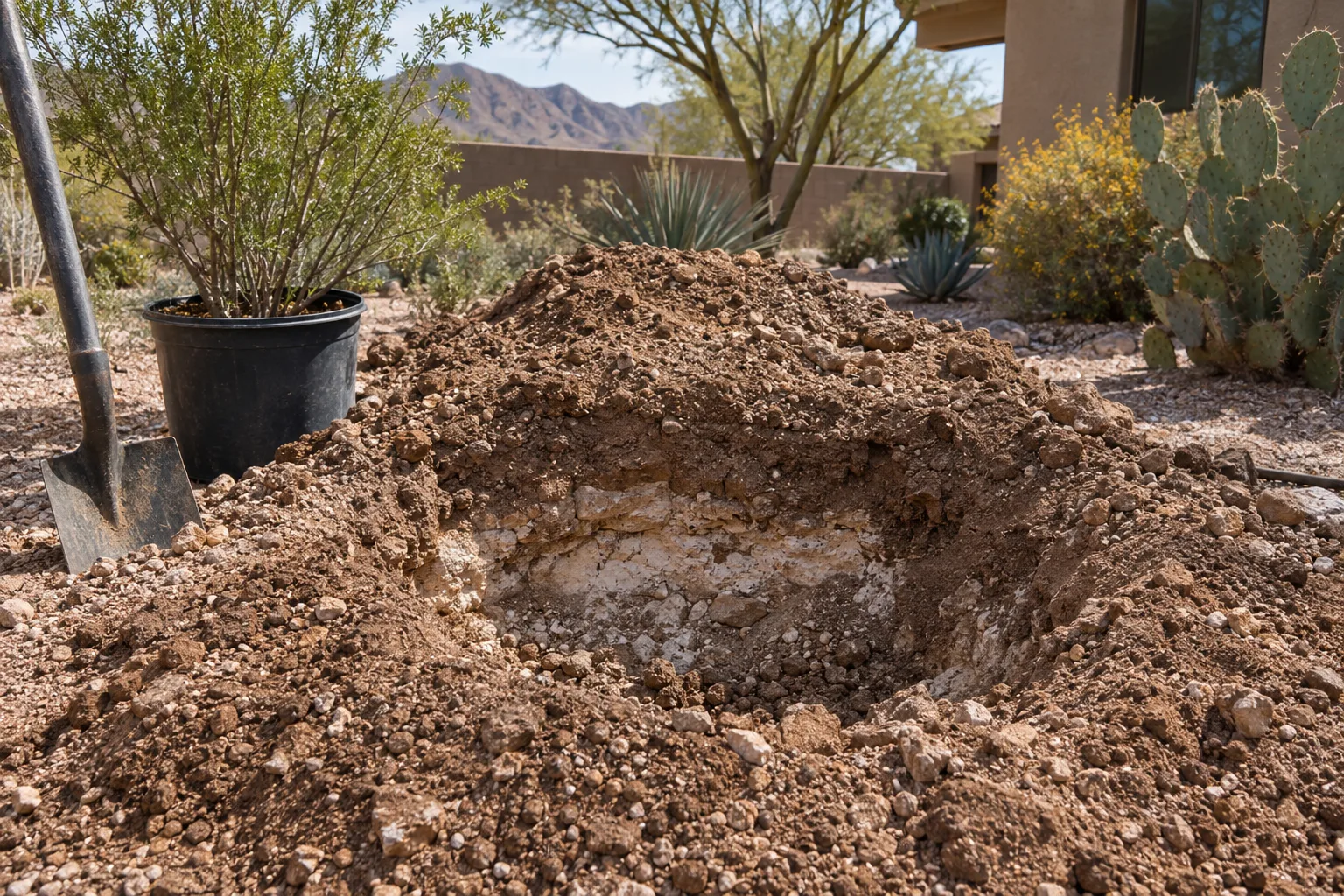
Test drainage before you plant
Dig a hole about 12 to 18 inches deep and fill it with water. Fill it again once it empties. If the second fill is still standing after an hour or so, the spot drains too slowly for lavender. Break through the caliche layer, or plant on a mound instead.
Mix a gritty planting soil
Blend native soil with coarse sand or pea gravel and some compost, using roughly equal parts of each. Skip heavy amendments that hold moisture. Mound the mix so the crown of the plant sits 3 to 6 inches above the surrounding soil. Water then runs away from the stem instead of collecting around it.
When is the best time to plant lavender in Arizona?
September through October is the best window, with February to early March as a second choice. Fall planting gives roots the whole cool season to spread before May heat arrives.
Spring plantings have only a few weeks before temperatures climb, so they need closer watching through their first summer. Avoid planting from June through August, when heat stress and monsoon moisture arrive together. Our gardening calendars lay out the planting seasons month by month for the low desert.
How do I plant lavender step by step?
Plant it high, in gritty soil, in full sun. The steps below take about 30 minutes per plant once the bed is prepared.
- Choose a spot with 6 to 8 hours of direct sun and no standing water after irrigation or rain.
- Run the drainage test described above, and build a mound if the hole drains slowly.
- Dig a hole twice as wide as the root ball and no deeper than the root ball.
- Loosen any circling roots gently, because lavender dislikes heavy root disturbance.
- Set the plant so the crown sits 3 to 6 inches above the surrounding grade.
- Backfill with your gritty mix and firm it lightly to remove air pockets.
- Spread 2 inches of gravel or decomposed granite around the plant, leaving a few inches of bare soil at the stem.
- Water deeply to settle the roots, then follow the schedule below.
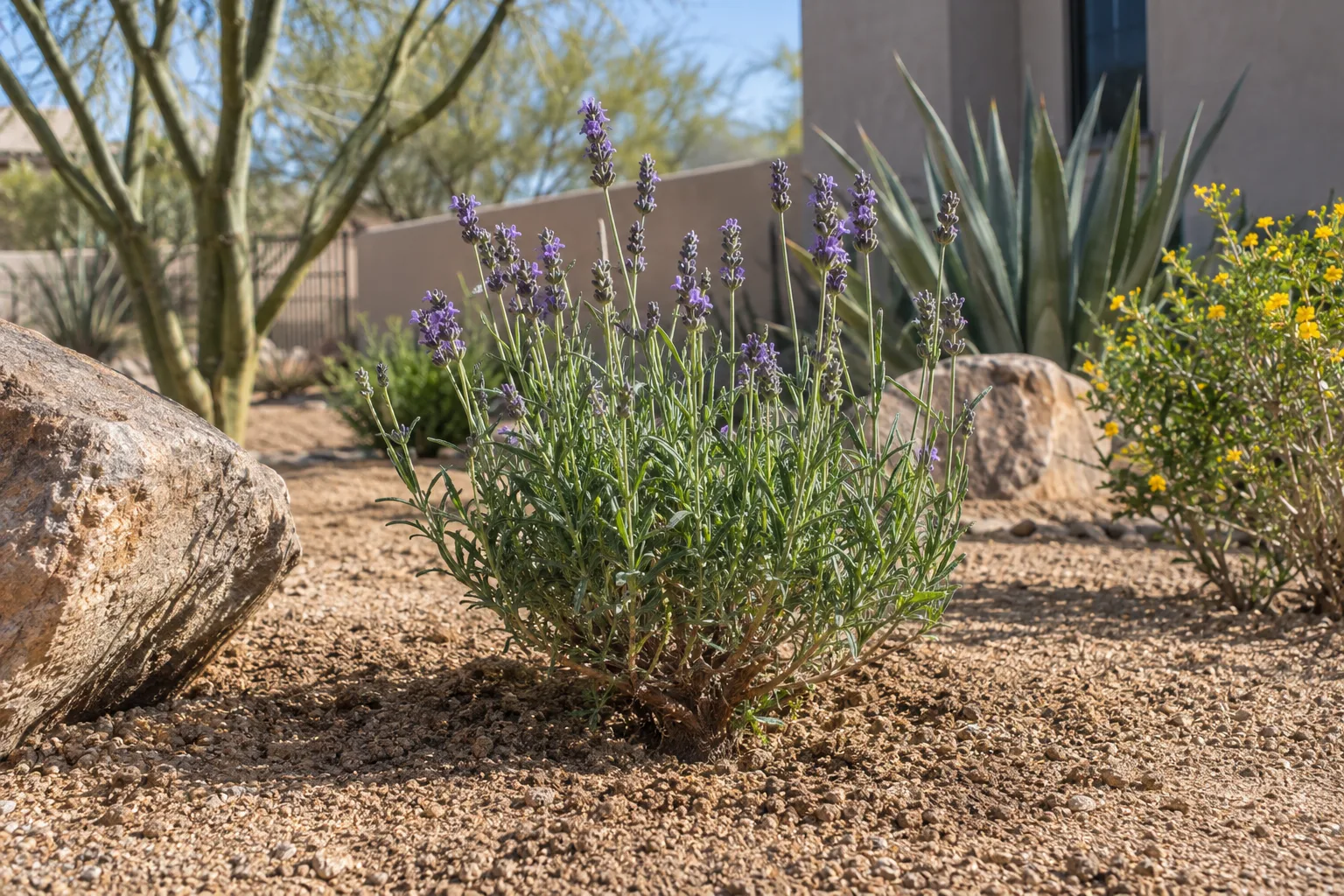
Space plants 24 to 36 inches apart. Crowding traps humidity in the foliage, which invites fungal disease during the monsoon.
How often should I water lavender in the low desert?
Water new lavender every 2 to 3 days at first, then taper to weekly, then to every 1 to 2 weeks once it is established. Always check the soil before you water.
- First month: deep watering every 2 to 3 days, so moisture reaches the full root zone.
- Months 2 and 3: stretch to about once a week.
- Established, cool season: roughly every 10 to 14 days, less after rain.
- Established, summer: roughly every 7 to 10 days in dry heat, and skip watering after monsoon storms.
Lavender often droops a little on a hot afternoon even when the soil is fine. Push a finger 3 to 4 inches into the soil. If it is damp, wait a day and look again. Water in the morning so the foliage dries before evening. Drip irrigation aimed at the soil, not the leaves, suits it best.
How do I keep lavender alive through summer and the monsoon?
Reduce moisture around the plant and cut heat stress where you can. Established Spanish, French and hybrid lavenders usually get through a low desert summer if the soil drains and the crown stays dry.
Shear the plant by about one-third after its main bloom flush so air moves through the center. Never cut back into bare, woody stems, because lavender rarely regrows from old wood. In a spot that gets reflected heat from a block wall or west-facing stucco, a piece of 30 percent shade cloth from June through August can take the edge off. Take it down by September.

Hold off on fertilizer during the hottest months. Lavender prefers lean soil, and too much feeding produces soft, floppy growth that struggles in humidity.
What problems does lavender get in Arizona?
Root rot is the biggest one, followed by iron chlorosis, woody growth and the occasional insect. Most of these trace back to drainage, pruning or soil chemistry.
Root rot
Signs are wilting that does not improve with water, yellowing leaves and sudden collapse after a storm or irrigation. Brown, mushy roots confirm it. A plant that reaches this stage rarely recovers. Replant in a raised, gritty bed and water less often.
Yellow leaves with green veins
This is iron chlorosis, common in our alkaline soil. A chelated iron product applied according to its label can help, and a gravel mulch with good drainage prevents the problem from returning.
Woody, sparse growth
Lavender that is never trimmed turns leggy and flowers less. Light annual shearing keeps it dense. Aphids and whiteflies sometimes show up on new growth, and a strong spray from the hose often knocks them off.
Frequently asked questions
Can I grow lavender in a pot in Queen Creek?
Yes, and a pot gives you full control of the soil. Use a cactus and succulent mix with extra pea gravel in a container at least 5 gallons in size, with drainage holes. Unglazed terracotta dries faster than plastic. Browse pottery and planters for options, and never let water collect in a saucer.
When do I harvest lavender flowers?
Harvest when the lower third to half of the flowers on a spike have opened. Cut in the morning after dew dries, just above a set of leaves. Bundle 20 to 30 stems and hang them upside down in a cool, shaded, well-ventilated spot for a few weeks. Cutting spent flowers also encourages a tidier plant.
What plants grow well alongside lavender?
Choose companions with the same needs: full sun, sharp drainage and little water. Rosemary, autumn sage (Salvia greggii), angelita daisy (Tetraneuris acaulis) and desert marigold (Baileya multiradata) all fit that description. Keep thirsty plants and lawn sprinklers away, since they raise soil moisture around the lavender roots.
Do I need to visit a lavender farm before planting?
No, but a visit shows you how mature plants look and how growers handle spacing and irrigation. Arizona has lavender farms, many at higher, cooler elevations than Queen Creek, so conditions differ from a low desert yard. Call ahead before you go, since bloom times, hours and u-pick access vary from farm to farm.
Why is English lavender so hard to keep here?
English lavender prefers cooler summers and drier air than the low desert provides. Heat above 100°F combined with monsoon humidity stresses it and invites rot. If you want to try one, plant it in a pot so you can move it to a spot with afternoon shade from June through September.
Is lavender right for your Queen Creek yard?
Lavender suits you if you have a sunny, well-drained spot and enjoy a plant that wants little water and attention once established. Choose Spanish, French or a hybrid, and plant it in fall. It will disappoint you in a shaded corner, in soil that stays wet, or beside a lawn sprinkler. If those describe your yard, pick another herb or shrub. Come see our classes and events, or stop by the nursery in Queen Creek and talk lavender with us in person.