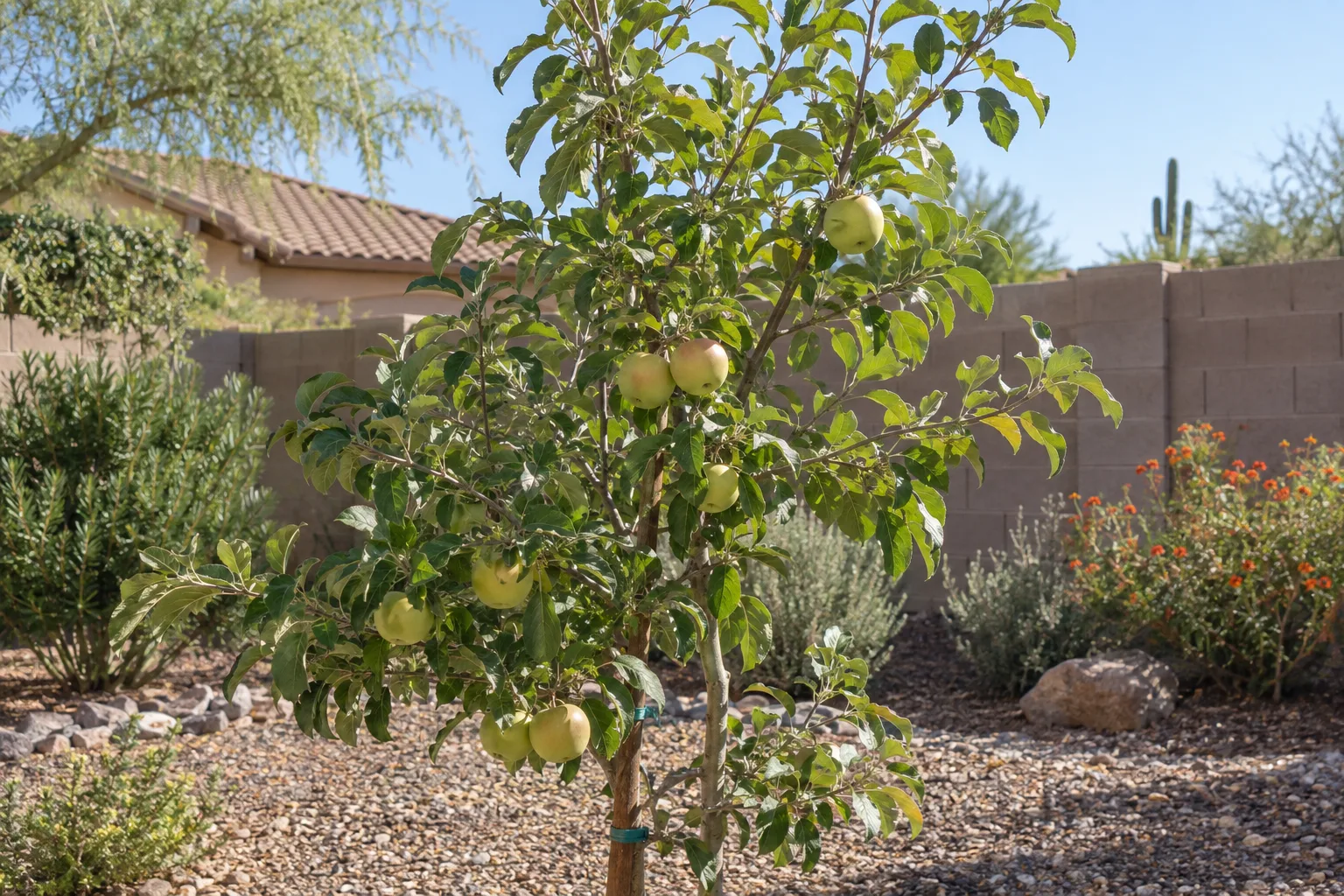
You can grow apples in Arizona’s low desert by choosing low-chill varieties such as Anna, Dorsett Golden or Ein Shemer, planting them in the cooler months, and shading them from the hottest afternoon sun. Standard apples bred for cold climates bloom poorly and fruit sparsely here.
Key takeaways
- Choose varieties that need roughly 100 to 300 chilling hours. Apples that need 800 hours or more will bloom unevenly and set little fruit in the East Valley.
- Plant from about November through February so roots establish before daytime highs pass 100°F.
- Give the tree 6 to 8 hours of sun, with shade from the hottest afternoon sun, and keep it at least 6 feet from a west-facing wall.
- Plant two compatible varieties, such as Anna and Dorsett Golden, because they set better fruit when they pollinate each other.
- Treat yellow leaves with green veins using EDDHA chelated iron, the form that stays available in alkaline soil.
What are chilling hours, and how many do apples need in the East Valley?
Chilling hours are the hours a dormant tree spends between roughly 32°F and 45°F, and every apple variety needs a minimum number of them before it will bloom and fruit normally. Apples are deciduous trees, so they drop their leaves and rest through winter.
Varieties bred for the Midwest or Pacific Northwest often need 800 to 1,200 hours or more. Winters in Queen Creek and the surrounding East Valley supply far fewer, commonly a few hundred hours, and the total changes from year to year and from one yard to the next. A cold pocket at the low corner of a lot may collect more than a spot against a warm wall.
A tree that falls short of its chilling requirement leafs out late, blooms in patches and sets little fruit. It rarely dies from this. It just disappoints you year after year. Low-chill varieties were bred to avoid that problem, so match the variety to our winters before anything else.
Which apple varieties grow best in the Arizona low desert?
Anna, Dorsett Golden and Ein Shemer are the low-chill apples most often recommended for the low desert. These are varieties we commonly carry among our fruit trees, though availability changes week to week and season to season.
Anna (Malus domestica ‘Anna’)
Anna needs roughly 200 to 300 chilling hours and bears medium to large yellow-green apples with a mild, sweet flavor. It grows vigorously and blooms early. The drawback is that it needs a pollinator partner nearby, and its fast growth calls for regular pruning to keep it a manageable size.
Dorsett Golden (Malus domestica ‘Dorsett Golden’)
Dorsett Golden needs roughly 100 to 250 chilling hours and blooms at about the same time as Anna, which makes it the classic pollination partner. The fruit is sweet and yellow and ripens in late spring to early summer. Its drawback is a soft, mild flavor that some gardeners find plain.
Ein Shemer (Malus domestica ‘Ein Shemer’)
This Israeli variety was developed for warm winters and needs very few chilling hours, around 100 to 200. The fruit is crisp and mild, close to a Golden Delicious. It is partly self-fertile, so it is the better pick if you only have room for one tree. The drawback is that the flavor will not excite anyone who loves a tart apple.
Tropic Sweet (Malus domestica ‘Tropic Sweet’)
Tropic Sweet was bred for warm climates and needs few chilling hours. It handles heat well. The drawback is that it is less widely grown than Anna or Dorsett Golden, so you may need to ask around to find it.
Where should I plant an apple tree in my yard?
Plant it where it gets 6 to 8 hours of sun but is shaded from the hottest afternoon sun, such as the east side of a house or fence. A west-facing block wall can radiate enough heat in summer, when highs pass 110°F, to scorch bark and fruit even on a well-watered tree.
If a hot wall is your only option, set the trunk at least 6 feet away and plan to hang shade cloth over the tree during the worst weeks of summer. Shade cloth in the 30 to 40 percent range is a common choice.
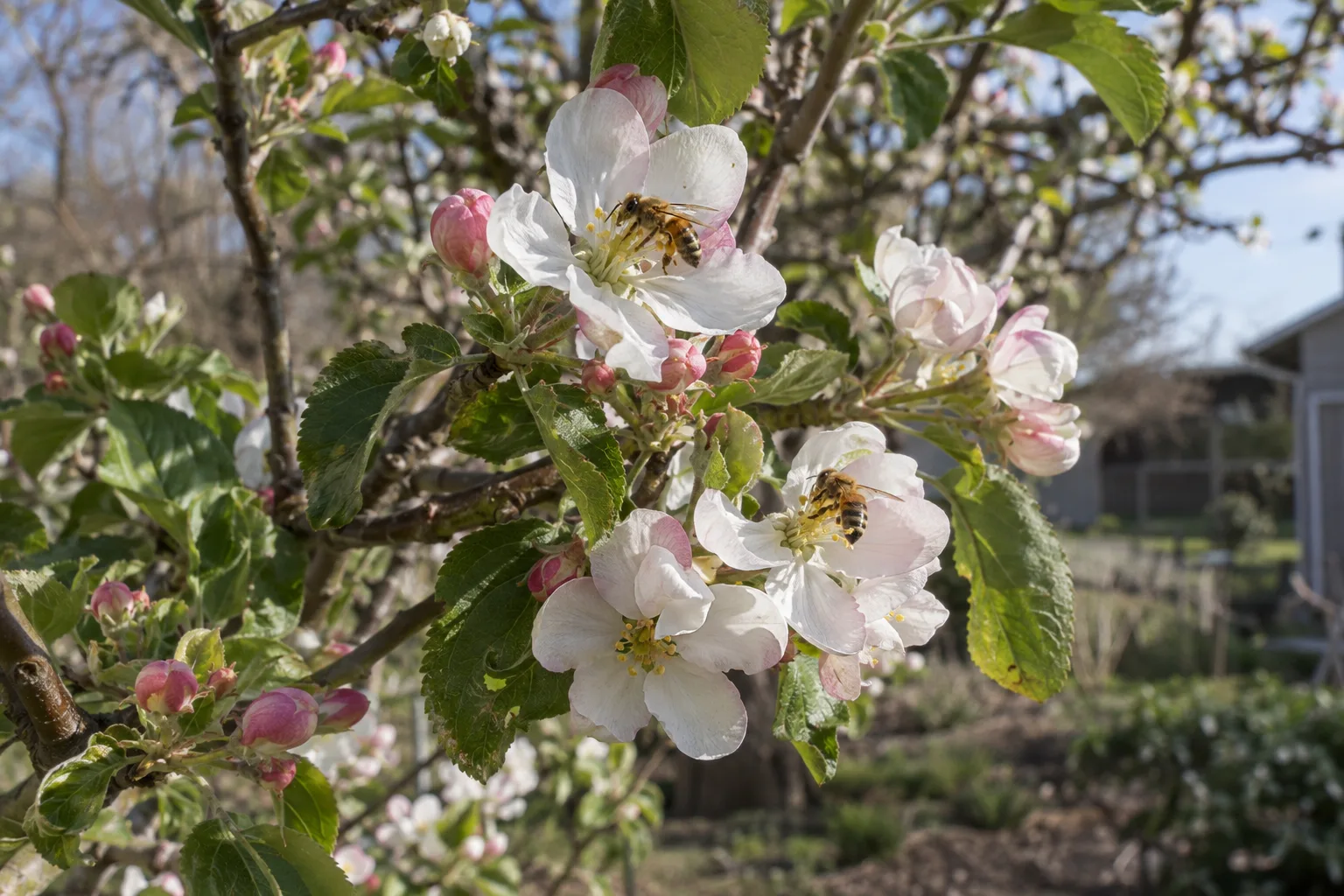
Skip the lowest corner of the yard. Cold air settles there on winter nights, and low-chill apples bloom early, often between late January and March. A late frost can kill open blossoms and cost you the year’s crop. Choose a spot with good drainage too, because apple roots sit poorly in standing water.
Space two trees close enough that bees can move easily between them. Unless you prune to keep it smaller, plan on a tree that reaches roughly 10 to 15 feet tall and wide.
When and how do I plant an apple tree in caliche and alkaline soil?
Plant between about November and February, when the weather is cool and the tree has months to build roots before summer. Soil here is usually alkaline, with a pH often between 7.5 and 8.5, and a layer of caliche (cemented calcium carbonate) may sit anywhere from a few inches to a few feet down.
You need a shovel, a digging bar or pick for caliche, compost, wood chip mulch, drip tubing and a hose. Test drainage first: dig the hole, fill it with water, and check it the next day. If water still stands after 24 hours, break through the caliche further or move the tree to another spot.
- Dig the hole as deep as the root ball and two to three times as wide.
- Break up any caliche at the bottom with the digging bar, then run the drainage test.
- Mix the native soil with a modest amount of compost, no more than about one quarter by volume. A very rich pocket in poor soil encourages roots to circle inside it.
- Take the tree out of its pot, loosen any circling roots and spread them outward.
- Set the tree so the bud union (the knobby graft scar) sits about 2 inches above the soil line. Never bury it.
- Backfill in stages, watering as you go to settle air pockets.
- Build a soil basin 4 to 6 inches high around the tree, wide enough to reach just past the root ball.
- Spread 3 to 4 inches of mulch, pulled back several inches from the trunk to prevent rot.
- Place drip emitters at the edge of the root ball, not against the trunk, and move them outward as the tree grows.
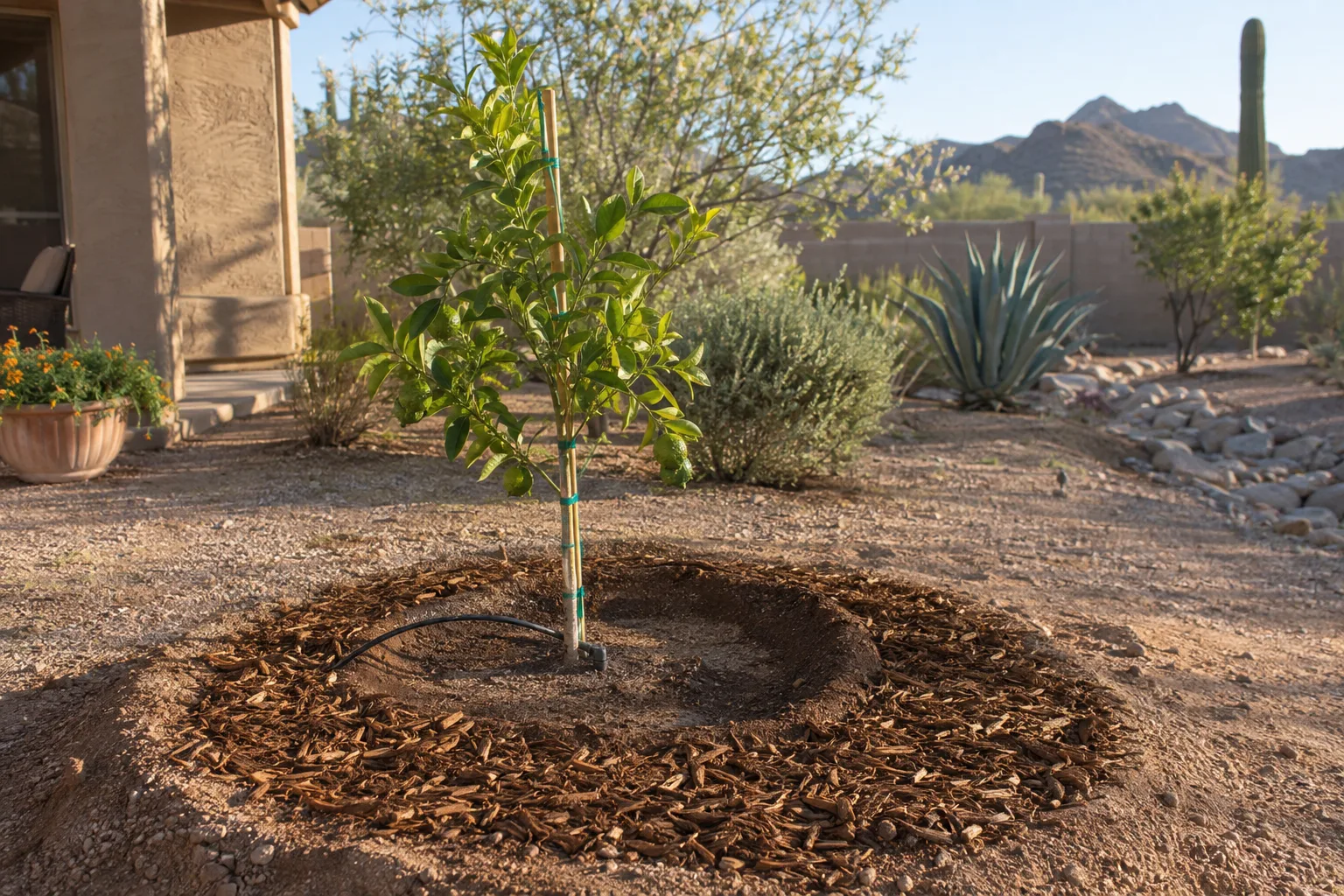
Hard irrigation water leaves salts in the soil over time. Every so often, give the tree a long, slow soaking to push those salts below the roots.
How often should I water apple trees in the low desert?
Water deeply, then let the top few inches of soil dry before watering again. Apples want steady moisture but suffer in soggy soil, and the right interval shifts with the season, your soil and the age of the tree.
| Season | Typical interval for an established tree | Notes |
|---|---|---|
| Winter (December to February) | Every 10 to 14 days | Dormant tree needs little. Skip a watering after rain. |
| Spring (March to May) | Every 5 to 7 days | Do not let the soil dry out during bloom and fruit set. |
| Summer (June to September) | Every 4 to 7 days | Check soil depth often when highs pass 110°F. Cut back after monsoon storms. |
| Fall (October and November) | Every 7 to 10 days | Taper off as nights cool. |
Treat these as starting points. Push a probe or screwdriver 6 to 8 inches into the soil near the drip line, and water when it comes out dry. A newly planted tree needs water more often than the table shows, since its roots have not yet spread.
During the monsoon, roughly July through September, let actual rain guide you. A single storm can soak the ground for days, and watering on top of it invites root rot. Our gardening calendars are a handy way to keep seasonal tasks like these on schedule.
How do I feed, prune and thin an apple tree here?
Feed lightly in late winter and again after fruit set, prune while the tree is dormant, and thin the young fruit in spring. Each step keeps a low-chill apple productive in our heat.
Feeding and yellow leaves
Use a fertilizer made for fruit trees, follow the label rate, and feed just before buds swell and again after the fruit sets. Skip feeding in fall, because new growth then can be damaged by a winter frost.
Yellow leaves with green veins point to iron chlorosis. Alkaline soil locks up iron that is already there. Apply EDDHA chelated iron to the soil, since this form stays available at high pH where other chelates break down. A foliar iron spray greens the leaves faster while the soil treatment works.
Pruning
Prune in late January or early February, before buds open. Aim for an open vase or modified central leader shape, and remove crossing branches and straight-up water sprouts. Light cuts are better than heavy ones.
Avoid hard summer pruning. Leaves shade the bark, and sudden exposure to 110°F sun causes sunscald, which shows as bleached, cracked patches. A coat of diluted white interior latex paint on exposed trunk and limbs is a common protection.
Thinning fruit
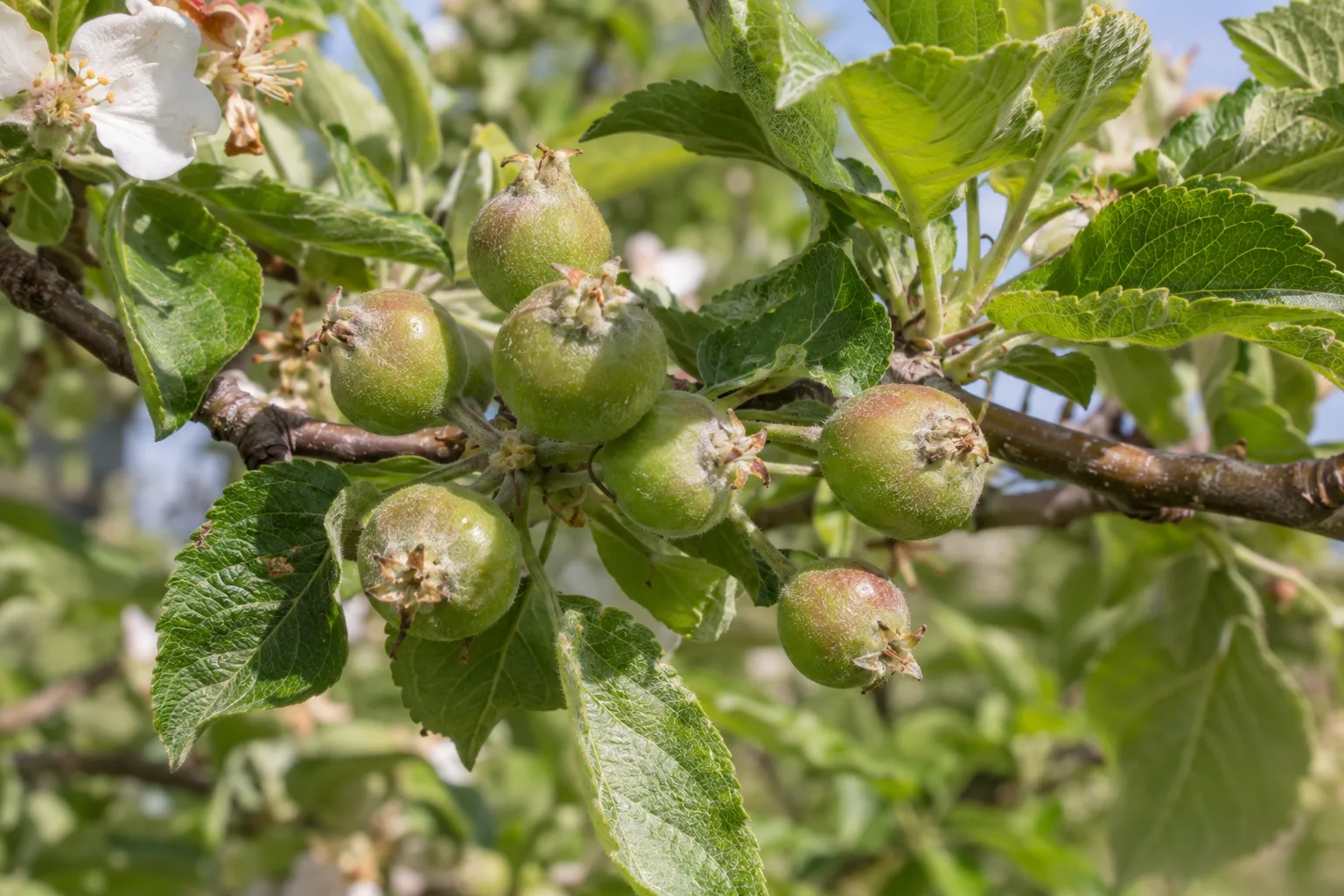
When the fruitlets are about the size of a marble, usually in spring, remove extras so only one apple remains per cluster, spaced several inches apart. Thinning gives larger fruit and prevents limbs from overloading.
What problems and mistakes cost gardeners their first apple tree?
Most failures trace back to a variety with too high a chilling need, poor drainage, overwatering during the monsoon, or bare bark in full summer sun. All four are avoidable at planting time.
- Buying a tree without checking its chilling hours.
- Planting into caliche without breaking through it.
- Burying the bud union.
- Putting the tree against a hot west wall.
- Watering shallow and often instead of deeply.
Pests are manageable if you catch them early. Spider mites favor hot, dry weather and leave stippled leaves with fine webbing. Aphids cluster on new growth. Codling moth larvae are the worm found inside apples, and borers go after stressed trees, so steady watering is your best defense.
Fire blight is a bacterial disease that blackens shoot tips so they look scorched. Cut affected wood well below the damage and disinfect your pruning tools between cuts. For any spray, read the label and check guidance from University of Arizona Cooperative Extension for Maricopa County before applying anything. Our classes and events are another place to ask questions in person.
Frequently asked questions
Do I need two apple trees to get fruit?
Plan on two, because Anna and Dorsett Golden set better fruit when they pollinate each other. Both bloom at about the same time in late winter, so bees can carry pollen between them. Ein Shemer is partly self-fertile and may give a modest crop alone. If you only have room for one tree, Ein Shemer is the safer choice.
Can I grow an apple tree in a container?
Yes, if the pot is large, roughly half-barrel size or about 20 to 25 gallons, and the tree is on dwarf rootstock. Containers dry out fast in summer and may need water every day or two. Move the pot into afternoon shade during the hottest months. Our pottery and planters section is a good place to look for a large pot with drainage holes.
When do low-chill apples ripen?
Low-chill apples such as Anna and Dorsett Golden usually ripen in late spring to early summer, roughly late May through June, before the worst of July heat. Dates shift with the year and variety. Pick when the fruit twists off the branch easily and the seeds have begun to darken. Ripe fruit left hanging in the heat softens quickly.
How long until a new tree gives apples?
Most young apple trees bear a small first crop about 2 to 4 years after planting, depending on rootstock and how well the tree has established. Dwarf rootstocks tend to fruit sooner than full-size ones. Thin off most of the early fruit so the tree puts its energy into roots and branches first.
Can I grow Honeycrisp or Fuji here?
Both are poor bets. Honeycrisp needs far more winter cold than the East Valley provides, so it blooms unevenly and gives little fruit. Fuji needs more chilling than the low-chill varieties and sits at the edge of what our winters supply. A variety rated for roughly 100 to 300 chilling hours gives you a much better harvest.
Are apples worth growing in the low desert?
Yes, if you pick a low-chill variety, plant it in winter, and manage drainage, water and iron. You get sweet, mild fruit in late spring, before summer heat peaks, plus a tree that gives some shade. Apples are not worth the effort if you want a tart, crisp fall apple like Honeycrisp, or if your only spot is a sun-baked west wall with no drainage. If you are unsure which variety suits your yard, visit us at the nursery in Queen Creek and we will talk it through.