
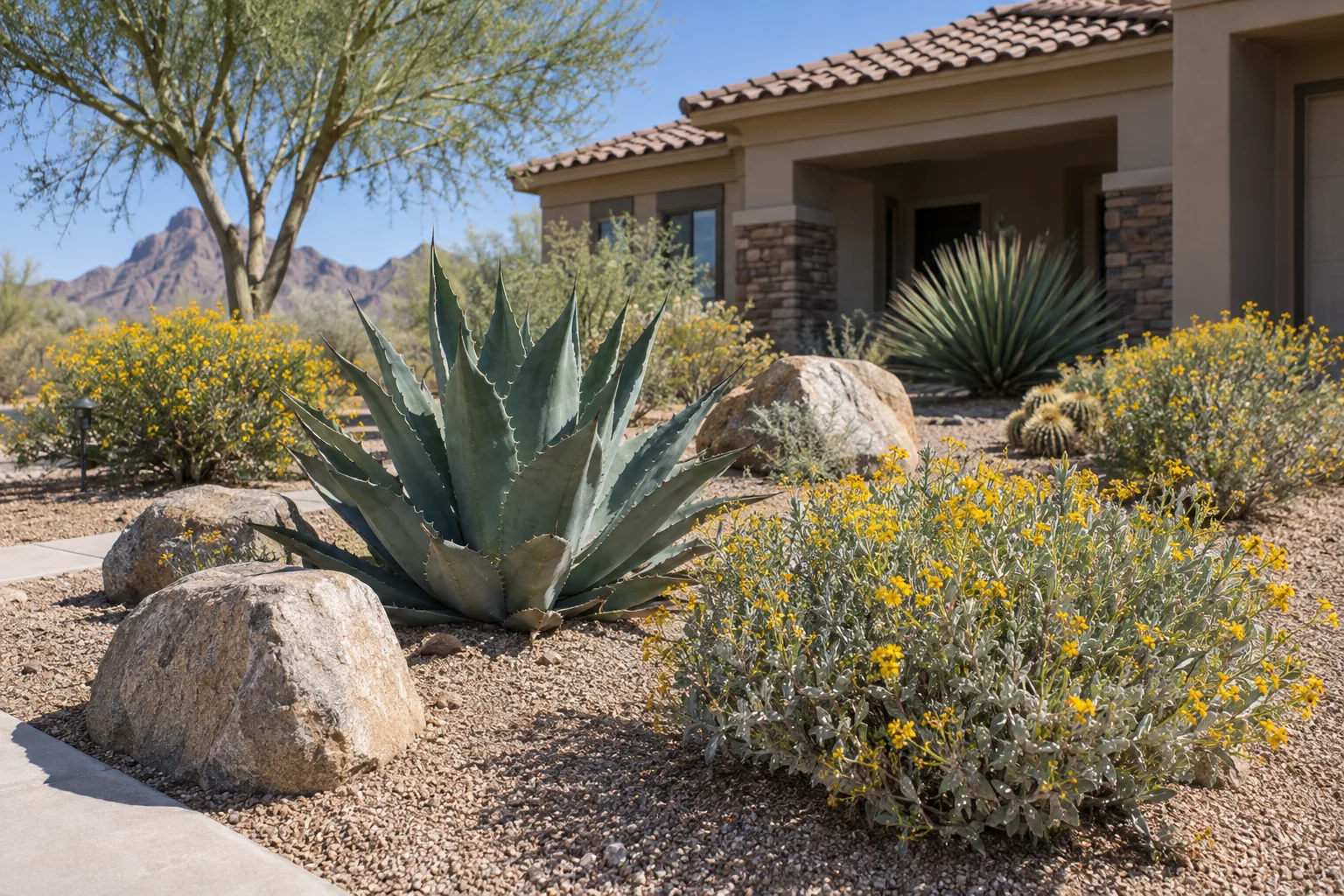
A gravel garden suits Arizona front yards because it uses far less water than a lawn, needs no mowing, and handles summer highs above 110°F. Plants supply the shade and color, and the gravel suppresses weeds and sheds monsoon runoff.
Key takeaways
- A planted gravel bed on drip irrigation often uses a fraction of the water a lawn does, once plants are established after one to two growing seasons.
- Spread 3 to 4 inches of gravel over ground graded 1 to 2 percent away from the house so monsoon runoff does not pool at the foundation.
- Plant in October through November or February through March, and avoid June and July, when highs can reach 115°F.
- Probe for caliche before you plant. If a rebar stake stops within 12 to 18 inches, break through the layer at each planting spot.
- Skip white marble chips, and think twice about large dark rock against west-facing walls, because both can add heat around nearby plants.
Why are gravel gardens so common in Arizona front yards?
They use far less water and labor than turf in a place that gets roughly 8 to 9 inches of rain a year. A lawn in the low desert needs frequent irrigation through summer highs above 110°F, while a gravel garden needs deep watering only at the plants.
There is no mowing, no edging and no fertilizer schedule. Plants do the rest, so a gravel garden is only as good as the planting inside it. Our plant department is a good place to sort out what fits your sun exposure and the space you have.
How much water does a gravel garden save?
A converted yard usually saves most of the water a lawn used, though the exact amount depends on your plants and your drip schedule. Estimates for turf in the low desert run into tens of thousands of gallons per 1,000 square feet each year, and a planted gravel bed on drip often uses well under half of that.
New plants are the exception. Most need regular watering for the first one to two growing seasons while their roots reach into native soil, and trees take longer. After that, taper to deep, infrequent soakings. Hard water leaves mineral crust in emitters, so check them each spring.
Which gravel is best for a front yard?
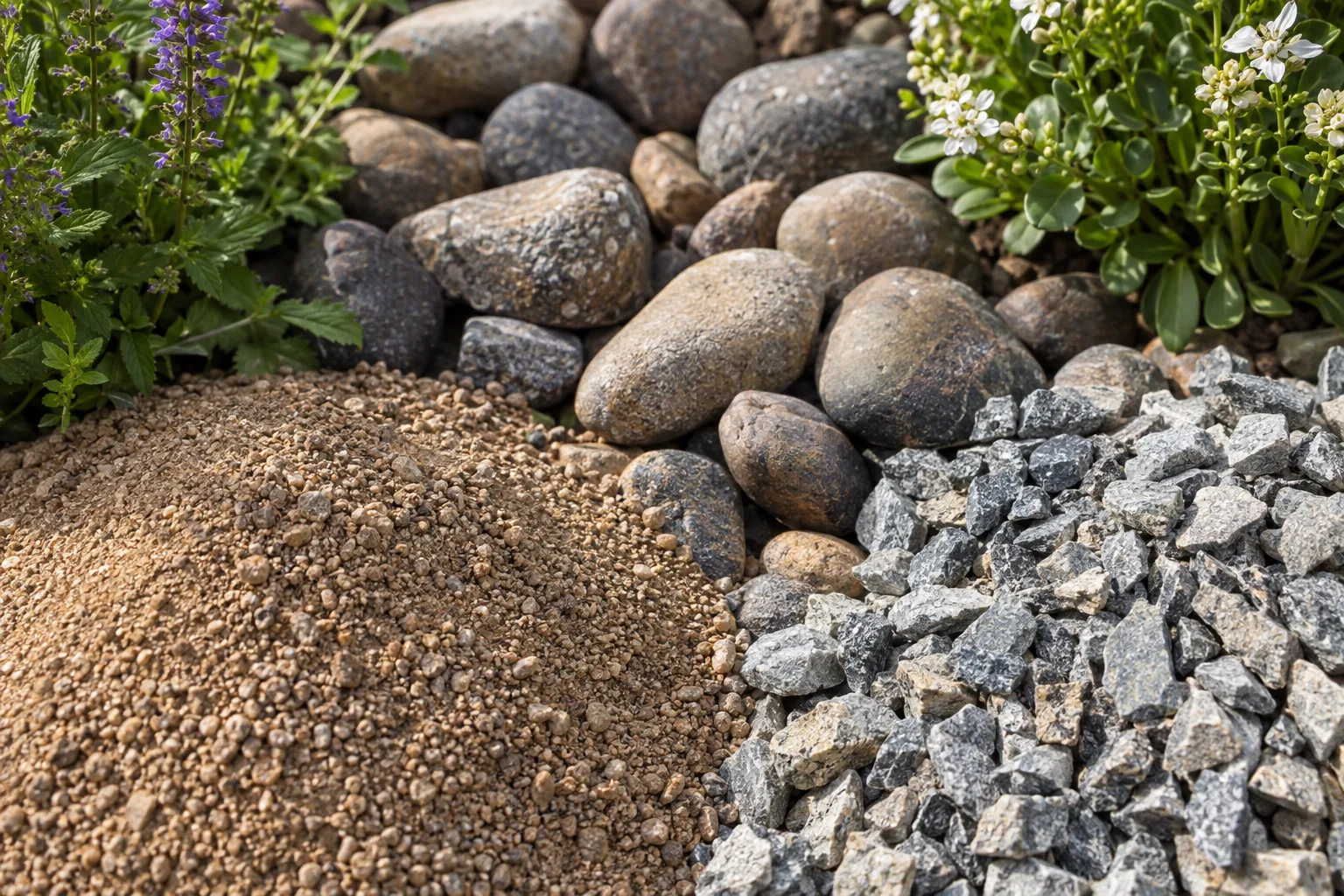
Decomposed granite suits most front yards because it packs firm underfoot, drains well and blends with desert plant colors. The other common choices each have a specific job.
| Gravel type | Look | Best use |
|---|---|---|
| Decomposed granite | Fine, sandy, tan to reddish-brown | Main surface, paths, planting beds |
| River rock | Rounded, mixed colors, 1 to 3 inches | Dry riverbeds, borders, accents |
| Crushed granite | Angular, tan to gray | Higher-traffic areas and edges |
| Pea gravel | Small, smooth, neutral | Seating areas and transitions |
Most designers use decomposed granite as the base and add river rock or boulders for contrast. White marble chips bounce intense light and heat onto low plants. Dark rock soaks up heat, so use it sparingly where a west-facing wall already bakes the bed in the afternoon.
Which plants work in a gravel garden?
Choose plants adapted to the low desert and mix three heights: ground covers and perennials at 1 to 2 feet, shrubs at 3 to 5 feet, and a tree or tall accent at 8 feet or more. These are varieties we commonly carry, though availability changes week to week and season to season.
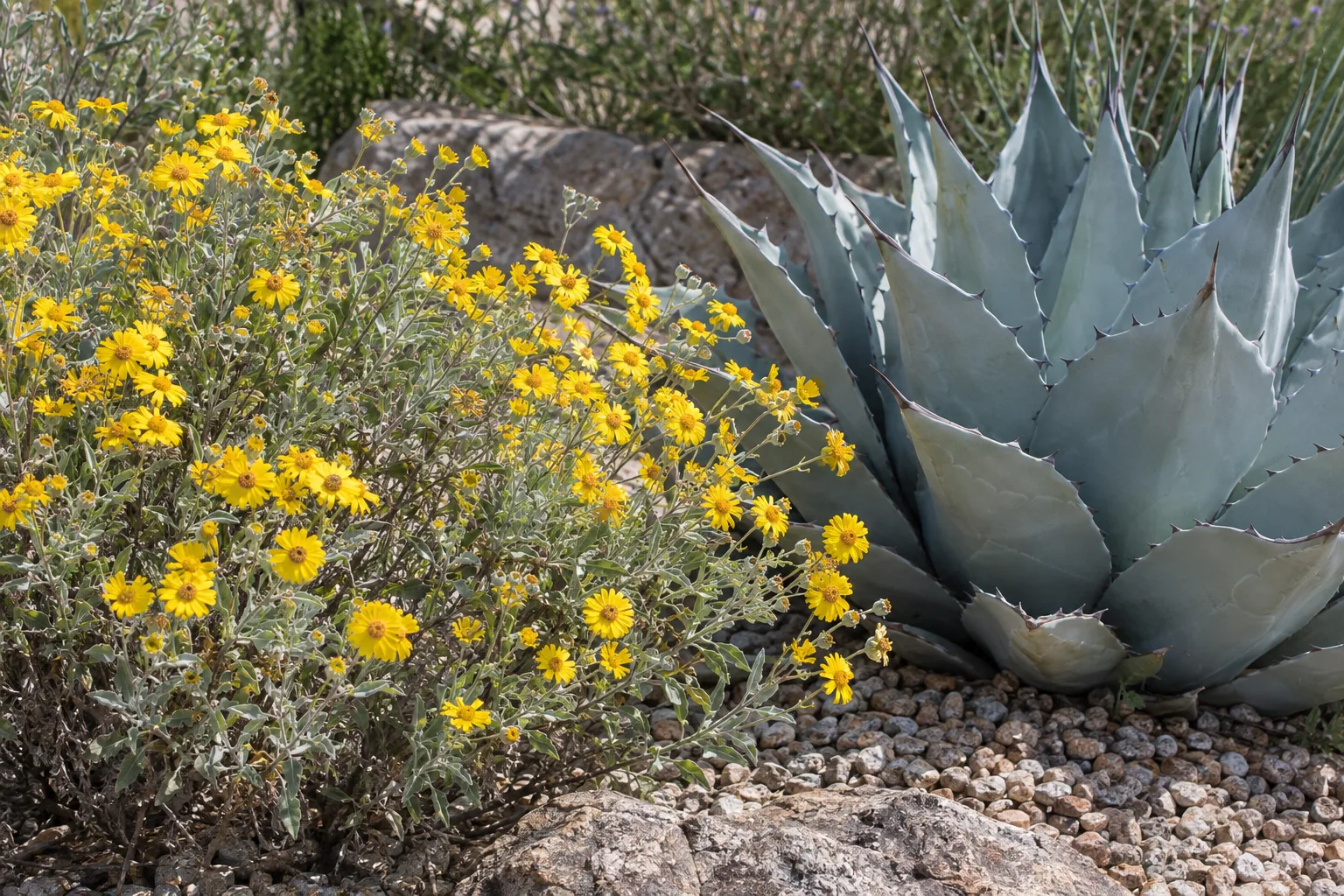
- Agave americana (century plant) forms a blue-gray rosette that can reach about 6 feet across. It flowers once, then the main plant dies, and offsets around the base carry on.
- Agave parryi stays more compact and symmetrical, which suits smaller beds.
- Encelia farinosa (brittlebush) covers itself in yellow daisies from roughly February through May and loses leaves in summer drought.
- Baileya multiradiata (desert marigold) blooms for long stretches in cool weather and reseeds through gravel.
- Salvia greggii (autumn sage) blooms in spring and fall and tolerates heat well with some afternoon shade.
- Opuntia (prickly pear) gives flat pads and spring flowers, and its spines make it a poor choice beside walkways.
For shade, look at palo verde or mesquite from our desert trees selection. Mesquite roots can lift paving, so give it room. Plant in groups of three or five, and space each plant for its mature width rather than its size in the pot.
When is the best time to build a gravel garden in Arizona?
October through November and February through March are the best windows, because roots establish while soil temperatures are mild. June and July are a poor choice, since new plants and bare roots face 115°F afternoons with very little tolerance for transplant stress.
You can strip sod and grade in any cool month. Plan the planting to land in the windows above. Our gardening calendars help you line up each step with the season. Frost is occasional here, so cover frost-tender succulents on nights forecast near freezing.
How do I install a gravel garden?
Remove the lawn, deal with the soil and drainage, plant, then add gravel last. You need a sod cutter (rentable), a rebar probe, a shovel and rake, drip tubing with emitters, and enough gravel for a 3 to 4 inch layer.
- Locate your irrigation lines and shut off the lawn circuit. Some lines can be reused for drip.
- Remove the grass and roots to about 2 inches deep. Dead turf left in place decomposes unevenly under the gravel.
- Probe the soil with a rebar stake at several points. Caliche is a hard calcium carbonate layer, and if you hit it within 12 to 18 inches, break through it where each plant will go, using a chisel bar or a rented breaker.
- Grade the surface 1 to 2 percent away from the foundation, and route low spots toward the street or a basin.
- Dig each planting hole two to three times as wide as the root ball. Backfill with native soil rather than a rich amended pocket, so roots keep spreading outward.
- Run 1/2-inch mainline with emitter lines to each plant. Use two emitters per shrub and more for trees, starting 12 to 18 inches from the trunk or crown.
- If you use landscape fabric, choose a commercial-grade woven product, overlap seams by 6 inches and cut X-shaped slits for plants.
- Set plants at the same depth they sat in the pot and water them in well.
- Spread 3 to 4 inches of gravel and keep it off stems and cactus bases.
- Set boulders last with about one-third buried, in clusters of two or three.

What mistakes ruin a gravel garden?
Most failures trace back to soil and water, not the gravel. Each of these is easy to avoid if you plan before you dig.
- Planting too close. A young brittlebush looks small but can spread 4 to 5 feet wide.
- Using thin plastic sheeting. It breaks down in a year or two under desert sun.
- Spreading gravel only 1 to 2 inches deep. It sinks into the soil and lets weeds through.
- Overwatering established plants. Taper irrigation once roots are settled, or roots rot.
- Ignoring monsoon runoff. A flat bed with no grade holds water against the house.
- Skipping the caliche check. Water collects above the hardpan like a bathtub.
Alkaline soil, often pH 7.5 to 8.5 here, can lock up iron. If leaves turn yellow while the veins stay green, that is iron chlorosis, and a chelated iron product applied in early spring often corrects it within a few weeks.
How much maintenance does a gravel garden need?
A gravel garden needs a few hours of work each season, far less than a lawn, but it is not maintenance free. The calendar below keeps the work small.
- Fall: add new plants, and top up gravel that has thinned from foot traffic or wind.
- Winter: cut drip run times, since established plants need little water below 65°F.
- Spring: remove weeds before they seed, deadhead for longer bloom and check emitters for mineral clogs.
- Summer: keep young plants on schedule, clear monsoon debris, and hold off on heavy pruning.
Wind-blown seeds still sprout on top of gravel, even over fabric. Pull weeds while they are small, ideally when soil is damp after rain. Check our classes and events page for upcoming workshops.
Frequently asked questions
Will a gravel garden make my yard hotter?
Not noticeably compared with a lawn, though it is warmer than turf at midday and cooler than concrete. Shade is the fix. A canopy tree over part of the gravel lowers surface heat, and keeping dark rock away from west-facing walls prevents hot pockets in the afternoon.
Can a gravel garden have color?
Yes, and the bloom calendar follows the cool seasons. Brittlebush, desert marigold, globe mallow, penstemon and autumn sage bring color roughly February through May and again in October and November. Mix species with staggered bloom times, and you can have something flowering for much of the year.
Are there rebates, permit rules or HOA limits?
It varies, so ask before you remove anything. Many East Valley cities and utilities have offered turf removal programs, but amounts and rules change and some require approval first. HOAs often set rules on rock color and plants. Check with your city about permits for grading or walls.
How do I keep weeds out long term?
Use proper gravel depth, careful installation and regular hand pulling. Gravel of 3 to 4 inches blocks most seedlings, and pulling weeds when small takes minutes. If you consider a pre-emergent herbicide, read the label, apply it only as directed and check which plants it is safe around.
Is a dry riverbed worth adding?
Yes, if you have runoff to move. A winding band of river rock, roughly 18 to 24 inches wide, can guide monsoon water away from the house while adding texture. Plant native grasses and desert perennials along its edges so it looks natural rather than like a drainage ditch.
Is a gravel garden right for your front yard?
A gravel garden is a good fit if you want lower water use, no mowing and a yard that looks designed year-round. It suits sunny front yards where you can commit to drip irrigation and a couple of years of establishment care. Skip it if you need soft turf for kids or pets to play on, or if you will not check irrigation. Come visit us in Queen Creek and we will help you plan the planting.