
The most common grapevine mistakes in Arizona are picking a cool-climate variety, planting in spring, watering too shallowly, skipping caliche work, pruning at the wrong time, ignoring summer sun and building a weak trellis. Each one is avoidable.
Key takeaways
- Plant dormant bare-root vines from January to mid-February so roots settle before summer highs pass 110°F.
- Choose low-chill, heat-tolerant table grapes such as Thompson Seedless, Flame Seedless or Perlette over cool-climate Concord types.
- Water deeply enough to wet the soil 18 to 24 inches down, and break through caliche before you plant.
- Prune in winter while the vine is dormant, and shade young trunks from afternoon sun in June and July.
- Build the trellis before planting, strong enough to carry a full canopy through monsoon gusts from July to September.

Which grape varieties do well in the Arizona low desert?
Low-chill, heat-tolerant table grapes (Vitis vinifera) such as Thompson Seedless, Flame Seedless, Perlette and Black Monukka have a long record in desert gardens. Cool-climate grapes like Concord are the usual mistake, because they want colder winters and milder summers than Queen Creek provides.
Grapevines need a stretch of winter cold, measured in chill hours, to break dormancy and set fruit evenly. East Valley winters deliver fewer chill hours than the regions where Concord was bred, and summer highs above 110°F stress varieties that evolved for gentler heat. Ask about a variety’s chill requirement and heat tolerance before you buy, rather than trusting the plant tag alone.
For a wine or dual-purpose grape, Muscat of Alexandria, Grenache and Carignan are commonly grown in hot, dry regions. Availability of vines changes week to week and season to season, so start with our fruit tree department and ask what is on hand. Ask first, then buy.
When should I plant grapevines in Queen Creek?
Plant bare-root grapevines while they are dormant, from January through mid-February. That window gives the roots about four months of mild weather to spread before triple-digit heat arrives in late May and June.
Planting in March or April is the common error. A young vine with a small root system and a new flush of leaves loses water faster than it can replace it, and its first summer becomes a struggle for survival. Dormant bare-root vines tend to establish quickly, and they skip much of the transplant shock that a leafed-out vine faces in warm soil.
If you miss the window, waiting for the next winter usually beats planting into spring heat. Our gardening calendars lay out the planting seasons for the low desert so you can mark the dates ahead of time.

How often should I water a young grapevine in Arizona?
Water young grapevines deeply and less often, wetting the soil to roughly 18 to 24 inches at each irrigation. Frequent shallow watering keeps roots near the surface, where heat and drying hit hardest, and it never trains them to go deep.
Use drip irrigation with emitters a foot or so from the trunk, then move them outward as the vine grows. A common starting point for first and second summers is a deep soak every 7 to 10 days, with longer gaps in winter. Treat that as a starting point and adjust to your soil. Sandy soil drains fast and needs more frequent watering, while heavy clay holds moisture and can rot roots if you overdo it.
Check the soil instead of trusting a timer. Push a long screwdriver or soil probe down 12 inches a day or two after watering. If it slides in easily and comes out cool and damp, the schedule is working. Dry and hard means water longer, and soggy means wait.
How do I prepare alkaline soil and caliche for grapes?
Dig a planting hole at least 24 inches wide and deep, break through any caliche, and mix compost into the backfill. Native soil here is alkaline and often sits on a layer of caliche, a cement-like hardpan that holds water above it and suffocates roots.
Test drainage before you plant by filling the hole with water. If it is still standing after a day, a hardpan or dense clay layer is trapping it, and you need to keep digging with a digging bar or get help. Mixing in roughly one part compost to two parts native soil is a common recommendation for backfill. Avoid pure potting mix, which breaks down quickly in the heat.
Grapes tolerate alkaline soil better than many fruit plants, yet local pH commonly runs from 7.5 to 8.5, and iron chlorosis can still show up. The sign is yellow leaves with green veins. A chelated iron product made for alkaline soil can help, and a soil test through the University of Arizona Cooperative Extension or a soil lab tells you what you are working with. Finish with 3 to 4 inches of mulch kept several inches off the trunk.
When should I prune grapevines in Arizona?
Prune in winter while the vine is dormant, typically January into February, before the buds begin to swell. Grapes fruit on new shoots that grow from buds on last year’s canes, so most of last year’s growth needs to come off each year.
The mistake runs in two directions. Some gardeners never prune because they fear cutting too much, and the vine becomes a tangle that blocks airflow and fruits poorly. Others prune late, after growth has started, and waste the vine’s stored energy.
Leave short spurs with 2 to 3 buds each on the canes you keep, and make clean cuts with sharp loppers or pruners. Stubs die back and give disease an entry point. At planting, cut a bare-root vine back to 2 to 3 buds so it puts its energy into roots first. Our classes and events page is worth checking for upcoming workshops on fruit care.

How do I protect grapevines from summer sun damage?
Shade the trunk and the developing clusters from direct afternoon sun in June and July. Sunscald shows up as bleached, cracked bark on the south and west side of the trunk, and exposed fruit can shrivel or drop before it ripens.
Let the canopy fill in on the south and west sides during summer instead of stripping leaves, since those leaves shade the fruit and wood beneath. On young vines, paint the lower trunk with white interior latex paint thinned with water to reflect heat. A 30 to 40 percent shade cloth over the trellis during the first one or two summers also helps. Take it down by late September so ripening fruit gets full sun.
Established vines with deep roots and a full canopy usually need less help. Young ones need it most.
What kind of trellis can handle a full grape canopy and monsoon wind?
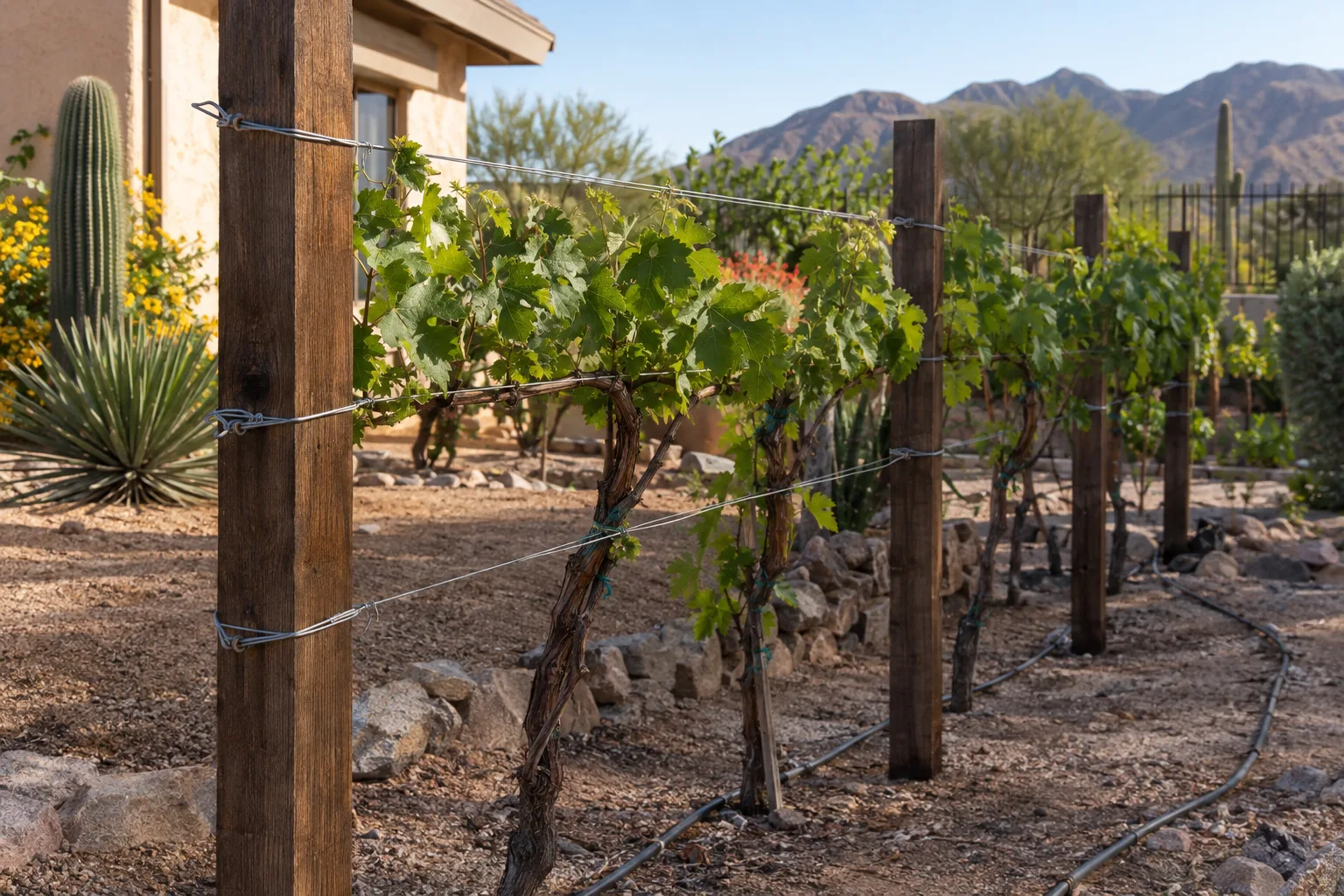
A trellis with sturdy 4×4 wooden or heavy-gauge galvanized steel posts, set deep and spaced no more than about 8 feet apart, holds up best. Build it before you plant, because a mature vine carries a heavy load of leaves and fruit and catches monsoon gusts like a sail.
Set posts at least 30 inches deep, deeper in sandy soil, and brace the end posts diagonally. Run 12-gauge galvanized wire tight between posts, using one to three levels depending on how you train the vine. A single T-post and a strand of wire suits only a first-year vine.
For an overhead ramada or pergola, confirm that the structure can support the weight of a fully leafed vine, which can be substantial. Check wire tension each late winter before growth starts, and re-tighten anything that sags.
Frequently asked questions
How long until a grapevine produces fruit in Arizona?
Expect a small crop in the second or third year and a fuller harvest by year three or four. Remove any flower clusters that form in the first year so the vine builds roots instead of fruit. Patience in the early years pays back with a stronger, longer-lived vine.
Do grapevines need frost protection in the East Valley?
Dormant grapevines rarely need protection, because the wood tolerates our winter lows. The risk is a late frost after buds open and new green shoots appear in late winter or early spring. Cover the vine overnight with frost cloth when the forecast drops to 32°F or below, and remove it the next morning.
When do table grapes ripen in the low desert?
Ripening depends on variety, but early types such as Perlette can be ready in late May or June, while others follow through summer. Taste grapes from different parts of the cluster instead of judging by color. Ripe fruit should taste sweet, not starchy or sour at the center, and clusters ripen unevenly.
Do grapevines lose their leaves in winter here?
Yes, grapevines are deciduous and drop their leaves in late fall or early winter, then sit dormant until spring. That cycle is useful over a ramada or patio, because the full summer canopy shades you in the heat and bare winter canes let the low sun through.
What if I miss the January planting window?
Wait for the next dormant season instead of planting into March or April heat. Vines planted late face a hard first summer with little root growth behind them. Meanwhile, you can build the trellis and prepare the soil. Contact us if you want to ask what is available.
Are grapevines worth growing in a Queen Creek yard?
Yes, if you have a sunny spot, room for a sturdy trellis and the patience to wait three or four years for a full crop. A well-placed vine gives summer shade and fresh fruit. Skip grapes if you cannot give them deep, regular watering, if your yard has unbroken caliche you are unwilling to dig through, or if you want fruit in the first year. Stop by the nursery in Queen Creek and we will help you choose a variety and a spot.