

The garden bed designs Arizona landscapers rely on are raised or built-up beds, curved borders 3 to 5 feet wide, and island beds around an anchor plant, all planted in amended soil with drip irrigation and 3 to 4 inches of mulch.
Key takeaways
- Raise beds 8 to 12 inches above grade where caliche sits close to the surface.
- Keep curved borders 3 to 5 feet wide so you can reach the back row without stepping in.
- Plant from mid-September through October or from February through April, so roots settle before summer highs above 110°F.
- Install drip irrigation before planting and cover the soil with 3 to 4 inches of mulch, held about 3 inches back from stems.
- Set the top of the rootball level with or slightly above the surrounding soil.
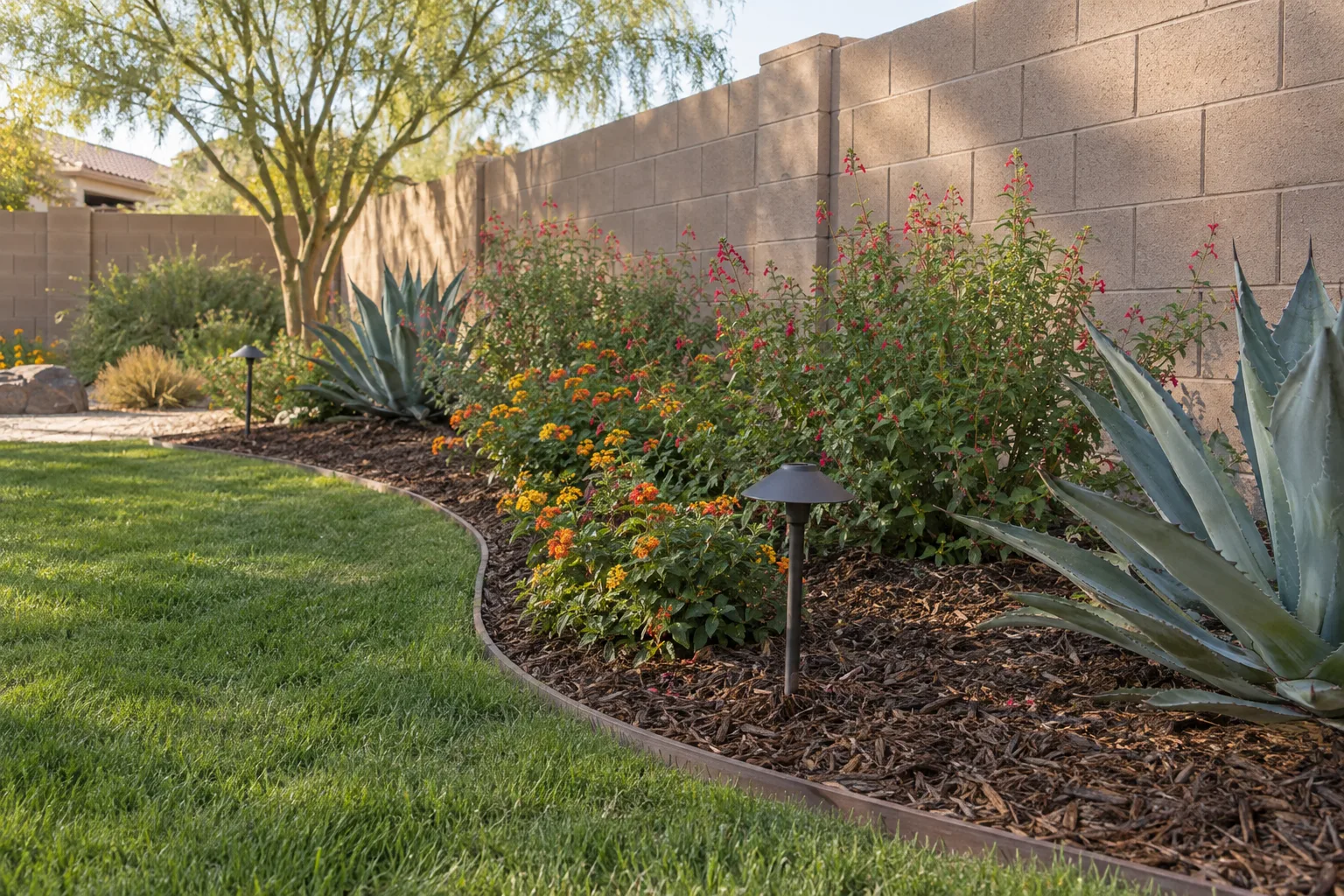
Which garden bed layout works best in the low desert?
It depends on the spot: raised beds suit caliche and slow drainage, curved borders suit walls and fences, and island beds suit open gravel or turf areas. Once the shape is settled, our plants department is the place to browse for shrubs, perennials and groundcovers. Shape comes first.
Raised beds
Raising a bed 8 to 12 inches above grade lifts roots over caliche, drains faster during monsoon downpours and lets you control the soil mix. Block or decomposed granite borders handle UV and heat better than wood. Cedar or composite lumber works, though you should plan to replace it sooner than block.

Curved in-ground borders
Curves along a wall, fence or property line soften hard block and concrete, and they blend gravel, turf and planted areas into one look. Keep them 3 to 5 feet wide so you can reach the back row without stepping in and compacting the soil.
Island beds
An island bed sits in open ground and gets seen from every side, so it needs an anchor in the middle, mid-height shrubs around it and low groundcovers at the edge. A small tree from our desert trees, such as desert willow (Chilopsis linearis), casts dappled shade over the plants beneath it.
When should I build a new garden bed in Queen Creek?
Build and plant in fall, from mid-September through October, or in spring from February through April. Fall gives roots the whole mild season to settle before summer highs pass 110°F. Spring plantings need time to root before June.
Frost-tender plants such as bougainvillea go in after the last frost, usually from March on. Avoid building beds from June through August, when heat stress on plants and on you is highest. Our gardening calendars list what to plant by month, and the University of Arizona Cooperative Extension publishes planting calendars for Maricopa County.
What do I need before I start?
You need a short list of tools and materials, plus a soil test. Gather these before the first shovel goes in:
- Garden hose for marking the outline
- Cardboard, enough for four layers over the footprint
- Soil pH test kit
- Digging fork, and a mattock if you may hit caliche
- Compost, plus sulfur if your test calls for it
- Drip tubing and emitters
- Mulch and edging
Test the soil first. Many East Valley yards are alkaline, often with a pH of 7.5 to 8.5, which ties up iron and turns new leaves yellow between the veins (chlorosis). Add sulfur only at the label rate and only if the test shows you need it.
For in-ground beds, mix about 4 inches of compost into the top 12 inches of native soil. For raised beds, a fill of roughly 60% screened topsoil, 30% compost and 10% coarse sand or perlite holds water without turning to mud. Avoid 100% potting mix, which dries fast and pulls away from the bed walls, letting water run around the roots instead of through them.
How do I build a garden bed step by step?
Mark the shape, clear the ground, loosen and amend the soil, lay drip lines, plant the tallest plants first, then water and mulch. The order matters, because drip lines are much easier to place before plants are in the ground.
- Lay a garden hose on the ground to mark the outline. Look at it from the street and from inside the house, and adjust until the proportions look right.
- Clear existing weeds, or smother them with four layers of wet cardboard that break down over a few months.
- Probe the area with a metal rod. If it stops hard within about 12 to 18 inches, you have caliche, so break through a thin layer with a mattock or build the bed up over a thick one.
- Loosen the top 12 inches with a digging fork and pull out rocks bigger than a golf ball.
- Spread compost and any other amendments, work them in, and water the bed well to settle it.
- Lay drip lines along the planting rows before any plant goes in, then run the system to check coverage.
- Set each plant, still in its pot, where it will go. Start with the tallest and work toward the front edge.
- Dig each hole twice as wide as the rootball and no deeper. The top of the rootball should sit level with or slightly above the soil around it.
- Backfill with native soil mixed with some compost, water deeply, water again two days later, then add mulch.
Which plants work well in a low desert garden bed?
Combine one or two structural plants, a few flowering shrubs and low fillers, and choose varieties that handle alkaline soil and reflected heat. These are varieties we commonly carry, though availability changes week to week and season to season.
Structure
Agave americana gives a bold rosette that reads from across the yard and needs little water once established. Give it room and keep it back from walkways, because the spine tips are sharp. Bougainvillea adds magenta, orange or coral color against a block wall, tends to bloom best when watered on the lean side, and needs frost protection in cold winters. Salvia greggii (autumn sage) grows 2 to 3 feet tall and blooms in red, pink or white for months.
Color and fillers
Lantana spreads to fill space and blooms from spring into fall, dying back in a hard freeze but usually returning from the roots. Desert marigold (Baileya multiradiata) is a native wildflower with yellow blooms that self-seeds into gaps. Pentas (Pentas lanceolata) keeps flowering through July heat and draws butterflies and hummingbirds.
For cool-season color from October to April, look at our annual flowers and foliage, such as African daisies (Osteospermum), snapdragons and pansies. They fill space between permanent shrubs and tolerate light frost.
A combination that holds together
Pair fine textures with bold ones. Red bougainvillea at the back, golden barrel cactus (Echinocactus grusonii) in the middle and trailing pink verbena along the front edge give three different shapes, and all three prefer soil that dries between waterings. Warm palettes of red, orange and yellow read as a unit from the street, while blue salvia, purple ruellia and white penstemon calm a shaded patio.

How should I water and mulch a new bed?
Use drip irrigation, water deeply and infrequently, and cover the soil with 3 to 4 inches of mulch. New plants need steady moisture for the first one to two summers, after which established desert shrubs often manage on watering about every 7 to 10 days in June and July. Summer annuals such as pentas may need water every 2 to 3 days in peak heat.
Place emitters 6 to 12 inches out from the trunk, not at the base, so roots grow outward. Keep mulch about 3 inches back from stems to prevent crown rot. Organic mulch suits planting areas, and decomposed granite suits the edges. Mulch slows evaporation and keeps roots cooler.
A bougainvillea that droops at 2 p.m. in July is often reacting to heat. Push a finger 2 inches into the soil before watering, and if it is damp, wait.

Which edging holds up in the heat?
Steel and concrete edging hold up best, with stacked flagstone a good natural option. Materials expand and contract between winter nights near freezing and summer days at 115°F, and that cycling cracks, warps or heaves anything that is not built for it. Plastic is the weak link.
- Galvanized or powder-coated steel keeps clean lines through temperature swings and does not crack.
- Poured concrete mow strips, 4 to 6 inches wide, separate beds from turf and need little upkeep.
- Stacked flagstone, two to three layers high, gives a natural raised edge for desert-style beds.
- Thin plastic edging is the one to skip, because UV breaks it down within a few years and it heaves as soil moisture changes.
What mistakes should I avoid with a new garden bed?
The most common mistake is overwatering plants that only look stressed. Midday drooping in July is a normal heat response, and adding water to damp, dense soil invites root rot. Check the soil before you reach for the hose.
Planting too deep comes second. A rootball set below grade can stay wet around the crown in slow-draining soil, and crown rot follows. Keep the top level or slightly high.
Choosing plants from national lists is third. A plant rated for Zone 9 may have been tested in coastal California or Texas, where summers are warm but milder than ours, so look for plants proven in local yards. Skipping the soil test and the mulch comes last, and both cost you later in yellow leaves and extra watering.
Frequently asked questions
How deep should a raised garden bed be?
Eight to 12 inches of improved soil suits most shrubs and perennials, because roots grow down into the native soil once they pass the fill. Vegetables do better in 12 to 18 inches of full mix, especially over caliche. Deeper beds also hold steadier soil temperatures, which helps in July.
Can I have flower color in July and August?
Yes, if you pick heat-tolerant plants. Pentas, vinca, portulaca, gazania and gaillardia keep blooming through summer, and Turk’s cap (Malvaviscus) and firebush (Hamelia patens) flower for months in the warm season. Expect bold, warm colors, and water them deeply under a layer of mulch.
Do established desert plants still need water?
Yes, though far less often. Established shrubs still want a deep soak in summer, and agave and cactus can go longer, roughly every 2 to 3 weeks in the hottest months. Winter needs drop to about once a month or less. Adjust for your soil and exposure.
What mulch works best in a garden bed?
Organic mulch such as shredded bark or wood chips suits planting beds, because it breaks down and improves the soil over time. Decomposed granite suits pathways and perimeters. Apply either 3 to 4 inches deep, keep it off plant stems, and top it up each year as it settles.
Is a built-up garden bed right for your yard?
Yes, if you have caliche, slow drainage or soil you want to control, because a raised or built-up bed addresses all three. Skip it if your yard already has deep, loose soil that drains well, since an amended in-ground border takes less work. Either way, the bed needs drip irrigation and a yearly mulch refresh, and a bed you will not maintain struggles by July. Come visit us in Queen Creek, and we will help you match plants to your spot.
