
To stop ants in your Arizona garden, find where they nest, fix irrigation leaks, use slow-acting bait the workers carry to the queen, and block trunk access to aphids on citrus. Start in late February or March, before colonies peak.
Key takeaways
- Start in late February or March, when soil warms and foraging picks up, because colonies are easier to reduce before they peak in April and May.
- Slow-acting bait carried back to the nest reaches the queen, while contact sprays kill only the workers you can see.
- Fix drip leaks and shorten irrigation runs first, since constantly damp soil near roots invites nesting.
- Put a sticky barrier on a paper or tree-wrap band around citrus trunks (never directly on the bark) to cut off ants that tend aphids in the canopy.
- Read and follow the label on every product, and keep baits and drenches away from edible roots and open flowers.
Why do ants get so active in spring in the low desert?
Ants speed up in spring because the soil warms and food sources multiply. Our winters rarely freeze hard enough to wipe out a colony, so nests slow down from December through February and then ramp up as soil temperatures climb, usually from late February into March in the East Valley.
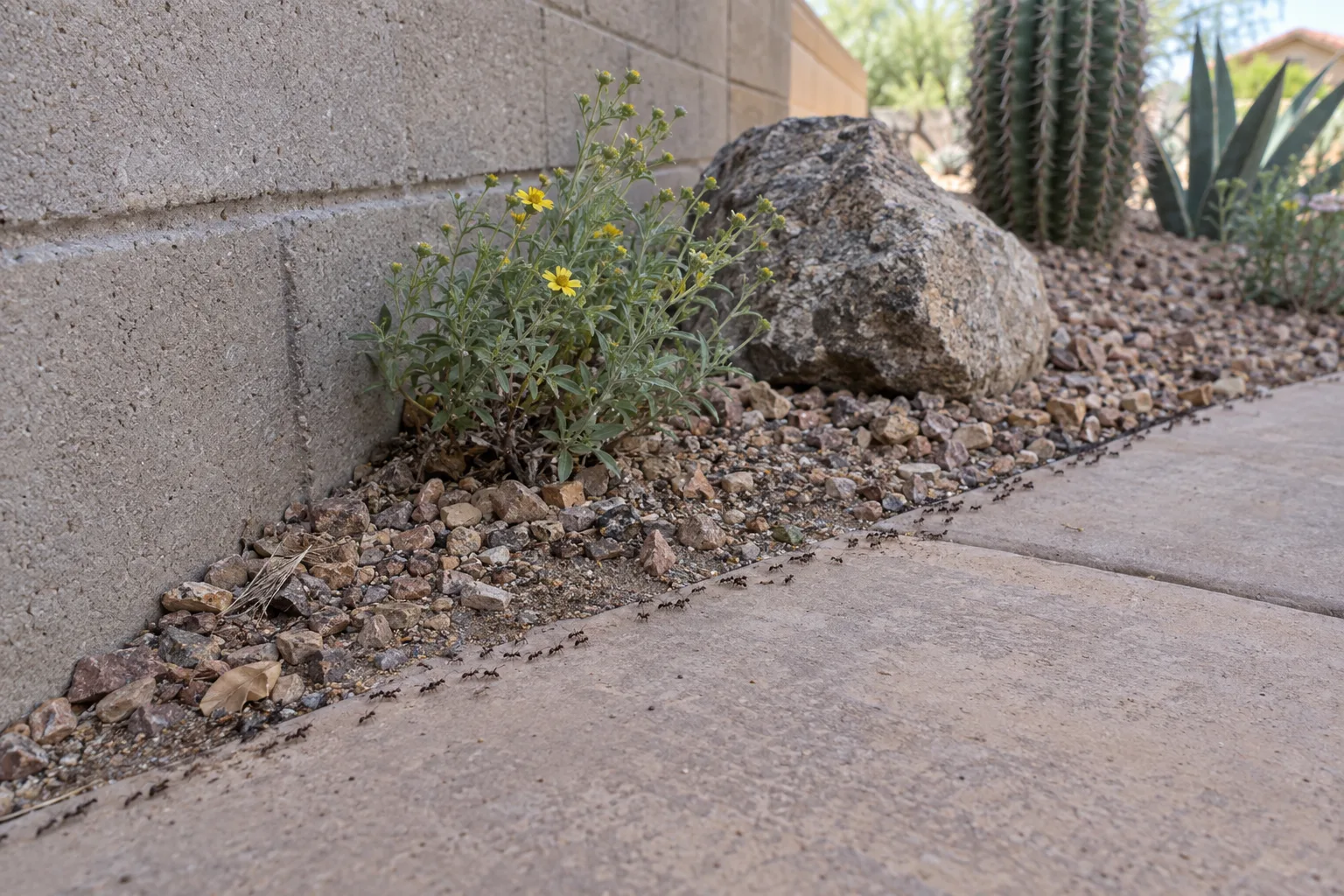
New growth brings soft, tender stems, and soft stems bring aphids. Ants feed on the sweet honeydew aphids produce, so a flush of spring growth pulls foragers into your beds and onto your trees. Many species also send out winged reproductives on warm days to start new nests, so a yard that looked quiet in January can hold several new colonies by April.
Treating early works better than treating late. A colony still building up has fewer workers to bait and fewer satellite nests to chase. Our gardening calendars show when spring growth starts for common crops and trees, a useful cue for starting your first walk around the yard.
Which ants show up in Queen Creek gardens?
A handful of species cause most of the trouble, and each calls for a slightly different response. Identify yours before you buy anything, because a clear photo is often enough for a pest professional or your county extension office to confirm the species.
Southern fire ants (Solenopsis xyloni)
This native species nests in loose soil, often beside walls, slabs and irrigation boxes. It stings when disturbed, and the sting burns. Nests often look like a patch of fine, crumbly soil with several small entrance holes, so they are easy to miss until someone steps on one.
Harvester ants (Pogonomyrmex species)
These large red to reddish-brown ants clear a bare disc around a single nest entrance and carry off seeds. The sting is painful. They cause the most trouble in vegetable beds and seeded areas, and far less in ornamental plantings.
Argentine ants (Linepithema humile)
Small, brown ants that travel in dense, steady trails. They tend aphids and scale heavily and favor well-irrigated yards. During the hottest, driest weeks they also push into houses looking for water, so a trail along a foundation wall deserves attention.
Carpenter ants (Camponotus species)
Large black or two-toned ants that excavate nests in damp or decaying wood. They do not eat the wood, but their galleries weaken it. Finding them often points to a leak or a wounded, constantly wet tree trunk.
What damage do ants do to garden plants?
Ants mostly harm plants indirectly, by protecting sap-feeding insects such as aphids, mealybugs and soft scale. They guard these pests from ladybugs and parasitic wasps in exchange for honeydew, so an aphid problem that keeps returning often traces back to an ant trail up the trunk.
Citrus shows this clearly. Look for sticky leaves and black sooty mold, a fungus that grows on honeydew, then follow the trail down the trunk. Cutting ants off from your citrus trees gives natural predators a better chance to work on the aphids.
Nests also disturb roots. Tunneling beside a young transplant can open air pockets around the root ball, and the wilting that follows looks like thirst, so a plant that droops beside an ant nest may need a soil check rather than another round of watering. Gardeners who add water at that point often feed the colony instead.
How do I get rid of ants in my garden, step by step?
Work through these steps in order, starting in late February or March. Read the label on every product and follow it exactly, because the label sets where and how that product may be used.

- Walk the yard and locate nests. Look for bare discs, loose soil mounds, trails along fences and slabs, and activity around valve boxes and tree bases.
- Fix moisture first. Check drip lines, emitters and hose bibs for leaks, because a slow leak keeps a nest supplied with damp soil.
- Apply a slow-acting granular bait beside trails and nests, not on top of them. Workers carry it back and share it with the queen. Put it on dry soil and leave that spot unwatered for the period the label gives.
- Be patient. Baits can take one to three weeks to reduce a colony, and spraying the trails in the meantime kills the workers carrying the bait.
- Treat single mounds in play areas or pet runs with a product labeled for mound treatment, and follow the label for timing and watering.
- Band tree trunks with a sticky barrier, as described below, so ants cannot reach aphids in the canopy.
- Recheck every couple of weeks through May and rebait where new trails appear. A single March treatment rarely covers the whole season.
Should I use bait, a drench or a spray?
Use bait as your main tool, a drench for single problem mounds, and sprays only for a quick knockdown. A spray kills the workers you can see while the queen keeps laying eggs, and the trail is usually back within days.
| Method | Best use | Speed | Reaches the colony | Main drawback |
|---|---|---|---|---|
| Slow-acting granular bait | Active trails and general suppression | One to three weeks | Yes, workers carry it to the queen | Spoiled by wet soil or rain |
| Mound drench | Single mounds near play areas | Days | Often, if it soaks the nest | Label limits near edibles and water |
| Contact spray | Quick knockdown of visible workers | Minutes | No | Harms beneficial insects, trail returns |
| Sticky trunk barrier | Citrus and other fruit trees | Immediate | No, it blocks access | Needs regular checking and cleaning |
Bait timing matters. Ants ignore wet or spoiled bait, so apply it to dry soil and hold off on irrigation in that spot for the period on the label. Monsoon storms from roughly July through September can wash bait away, so reapply after heavy rain if trails persist.
How do I keep ants off citrus trees and container plants?
Block the trunk with a sticky barrier and keep canopy branches off walls and the ground. Ants reach the canopy by climbing the trunk or crossing from fences, so both routes need to be cut.
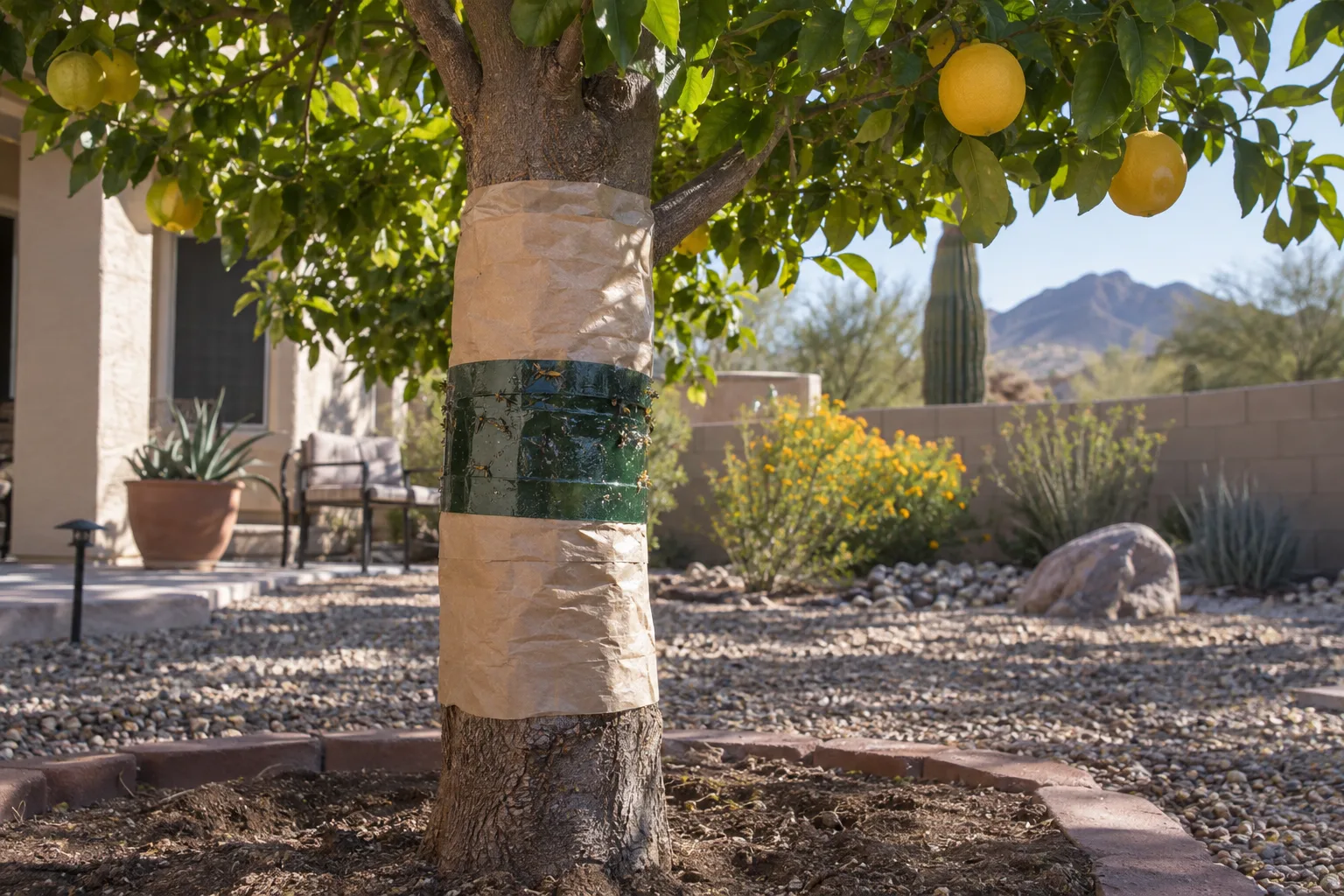
Wrap a band of paper or tree wrap around the trunk and apply the sticky product to the band, not to the bark, which can damage thin-barked young trees. Check the band monthly. Dust, leaves and dead ants can bridge it, so wipe or replace it as needed. Prune any branch that touches a wall or the soil.
For pots, set the container on feet over a saucer that holds a little water, or stand the legs in water cups. The water barrier stops most trail-forming ants, though it evaporates fast in summer heat and standing water can breed mosquitoes, so empty and refill it weekly. Raised, footed pottery and planters make this setup easier.
Can my watering and mulch habits change ant pressure?
Yes, because ants nest where soil stays moist and sheltered. Long or frequent drip cycles keep the root zone damp, and caliche, the cemented layer that sits a foot or two down in many East Valley yards, can hold water in a pocket that rarely dries.
Audit your irrigation each spring. Most established desert plants do well with deep, infrequent watering that lets the top few inches dry between cycles, though the right interval varies by plant and season.
Thick organic mulch gives ants shelter. A layer of 2 to 3 inches is usually enough to hold moisture around plants, and it should stay a few inches back from trunks and foundation walls. In bare, high-ant areas, decomposed granite is less inviting for nesting.
What are the lower-impact options for vegetable and herb beds?
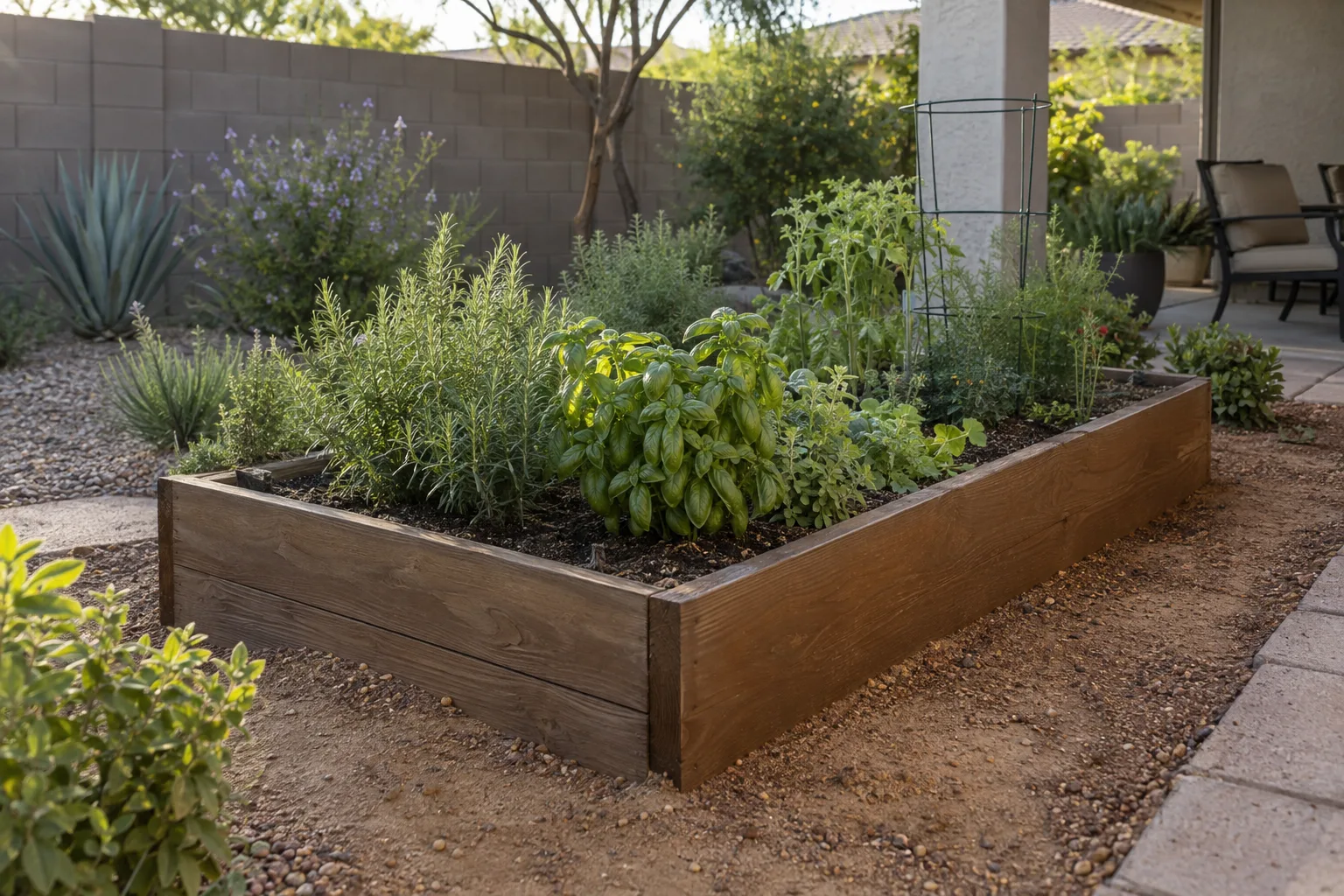
Start with the steps that use no pesticide: fixing leaks, trimming irrigation, pulling mulch back and blocking trunks. If you still need bait, choose a product whose label allows use around edibles, and place it on bare soil beside beds rather than inside them. For your herbs, vegetables and berries, this order keeps treatments away from roots and harvest.
Some garden baits use spinosad, a compound made by a soil bacterium, and others use boric acid. Labels differ on edible crops, so check each one. We do not recommend mixing your own boric acid bait, because the concentration matters (too strong a mix kills foragers before they reach the nest) and a homemade mix carries no label.
Food-grade diatomaceous earth dusted along a bed edge can slow ants, but it works only while dry, so irrigation and monsoon rain end its usefulness. Keep it off open flowers, since it can also harm bees. Orange oil and soap sprays kill the ants they touch. Use them for spot knockdown only.
Frequently asked questions
Are fire ant stings dangerous to kids and pets?
Fire ant stings are painful, and a small number of people and pets have severe allergic reactions. Watch anyone stung for swelling of the face or throat, trouble breathing or dizziness, and get emergency medical or veterinary care right away if those appear. Treat nests near play areas promptly and keep children and dogs away from treated spots until the label says it is safe.
Why do ants return every year after I treat them?
Ants return because colonies can have several queens and satellite nests, and neighboring yards supply new foragers. A one-time treatment usually misses part of the colony. Repeating bait through April and May, fixing the moisture that attracted them, and trimming mulch and trunk access lowers the numbers each year, though in a connected neighborhood you will not reach zero.
How can I tell flying ants from termites?
Flying ants have a pinched waist, elbowed antennae and front wings longer than the back pair. Termite swarmers have a thick, straight-sided body, straight antennae and four wings of equal length. Because termites are treated very differently, collect a few in a sealed container or take clear photos and ask a licensed pest professional or your county extension office to confirm before you treat.
Do mint, lavender or marigolds keep ants away?
Strong-scented plants may discourage foragers from a small spot, but we do not know of strong evidence that they clear an established colony. Treat them as an attractive extra. If you want help sorting out a persistent ant problem, send a question through our contact page and include a photo.
Is ant bait safe near vegetables?
Safety depends on the specific product, so the label decides. Choose a bait labeled for use around edible gardens, place it on bare soil beside beds rather than in them, and keep it out of reach of children and pets. Wash produce before eating, as you would any harvest, and skip any product whose label does not allow garden use.
Is DIY ant control enough for your yard?
For most home gardens, yes. Bait, leak repair and trunk barriers handle typical spring ant pressure if you start by March and keep up through May. You may need a licensed pest professional if ants are nesting in your walls, you cannot identify the species, or someone in the household has a serious sting allergy. If you see only a few ants a week and no aphid problem, skip treatment altogether. Visit us at the nursery in Queen Creek and bring a photo of your ant trouble.