
The best flowering shade trees for Arizona backyards include Desert Museum palo verde, velvet mesquite, jacaranda and vitex, plus four more below. Each one gives color and shade in the low desert, and each comes with one drawback you should know about.
Key takeaways
- Desert Museum palo verde and Chilean mesquite grow fastest, and most of these trees give useful shade within 3 to 5 years.
- Jacaranda, orchid tree and pink trumpet tree are frost tender, so young trees need cover on nights forecast near freezing.
- Plant from late February through April or from September through October, and avoid June through August.
- Vitex blooms from late spring through summer, long after the spring bloomers have finished.
- Keep mesquites at least 15 feet from paving, pools and walls because their roots spread wide and shallow.
How do we choose flowering trees for shade in the East Valley?
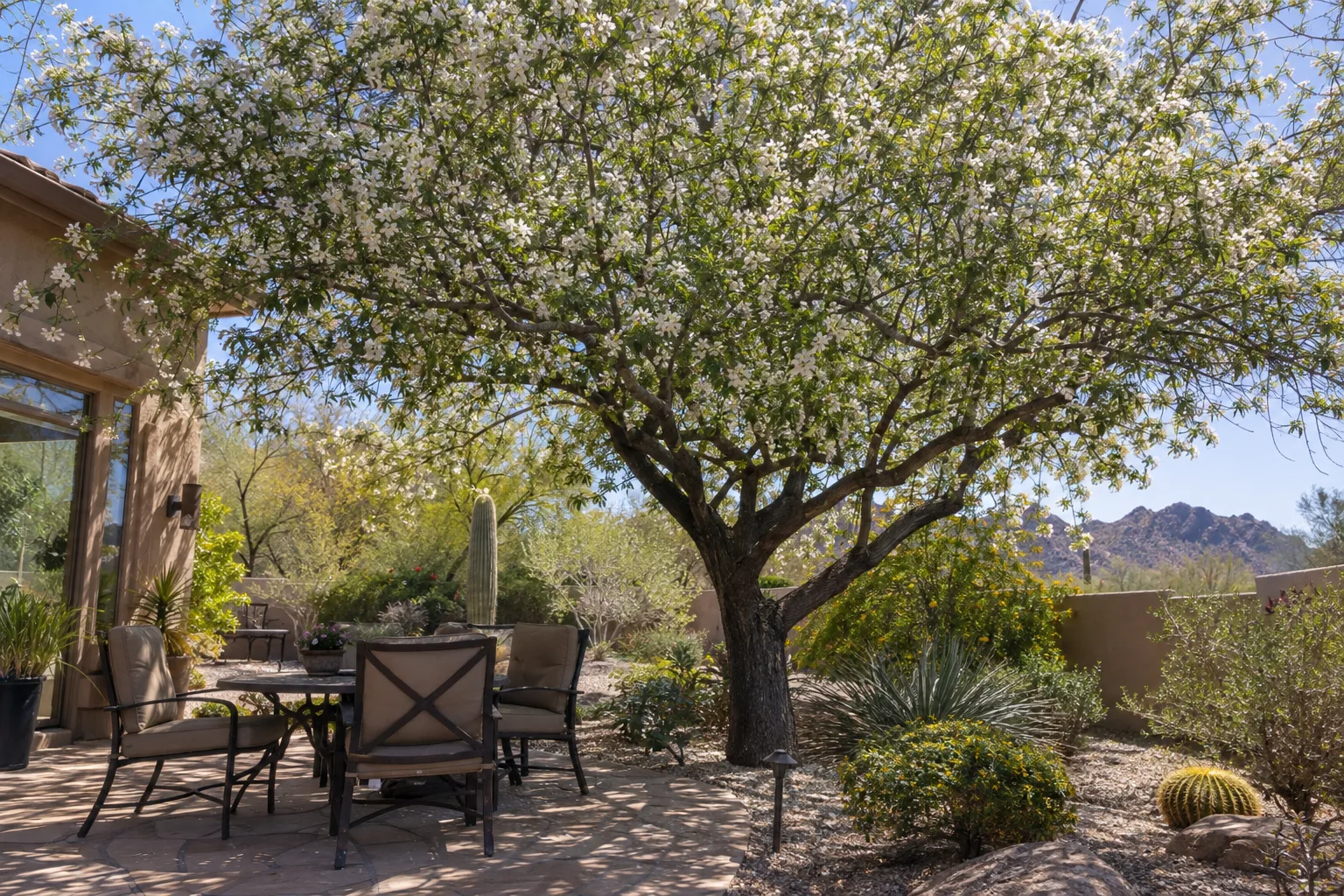
We look at four things: mature size, frost tolerance, water needs once established, and what the tree drops on your patio. A tree that blooms beautifully but burns at 28°F or clogs a pool skimmer is a poor match for many yards. Start with the space you have. You can browse more options in our flowering trees department. These are varieties we commonly carry, though availability changes week to week and season to season.
Which flowering trees give shade in Arizona backyards?
These eight cover a range of sizes, bloom seasons and maintenance levels, from a compact evergreen to a large native mesquite.
1. Desert Museum palo verde (Parkinsonia ‘Desert Museum’)
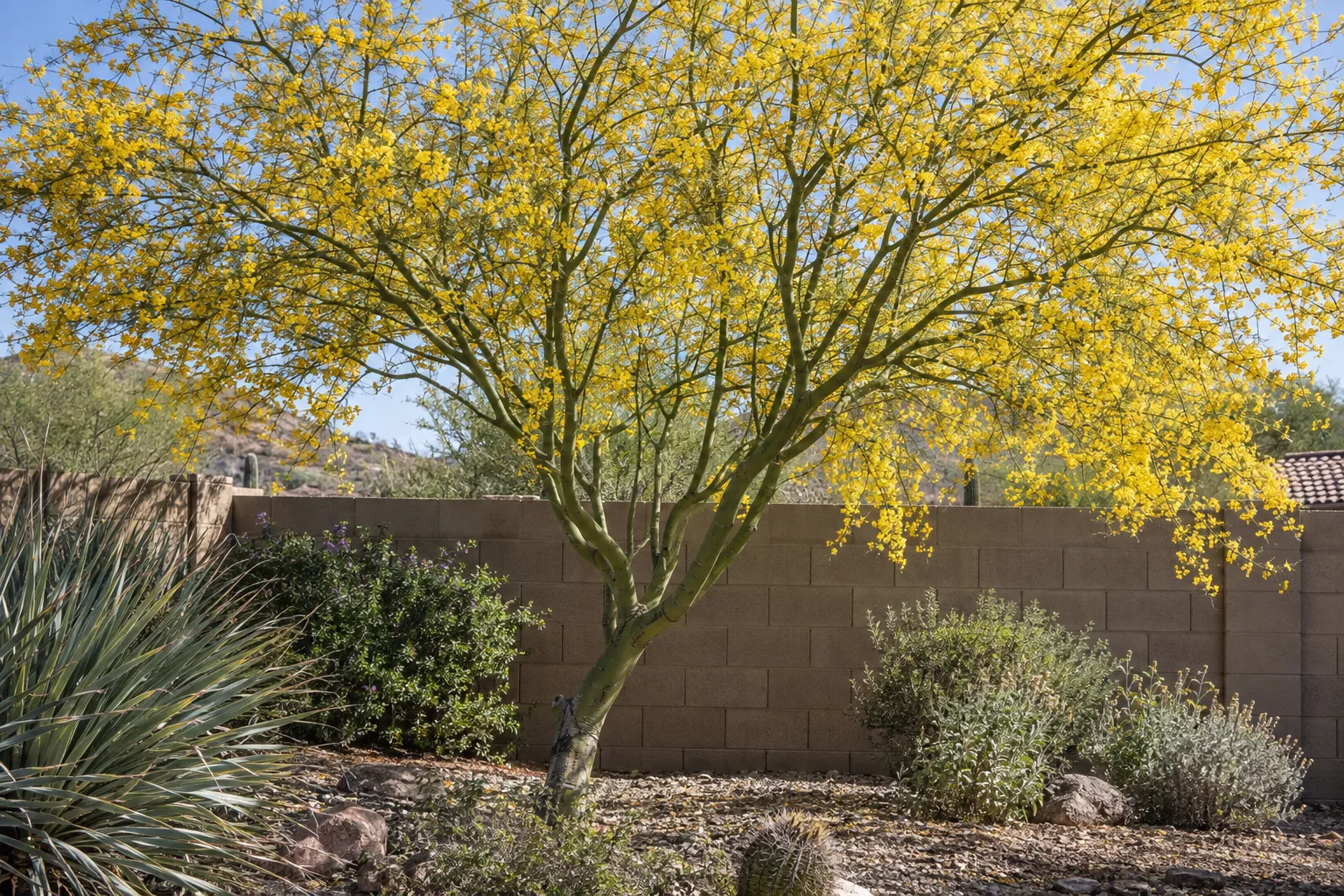
This hybrid palo verde reaches 20 to 30 feet tall and about as wide, with a light, filtered canopy and few thorns. It covers itself in yellow flowers around March and April. It wants full sun and little water once established, though a deep soak every couple of weeks in summer keeps the canopy fuller. The drawback is the light shade, which suits a patio but will not block a hot west wall as fully as a mesquite, and it drops fine leaflets and petals.
2. Texas mountain laurel (Dermatophyllum secundiflorum)
This evergreen grows slowly to roughly 10 to 20 feet tall and 8 to 12 feet wide, with grape-scented purple flower clusters in March. It takes full sun and low water once established, and it handles alkaline soil when drainage is good. Its seeds are considered toxic if chewed or swallowed, so think about that near children and pets. The drawback is growth speed. Expect many years before it gives broad shade.
3. Jacaranda (Jacaranda mimosifolia)
Jacaranda reaches 25 to 40 feet tall with a broad, arching canopy and lavender-purple trumpet flowers from late April into June. It needs full sun, moderate water and well-drained soil. Frost is the weak point. Young trees can freeze back near 28°F, and some East Valley yards run colder than others on clear winter nights. Fallen flowers and leaves also need regular sweeping from patios and pools.
4. Vitex, or chaste tree (Vitex agnus-castus)
Vitex grows 15 to 20 feet tall and nearly as wide, with lavender-purple flower spikes from late spring through summer that bees and butterflies visit. It likes full sun, low to moderate water, and drops its leaves in winter. Removing spent spikes can encourage more bloom. The drawback is a sprawling, multi-trunk habit that needs early pruning to become a tidy tree, plus seedlings that can appear nearby.
5. Chilean mesquite (Prosopis chilensis)
Chilean mesquite grows fast to 30 to 40 feet tall and wide, giving dense shade and small yellow spring flowers that pollinators use. It takes full sun and very little water once established. It has the most drawbacks on this list: shallow surface roots that can lift paving, heavy pod and leaf litter, and seedlings that can spread into nearby desert. It belongs in a large yard with room to spare.
6. Orchid tree (Bauhinia variegata)
Orchid tree reaches 20 to 30 feet tall and bears orchid-like flowers 3 to 4 inches across in purple, pink or white from late winter into spring. The white ‘Candida’ form looks cooler against a stucco wall. It does best in full sun to light afternoon shade with moderate water and good drainage. Its drawbacks are frost tenderness and long seed pods that need cleanup through summer.

7. Velvet mesquite (Prosopis velutina)
Velvet mesquite is a native of the Sonoran Desert that grows 20 to 30 feet tall with a wide, spreading canopy and yellow spring catkins. It needs full sun and very little water once established. Birds and pollinators use it, and the shade is dense in summer. The drawbacks are thorns, which call for placement away from walkways, and a bare period in winter.
8. Pink trumpet tree (Handroanthus impetiginosus)
Sometimes sold as Tabebuia, this tree reaches 20 to 30 feet tall and opens pink to magenta trumpet flowers on bare branches in spring. It wants full sun, moderate water and good drainage. It grows more slowly than mesquite or palo verde. Young trees are frost tender, and the canopy is bare during the first part of its bloom, so the shade arrives after the show.
How do the eight trees compare?
Mesquites give the densest summer shade, while palo verde and vitex give lighter canopies and more color. Winter-bare trees let sun reach the house in cold months, a point worth weighing against our deciduous trees options.
| Tree | Bloom | Height | Shade | Water once established | Leaves |
|---|---|---|---|---|---|
| Desert Museum palo verde | March to April | 20 to 30 ft | Filtered | Low | Mostly deciduous |
| Texas mountain laurel | March | 10 to 20 ft | Moderate | Low | Evergreen |
| Jacaranda | Late April to June | 25 to 40 ft | Moderate to dense | Moderate | Semi-deciduous |
| Vitex | Late spring to summer | 15 to 20 ft | Moderate | Low to moderate | Deciduous |
| Chilean mesquite | Spring | 30 to 40 ft | Dense | Very low | Semi-deciduous |
| Orchid tree | Late winter to spring | 20 to 30 ft | Moderate | Moderate | Semi-deciduous |
| Velvet mesquite | Spring | 20 to 30 ft | Dense | Very low | Deciduous |
| Pink trumpet tree | Spring | 20 to 30 ft | Moderate | Moderate | Deciduous |
When should I plant a flowering shade tree in Queen Creek?
Plant from late February through April or from September through October, when soil temperatures let roots grow before the next temperature extreme. Summer planting is possible but demands daily attention and shade cloth. Our gardening calendars show how these windows fit the rest of the year.
Dig a hole two to three times as wide as the root ball and no deeper than its height, with the top of the root ball level with or slightly above the surrounding soil. Probe with a steel rod first. If it stops within about 18 inches, you have caliche, and breaking through it improves drainage.
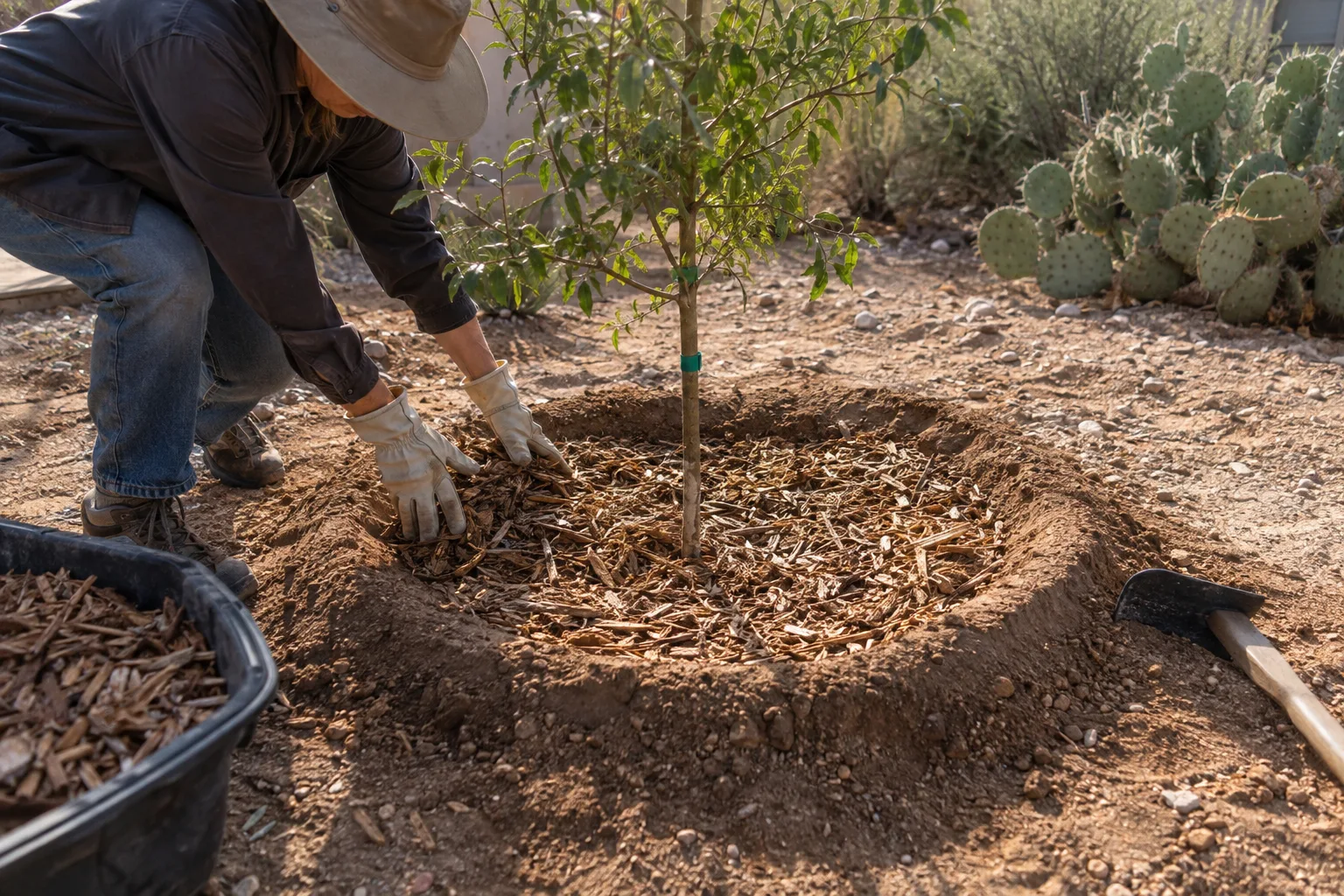
Build an earthen ring 4 to 6 inches tall at the edge of the root ball, then spread 3 to 4 inches of wood chip mulch, keeping it a few inches off the trunk. Stake only if the tree cannot stand alone, and remove ties within a year.
How often should I water a new flowering tree?
Water a new tree every 2 to 3 days for the first month, every 4 to 5 days in the second month, then stretch to every 1 to 2 weeks as roots spread. Each watering should be slow and deep so the soil is wet 18 to 24 inches down, which you can check with a long screwdriver an hour later.
Established desert natives such as palo verde and mesquite usually need a deep soak every 10 to 14 days in summer and far less in winter. Jacaranda, orchid tree and pink trumpet tree want water a bit more often. Shallow, frequent watering keeps roots near the surface, where they suffer when summer highs pass 110°F.
How do alkaline soil and caliche affect these trees?
Alkaline soil, often pH 7.5 to 8.5, locks up iron and can turn leaves yellow with green veins, a condition called chlorosis. Jacaranda, orchid tree and pink trumpet tree show it most. A chelated iron product applied as the label directs usually helps, and treating it early works better than waiting for severe yellowing.
Caliche is a hard mineral layer that holds water around roots after monsoon storms. Native desert trees like palo verde and mesquite do best in mostly native soil, because heavy compost can create a soggy pocket around the roots. Non-natives tolerate a modest amount of planting mix blended into the backfill.
Where should I plant a shade tree in my yard?
Put the biggest tree on the west or southwest side of the house, where it blocks the afternoon sun from roughly 2 to 7 PM. Filtered canopies such as palo verde and vitex suit patios because air still moves through them. Dense trees work better along walls and property lines.
Roots matter as much as canopy. Keep mesquites at least 15 to 20 feet from paving, pool shells and foundations. Smaller trees such as Texas mountain laurel and vitex fit tight lots and pool areas better.
When should I prune flowering shade trees?
Prune spring bloomers lightly right after flowers fade, since cutting earlier removes the buds. Do structural pruning on vitex and mesquite in late winter, and deadhead vitex through summer for more spikes. Avoid cutting mesquite during monsoon season, when fresh wounds stay damp.
Topping a tree into a lollipop shape weakens branch attachment and invites fast, brittle regrowth that breaks in storm winds. Aim for a few well-spaced main limbs in the first three to five years, then light maintenance.Our classes and events page lists what is scheduled.
Frequently asked questions
How fast do these trees grow?
Desert Museum palo verde and Chilean mesquite grow fastest, often 3 to 6 feet a year when young and watered well. Jacaranda and orchid tree add roughly 2 to 4 feet. Texas mountain laurel adds about a foot a year. Most of the trees here give useful shade within 3 to 5 years.
Which flowering tree works best near a pool?
Texas mountain laurel and vitex make the tidiest choices near a pool, since laurel is evergreen and vitex drops moderate litter. Mesquite, jacaranda and orchid tree shed pods, flowers or leaflets that clog skimmers. Place any tree so prevailing wind carries debris away from the water, and keep roots well clear of the pool shell.
Do flowering shade trees need fertilizer?
Desert natives like palo verde, mesquite and mountain laurel usually need no regular fertilizer. Jacaranda, orchid tree and pink trumpet tree can use a slow-release feeding in early spring. Yellow leaves with green veins point to iron deficiency from alkaline soil, and a chelated iron product often helps more than extra fertilizer.
Can jacaranda grow in Gilbert, Chandler or Queen Creek?
Jacaranda can grow in Gilbert, Chandler, Mesa and Queen Creek, but it is frost tender. Choose a spot near a south or west wall that holds heat, and cover young trees on nights forecast near freezing. Mature trees handle brief dips better, though a hard freeze can still burn growth and delay bloom.
Will a shade tree lower my cooling bill?
A tree on the west or southwest side of the house gives the most relief from afternoon sun. Shade lowers the heat reaching walls and windows in the late afternoon, and cooler walls reduce air conditioner load. Savings depend on the tree and the house, so expect the benefit to grow as the canopy fills in over several years.
Which flowering shade tree is right for your yard?
Choose Desert Museum palo verde or velvet mesquite for low-effort shade, vitex for summer color, and jacaranda, orchid tree or pink trumpet tree only if you can protect young trees from frost. Skip Chilean mesquite in small or pool-side yards. Texas mountain laurel suits tight spaces but will not give broad shade. Stop by our nursery in Queen Creek and we will help you match a tree to your yard.