
The best flowering perennials for low-care Arizona yards are blackfoot daisy, desert marigold, red bird of paradise, globe mallow, autumn sage, yellow bells and angelita daisy. Each blooms in full sun, tolerates alkaline soil and needs little water once established.
Key takeaways
- Plant in September through November or late February through April, so roots settle in before summer highs above 110°F.
- Water deeply every 2 to 3 days for the first 2 to 4 weeks, then taper over the first season.
- Dig the hole 2 to 3 times as wide as the root ball but no deeper, and refill with native soil.
- All seven need at least 6 hours of direct sun to bloom well.
- Red bird of paradise and yellow bells can freeze to the ground in a hard frost and regrow from the roots.
What makes a flowering perennial low-maintenance in the low desert?
A low-maintenance perennial here handles summer highs above 110°F, alkaline soil and long dry stretches once its roots are established. Queen Creek soil often tests between pH 7.5 and 8.5, and many yards have caliche, a cemented layer of calcium carbonate that can start a few inches to a couple of feet down. Plants that want rich, acidic soil struggle in that.
Established means about one full growing season in the ground.
All seven plants below are varieties we commonly carry in our plants department, though availability changes week to week and season to season.
Which seven flowering perennials need the least care in Arizona?
Blackfoot daisy, desert marigold, red bird of paradise, globe mallow, autumn sage, yellow bells and angelita daisy need the least care. Each has one drawback worth knowing before you buy. Sizes are typical ranges for mature plants in the ground and vary by variety.
Blackfoot daisy (Melampodium leucanthum)
This mounding plant reaches about 1 foot tall and 1 to 2 feet wide, with small white daisies from late winter into early summer and again after monsoon rains. It wants full sun and sharp drainage, and a deep soak every two to three weeks in summer is usually enough once established. Drawback: it rots in soggy soil.
Desert marigold (Baileya multiradiata)
Woolly gray-green foliage carries bright yellow flowers on tall stems, mostly from spring into fall. It grows 1 to 2 feet tall and wide in full sun and asks for very little water after its first season. Drawback: it often declines after a few years and relies on reseeding to stay in the bed.
Red bird of paradise (Caesalpinia pulcherrima)
This shrubby perennial grows 5 to 10 feet tall and wide, with orange-red and yellow flower clusters from roughly May through October. It likes full sun and a deep soak every week or two in summer once established. Drawback: a hard frost freezes it to the ground, and it leafs out late in spring.
Globe mallow (Sphaeralcea ambigua)
A native with silvery gray-green leaves, globe mallow reaches 2 to 3 feet tall and wide and produces cup-shaped flowers in orange, coral, pink or red, mostly in spring with repeat bloom after rain. Full sun and low water suit it. Drawback: it turns leggy and sparse unless you cut it back, and it self-seeds.
Autumn sage (Salvia greggii)
Autumn sage grows 2 to 3 feet tall and wide with tubular red, pink, coral or white flowers in spring and fall, pausing through the hottest weeks of midsummer. It takes full sun and drains best in alkaline soil. Drawback: it gets woody and open without regular pruning, and it dislikes wet roots.
Yellow bells (Tecoma stans)
Clusters of yellow trumpet flowers cover this large shrub from spring through fall. It reaches 6 to 10 feet tall in full sun and needs a deep soak every week or two in summer once established. Drawback: size and frost. Give it room, and expect it to freeze back in a hard winter.
Angelita daisy (Tetraneuris acaulis)
Angelita daisy forms a tight mound 8 to 12 inches tall and wide, with yellow daisies on slender stems nearly year-round. It suits small beds, borders and rock gardens in full sun. Drawback: the clumps decline in soggy soil, and the foliage can look tired in peak summer heat.
How do I plant perennials in caliche and alkaline soil?
Dig a wide, shallow hole, refill it with the native soil you removed, and set the crown level with or slightly above the ground. Heavily amended soil forms a pocket that holds water while the surrounding soil drains, and that pocket can rot roots.
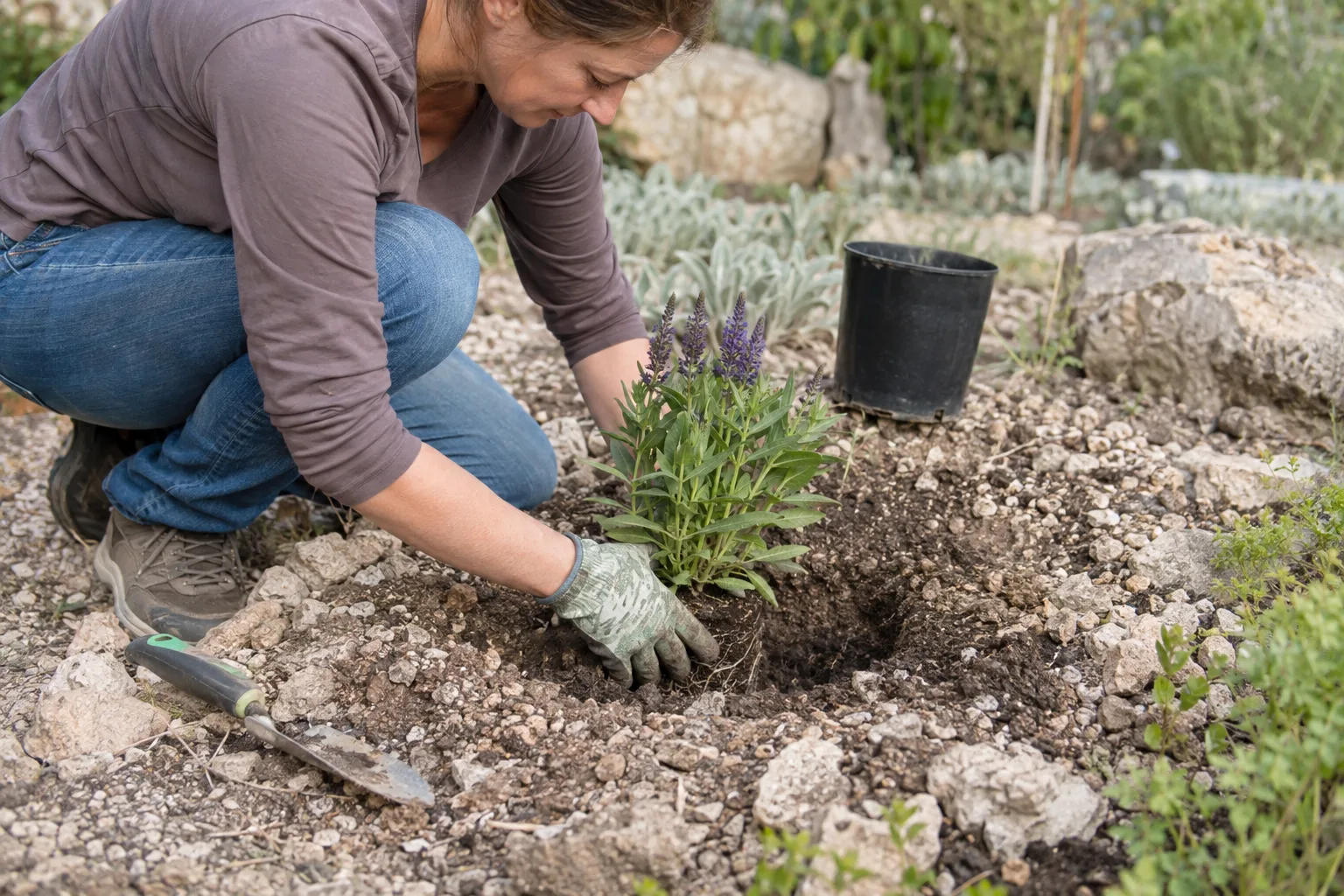
- Dig the hole 2 to 3 times as wide as the root ball and no deeper.
- Fill the hole with water. If it is still standing after an hour, you have hit caliche. Break through it with a digging bar or plant on a low mound instead.
- Loosen any circling roots on the sides and bottom of the root ball.
- Set the root ball about an inch above the surrounding grade.
- Backfill with native soil, pressing gently to remove large air pockets.
- Build a low berm of soil around the outer edge of the hole to hold water.
- Spread 2 to 3 inches of gravel or decomposed granite around the plant, keeping it off the stems.
- Soak the whole root zone right away.
Planting too deep is the most common error. Burying the crown invites rot, especially where water sits above caliche.
How often should I water new perennials in Arizona?
Water every 2 to 3 days for the first 2 to 4 weeks, then taper to about once a week in summer and every 10 to 14 days in cooler months. After the first full growing season, most of these plants manage on monsoon rain plus a deep soak every two to three weeks in summer.
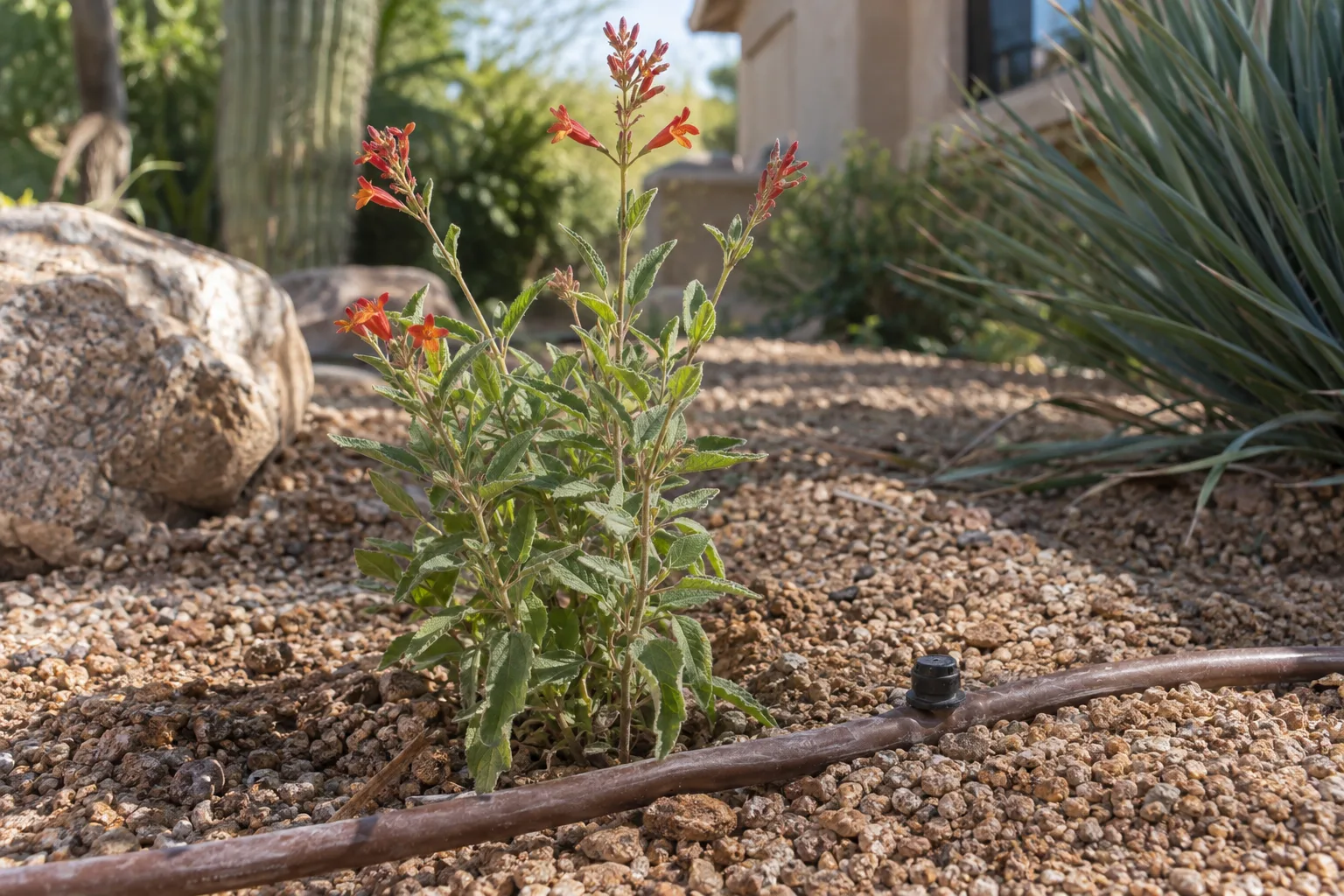
Place drip emitters at the outer edge of the root ball and widen the ring as the plant grows. That pulls roots outward and builds drought tolerance. Hard irrigation water leaves salts in the soil, so an occasional deep soak, rather than frequent light sprinkles, moves them below the roots.
Check the soil 4 to 6 inches down before you water. If it is still slightly damp, wait.
When is the best time to plant perennials in the East Valley?
September through November and late February through April are the best windows. Fall planting gives roots a mild winter to grow, and spring planting gives them a full warm season before the first 110°F days arrive.
Avoid June through August. Soil above 100°F stresses new roots, and young plants need near-daily water and afternoon shade to get through. For month-by-month timing, see our gardening calendars.
When should I prune these perennials, and what should I leave alone?
Prune in late February to March, after the last frost risk, and again lightly in late summer. Avoid hard cuts in June and July, when plants are already coping with extreme heat.
Cut red bird of paradise and yellow bells back hard in late winter, removing frost-killed stems once new growth shows. Shear autumn sage by about one-third in late February and again after the summer flush. Cut globe mallow back by roughly half after its main bloom. Blackfoot daisy and angelita daisy need only a light trim of spent stems, and desert marigold can keep its seedheads so it reseeds.
How do I combine these perennials in one bed?
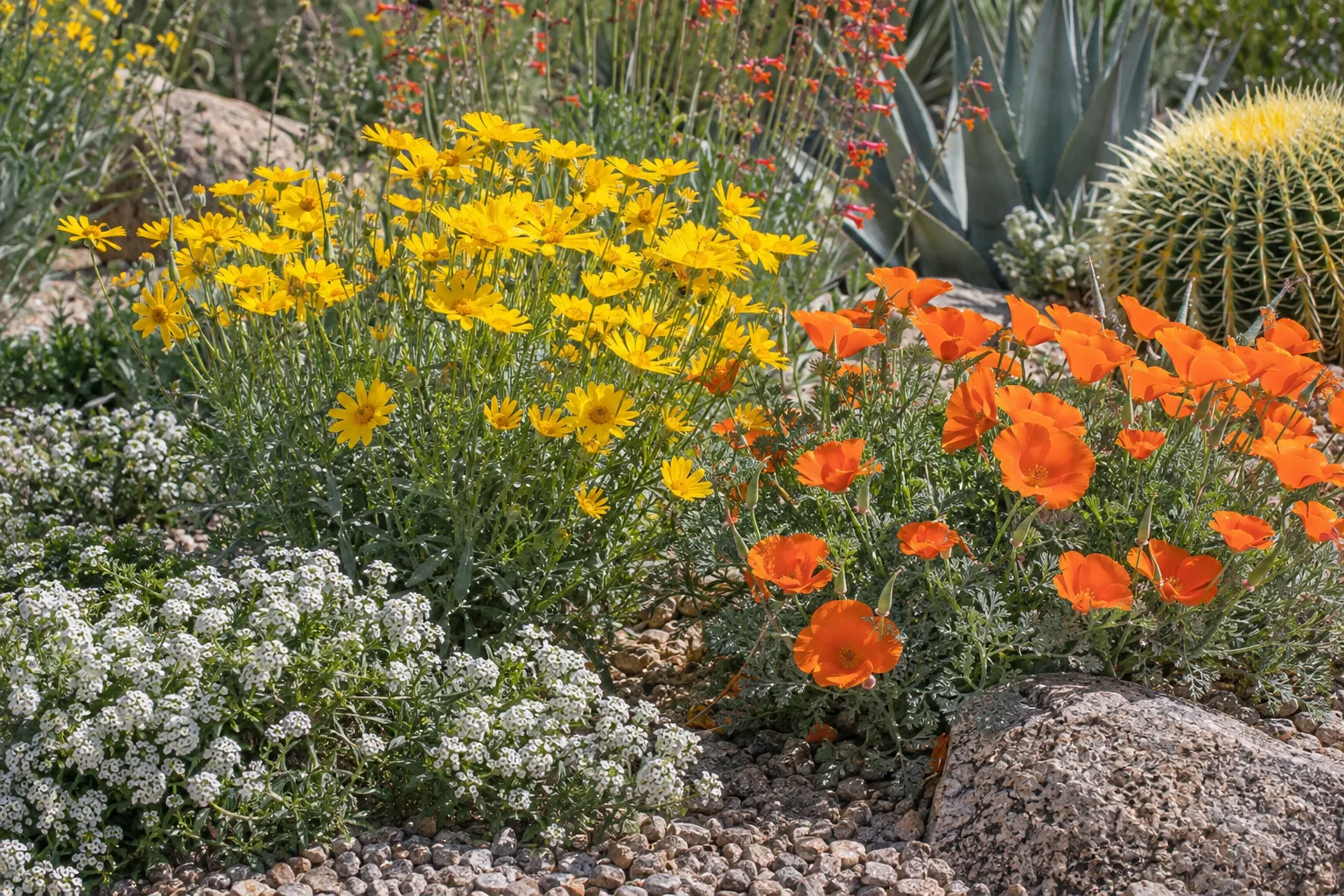
Stack them by height: tall shrubs at the back, mid-size plants in the middle and low daisies along the edge. All seven want full sun and lean soil, so they share the same irrigation zone without fuss.
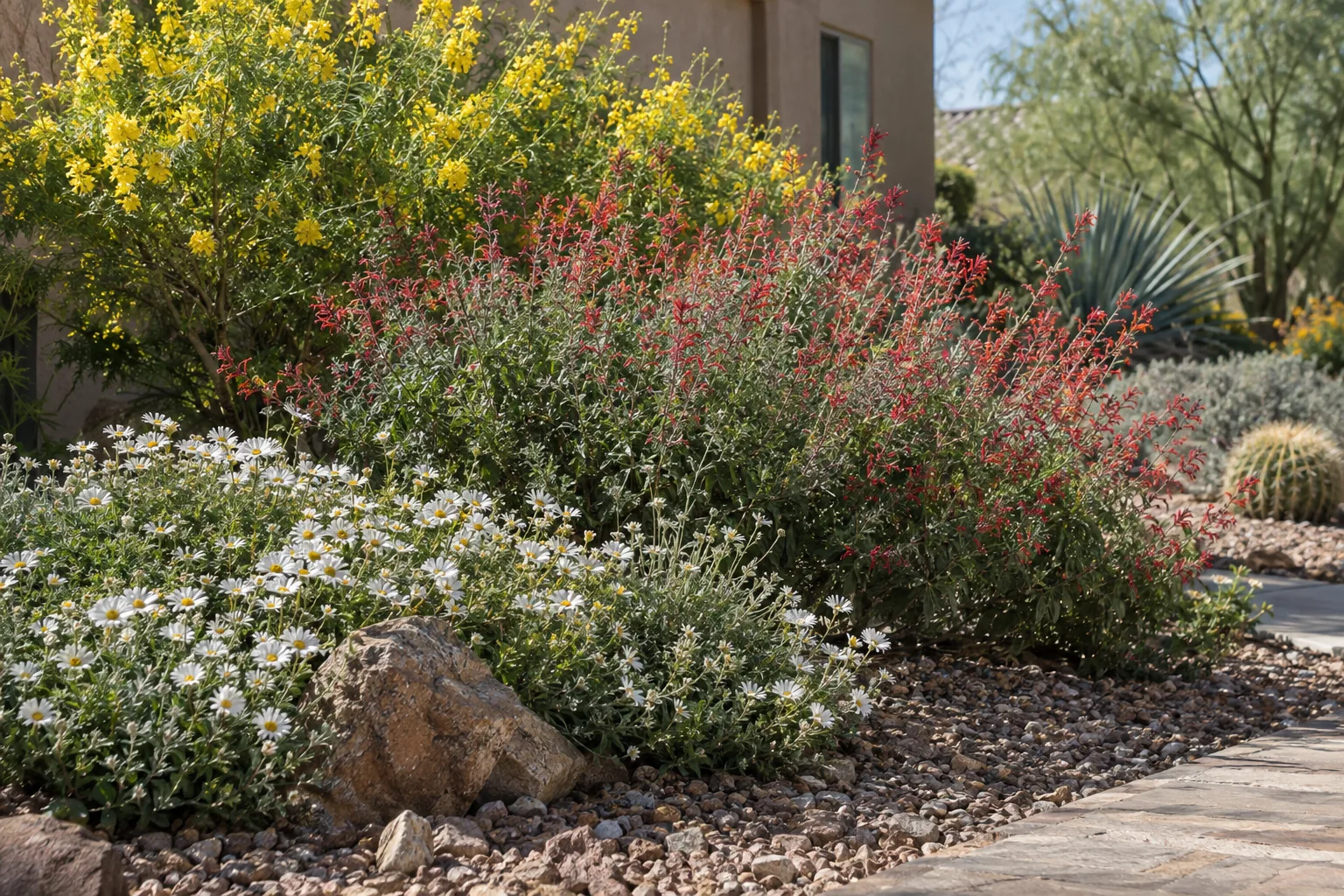
Yellow bells or red bird of paradise make a strong back row. Autumn sage and globe mallow fill the middle with red, coral and orange. Blackfoot daisy, angelita daisy and desert marigold finish the front with white and yellow, and they spill over a gravel path or boulder.
Frequently asked questions
Can I plant these perennials in summer?
You can, but June through August is the hardest time to establish perennials. Soil above 100°F stresses new roots, so expect to water daily for the first two weeks and shade new plants in the afternoon. Planting in the evening gives roots a cooler night to start. Waiting for September makes the work much easier.
What happens to red bird of paradise and yellow bells in a frost?
Both can freeze to the ground in a hard frost, and most resprout from the roots in spring. Leave the damaged stems in place until new growth appears in March, since they shelter the crown. Frost cloth overnight helps on the coldest nights, and it comes off in the morning.
Do any of these grow well in pots?
Angelita daisy, blackfoot daisy and autumn sage do well in pots with a drainage hole and a fast-draining cactus mix. Potted plants dry out faster than ground plants, so expect to water every two to three days in summer. Browse our pottery and planters for options with room for roots.
Why is my healthy perennial not blooming?
Too little sun and too much nitrogen are the usual causes. All seven need at least 6 hours of direct sun, and lawn fertilizer drifting into a bed pushes leaves instead of flowers. A hard cut at the wrong time can also remove buds. Our classes and events page lists gardening classes when we offer them.
Are low-care flowering perennials right for your yard?
Yes, if your bed gets 6 or more hours of sun and drains well. These seven give months of color for a few deep soaks and one or two prunings a year. Skip them if the spot stays shaded, sits on a lawn zone that stays wet, or if you want a tidy, uniform look all year, since several of these plants get loose and wild. Stop by our nursery in Queen Creek and we can talk through your sun and soil.